Revision notes for Edexcel AS Level Religious Studies The world of the first century and the significance of this context for the life and work of Jesus. Open the guide for explanations and worked examples. Written against the Edexcel AS Level Religious Studies specification, so the content matches what's examinable rather than general Religious Studies background.
The world of the first century and the significance of this context for the life and work of Jesus
To fully comprehend the New Testament, you must step into the volatile, politically charged, and deeply religious world of first-century Palestine. Jesus did not live in a vacuum; his actions, parables, and conflicts were direct responses to the cultural, political, and spiritual forces of his day.
For your Edexcel Paper 3 exam, you need to know how these different forces interacted and evaluate how Jesus positioned himself in relation to them.
What you'll learn
- The distinct beliefs, practices, and political stances of the key Jewish religious groups.
- The cultural influence of Hellenism and how it shaped the Jewish world.
- The oppressive reality of the Roman occupation and how it fueled messianic expectations.
- How Jesus’ legal teachings and ethical actions challenged or aligned with these diverse first-century influences.
1. Religious Groups in Palestine
First-century Palestine was not a unified religious landscape. Instead, it was highly sectarian, split into several competing factions, each offering a different answer to the question: How can Israel remain faithful to God under foreign pagan rule?
The Pharisees
The Pharisees were a highly influential, largely middle-class group of lay scholars and legal experts. They were not priests, but they believed that all of Israel was called to a life of priestly purity.
Definition
Oral Torah (Mishnah)
The Oral Torah (later codified as the Mishnah) is a body of oral traditions and interpretations believed by the Pharisees to have been given to Moses alongside the written Law. It functioned as a "hedge around the Law" to prevent accidental violations of the commandments.
- Beliefs: They believed in the resurrection of the dead, a complex angelology and demonology, and a balance between human free will and divine providence.
- Practice: They focused on strict adherence to dietary laws, tithing, and Sabbath observance.
- Scholarship: New Testament scholar E.P. Sanders revolutionized our understanding of this group with his concept of Covenantal Nomism. Sanders argued that first-century Palestinian Judaism was not a cold, legalistic religion of "works-righteousness" (as later Christian writers often claimed). Instead, keeping the law was a loving response to God’s covenant initiative: you got "in" the covenant by grace, and you stayed "in" by keeping the Law.
The Sadducees
The Sadducees were the wealthy, aristocratic priestly class who controlled the Jerusalem Temple and dominated the Sanhedrin (the Jewish high court).
- Beliefs: They were theological conservatives. They rejected the Oral Torah and accepted only the written Torah (the Pentateuch) as authoritative. Consequently, they rejected the resurrection of the dead, afterlife judgements, and belief in angels, as they found no explicit mention of them in the Pentateuch.
- Political Stance: They practiced political pragmatism. To maintain their wealth, power, and the smooth running of the Temple, they actively collaborated with the Roman occupying forces.
The Essenes
The Essenes were an ascetic, monastic sect that separated themselves from mainstream society. Many lived in isolated communities, most famously at Qumran near the Dead Sea (associated with the Dead Sea Scrolls).
- Beliefs: They believed that the Jerusalem priesthood (the Sadducees) was thoroughly corrupt and the Temple polluted. They were highly apocalyptic, viewing the world as a battleground between the "Sons of Light" and the "Sons of Darkness."
- Expectations: They expected two Messiahs: a priestly Messiah (from the line of Aaron) and a royal/military Messiah (from the line of David).
The Zealots
The Zealots were a militant, nationalistic revolutionary movement.
- Beliefs: They believed that acknowledging any earthly ruler other than God was an act of treason against Yahweh.
- Actions: They advocated and actively engaged in violent rebellion against Roman rule, refusing to pay taxes and assassinating Roman collaborators. This movement eventually led to the disastrous Jewish Revolt of 66–70 CE, which resulted in the destruction of the Temple.
The Samaritans
The Samaritans inhabited the region between Judea and Galilee.
- Beliefs: They claimed to be the true descendants of the northern tribes of Israel. They rejected the Jerusalem Temple, worshipping instead at their own temple on Mount Gerizim, and accepted only their own version of the Torah (the Samaritan Pentateuch).
- Social Dynamic: Mainstream Judaean Jews viewed them as ethnically compromised and heretical. There was deep-seated mutual hostility and violence between the two groups.
2. Hellenism
Definition
Hellenism
Hellenism refers to the spread of Greek culture, language, philosophy, and lifestyle throughout the Mediterranean and Near East, initiated by the conquests of Alexander the Great in the fourth century BCE.
By the first century, Palestine was deeply impacted by Hellenism, creating a cultural tug-of-war between assimilation and traditional Jewish identity.
Cultural and Linguistic Impact
Greek was the lingua franca (common language) of the Roman Empire, used for trade, administration, and literature. Even in Palestine, many Jews spoke Greek alongside Aramaic (the local spoken language) and Hebrew (the liturgical language). The Hebrew Bible had already been translated into Greek (the Septuagint), making Jewish scriptures accessible to the wider Greco-Roman world.
Philosophical and Theological Syncretism
Jewish thinkers, most notably Philo of Alexandria, sought to reconcile Jewish scriptures with Greek philosophy (such as Platonic and Stoic thought).
- Scholarship: The German scholar Martin Hengel famously argued that first-century Judaism was thoroughly Hellenised. He asserted that it is historically inaccurate to draw a sharp dividing line between "Palestinian Judaism" and "Hellenistic Judaism"; even inside Palestine, Greek cultural forms, architecture, and educational models had deeply penetrated Jewish life.
3. Roman Occupation
In 63 BCE, the Roman general Pompey captured Jerusalem, ending Jewish independence and bringing Palestine under Roman imperial control.
                          ┌───────────────────────────┐
                          │   Roman Empire Control    │
                          │   - Pontius Pilate        │
                          │   - Heavy tribute taxes   │
                          └─────────────┬─────────────┘
                                        │
                                        ▼
┌───────────────────────────────────────────────────────────────────────────┐
│                       First-Century Jewish Context                        │
├───────────────────────────────┬───────────────────────────────────────────┤
│    Temple Establishment       │             Torah Reformers               │
│  - Sadducees (Collaborators)  │  - Pharisees (Strict oral law)            │
│  - Maintain status quo        │  - Essenes (Withdrew to desert)           │
│  - Control Temple trade       │  - Zealots (Violent revolutionaries)      │
└───────────────────────────────┼───────────────────────────────────────────┘
                                │
                                ▼
                  ┌───────────────────────────┐
                  │    Jesus' Life & Work     │
                  │    - Clashed with elites  │
                  │    - Preached God's Reign │
                  └───────────────────────────┘
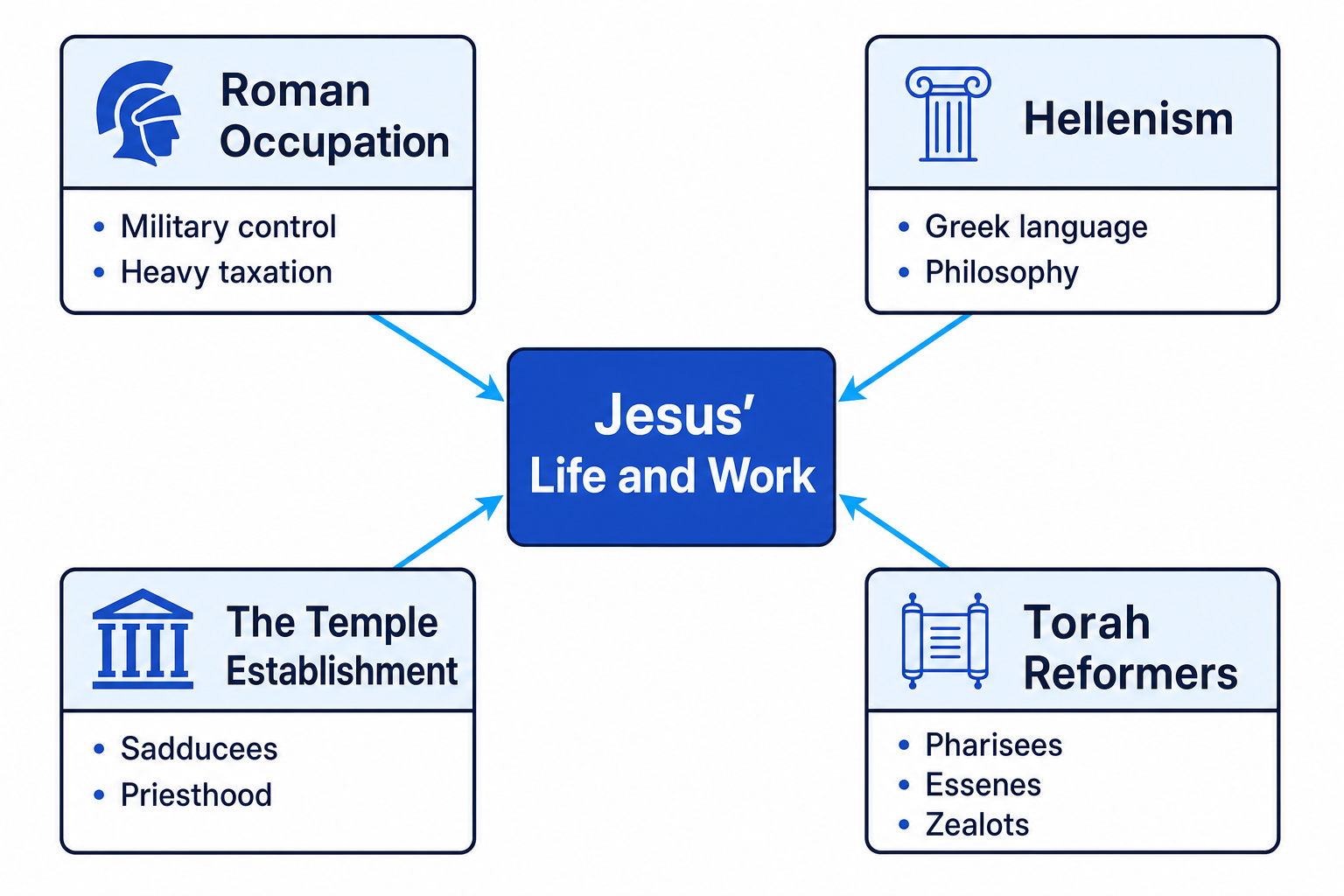
The Governance of Palestine
By the time of Jesus' public ministry (approx. 26–30 CE), Palestine was divided:
- Galilee and Perea: Ruled by Herod Antipas, a client ruler submissive to Rome.
- Judea and Samaria: Under direct Roman rule, administered by a prefect or procurator, most famously Pontius Pilate.
The Social and Economic Burden of Rome
The Roman occupation was maintained by brutal military force. Cruficixion was widely used as a public deterrent against treason and rebellion. Crucially, Rome imposed a heavy tax burden, including poll taxes (tributum capitis) and land taxes (tributum soli), alongside indirect tolls collected by local tax collectors (publicans). This double taxation—paying both Roman imperial taxes and Jewish Temple taxes—created severe economic hardship, pushing many small landowners into landlessness and poverty.
Key Idea
Messianic Expectation
The crushing weight of Roman oppression and economic distress caused apocalyptic and messianic expectations to reach a boiling point. Many Jews eagerly anticipated a "Messiah"—typically envisioned as a militaristic, Davidic king who would violently overthrow Rome and restore Israel’s sovereignty.
4. Legal, Ethical and Theological Interactions: Jesus' Relationship to this Context
How did Jesus navigate this complex grid of Roman oppression, Hellenistic culture, and sectarian Jewish debates?
Jesus and the Law (Torah)
Jesus' relationship with the Jewish Law was a central point of conflict, particularly with the Pharisees.
- Sabbath Controversy: Jesus frequently broke Pharisaic oral traditions regarding the Sabbath (e.g., healing the sick or letting his disciples pluck grain in Mark 2:23–28). He declared that "the Sabbath was made for man, not man for the Sabbath", prioritizing human ethical welfare over legalistic compliance.
- Purity Laws: Jesus directly challenged the Pharisaic boundaries of ritual purity. He touched lepers, bleeding women, and corpses—acts that made one ritually unclean. He declared that it is not what goes into a person from the outside that defiles them, but what comes out of the heart (Mark 7:15).
- Scholarship: Geza Vermes, in his seminal work Jesus the Jew, argued that Jesus is best understood not as the founder of a new religion, but as a Galilean Hasid (a charismatic holy man). Like other charismatic figures of his day (such as Hanina ben Dosa), Jesus was a devout Jew who prioritized a direct, heart-felt, ethical relationship with God over formalistic ritual and institutional structures.
Common Mistake
The 'Anti-Jewish' Jesus Myth
It is highly inaccurate to argue that Jesus sought to destroy or replace Judaism. Avoid writing that "Jesus rejected the Jewish Law." Jesus himself stated in Matthew 5:17 that he did not come to abolish the Law but to fulfill it. His debates were inner-Jewish disputes about how the Law should be correctly interpreted and lived out.
Jesus and the Temple Establishments
Jesus’ most politically explosive actions targeted the Sadducees and the Temple institution.
- The Cleansing of the Temple: By overturning the tables of the money changers (Mark 11:15–18), Jesus did not just perform a random act of anger; he performed a prophetic, symbolic act warning of the Temple's imminent destruction. This directly threatened the economic monopoly and political stability of the Sadducean elite.
- The Trial: It was ultimately the Sadducean high priest Caiaphas, fearing that Jesus would spark a Roman military intervention, who spearheaded Jesus' arrest and handed him over to Pilate.
Jesus and the Roman State
Jesus rejected both the violent militarism of the Zealots and the political collaboration of the Sadducees.
- The Zealot Option: While Jesus had a disciple named Simon the Zealot (Luke 6:15) and used apocalyptic language, he consistently rejected violence. He preached love of enemies (Matthew 5:44) and warned that "those who draw the sword will die by the sword" (Matthew 26:52).
- Scholarship: Scholars like S.G.F. Brandon historically argued that Jesus was more of a political revolutionary than the Gospels admit. However, most modern scholars, such as N.T. Wright, reject this, arguing that Jesus was redefining the Kingdom of God. For Wright, Jesus believed Israel's true exile was ending, but the battle was not against flesh-and-blood Romans, but against the spiritual forces of evil.
Worked Example
Example
Analysing historical context in a Gospel controversy narrative
Using your knowledge of the political and religious context of first-century Palestine, explain and evaluate the dynamics of the question put to Jesus in Mark 12:13–17: "Is it lawful to pay taxes to Caesar or not?"
-
Identify the religious and political alliances of the challengers: The text states that the Pharisees and Herodians came together to trap Jesus. This is a highly unusual alliance; the Pharisees resented Roman taxation on theological grounds, while the Herodians (supporters of Herod Antipas) supported Rome to preserve their political power. Their unity demonstrates how Jesus' growing popularity was perceived as a common threat to both factions.
-
Analyse the political trap: If Jesus answered "Yes, pay the tax," he would lose the support of the Jewish crowds, who despised Roman rule and viewed paying tribute as a betrayal of God's sovereignty (the Zealot position). If he answered "No, do not pay," he would be guilty of sedition and treason against the Roman Empire, giving the Herodians immediate grounds to arrest him.
-
Decode the physical evidence (the Denarius): Jesus asks for a denarius. By showing that they carry a Roman coin in the Temple courts, Jesus exposes his challengers' hypocrisy; they are already using Caesar’s currency, complete with his image (Tiberius Caesar) and blasphemous imperial inscription ("Son of the Divine Augustus").
-
Evaluate Jesus' theological resolution: Jesus' response, "Render to Caesar the things that are Caesar's, and to God the things that are God's", is a masterpiece of first-century rhetoric. He avoids the charge of Roman treason while simultaneously making a radical monotheistic statement. Because humans bear the image of God (Genesis 1:27), they belong entirely to God. Jesus subverts both the Roman claim to absolute lordship and the Zealots' call to violent revolution.
Tip
Use Scholar Names Intentionally
When writing your AO2 evaluation essays, don't just "name-drop." Connect the scholar's thesis directly to the prompt. For example: "While Geza Vermes depicts Jesus as a charismatic Galilean Hasid who operated fully within Judaism, E.P. Sanders emphasizes his role as an apocalyptic prophet whose symbolic destruction of the Temple was the catalyst for his execution."
Exam technique
In the exam
- Contextualise the Conflict: Whenever you discuss a Gospel passage where Jesus is arguing, immediately identify which group he is arguing with (e.g., Pharisees on Sabbath laws; Sadducees on the resurrection) and explain why their specific beliefs caused the clash.
- Incorporate E.P. Sanders: Ensure you use Sanders’ concept of Covenantal Nomism to challenge older, outdated views of Judaism. Show that Jesus was not fighting a legalistic, heartless religion, but was debating the boundaries of covenant membership.
- Link to the Trial and Crucifixion: Always show how the social and political dynamics of the first century directly led to Jesus' death. His death was a collaborative effort: the Sadducees saw him as a threat to their religious power and peace with Rome; Pontius Pilate saw him as a potential leader of an anti-Roman seditious movement.
Self review
Check yourself
- Why did the Sadducees and Pharisees hold completely opposing views on the resurrection of the dead, and how did this affect their interactions with Jesus?
- How does Martin Hengel's thesis on Hellenism challenge the idea that Jesus lived in an isolated, purely traditional Jewish society?
- In what ways did the Roman taxation system create the social conditions that made Jesus’ teaching on the "Kingdom of God" so appealing and volatile?

Keep learning
Make a free account to read the full revision notes and worked examples.