Revision notes for Edexcel AS Level Religious Studies Prophecy regarding the Messiah. Open the guide for explanations and worked examples. Written against the Edexcel AS Level Religious Studies specification, so the content matches what's examinable rather than general Religious Studies background.
Prophecy regarding the Messiah
What you'll learn
- What “Messiah” meant in the Jewish social, historical and religious context of the New Testament.
- How the Suffering Servant in Isaiah and the line of David shaped Gospel portrayals of Jesus.
- Why the messianic secret matters, especially in Mark’s Gospel.
- How Matthew uses “proof texts” in the birth narratives, with evaluation from Raymond Brown and Morna Hooker.
The starting point: Messiah, prophecy and fulfilment
Before looking at the Gospel texts, you need to separate three ideas that often get blurred together.
Definition
Core terms
- Messiah comes from the Hebrew mashiach, meaning “anointed one”. In Greek this becomes Christos, or “Christ”. It is a title, not Jesus’ surname.
- Prophecy is speech believed to come from God through a prophet. It can include prediction, but it also includes warning, judgement, encouragement and interpretation of events.
- Fulfilment means that an earlier scriptural pattern, promise or hope is seen as being brought to its intended meaning. It does not always mean a simple “prediction then exact event” pattern.
In first-century Judaism, messianic hope was not one single tidy belief. Some expected a royal deliverer, some a priestly figure, some a prophet like Moses, and some expected God to act directly. The New Testament writers present Jesus as Messiah, but they often redefine what messiahship means through suffering, humility, death and resurrection.
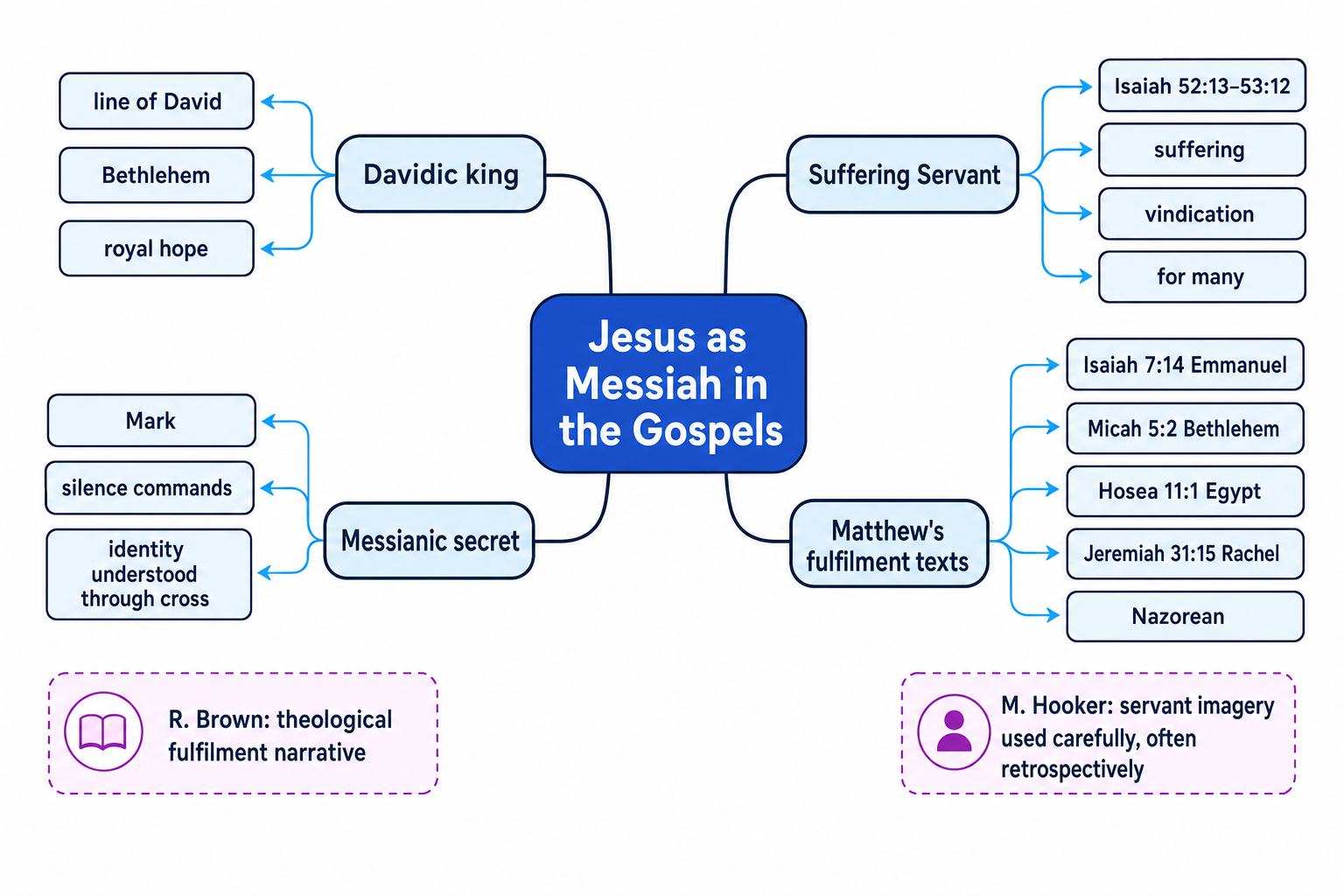
The map below shows the main links you need for this topic.
Key Idea
The big picture
The Gospel writers do not simply quote the Old Testament to “prove” Jesus by isolated predictions. They use Israel’s scriptures to interpret who Jesus is: Davidic king, suffering servant, true Israel and hidden Messiah revealed through the cross.
The Suffering Servant of Isaiah
The Suffering Servant refers especially to passages in Isaiah 40–55, often called the Servant Songs. The most important for this topic is Isaiah 52:13–53:12.
In Isaiah 53, the servant is rejected, suffers innocently, bears the sins of others and is later vindicated by God. Key ideas include suffering “for many”, being “wounded” for others, and being compared to a lamb led to slaughter.
However, in its original context the servant is not obviously “Jesus”. The servant may refer to Israel, a faithful remnant within Israel, a prophet-like figure, or an individual servant of God. This matters because exam answers should avoid sounding as if Isaiah was simply writing a direct biography of Jesus centuries in advance.
Morna Hooker is especially useful here. Hooker is cautious about claiming that Isaiah 53 was already a clear, fixed expectation of a suffering Messiah in Judaism before Christianity. She argues that many New Testament links with the Servant are better understood as early Christian interpretation after Jesus’ death and resurrection. In other words, the Church looked back at Isaiah and found language that made sense of the scandal of a crucified Messiah.
Impact on New Testament texts
The Suffering Servant idea helps explain why the Gospels present Jesus’ suffering not as failure, but as part of his vocation.
Examples include:
- Mark 10:45: “the Son of Man came not to be served but to serve, and to give his life a ransom for many.”
- Matthew 8:17: Matthew applies Isaiah 53:4 to Jesus’ healing ministry.
- Matthew 12:17–21: Matthew quotes Isaiah 42 to present Jesus as God’s chosen servant.
- Luke 22:37: Jesus refers to being “numbered with the transgressors”, echoing Isaiah 53:12.
Example
Connecting Isaiah 53 to Mark 10:45
-
Notice the shared themes: Isaiah’s servant suffers innocently and benefits “many”; Mark 10:45 says Jesus gives his life “for many”.
-
Compare the function of suffering in both texts. In Isaiah, suffering is not meaningless defeat; it becomes part of God’s saving purpose. In Mark, Jesus’ death is similarly presented as purposeful service.
-
Add Hooker’s caution. You can argue that Mark may be using Servant language, but you should avoid claiming that every first-century Jew expected a suffering Messiah from Isaiah 53.
-
Reach a balanced judgement: the link is theologically powerful for Christian interpretation, but historically it is probably a retrospective interpretation rather than a universally accepted messianic expectation.
Common Mistake
Treating Isaiah 53 as obviously Christian
Do not write as if Isaiah 53 can only mean Jesus. A stronger answer explains the original Jewish context, then shows how New Testament writers reread the passage in light of Jesus’ suffering and resurrection.
The importance of the line of David
The line of David means descent from King David, Israel’s ideal king. This expectation is rooted especially in 2 Samuel 7, where God promises David that his dynasty will endure.
By the time of Jesus, many Jews hoped for a Davidic Messiah who would restore Israel, defeat enemies and rule with justice. This hope had political force because Judea was under Roman power. Calling someone “Son of David” could therefore sound like a claim about kingship and liberation.
In the Gospels, Davidic identity appears in several ways:
- Matthew begins: “Jesus the Messiah, the son of David, the son of Abraham” (Matthew 1:1).
- Matthew and Luke include genealogies linking Jesus to David.
- Jesus is associated with Bethlehem, David’s city.
- People call Jesus “Son of David”, especially in healing stories.
- The triumphal entry into Jerusalem uses royal imagery.
Yet the Gospels also reshape Davidic expectation. Jesus is not presented as a military revolutionary. His kingship is revealed through humility, service and suffering.
Key Idea
Davidic Messiahship
The line of David gives Jesus royal legitimacy in the Gospels, but the meaning of kingship is transformed: Jesus is king through obedience, suffering and the cross, not through military conquest.
The messianic secret
The messianic secret is the idea that Jesus’ identity as Messiah is hidden or deliberately kept quiet during his ministry. The term is associated with the scholar William Wrede, but it is most important for understanding Mark’s Gospel.
Definition
Messianic secret
The messianic secret is the pattern, especially in Mark, where Jesus commands demons, healed people or disciples not to reveal his identity before his suffering, death and resurrection.
In Mark, Jesus silences demons who recognise him, tells healed people not to spread news, and orders the disciples not to speak after Peter confesses him as Messiah. This is not because Jesus is not the Messiah, but because people misunderstand what “Messiah” means.
A popular expectation might imagine a victorious Davidic king. Mark presents Jesus’ identity as something that can only be properly understood through the cross. Peter calls Jesus Messiah in Mark 8, but immediately rejects the idea that Jesus must suffer. This shows the problem: Peter has the right title, but the wrong understanding.
Hooker is helpful again because she stresses the need to understand Jesus’ identity through suffering and discipleship. The “secret” is not just a puzzle; it protects Jesus’ mission from being reduced to political triumphalism.
Example
Explaining a silence command in Mark
-
Start with the event: Jesus’ identity is recognised, but he commands silence.
-
Ask why silence matters in the narrative. In Mark, people can use correct titles while still misunderstanding Jesus’ mission.
-
Connect this to messianic expectation. If Messiah means only royal victory, then Jesus’ suffering makes no sense.
-
Interpret the command: Mark delays full recognition until the cross, where Jesus’ identity is revealed through suffering obedience.
Matthew’s proof texts in the birth narratives
A proof text is a scriptural quotation used to support a claim. In Matthew’s Gospel, these are often called fulfilment quotations because Matthew repeatedly says that events happened “to fulfil” scripture.
Matthew’s birth narrative is packed with these texts. They present Jesus as the fulfilment of Israel’s story.
| Matthew passage | Scriptural text used | How Matthew uses it |
|---|---|---|
| Matthew 1:22–23 | Isaiah 7:14 | Jesus’ birth fulfils “Emmanuel”, meaning “God with us”. |
| Matthew 2:5–6 | Micah 5:2 | Bethlehem is identified as the birthplace of a ruler. |
| Matthew 2:15 | Hosea 11:1 | “Out of Egypt I called my son” is applied to Jesus’ return from Egypt. |
| Matthew 2:17–18 | Jeremiah 31:15 | Rachel weeping is applied to Herod’s massacre of the infants. |
| Matthew 2:23 | “He will be called a Nazorean” | This is not a clear direct quotation; it may be a broader scriptural theme or wordplay. |
Raymond Brown is the key scholar for Matthew’s infancy narratives. Brown argues that these narratives are deeply theological. Matthew is not just reporting interesting childhood details; he is presenting Jesus’ identity through Israel’s scriptures. For Brown, the infancy narratives act like an overture to the whole Gospel: themes of conflict, fulfilment, Gentile recognition, Jewish rejection, divine guidance and Jesus as “God with us” are introduced from the beginning.
A crucial example is Hosea 11:1. In Hosea, “Out of Egypt I called my son” originally refers to Israel’s exodus from Egypt, not a future child Messiah. Matthew applies it to Jesus because Jesus is portrayed as embodying Israel’s story. This is typology.
Definition
Typology
Typology is a way of reading scripture where an earlier person, event or pattern is seen as being repeated and fulfilled more deeply later. Matthew presents Jesus as the true Israel and, in some ways, as a new Moses.
Example
Reading Hosea 11:1 in Matthew
-
Identify the original meaning: in Hosea, God’s “son” is Israel, called out of Egypt in the exodus.
-
Notice Matthew’s narrative pattern: Jesus goes down into Egypt and then returns, echoing Israel’s earlier story.
-
Apply typology: Matthew is not using Hosea as a simple prediction; he is saying Jesus sums up and fulfils Israel’s identity.
-
Evaluate with Brown: this supports Brown’s view that Matthew’s infancy narrative is theological interpretation shaped by scripture, not merely a list of predictions coming true.
Tip
Use the word fulfil carefully
In Matthew, “fulfil” often means “fill up the meaning of” rather than “match a prediction in the most literal possible way”. This is especially important for Hosea 11:1 and Jeremiah 31:15.
Why these expectations matter for understanding the Gospels
Messianic prophecy affects the Gospels in three major ways.
1. It shapes Jesus’ identity
The Gospel writers use scripture to answer the question: “Who is Jesus?” Matthew emphasises Jesus as Son of David, Son of Abraham, Emmanuel and true Israel. Mark emphasises that Jesus is Messiah, but only rightly understood through suffering.
2. It explains the problem of a crucified Messiah
A crucified Messiah was difficult to accept because crucifixion looked like shame and defeat. The Suffering Servant tradition helped early Christians argue that suffering could be part of God’s plan rather than evidence against Jesus’ messiahship.
3. It shows that the Gospel writers are interpreters, not neutral reporters
Brown helps you explain Matthew’s method: the birth narratives are theological narratives shaped by scripture. Hooker helps you evaluate claims about Isaiah: the Suffering Servant became very important for Christian interpretation, but it may not have been a straightforward pre-Christian messianic expectation.
Key Idea
Best evaluative judgement
The strongest view is that Old Testament prophecy significantly shaped New Testament portrayals of Jesus, but not in a simplistic prediction-and-proof way. The Gospel writers creatively interpret Israel’s scriptures to show that Jesus fulfils God’s purposes through Davidic kingship, servant suffering and hidden messiahship.
Exam technique
In the exam
-
Define “Messiah” early, and remember that “Christ” is a title meaning “anointed one”.
-
Use both scholars with precision: Brown for Matthew’s fulfilment narratives, Hooker for caution about the Suffering Servant as a fixed messianic expectation.
-
Avoid one-sided answers. Show how prophecy supports Christian claims about Jesus, but also evaluate whether the Gospel writers are rereading scripture retrospectively.
Self review
Check yourself
- Why is Isaiah 53 important for Christian interpretation of Jesus’ death, and why must it be handled carefully?
- How does Matthew use Hosea 11:1 typologically rather than as a simple prediction?
- What does the messianic secret reveal about misunderstanding Jesus’ identity in Mark?

Keep learning
Make a free account to read the full revision notes and worked examples.