Revision notes for Edexcel AS Level Religious Studies The relationship between religion and morality. Open the guide for explanations and worked examples. Written against the Edexcel AS Level Religious Studies specification, so the content matches what's examinable rather than general Religious Studies background.
The relationship between religion and morality
What you'll learn
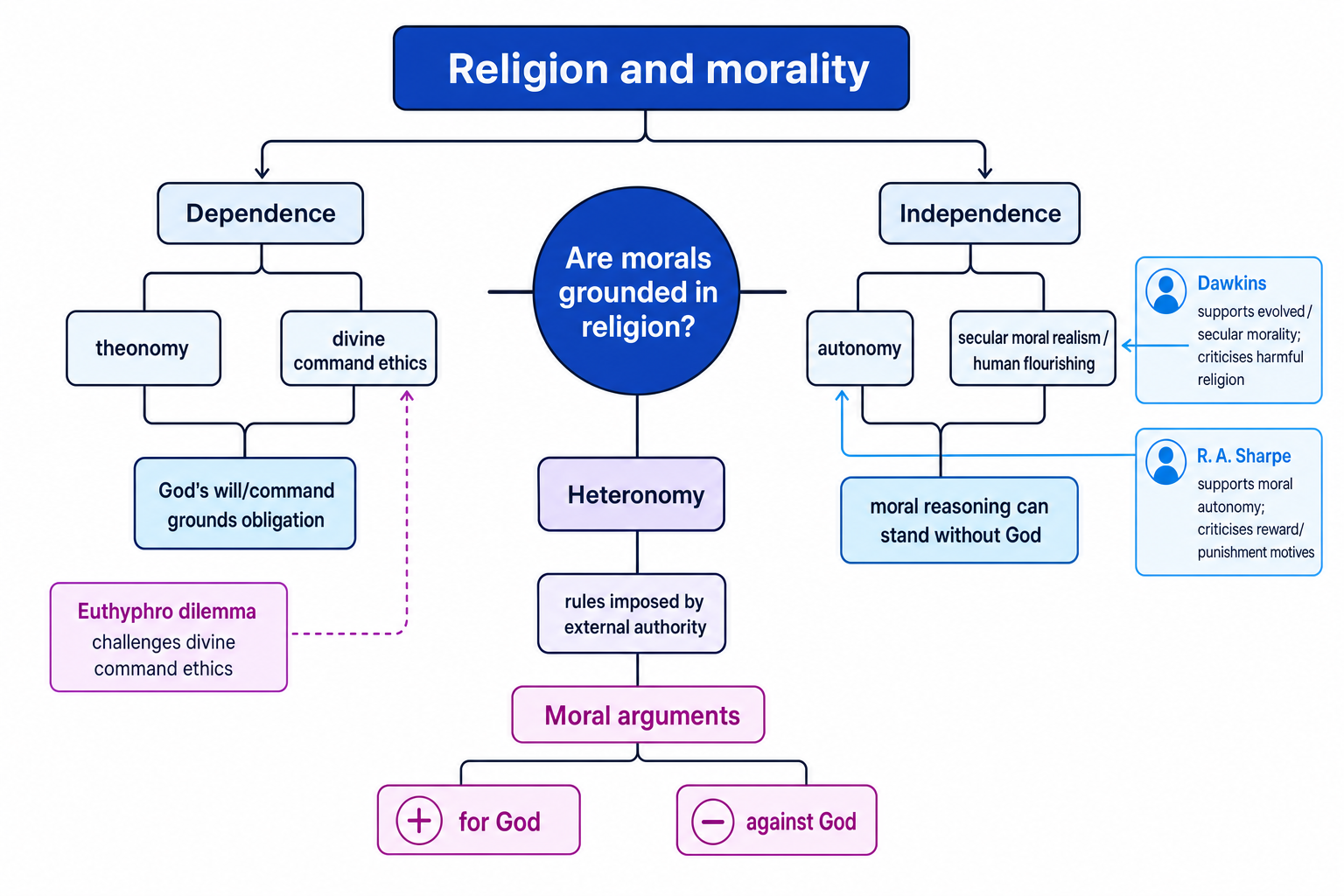
- How to distinguish dependence, independence, autonomy, theonomy and heteronomy.
- Why divine command ethics is attractive to some religious believers, and why the Euthyphro dilemma challenges it.
- How Richard Dawkins and R. A. Sharpe argue that morality does not need religion.
- How to use contemporary examples such as the Westboro Baptist Church, religion and terror, Quiverfull and biblical parenting in balanced essay answers.
Why this topic matters
This topic asks a big meta-ethical question: does morality need religion? In other words, when someone says “this is right” or “this is wrong”, are they really depending on God, scripture or religious authority — or can moral reasoning stand on its own?
Because this sits under ethical language, focus not only on what people think is moral, but on what gives moral language its authority: divine command, reason, conscience, human flourishing, community, or something else.
Morality and religion: the basic issue
Definition
Morality and religion
Morality means principles about right and wrong conduct, character and responsibility. Religion means a system of beliefs and practices usually involving ultimate reality, God or gods, sacred texts, worship, community and moral guidance.
The key question is not simply “are religious people moral?” Many are, and many non-religious people are too. The deeper question is whether morality is grounded in religion, known through religion, or motivated by religion.
Dependence and independence
Definition
Dependence and independence
Dependence means morality relies on religion in some important way. Independence means morality can be understood, justified or practised without relying on religion.
Dependence can mean several different things:
- Ontological dependence: moral truths exist because of God.
- Epistemological dependence: we know moral truths through revelation, scripture or religious teaching.
- Motivational dependence: religion gives people motivation to act morally, for example through worship, community, hope, judgement or fear of punishment.
Independence does not necessarily mean “religion is bad”. It means moral reasoning can work without appeal to God. A non-religious person might appeal to reason, empathy, human rights, consequences, virtue, social cooperation or human flourishing.
Example
Distinguishing types of dependence
A believer says: “I know stealing is wrong because my religion teaches it, but I think it would still be wrong even if no scripture mentioned it.”
- The phrase “I know stealing is wrong because my religion teaches it” shows epistemological dependence, because religion is the source of moral knowledge.
- The phrase “it would still be wrong even if no scripture mentioned it” rejects full ontological dependence, because the wrongness is not created only by the command.
- The view is therefore not pure divine command ethics. It is closer to the idea that religion reveals or supports moral truths that may also be accessible by reason.
Common Mistake
Dependence is not one simple claim
Do not write “religion and morality are dependent” without saying how. An essay becomes much sharper if you ask whether the dependence is about existence, knowledge or motivation.
Autonomy, theonomy and heteronomy
These three terms help you classify different views of moral authority.
Definition
Autonomy, theonomy and heteronomy
Autonomy means self-rule: moral agents use reason and conscience to recognise or give themselves moral law. Theonomy means God’s law or divine rule is the source of morality. Heteronomy means being ruled by an external authority rather than by one’s own rational moral judgement.
In ethics, autonomy does not mean “doing whatever you want”. It means being morally responsible because you understand and endorse the moral reason for your action. Kant is useful background here: for Kant, a genuinely moral action is done from duty recognised by reason, not merely from fear, desire or pressure.
Theonomy is common in religious ethics: moral law is understood as coming from God. This may be through scripture, revelation, tradition, conscience or religious authority.
Heteronomy is often used critically. If someone obeys a rule only because a powerful authority says so, without understanding or morally endorsing it, critics argue this is not mature morality.
Tip
A quick way to remember the terms
Auto = self, theo = God, hetero = other. So autonomy is self-rule, theonomy is God-rule, and heteronomy is rule by another external authority.
Divine command ethics
Definition
Divine command ethics
Divine command ethics is the view that an action is right because God commands it, and wrong because God forbids it.
Divine command ethics is a strong form of moral dependence. It can seem attractive because it gives morality a clear, objective authority: moral rules do not depend on human opinion, culture or changing social fashion.
Religious believers may argue that if God is perfectly good, all-knowing and creator of the universe, then God has the authority to command moral duties. This can also give moral life seriousness: duties are not just preferences, but obligations before God.
However, divine command ethics faces a major problem: the Euthyphro dilemma, from Plato.
Definition
The Euthyphro dilemma
The Euthyphro dilemma asks: is something good because God commands it, or does God command it because it is good?
If something is good only because God commands it, morality can seem arbitrary. If God commanded cruelty, would cruelty become good? But if God commands something because it is already good, then goodness seems independent of God.
Example
Applying the Euthyphro dilemma
Suppose someone argues: “Helping the poor is good because God commands it.”
- Take the first horn: if helping the poor is good only because God commands it, then the command seems to create the goodness. The worry is that any command could become good, even a cruel one.
- Take the second horn: if God commands helping the poor because compassion is already good, then moral goodness appears to exist independently of the command.
- A religious reply may say that God’s commands flow from God’s perfectly loving nature, so they are not arbitrary. The critic can then ask whether “God’s nature is good” is judged by an independent moral standard.
Dawkins: morality without God
Richard Dawkins is an atheist and often an anti-theist, meaning he does not merely disbelieve in God but argues that religious belief can be harmful.
Dawkins rejects the claim that people need God to be moral. In The God Delusion, he argues that moral behaviour can be explained through evolution and social life. Humans may develop altruism through kinship, reciprocal cooperation, reputation and sympathy. These are natural explanations of why moral instincts exist.
He also argues that religious people often select which scriptural teachings to follow. For example, many modern believers reject slavery or harsh punishments even where ancient texts appear to tolerate them. Dawkins thinks this shows people are using a moral standard outside scripture. He calls changing moral awareness the moral Zeitgeist: the broad moral spirit of an age.
For Dawkins, religion can make morality worse when it encourages unquestioning obedience, absolutism or hostility to outsiders. His challenge is especially strong against divine command ethics: if people think God has commanded something, they may stop asking whether it is compassionate, just or reasonable.
Sharpe: morality needs autonomy
R. A. Sharpe also challenges the dependence of morality on religion, but his emphasis is more philosophical than Dawkins’ evolutionary approach.
Sharpe argues that morality requires genuine moral judgement. If someone acts only because they want heaven, fear hell, or obey an external authority, then their action may not be fully moral. They are responding to reward, punishment or command rather than to the moral value of the action itself.
Sharpe’s criticism is especially powerful against heteronomy. If religion trains people to obey rather than think morally, then religion may weaken moral responsibility. On this view, a person should do good because it is good, not merely because religion tells them to.
Key Idea
Dawkins and Sharpe compared
Dawkins attacks religious morality mainly through evolution, scripture and the social harms of religion. Sharpe attacks it through moral autonomy: goodness requires rational moral judgement, not obedience to authority.
Moral arguments for God
A moral argument for the existence of God tries to move from moral experience to belief in God. It does not simply say “religious people are moral”. It argues that morality is best explained by God.
One version argues:
- Objective moral values and duties exist.
- Objective moral law needs a foundation beyond human opinion.
- God is the best explanation for that foundation.
Kant offers a more careful version. He thought morality is known through practical reason, not through divine command. However, he argued that moral life points towards the summum bonum, the highest good, where virtue and happiness are ultimately united. Since this does not reliably happen in this life, Kant saw God and immortality as postulates of practical reason: not scientific proofs, but rational beliefs connected to moral hope and justice.
Moral arguments against God
A moral argument against God argues that certain moral facts count against belief in a perfectly good God, or against specific religious claims.
For example, critics may argue that if a religion presents God as commanding cruelty, hatred or violence, then either:
- that command has been wrongly interpreted;
- the text is not a reliable revelation of God;
- or the God described is not morally perfect.
Dawkins uses this kind of reasoning when he criticises violent or discriminatory religious texts and practices. Sharpe’s version is more focused on moral corruption: if religion leads people to suspend ordinary compassion and moral judgement, that is evidence against religion as the foundation of ethics.
Common Mistake
Do not treat this as a simple proof either way
Moral arguments rarely force one conclusion. A strong essay weighs whether God explains morality better than secular accounts, and whether religious harm comes from religion itself or from human misuse of religion.
Contemporary focus: Westboro Baptist Church
The Westboro Baptist Church is a small American independent Baptist group associated with Fred Phelps and notorious for extreme anti-LGBT messages and picketing funerals. It claims biblical justification for its actions, including the idea that disasters or deaths can be signs of divine judgement.
This is useful for the specification because it raises the question: what happens when religious moral language becomes absolutist and hostile?
Dawkins would likely use Westboro as an example of religion making moral attitudes worse by giving hatred divine authority. Sharpe would focus on the danger of heteronomy: members may treat obedience to a claimed divine message as more important than compassion.
A balanced answer must add that Westboro is not representative of Christianity. Many Christians condemn the group by appealing to Jesus’ teaching on love, mercy and the dignity of persons. This shows that the issue is not simply “religion versus morality”, but also interpretation within religion.
Contemporary focus: religion and terror
Terror means violence intended to intimidate civilians or communities, often for political, ideological or religious aims. Religion can be involved when attackers believe they are obeying God, defending sacred truth, gaining divine reward or fighting enemies of the faith.
Dawkins argues that religion can intensify violence because it may add certainty, sacred authority and hopes of martyrdom. Sharpe’s critique also applies: if people outsource morality to religious authority, they may override ordinary moral limits.
But evaluation matters. Terrorism is often shaped by politics, identity, trauma, social conditions and power, not religion alone. Also, religious traditions often contain strong resources against terror: sanctity of life, justice, mercy, peacemaking and condemnation of murder.
Tip
How to keep contemporary examples balanced
Use examples like terror or Westboro to test a theory, not to stereotype a whole religion. Ask: does this case reveal something essential about religious ethics, or a distortion of it?
Contemporary focus: Quiverfull and biblical parenting
Quiverfull is a conservative Christian movement that rejects contraception and encourages large families, drawing on Psalm 127’s image of children as arrows in a warrior’s quiver. It is often linked with patriarchal family structures, female submission, homeschooling and distrust of secular culture.
Biblical parenting is a broad term for parenting based on biblical principles. In moderate forms, this may mean teaching faith, discipline, love, service and virtue. In more controversial forms, it may involve strict obedience, physical punishment or strong control over children’s education and social life.
These examples raise questions about autonomy. Supporters may say religious parents have a right to raise children according to their faith and that moral formation requires discipline and community. Critics may argue that children’s welfare, freedom and developing autonomy can be harmed when religious authority is used to justify control or punishment.
Example
Using a contemporary case in an argument
Consider the claim: “Quiverfull shows that religion makes morality heteronomous.”
- Link the case to the concept: Quiverfull can be presented as heteronomous if moral duties about gender, family and reproduction are treated as fixed by external religious authority.
- Apply Sharpe: he would challenge whether obedience to such roles counts as genuine moral judgement if individuals are discouraged from autonomous reasoning.
- Apply evaluation: supporters could reply that religious communities can form virtues such as commitment, sacrifice and care, so the case criticises a particular conservative movement rather than proving that all religious morality is heteronomous.
- Reach a judgement: the example is strongest against rigid or authoritarian forms of religious ethics, but weaker against religious traditions that encourage reason, conscience and moral development.
Overall evaluation: does morality need religion?
A strong answer should avoid extremes.
The case for dependence is that God can provide an objective foundation, moral authority, motivation and ultimate justice. Religious traditions can form virtuous people through worship, community, stories and practices. Aquinas’ natural law is a useful reminder that religious ethics need not be crude divine command: reason can participate in God’s moral order.
The case for independence is that non-religious people clearly make serious moral judgements, and religious people often use reason and conscience when interpreting scripture. Dawkins strengthens this through evolutionary and cultural explanations. Sharpe strengthens it through the idea that morality requires autonomy.
Your judgement might be that morality does not need religion to be meaningful or motivating, but religion can still support moral life when it encourages compassion, reason and responsibility. The strongest criticisms apply when religion becomes authoritarian, absolutist or immune to moral challenge.
Exam technique
In the exam
- Define the relationship carefully: say whether you are discussing ontological, epistemological or motivational dependence.
- Compare Dawkins and Sharpe explicitly: Dawkins focuses on evolution, scripture and harm; Sharpe focuses on autonomy and the problem of obedience.
- Use contemporary examples as evidence, but evaluate them fairly by asking whether they represent religion itself or a disputed interpretation.
- Reach a justified judgement: avoid simply saying “religion is good” or “religion is bad”; decide which form of religious morality is strongest or weakest.
Self review
Check yourself
- Can you explain the difference between theonomy and heteronomy without confusing them?
- How does the Euthyphro dilemma challenge divine command ethics?
- Why might Dawkins and Sharpe both reject moral dependence on religion, but for different reasons?

Keep learning
Make a free account to read the full revision notes and worked examples.