Revision notes for Edexcel AS Level Religious Studies A comparison of the work of Immanuel Kant and Aristotle with regard to Deontology and Virtue Ethics respectively. Open the guide for explanations and worked examples. Written against the Edexcel AS Level Religious Studies specification, so the content matches what's examinable rather than general Religious Studies background.
A comparison of the work of Immanuel Kant and Aristotle with regard to Deontology and Virtue Ethics respectively
What you'll learn
- How Kant’s deontology makes morality depend on duty, reason and the categorical imperative.
- How Aristotle’s virtue ethics makes morality depend on character, flourishing and practical wisdom.
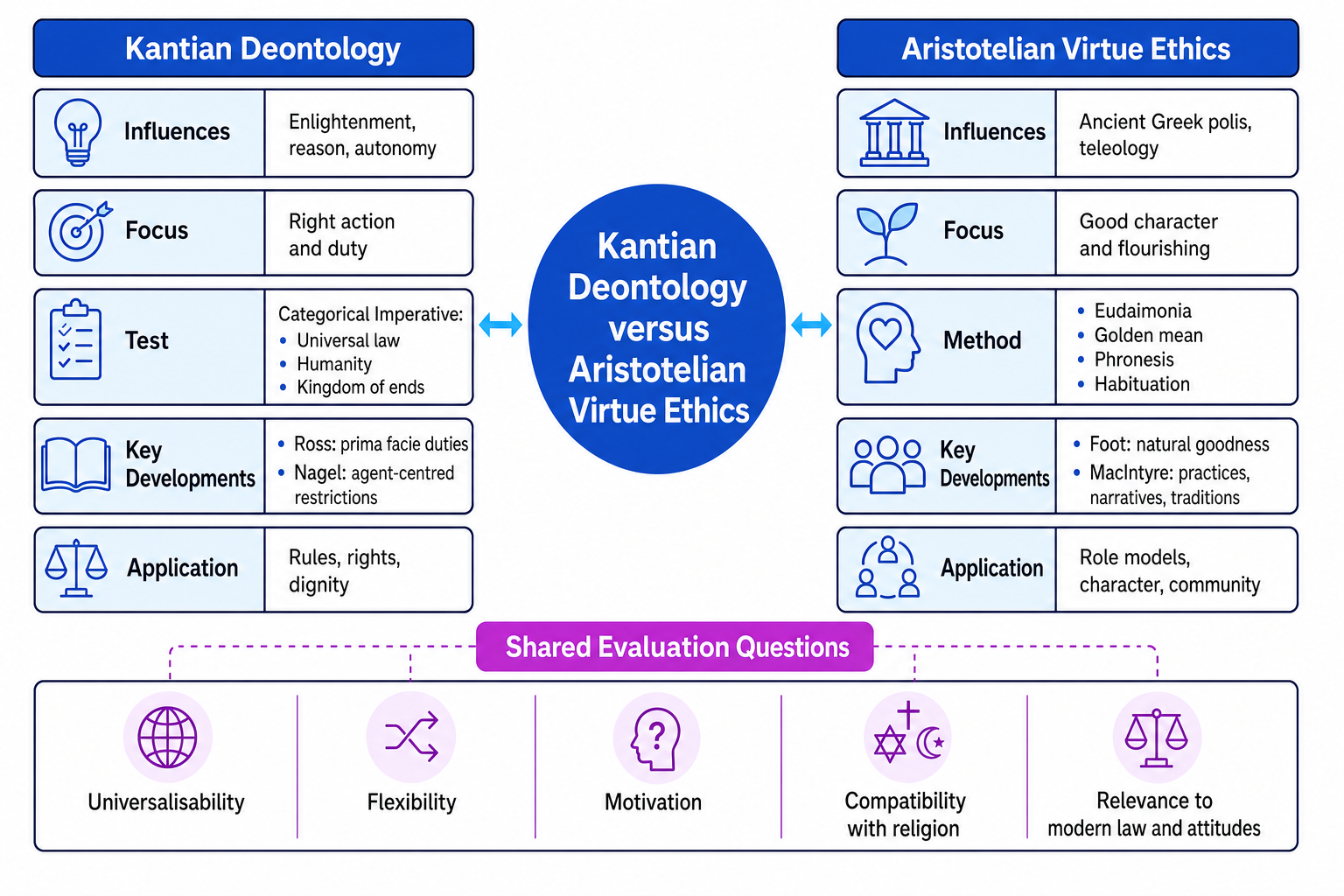
- How later scholars — W. D. Ross, Thomas Nagel, Philippa Foot and Alasdair MacIntyre — develop these approaches.
- How to compare the strengths, weaknesses and modern relevance of both theories in Edexcel essays.
The big picture: actions or character?
Kant and Aristotle ask different ethical questions.
Kant mainly asks: “What is my duty?”
Aristotle mainly asks: “What kind of person should I become?”
That difference shapes almost everything else: Kant focuses on universal rules for action, while Aristotle focuses on the formation of excellent character over a whole life.
Definition
Deontology and Virtue Ethics
Deontology is a duty-based ethical theory: an action is right if it follows the correct moral rule or duty, regardless of consequences. Virtue ethics is a character-based ethical theory: morality is about developing virtues — stable good character traits — that enable a person to live well.
Kantian deontology
Influences on Kant
Immanuel Kant was shaped by the Enlightenment, an eighteenth-century movement that stressed reason, autonomy and universal human dignity. He was also influenced by Protestant moral seriousness, especially the idea that morality requires inner sincerity, not just outward obedience.
Politically and culturally, Kant lived in a world increasingly concerned with freedom, rational law and the equal worth of persons. This helps explain why his ethics is not based on tradition, emotion or religious authority alone, but on practical reason.
Definition
A priori moral reasoning
A priori reasoning means reasoning that does not depend on sense experience. Kant thinks the basic moral law can be known through reason itself, not by checking what produces the best consequences.
Duty, good will and moral worth
For Kant, the only thing good “without qualification” is the good will: the will that acts because it recognises moral duty. This means an action has full moral worth only when it is done from duty, not merely in accordance with duty.
For example, a shopkeeper who gives correct change only to protect his reputation acts in accordance with duty, but not from duty. His motive is self-interest.
Key Idea
Kant’s central idea
For Kant, morality is not about becoming happy or producing useful results. It is about rationally choosing what duty requires, because persons have dignity and must never be treated as mere tools.
The categorical imperative
Kant distinguishes between hypothetical imperatives and the categorical imperative.
A hypothetical imperative is conditional: “If you want X, do Y.” For example, “If you want good grades, revise.” A categorical imperative is unconditional: it applies to all rational beings regardless of their desires.
Kant gives several formulations of the categorical imperative.
Formula of Universal Law
Kant says you should act only on a maxim — a personal principle of action — that you could will to become a universal law.
A maxim fails if universalising it creates a contradiction or becomes impossible to will consistently.
Formula of Humanity
Kant says you must treat humanity, whether in yourself or others, always as an end and never merely as a means. This protects the dignity of rational persons.
This does not mean you can never use someone’s help. It means you must not manipulate, deceive or exploit them as though their rational choice did not matter.
Kingdom of Ends
The kingdom of ends is Kant’s ideal moral community: each rational person acts as if they are legislating universal moral laws for everyone, while respecting every other rational person as an end.
Example
Testing a lying promise
Suppose you are considering lying to borrow money you know you cannot repay.
- Formulate the maxim: “When I need money, I may make a false promise to get it.”
- Universalise it: imagine everyone made false promises whenever it was useful.
- Check whether the practice still works: if everyone lied in promises, trust in promising would collapse, so the maxim undermines itself.
- Apply the humanity formula: the lender is being deceived and cannot rationally consent, so they are treated merely as a means.
- Kant’s conclusion: making the lying promise is morally wrong, whatever useful consequences might follow.
Common Mistake
Kant is not just ‘following rules’
Do not present Kant as mindless rule-following. His rules come from autonomous reason: rational agents give the moral law to themselves through reason, rather than being controlled by desire, culture or authority.
Developments of deontology: Ross and Nagel
W. D. Ross: prima facie duties
W. D. Ross thought Kant’s ethics was too rigid because real life contains conflicts between duties. He proposed prima facie duties, meaning duties that are genuinely binding “at first sight” unless outweighed by a stronger duty in that situation.
Ross lists duties such as:
- Fidelity — keeping promises.
- Reparation — making amends for wrongs.
- Gratitude — returning kindness.
- Justice — treating people fairly.
- Beneficence — helping others.
- Self-improvement — developing oneself.
- Non-maleficence — avoiding harm.
Ross remains deontological because duties still matter in themselves. However, he is more flexible than Kant because he allows judgement about which duty becomes the actual duty.
Example
Weighing prima facie duties
You promised to meet a friend, but on the way you see an injured person needing urgent help.
- Identify the prima facie duties: fidelity supports keeping the promise; beneficence and non-maleficence support helping the injured person.
- Compare moral seriousness: breaking a social promise causes inconvenience, but ignoring serious injury risks major harm.
- Decide the actual duty: Ross would likely say the duty to help overrides the duty to meet the friend on time.
- Notice the difference from Kant: Ross does not abandon duty, but he allows duties to be ranked in context.
Thomas Nagel: constraints and moral limits
Thomas Nagel defends a modern deontological idea: there are some things we must not do to people, even for good outcomes. In discussions of war and political violence, Nagel argues against treating persons simply as containers of overall welfare.
This supports agent-centred restrictions: restrictions on what I may do, even if breaking the rule would increase total happiness. For example, intentionally killing civilians may remain wrong even if it is claimed to shorten a war.
Nagel therefore strengthens Kant’s concern for human dignity, but he also recognises the tragic pressure of moral conflict more than Kant sometimes appears to.
Aristotelian virtue ethics
Influences on Aristotle
Aristotle’s ethics developed in ancient Greek culture, especially the polis, the city-state. Greek ethics was concerned with the kind of life humans are naturally suited to live.
Aristotle’s thinking is teleological, meaning it explains things in terms of their telos: their end, goal or purpose. The human telos is fulfilled by using reason excellently.
Eudaimonia and living well
Aristotle’s central concept is eudaimonia, often translated as flourishing, happiness or living well. It is not a mood. It is the successful fulfilment of human life as a whole.
In the Nicomachean Ethics, Aristotle argues that eudaimonia is achieved by “activity of the soul in accordance with virtue.” You become good by repeatedly choosing well until virtuous action becomes part of your character.
Definition
Phronesis
Phronesis means practical wisdom: the ability to judge what virtue requires in a particular situation. It is not just knowing moral rules; it is wise perception and decision-making.
The golden mean, virtues and vices
A virtue is a stable character trait that helps a person flourish. A vice is a bad character trait that damages flourishing.
Aristotle says moral virtue usually lies in a golden mean between two extremes: one of excess and one of deficiency. For example, courage is the mean between rashness and cowardice.
The mean is “relative to us”, so it is not a simple mathematical middle. The right action depends on the person, situation, motive and practical wisdom.
Example
Finding the mean in anger
Imagine someone has been publicly insulted and must decide how to respond.
- Identify the emotional field: the issue is anger and self-respect.
- Find the deficiency: never responding may show servility or lack of proper self-respect.
- Find the excess: screaming, threatening or humiliating the other person may show irascibility.
- Judge the mean using phronesis: a calm but firm response may express proper anger at the right time, toward the right person, for the right reason.
- Aristotle’s conclusion: the virtuous response is not “no anger”; it is rightly ordered anger.
Character, habituation and role models
Aristotle thinks virtues are developed by habituation: repeated practice until good actions become settled dispositions. This is why upbringing, education and community matter.
A virtuous role model is also important. Aristotle refers to the person of practical wisdom, often called the phronimos, as the model for judging what the virtuous person would do.
Key Idea
Aristotle’s central idea
Virtue ethics is less about asking “Which rule applies?” and more about asking “What would a wise and flourishing person characteristically do?”
Developments of virtue ethics: Foot and MacIntyre
Philippa Foot: natural goodness
Philippa Foot develops virtue ethics by arguing that virtues are connected to facts about human life. Humans are vulnerable, dependent, social and rational, so traits such as justice, courage and honesty are not arbitrary preferences; they help humans live well.
This gives virtue ethics an objective basis. Foot’s approach avoids saying “virtue is whatever my culture likes”, because virtues are judged by whether they contribute to human flourishing.
Alasdair MacIntyre: practices, narratives and traditions
Alasdair MacIntyre argues in After Virtue that modern moral debate is fragmented because society has lost a shared account of the human good. He links virtues to practices, narratives and traditions.
A practice is a socially established activity with internal goods, such as medicine, teaching or music. Virtues help people pursue these goods honestly rather than merely chasing external rewards such as money or status.
For MacIntyre, you cannot understand a person’s moral life as isolated choices. You must see it as part of a life story within a community and tradition.
Comparing strengths and weaknesses
Kant’s theory is powerful because it protects universal dignity. It supports human rights, informed consent, equality before the law and opposition to exploitation. It is especially useful where society needs clear moral limits: torture, slavery, trafficking and deliberate killing of innocents.
However, Kant can seem too absolute. If lying is always wrong, it becomes difficult to deal with cases where truth-telling enables serious harm. Ross improves deontology here by allowing conflicting duties, while Nagel keeps Kant’s seriousness about moral limits.
Aristotle’s theory is powerful because it takes motivation, emotion, character and community seriously. It explains why moral education matters and why a good life is more than isolated correct actions.
However, Aristotle can be less decisive in crisis situations. “Act virtuously” may not give a clear answer when urgent rules are needed. His ancient context also included assumptions about gender, slavery and citizenship that modern students should criticise. Foot and MacIntyre help modernise virtue ethics, but MacIntyre’s stress on tradition can raise worries about exclusion or conservatism.
Contemporary application, law and religion
In modern law and social attitudes, Kantian ethics fits strongly with rights-based thinking: persons have dignity and should not be used merely as means. This can support anti-discrimination law, medical consent and privacy rights.
Virtue ethics fits areas where law alone is not enough. A doctor may follow rules but still lack compassion; a politician may obey the law but lack integrity. Virtue ethics asks what kind of character a good professional, citizen or friend needs.
Religiously, both theories can connect with faith traditions, but neither is simply the same as religion. Kant’s ethics is compatible with belief in God, and Kant thought morality points towards God, freedom and immortality as postulates of practical reason. Yet his ethics is autonomous, not based directly on divine command.
Aristotle influenced Christian ethics through Aquinas, especially ideas of telos, virtue and natural law. Virtue ethics also resonates with religious character formation in many traditions. But Aristotle’s original goal is rational human flourishing, not necessarily salvation, liberation or obedience to revelation.
Tip
Best comparison angle
A strong essay does not say “Kant is about actions; Aristotle is about people” and stop. Push further: Kant gives clearer universal protection for persons, while Aristotle gives a richer account of moral formation, emotion and practical judgement.
Overall judgement
Kant is strongest when moral limits must be defended against convenience, pressure or majority opinion. Aristotle is strongest when morality requires wise character, not just rule compliance.
The best evaluation may be that the theories answer different ethical needs. A society needs Kantian respect for persons and clear duties, but it also needs Aristotelian formation of virtuous people who can apply principles wisely.
Exam technique
In the exam
- Compare throughout: after explaining Kant, immediately contrast Aristotle on the same issue, such as motive, rules, character or consequences.
- Use the named scholars deliberately: Ross and Nagel as developments of deontology; Foot and MacIntyre as developments of virtue ethics.
- Reach a justified judgement: decide which theory is more convincing for the example you discuss, rather than listing strengths and weaknesses neutrally.
Self review
Check yourself
- Why does Kant think a good will matters more than good consequences?
- How does Ross’s idea of prima facie duties soften Kantian deontology?
- In what ways do Foot and MacIntyre make Aristotle’s virtue ethics more relevant today?

Keep learning
Make a free account to read the full revision notes and worked examples.