Revision notes for Edexcel AS Level Religious Studies Meta-ethics. Open the guide for explanations and worked examples. Written against the Edexcel AS Level Religious Studies specification, so the content matches what's examinable rather than general Religious Studies background.
Meta-ethics
What you'll learn
- How meta-ethics differs from normative ethics.
- The key divide between cognitivist and non-cognitivist approaches to ethical language.
- How G E Moore challenges ethical naturalism through the naturalistic fallacy and open question argument.
- How A J Ayer develops emotivism from logical positivism, and how to evaluate it.
1. What is meta-ethics?
Most ethics asks: “What should I do?” Meta-ethics takes a step back and asks: “What do moral words like good, bad, right and wrong actually mean?”
For example, if someone says, “Stealing is wrong,” are they stating a fact, expressing a feeling, giving a command, or pointing to a special moral property?
Definition
Meta-ethics
Meta-ethics is the study of the meaning, status and function of ethical language. It asks whether moral claims are true or false, how we could know moral truths, and what moral words are doing when we use them.
Meta-ethics is different from normative ethics, which gives theories about how we should act, such as utilitarianism or natural law. Meta-ethics investigates the language and logic behind those theories.
2. Cognitivism and non-cognitivism
The first big divide is about whether moral statements are truth-apt. A statement is truth-apt if it can be true or false.
Definition
Cognitivism and non-cognitivism
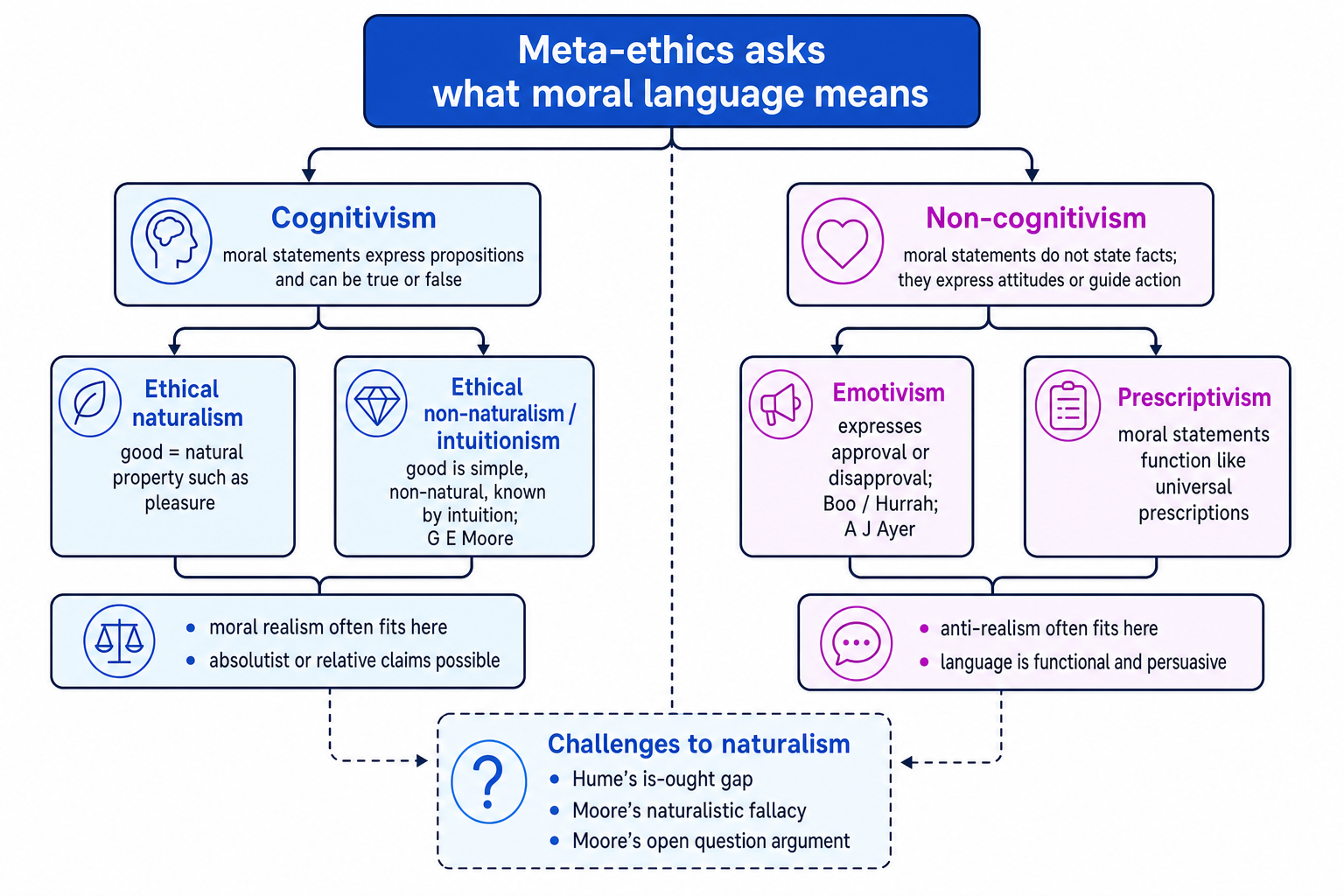
Cognitivism says ethical statements express propositions, so they can be true or false. Non-cognitivism says ethical statements do not state facts; instead, they express attitudes, emotions, prescriptions or commitments.
So, for a cognitivist, “Murder is wrong” is like “Paris is in France”: it makes a claim that could be true or false. For a non-cognitivist, “Murder is wrong” is more like “Boo to murder!” or “Do not murder!” It functions morally, but it does not describe a moral fact.
Here is the overall map of the main positions you need for Edexcel meta-ethics.
Key Idea
The core question
In meta-ethics, always ask: Is this theory treating moral language as factual, or as functional? Factual language describes reality; functional language expresses, persuades, commands or guides action.
3. Realism, anti-realism, absolutism and relativism
Moral realism is the view that moral facts or properties exist independently of human opinions. A realist might say that cruelty really is wrong, even if a whole society approves of it.
Moral anti-realism denies that there are stance-independent moral facts. Non-cognitivist theories such as emotivism are usually anti-realist because they see moral language as expressing attitudes rather than describing moral reality.
However, be careful: anti-realism and non-cognitivism are not identical. Some anti-realists may still think moral sentences are truth-apt, but only relative to human attitudes or cultures.
Ethical claims may also be absolutist or relative. An absolutist claim applies universally, such as “Torture is always wrong.” A relative claim depends on a culture, person or situation, such as “This action is wrong according to this society’s values.”
Common Mistake
Mixing up the categories
Do not assume that “relative” automatically means “non-cognitive”. A relativist could still be a cognitivist if they think “X is wrong in this culture” is a true or false claim about that culture’s moral code.
4. Ethical naturalism
Ethical naturalism is a cognitivist theory. It says moral terms can be defined using natural properties: features of the world that can be observed, experienced or studied.
For example, a naturalist might say:
- “Good” means “what produces pleasure”.
- “Good” means “what promotes human flourishing”.
- “Wrong” means “what causes suffering”.
- “Good” means “what is approved by society”.
Definition
Ethical naturalism
Ethical naturalism is the view that moral properties can be reduced to, or identified with, natural properties such as pleasure, happiness, survival, social approval or human flourishing.
Ethical naturalism makes moral language factual. If “good” means “pleasurable”, then “This action is good” can be checked by asking whether it produces pleasure.
Its strength is clarity: it connects ethics to evidence, human experience and practical consequences. Its weakness is that it may reduce morality too much. Is goodness really the same as pleasure, survival or approval?
5. The is–ought gap
The is–ought gap comes from David Hume. Hume noticed that moral arguments often move from factual claims about what is the case to moral claims about what ought to be the case.
For example:
- “This action causes pleasure.”
- Therefore, “This action is morally good.”
Hume’s challenge is that the conclusion does not follow unless you add a moral bridge premise, such as “Whatever causes pleasure is morally good.”
Definition
The is–ought gap
The is–ought gap is the problem that descriptive statements about facts do not logically entail prescriptive moral conclusions unless an extra moral principle is added.
Example
Spotting the is–ought gap
-
Consider the argument: “Lying protects my reputation, so I ought to lie.” The first claim is descriptive: it tells us what lying will do.
-
Test whether the conclusion follows logically. The fact that lying protects reputation does not by itself prove that protecting reputation is morally right.
-
Add the missing moral premise: “I ought to do whatever protects my reputation.” Now the argument works logically, but the key moral assumption has been exposed and can be challenged.
This matters because ethical naturalists often try to move from facts about human nature, pleasure or society to moral conclusions. Hume’s point is that facts alone do not generate duties.
6. G E Moore: the naturalistic fallacy and open question argument
G E Moore, in Principia Ethica, rejected ethical naturalism. He argued that “good” cannot be defined in terms of any natural property.
Moore called it the naturalistic fallacy to define “good” as something natural, such as pleasure, desire or social approval.
Definition
Naturalistic fallacy
For G E Moore, the naturalistic fallacy is the mistake of identifying “good” with a natural property, such as pleasure or happiness. Moore argues that goodness is simple, indefinable and non-natural.
Moore’s main support for this is the open question argument. If “good” really meant “pleasurable”, then asking “Is pleasure good?” would be a closed, pointless question, like asking “Is pleasure pleasure?” But Moore says the question remains meaningful and open. Therefore, “good” cannot simply mean “pleasurable”.
Example
Testing a naturalist definition
-
Take the naturalist claim: “Good means what maximises happiness.”
-
Replace the word “good” with the proposed definition. The question “Is maximising happiness good?” becomes “Does maximising happiness maximise happiness?”
-
Notice the difference. The second question is closed and tautological, but the first question is still morally debatable, especially if maximising happiness harms an innocent minority.
-
Moore concludes that “good” does not mean “maximises happiness”; goodness must be a distinct, non-natural property.
Moore’s own view is ethical non-naturalism: moral properties are real, but they are not natural properties. He is still a cognitivist because he thinks moral statements can be true or false.
Moore is also an intuitionist. Intuitionism says we know basic moral truths by direct rational insight, not by sense experience or deduction. For Moore, “good” is like “yellow”: you cannot define it fully, but you can recognise it.
7. Evaluating Moore
Moore’s theory has important strengths. It protects the objectivity of morality. If goodness is real and not reducible to pleasure or social approval, then a society can be morally wrong even if most people approve of its actions.
It also gives a powerful criticism of simplistic naturalism. Many students find Moore convincing because “good” does seem richer than “pleasant”, “popular” or “useful”.
However, Moore’s view faces serious problems. If goodness is non-natural, how do we access it? “Intuition” can sound vague. Different people claim different moral intuitions, so intuitionism may struggle to resolve disagreement.
There is also a criticism of the open question argument. Some philosophers argue that a question can feel “open” even when two terms refer to the same thing. For example, before modern chemistry, “Is water H2O?” was a meaningful question, but water still is H2O. So perhaps “good” could be identical with a natural property even if we can still ask Moore’s question meaningfully.
8. Prescriptivism
Prescriptivism is a non-cognitivist theory associated especially with R M Hare. It says moral language functions like a prescription or command.
When someone says “You ought not lie,” they are not describing a moral fact. They are prescribing: “Do not lie.”
However, Hare does not think morality is just random personal preference. Moral prescriptions must be universalizable. This means if you prescribe an action for one person in a situation, you must be willing to prescribe the same action for anyone in relevantly similar circumstances.
Example
Applying prescriptivism
-
Suppose someone says, “Other people ought to keep promises to me, but I may break promises to them.”
-
Translate the moral claim into a prescription: “People in this kind of situation must keep promises.”
-
Universalise it. If the same relevant circumstances apply to the speaker, they must prescribe promise-keeping for themselves too.
-
If they refuse, the problem is not a false factual statement but an inconsistency in their moral prescribing.
Prescriptivism improves on simple emotivism because it keeps the action-guiding nature of morality while adding a rational demand for consistency.
9. A J Ayer: logical positivism and emotivism
A J Ayer develops emotivism in Language, Truth and Logic. His view is influenced by logical positivism, a philosophical movement that argued meaningful factual statements must be either analytic or empirically verifiable.
An analytic statement is true by definition, such as “All bachelors are unmarried.” An empirically verifiable statement can be checked through sense experience, such as “It is raining.”
Ayer argues that moral statements are neither analytic nor empirically verifiable. You cannot observe “wrongness” in the same way you can observe a physical object. Therefore, moral statements are not factual propositions.
Definition
Emotivism
Emotivism is the non-cognitivist view that ethical language expresses feelings of approval or disapproval and often tries to influence the attitudes or actions of others.
For Ayer, saying “Stealing is wrong” does not state an extra fact about stealing. It expresses disapproval of stealing. His famous idea is that “Stealing money is wrong” functions rather like saying “Stealing money!” with a tone of moral horror.
So ethical language is functional and persuasive. It expresses emotion and encourages others to share that emotion. This is why emotivism is sometimes nicknamed the “boo-hurrah” theory: “Murder is wrong” means something like “Boo to murder!”, while “Charity is good” means “Hurrah for charity!”
Tip
Moore versus Ayer
Moore says moral language points to real but non-natural moral properties. Ayer says moral language does not point to moral properties at all; it expresses attitudes and influences behaviour.
10. Developments and criticisms of emotivism
C L Stevenson developed emotivism by arguing that ethical language has both emotive meaning and persuasive force. Moral disagreements are often disagreements in attitude, not just disagreements about facts. If two people know all the same facts about abortion or capital punishment but still disagree morally, Stevenson would say their attitudes differ.
This improves Ayer’s view because it explains why people argue morally: they use reasons, examples and emotional language to shift each other’s attitudes.
However, emotivism faces major criticisms.
First, it may make moral disagreement too shallow. If “Murder is wrong” means “Boo to murder,” and “Murder is not wrong” means “Hurrah for murder,” then the two speakers are expressing opposing feelings, but are they genuinely contradicting each other?
Second, the verification principle itself is controversial. The claim “A statement is meaningful only if analytic or empirically verifiable” is not obviously analytic or empirically verifiable. This makes Ayer’s foundation look self-defeating.
Third, emotivism struggles with moral reasoning. In real moral debate, people appeal to consistency, human dignity, consequences, rights and duties. This seems more serious than merely trying to spread emotions.
Ayer’s strength is that he explains why ethical language motivates action. Moral language does not feel like cold description; it pushes, condemns, praises and persuades. But his weakness is that he may strip morality of truth, knowledge and rational authority.
11. Building a balanced judgement
For essays, your comparison of Moore and Ayer should be direct.
Moore gives ethics objectivity. He can say some actions are genuinely good or bad, even if people disagree. This fits ordinary moral seriousness and allows criticism of immoral societies. But his appeal to non-natural properties and intuition is hard to verify.
Ayer gives a clearer account of how ethical language works in practice. Moral claims often do express approval, disapproval and persuasion. But if moral claims are never true or false, it becomes difficult to explain genuine moral progress, rational moral criticism or the idea that some attitudes are better justified than others.
A strong final judgement might be that Ayer successfully exposes the expressive and persuasive function of moral language, but Moore better preserves the objectivity that moral argument seems to require. Alternatively, you could argue that Moore’s non-natural goodness is too mysterious, making Ayer’s anti-realist approach more philosophically disciplined.
Exam technique
In the exam
-
Start by identifying whether the theory is cognitive or non-cognitive, then link that to realism, anti-realism, factual language or symbolic/function-based language.
-
Compare Moore and Ayer explicitly: Moore is a cognitivist, non-naturalist and intuitionist; Ayer is a non-cognitivist emotivist influenced by logical positivism.
-
Evaluate as you go: Moore protects moral truth but struggles to explain intuition; Ayer explains persuasion but struggles to account for genuine moral reasoning and disagreement.
Self review
Check yourself
- Why does Moore think “Is pleasure good?” remains an open question?
- How does Ayer’s verification principle lead him to emotivism?
- What is the difference between saying moral language is factual and saying it is functional?

Keep learning
Make a free account to read the full revision notes and worked examples.