Revision notes for Edexcel AS Level Religious Studies Interpreting the text. Open the guide for explanations and worked examples. Written against the Edexcel AS Level Religious Studies specification, so the content matches what's examinable rather than general Religious Studies background.
Interpreting the text
What you'll learn
- Why Matthew, Mark and Luke are called the Synoptic Gospels, and what the synoptic problem is.
- How source criticism, form criticism and redaction criticism help scholars interpret Gospel texts.
- What scholars mean by Markan priority, Q, M, L, proto-Gospels and units of tradition.
- Why translation, editing and transmission matter for understanding Gospel purpose, authorship and reliability.
Starting point: what are the Synoptic Gospels?
The Gospels are narrative accounts of Jesus’ life, teaching, death and resurrection. In New Testament Studies, the first three canonical Gospels — Matthew, Mark and Luke — are grouped together because they share a lot of material.
Definition
Synoptic Gospels
The Synoptic Gospels are Matthew, Mark and Luke. “Synoptic” means “seen together”, because these three Gospels can be compared side by side: they often contain the same stories, sayings, order of events and wording.
John is not usually included in the synoptic comparison because its style, structure and selection of material are much more distinctive. This does not make John “less important”; it simply means the literary relationship between Matthew, Mark and Luke is a separate problem.
The synoptic problem
The synoptic problem is the question of how to explain the similarities and differences between Matthew, Mark and Luke.
They are too similar to be completely independent. Sometimes they share long sequences of events and even very similar Greek wording. But they are also too different to be treated as identical copies. Matthew, for example, has the Magi and the Sermon on the Mount; Luke has the Good Samaritan and the Prodigal Son; Mark has a shorter, fast-moving style.
Scholars often divide the material into three categories:
- Triple tradition: material found in Matthew, Mark and Luke.
- Double tradition: material found in Matthew and Luke, but not Mark.
- Special material: material found in only one Gospel, such as material unique to Matthew or unique to Luke.
Key Idea
The central question
The synoptic problem is not “Which Gospel is true?” but “What literary relationship best explains both the agreements and the differences between Matthew, Mark and Luke?”
Source criticism: tracing possible written sources
Source criticism is the study of the sources a writer may have used. A source is earlier material — oral or written — used by a later author.
In Gospel study, source criticism asks whether Matthew and Luke used Mark, whether they used another shared source, and whether they had their own unique traditions.
Markan priority
Markan priority is the view that Mark was written first and was used by Matthew and Luke.
The main reasons are:
- Mark is the shortest Gospel, yet much of Mark appears in Matthew and Luke.
- Matthew and Luke often follow Mark’s order.
- Matthew and Luke sometimes seem to smooth out Mark’s rougher Greek or more difficult wording.
- It is easier to explain Matthew and Luke expanding Mark than Mark cutting down both Matthew and Luke.
The two-source hypothesis
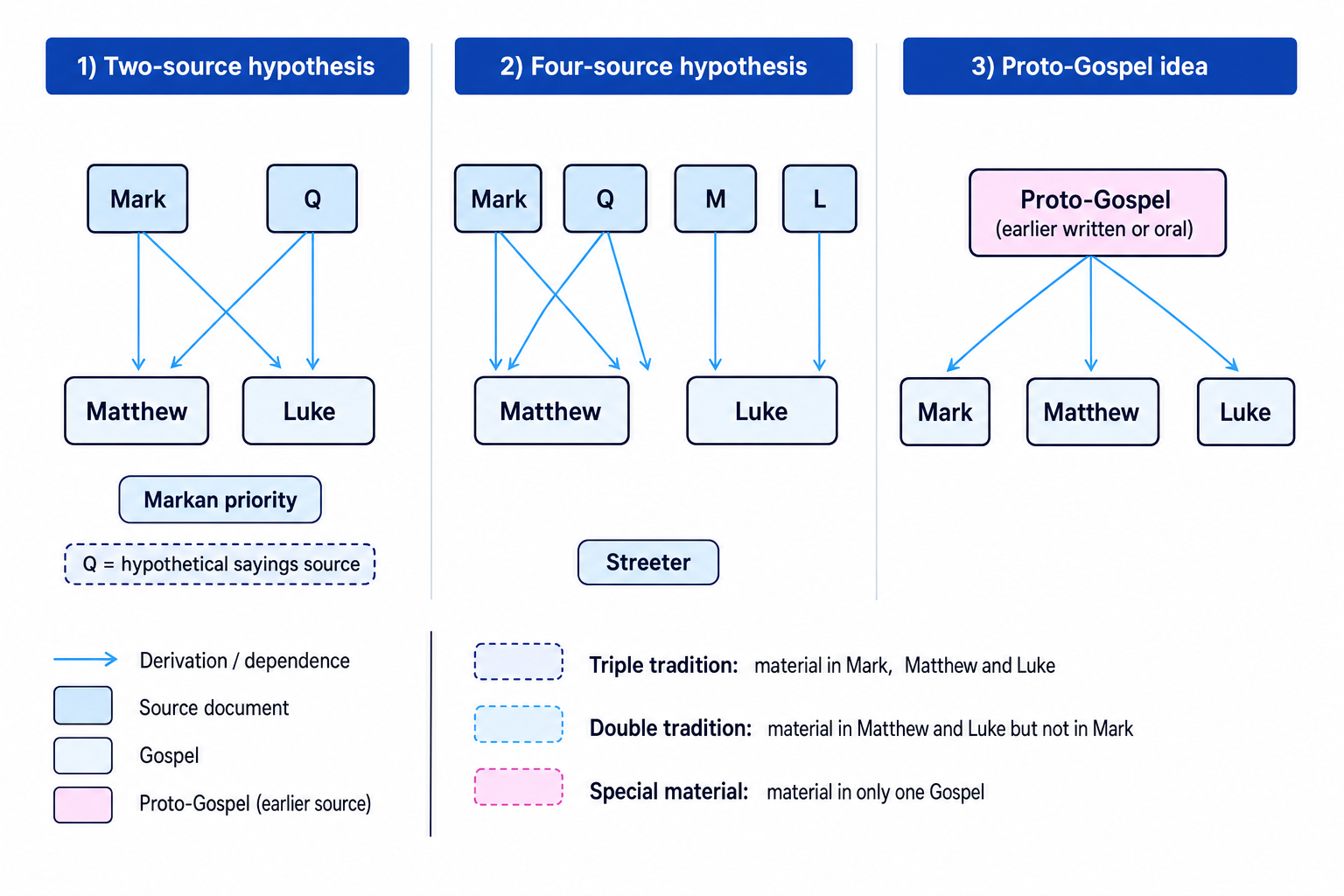
The two-source hypothesis says that Matthew and Luke used two main sources:
- Mark, especially for narrative structure.
- Q, a hypothetical sayings source used by Matthew and Luke.
Q comes from the German word Quelle, meaning “source”. It is used to explain the double tradition: sayings and teachings found in Matthew and Luke but not in Mark, such as versions of the Beatitudes and the Lord’s Prayer.
Scholars describe these relationships with models. The diagram puts the three main ideas from the specification side by side: the two-source hypothesis, Streeter’s four-source hypothesis, and the idea of earlier proto-Gospels.
Common Mistake
Treating Q as a discovered book
Q is hypothetical. No manuscript of Q has been found. It is a scholarly explanation for the shared Matthew-Luke material not found in Mark, not a physical book we can quote from directly.
Example
Explaining shared wording
Suppose Matthew and Luke contain a very similar saying of Jesus, but Mark does not contain it.
-
First, classify the material. Because it is in Matthew and Luke but not Mark, it belongs to the double tradition.
-
Next, ask what source relationship could explain it. Mark cannot be the direct source for this saying, because Mark does not contain it.
-
Under the two-source hypothesis, the most likely explanation is that Matthew and Luke both used Q for this saying.
-
Then evaluate the model. A supporter of Q says this explains shared wording neatly; a critic, such as Austin Farrer, argues that Luke may simply have used Matthew, making Q unnecessary.
Streeter and the four-source hypothesis
The four-source hypothesis is associated especially with B. H. Streeter. It develops the two-source hypothesis by adding two further sources:
- M: material special to Matthew.
- L: material special to Luke.
So, on Streeter’s model:
- Matthew used Mark, Q and M.
- Luke used Mark, Q and L.
This helps explain why Matthew and Luke contain distinctive material. For example, the Magi and the sheep and goats are special to Matthew, while the Good Samaritan and the Prodigal Son are special to Luke.
The strength of Streeter’s model is that it explains a lot of the data. Its weakness is that M and L can become labels for “whatever is unique”, rather than clearly identifiable documents.
Proto-Gospels
A proto-Gospel is an earlier Gospel-like source, either written or oral, which may have existed before the canonical Gospels.
This idea is partly encouraged by Luke 1:1–4, where Luke says that “many” had already attempted to write accounts before him. A proto-Gospel theory suggests that Matthew, Mark and Luke may have drawn on earlier collections of stories, sayings or narrative outlines.
Proto-Gospel theories are useful because they remind us that Gospel tradition did not begin with the final written texts. However, they can be hard to prove, because the proposed earlier documents usually no longer exist.
Form criticism: units of tradition
Form criticism studies the smaller units of tradition inside the Gospels. A unit of tradition, often called a pericope, is a self-contained passage, such as a healing story, a parable or a controversy story.
Form critics ask: what kind of passage is this, and how might it have been used in the early Christian community?
Important forms include:
- Parables: short stories or comparisons used to teach, often about the Kingdom of God.
- Miracle stories: accounts of healing, exorcism or power over nature.
- Pronouncement stories: short narratives that lead up to an important saying of Jesus.
- Controversy stories: disputes between Jesus and opponents, often about law, authority or purity.
- Passion narrative: the connected tradition about Jesus’ arrest, trial, crucifixion and death.
A key term here is Sitz im Leben, a German phrase meaning “setting in life”. It refers to the situation in the early Church where a tradition may have been used: preaching, worship, teaching converts, defending belief, or debating with opponents.
Rudolf Bultmann is a major figure in form criticism. He argued that Gospel traditions were shaped by the needs of early Christian communities. This is valuable because it takes oral tradition seriously, but it can be criticised if it becomes too sceptical about historical memory.
Example
Classifying a unit of tradition
Imagine a passage where a religious expert asks Jesus a question, Jesus tells a story, and the passage ends with a command such as “Go and do likewise.”
-
Identify the shape of the passage. It begins with a challenge or question and ends with a decisive teaching.
-
Notice the form inside the passage. The story Jesus tells functions as a parable, because it teaches through a narrative example.
-
Link form to purpose. The passage may have been preserved for teaching disciples how to live, not merely to record an interesting conversation.
Redaction criticism: the evangelists as editors and theologians
Redaction criticism studies how Gospel writers selected, arranged and edited their sources. A redactor is an editor, but in Gospel studies this does not mean “someone who merely cuts and pastes”. It means an author who shapes material to communicate a theological message.
This method treats Matthew, Mark and Luke as purposeful writers.
For example:
- Matthew often emphasises Jesus as the fulfilment of Jewish Scripture, the new Moses, and the teacher of righteousness.
- Mark often emphasises urgency, conflict, secrecy and the suffering Messiah.
- Luke often emphasises salvation for outsiders, concern for the poor, the work of the Holy Spirit and the universal scope of the Gospel.
Example
Interpreting Matthew and Luke’s beatitudes
Matthew has “Blessed are the poor in spirit”, while Luke has “Blessed are you who are poor.”
-
Compare the wording. Matthew’s version has a more spiritual or ethical phrase, while Luke’s version directly addresses materially poor people.
-
Relate this to each Gospel’s emphasis. Matthew often stresses righteousness and inner obedience; Luke often stresses social reversal and God’s concern for the marginalised.
-
Draw an interpretive conclusion. Redaction criticism suggests the difference is not random: each evangelist shapes inherited tradition to serve a theological purpose.
Common Mistake
Assuming editing means invention
Redaction does not automatically mean the evangelists “made things up”. It means they selected, arranged and emphasised material. Ancient writers could be faithful to tradition while still shaping it for purpose and audience.
Translation, editing and transmission
The Gospel tradition moved through several stages before reaching modern readers. Jesus and his first followers were in a mainly Jewish, Aramaic-speaking setting, while the Gospels were written in Greek. Translation means rendering words from one language into another. Transmission means passing material on, first orally and then through manuscripts.
The process is easiest to see as a chain: teaching and events, oral tradition, smaller units, possible written sources, Gospel redaction, manuscript copying and modern interpretation.
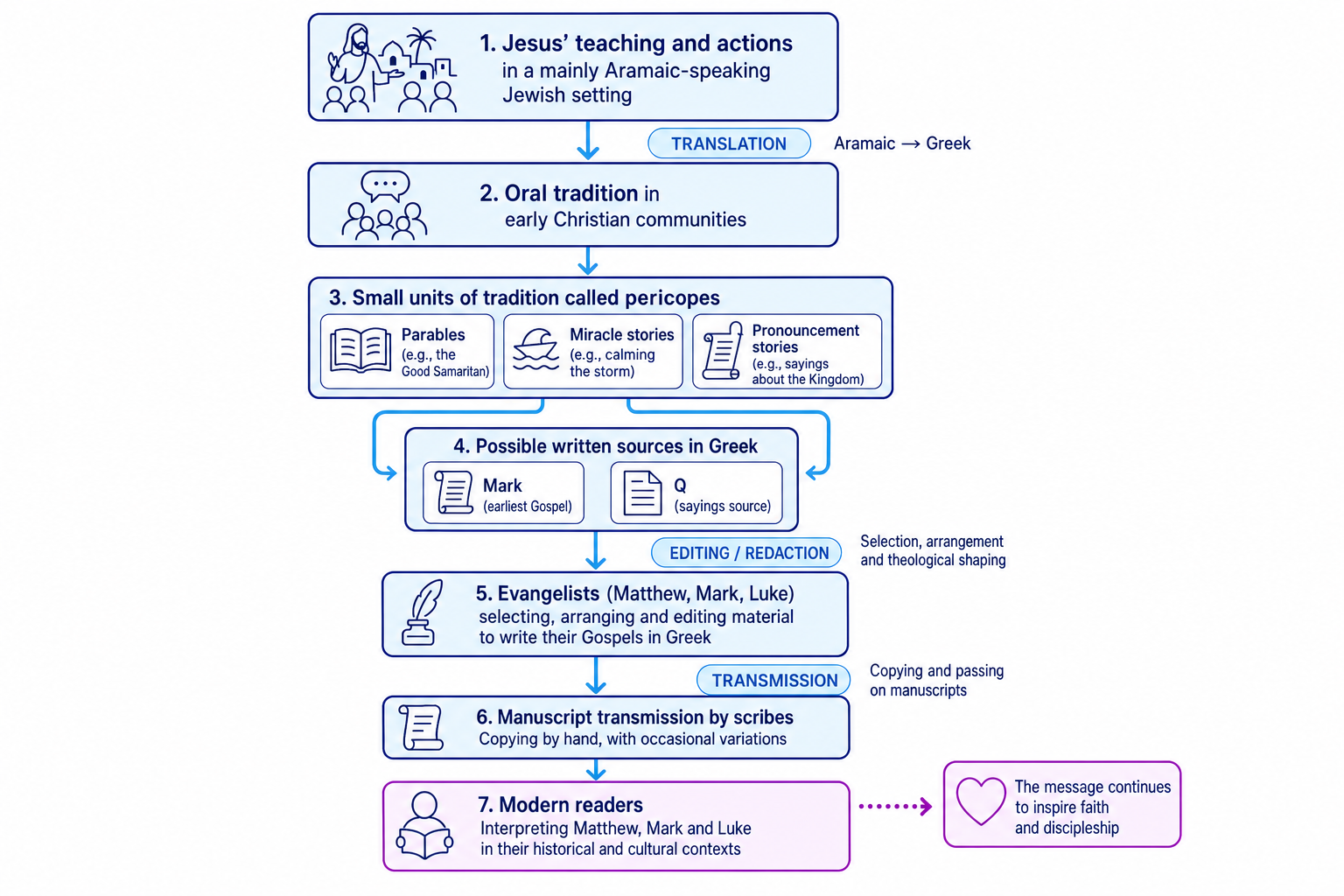
The Gospels sometimes preserve signs of translation. Mark, for instance, includes Aramaic expressions such as “Talitha koum” and then explains them for Greek-speaking readers. This suggests that traditions moved between languages and audiences.
Editing is also visible. Gospel writers arrange events differently, include explanations for their audiences, and emphasise different themes. Luke’s prologue explicitly says he has investigated earlier traditions and arranged an orderly account.
Transmission continued after the Gospels were written. The autographs, meaning the original written versions, no longer survive. What we have are manuscripts copied by hand. This does not make the text unusable, but it reminds you that interpretation involves historical judgement, not simplistic proof-texting.
Why this matters for understanding the texts
These methods matter because they change the way you read the Gospels.
First, they help you understand the relationship between the Synoptics. If Mark was used by Matthew and Luke, then similarities may show dependence, while differences may reveal theological editing.
Second, they clarify purpose. Matthew, Mark and Luke are not neutral biographies in the modern sense. They are theological narratives, written to proclaim Jesus and form communities of faith.
Third, they affect discussions of authorship. The traditional names Matthew, Mark and Luke remain important, but critical study focuses on what can be inferred from the texts: sources, audience, language, structure and theological aims.
Finally, they sharpen evaluation. Streeter’s four-source hypothesis explains much of the synoptic data, but it depends on hypothetical sources. Bultmann’s form criticism highlights community shaping, but may underestimate continuity of memory and eyewitness tradition. A strong essay recognises both the usefulness and limits of each method.
Key Idea
The big significance
Interpreting the text means reading the Gospels as both faith documents and ancient texts with histories of composition. The methods do not settle every question, but they give you disciplined ways to explain evidence.
Exam technique
In the exam
-
Start by defining the method or model you are using: source criticism, form criticism, redaction criticism, Markan priority, Q, M, L or proto-Gospel.
-
Use specific Gospel evidence, such as triple tradition, double tradition, special material, altered wording or distinctive theological emphasis.
-
Evaluate carefully: explain why a theory is persuasive, then acknowledge its limits, especially where sources like Q, M, L or proto-Gospels are hypothetical.
Self review
Check yourself
- What evidence supports Markan priority, and what problem is Q meant to solve?
- How is form criticism different from redaction criticism?
- Why does recognising translation, editing and transmission affect how you interpret Gospel differences?