Revision notes for Edexcel AS Level Religious Studies Scientific and historical-critical challenges – faith and history: the death and resurrection of Jesus in modern scholarship. Open the guide for explanations and worked examples. Written against the Edexcel AS Level Religious Studies specification, so the content matches what's examinable rather than general Religious Studies background.
Scientific and historical-critical challenges – faith and history: the death and resurrection of Jesus in modern scholarship
For Christians, the resurrection of Jesus Christ is not merely a comforting symbol; it is the cornerstone of the Christian faith. As St Paul wrote in 1 Corinthians 15:14, "If Christ has not been raised, our preaching is useless and so is your faith."
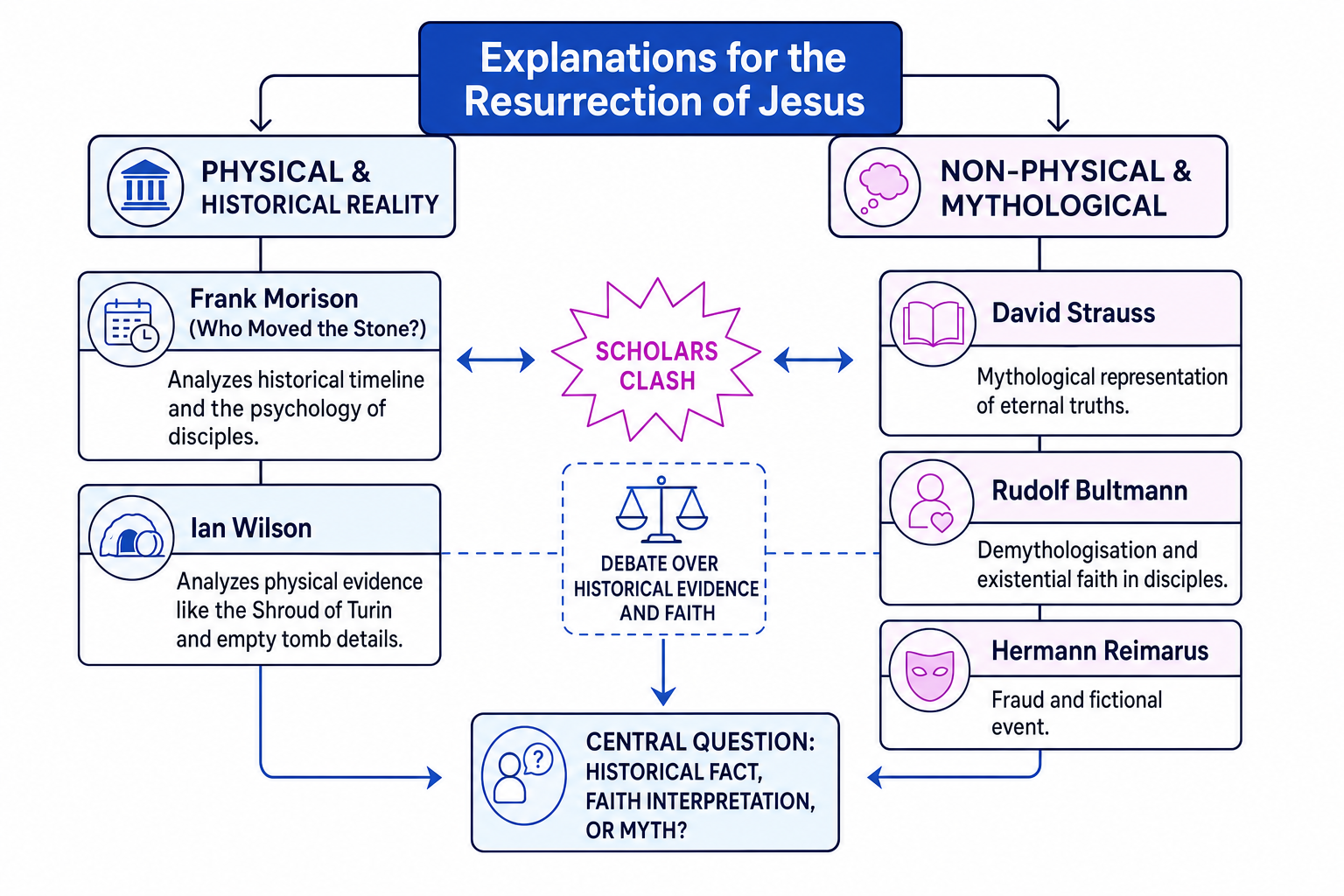
However, the rise of the scientific revolution and historical-critical scholarship in the modern era has presented deep challenges to the physical reality of this event. In this topic, we will explore the roots of these scientific challenges and analyze how modern scholars like Frank Morison and Ian Wilson have sought to defend the historical plausibility of the resurrection.
What you'll learn
By the end of these study notes, you will be able to:
- Explain the Enlightenment and scientific challenges to the resurrection as a miracle.
- Contrast the views of the resurrection as a fictional event, a myth, and a subjective experience of the disciples.
- Critically analyze the historical evidence presented by Frank Morison in Who Moved the Stone? (Anthology Extract 8).
- Critically analyze the scientific and historical evidence presented by Ian Wilson (Anthology Extract 9).
- Compare and evaluate the strengths and weaknesses of these views for New Testament study.
1. The Enlightenment and Scientific Challenges to Miracles
To understand modern scholarship on the resurrection, we must go back to the Enlightenment (the "Age of Reason" in the 17th and 18th centuries). During this period, thinkers began to prioritize human reason, empirical observation, and scientific laws over religious dogma and the authority of scripture.
Definition
Historical-Critical Method
A branch of literary and historical analysis that investigates the origins of ancient texts to understand 'the world behind the text'—their historical context, authorship, sources, and the literal meaning intended by the original authors, rather than accepting them as unmediated divine revelation.
The scientific worldview views the universe as a closed system of cause and effect governed by unbreakable natural laws. From this perspective, a physical resurrection—where a dead human body, undergoing decomposition, returns to biological life with eternal properties—is a scientific impossibility. This led Enlightenment and post-Enlightenment thinkers to propose alternative explanations for the Gospel accounts:
A. The Resurrection as a Fictional Event (Fraud/Deception)
Early Enlightenment sceptics like Hermann Samuel Reimarus (1694–1768) argued that the resurrection was a deliberate hoax. Reimarus asserted that Jesus was a political messiah who failed. Following his death, his grieving, embarrassed disciples stole his body from the tomb and fabricated the story of the resurrection to maintain their religious movement and secure prestige.
B. The Resurrection as Myth
In the 19th and 20th centuries, scholars shifted from accusing the disciples of fraud to viewing the resurrection as a product of myth-making.
- David Friedrich Strauss (1808–1874) argued in The Life of Jesus Critically Examined that the resurrection accounts were "myths." By myth, Strauss did not mean a "lie," but rather a poetic, imaginative expression of religious ideas. The early Church, steeped in Jewish messianic expectations, unconsciously generated these stories to express their belief that Jesus' spiritual influence lived on.
- Rudolf Bultmann (1884–1976) famously argued for demythologisation. He asserted that the New Testament is wrapped in an ancient, unscientific cosmology (a three-tiered universe of heaven, earth, and hell, populated by supernatural forces). To make the Gospel meaningful for modern scientific minds, we must strip away this mythological outer shell to find the existential truth (the kerygma). For Bultmann, the resurrection is not a historical event of an empty tomb, but an event in the subjective experience of the disciples, whose faith was renewed.
C. The Resurrection as an Event in the Experience of the Disciples (Grief Hallucinations)
Modern sceptics like Gerd Lüdemann argue that the resurrection appearances can be explained psychologically. Under extreme grief and cognitive dissonance (the shock of their Messiah dying), disciples like Peter and Paul experienced subjective, auditory and visual hallucinations. Over time, these intensely real psychological visions were externalized and historicized into the physical resurrection stories we read in the Gospels.
Key Idea
The Enlightenment Shift
Before the Enlightenment, scripture was treated as divinely inspired historical fact. Post-Enlightenment, the scientific impossibility of miracles forced scholars to choose between rejecting the resurrection as a fraud, interpreting it as an existential myth, or explaining it away psychologically.
2. Frank Morison: Who Moved the Stone? (Extract 8)
Frank Morison (the pen name of Albert Henry Ross, 1881–1950) was a British advertising agent and journalist. Influenced by the scientific scepticism of his age, he set out to write a book that would thoroughly disprove the physical resurrection of Jesus, stripping it of its miraculous elements.
However, as he deeply analyzed the historical timeline of the last days of Jesus, his mind changed. He concluded that the physical resurrection was the only explanation that fit the historical data. The resulting book, Who Moved the Stone? (1930), became a classic of Christian apologetics.
Morison’s Key Arguments:
Morison uses a legal, forensic approach to the Gospel texts, analyzing the details like a detective examining a crime scene:
- The Timeline of the Trial: Morison argues that the rapid, late-night arrest and trial of Jesus before the Sanhedrin (the Jewish high council) bears the stamp of historical authenticity. The Jewish authorities had to act quickly and secretly before the crowds of Passover pilgrims could riot. This psychological urgency is highly realistic and points to reliable historical testimony.
- The "Stone" and the Tomb: The physical details of the tomb are central. The stone blocking the entrance was immensely heavy, requiring several men to roll it up an incline. Morison argues that it is highly improbable that the Roman guards or the terrified, fleeing disciples could have moved it silently in the night.
- The Psychology of the Disciples: Morison focuses heavily on the transformation of the disciples. On Good Friday, they were terrified, hiding, and despairing. Yet, within weeks, they were boldly preaching the resurrection in Jerusalem—the very city where Jesus was executed—facing persecution and death. Morison argues that psychological hallucinations or a conscious lie (theft) cannot account for such a radical, permanent psychological shift.
- The Witness of James and Paul: Morison notes that sceptics like James (Jesus' brother) and Saul of Tarsus (a fierce persecutor of the early Church) suddenly converted. Only a real, objective encounter with the risen Jesus can explain these sudden conversions.
Tip
Focus on Morison's Methodology
In your essays, emphasize that Morison is not starting with the theological assumption that the Bible is the inspired word of God. His methodology is historical-critical; he treats the Gospels as secular historical documents and tests them for internal coherence and psychological plausibility.
3. Ian Wilson: Physical and Historical Evidence (Extract 9)
While Morison focused on the literary and psychological evidence of the Gospels, Ian Wilson (born 1941), a modern British historian and writer, focuses on both the literary relationships of the Gospel narratives and the physical/archaeological evidence associated with Jesus' death and burial.
Wilson's Key Arguments:
- Analysis of Gospel Narratives: Wilson recognizes that the four Gospels contain differences and apparent contradictions (e.g., the number of women at the tomb, the location of the appearances). Rather than seeing this as proof of fabrication, Wilson argues that these inconsistencies are exactly what we expect from genuine, independent eyewitness testimonies. If the early Church had fabricated the resurrection, they would have carefully synchronized the accounts to avoid discrepancy. The raw, unpolished nature of the narratives points to their authenticity.
- The Physical Nature of the Crucifixion: Wilson examines the scientific reality of Roman crucifixion. He argues that Jesus must have been genuinely dead when taken down from the cross. The "Swoon Theory" (that Jesus merely fainted, woke up in the cool tomb, and escaped) is physically impossible given the trauma of the Roman scourging, blood loss, and asphyxiation on the cross.
- The Shroud of Turin: Wilson is famous for his extensive research into the Shroud of Turin—a linen cloth bearing the negative image of a crucified man, which many believe to be the burial shroud of Jesus. Wilson has used scientific analysis of the shroud (such as blood stain patterns, pollen samples from Palestine, and the unique three-dimensional properties of the image) to argue that it is a genuine first-century artifact. He suggests that the mysterious image on the shroud was caused by a brief, intense burst of radiation at the moment of resurrection, leaving a physical "photograph" of the event.
Common Mistake
Confusing the Shroud's Status
Do not write that the Shroud of Turin is universally accepted as proof of the resurrection. It remains highly controversial, especially after 1988 radiocarbon dating placed its origin in the medieval period (though Wilson and other 'sindonologists' dispute the validity of those specific tests). Always present the scientific debate with AO2 balance.
4. Worked Example: Evaluating the "Theft Theory"
When writing an AO2 essay, you must be able to evaluate specific alternative explanations for the resurrection using the historical-critical standards of Morison and Wilson. Let's walk through an evaluation of the Theft Theory (that the disciples stole the body).
Example
Evaluating the Theft Theory of the Resurrection
-
State the hypothesis: The Theft Theory (originating with Reimarus) posits that Jesus' disciples secretly removed his body from the tomb of Joseph of Arimathea and lied to the public, claiming he had risen from the dead.
-
Apply historical and situational criteria (using Morison): Evaluate the physical plausibility. The tomb was sealed with a massive stone and guarded by a Roman detachment (custodia). It is highly improbable that a small, panicked group of disciples—who had fled at Jesus' arrest—could have overpowered Roman soldiers and rolled away a giant stone without alerting anyone in the quiet Passover night.
-
Apply psychological criteria (using Morison and Wilson): Evaluate the plausibility of the disciples' subsequent behavior. Men do not willingly die for what they know to be a lie. Nearly all of the disciples faced martyrdom (e.g., Peter was crucified upside down, James was stoned). If they had stolen the body, at least one would likely have confessed under torture. Their unwavering willingness to die proves they sincerely believed they had seen the risen Christ.
-
Reach a justified conclusion: The Theft Theory is historically and psychologically unsustainable. It fails to account for the secure tomb conditions and cannot explain the radical psychological transformation of the disciples from cowards to martyrs. Therefore, the theory has extremely weak explanatory power compared to the hypothesis of a real, objective event.
5. Scholar Comparison: Morison vs. Wilson
For Edexcel Paper 3, you must compare and contrast the arguments of your named scholars. Use this comparison table to help structure your AO2 evaluative paragraphs:
| Feature | Frank Morison (Who Moved the Stone?) | Ian Wilson (Jesus: The Evidence) |
|---|---|---|
| Primary Method | Literary, legal, and psychological analysis of the Gospel narratives. | Historical-critical source analysis combined with physical/scientific evidence. |
| Key Evidence | The psychology of the disciples, the trial timeline, the conversion of sceptics (Paul, James). | The discrepancies in Gospel accounts as proof of authentic eyewitnesses; the Shroud of Turin. |
| Response to Sceptics | Disproves fraud/theft by showing the logical and psychological impossibility of a conspiracy. | Disproves swoon and myth theories by pointing to the medical reality of crucifixion and physical artifacts. |
| Major Strength | Highly persuasive logical and psychological deconstruction of human behavior and motives. | Integrates modern forensic science, archaeology, and historical-critical text evaluation. |
| Major Weakness | Relies heavily on the historical accuracy of details in the Gospels (e.g., assuming Roman guards were present, which some historical critics dispute). | The Shroud of Turin is highly contested and controversial; relying on it can weaken his historical case if the shroud is proven a medieval forgery. |
Common Mistake
Watch out for Circular Arguments
A common mistake in essays is arguing: "The resurrection must have happened because the Bible says so." This is a circular, theological argument that will not gain marks in a historical-critical essay. Instead, argue like Morison and Wilson: analyze the texts as historical documents and evaluate whether the physical/psychological data within them makes the resurrection the most plausible explanation.
Exam technique
In the exam
- Address the Anthology directly: Refer explicitly to Morison's forensic analysis of the stone and the disciples' psychology (Extract 8), and Wilson's focus on historical-critical Gospel evaluation and physical evidence (Extract 9).
- Balance AO1 and AO2: Do not just retell Morison's story or explain what the Shroud of Turin is. You must evaluate why their arguments are convincing or unconvincing. Use phrases like: "A major strength of Morison’s thesis is..." or "However, modern historical critics object to Wilson’s reliance on..."
- Engage with Enlightenment critics: Contrast Morison and Wilson with Bultmann (demythologisation) or Lüdemann (hallucination). A high-level essay will show how Morison and Wilson are direct counter-arguments to these non-physical theories.
- Conclude with a clear judgment: Decide which scholar offers the more robust defence. For instance, you could argue that Morison's psychological arguments remain powerful even if one rejects Wilson's controversial physical evidence (the Shroud).
Self review
Check yourself
- Why did the Enlightenment cause scholars to reject the physical resurrection of Jesus?
- What is Rudolf Bultmann's concept of "demythologisation" and how does it explain the resurrection?
- Why did Frank Morison conclude that the "Theft Theory" was psychologically impossible for the disciples?
- How does Ian Wilson interpret the differences and contradictions between the different Gospel resurrection accounts?