Revision notes for Edexcel AS Level Religious Studies Social and historical developments including challenges and responses. Open the guide for explanations and worked examples. Written against the Edexcel AS Level Religious Studies specification, so the content matches what's examinable rather than general Religious Studies background.
Social and historical developments including challenges and responses
What you'll learn
- How modern Hindu movements developed under colonial rule, missionary critique, Islamic influence, secularisation and science.
- The key emphases of Brahmo Samaj, Neo-Vedanta, Ramakrishna Mission, Arya Samaj and Hindutva.
- How figures such as Ram Mohan Roy, Sri Ramakrishna, Dayananda Saraswati and Mahatma Gandhi shaped Hinduism in India and worldwide.
- How to evaluate debates about Hindu “renaissance”, nationalism, tolerance and Hinduism as a world religion.
The modern context: why did Hindu movements develop?
From the eighteenth to twentieth centuries, India experienced major political, intellectual and social change. Much of India came under British colonial rule, meaning rule by a foreign imperial power. This created pressure on Hindu traditions through law, education, missionary activity, census categories and Western ideas of “religion”.
Definition
Secularisation
Secularisation is the process by which religion loses social authority or becomes separated from public institutions such as government, education and law.
Christian missionaries criticised practices such as sati — widow self-immolation, later legally abolished in 1829 — caste hierarchy, child marriage and image worship. Islamic influence was also important because India had long histories of Muslim rule, Sufi interaction, Hindu-Muslim devotional exchange and later communal tension. Modern Hindu reformers therefore had to decide whether to defend tradition, reform it, reinterpret it, or mobilise it politically.
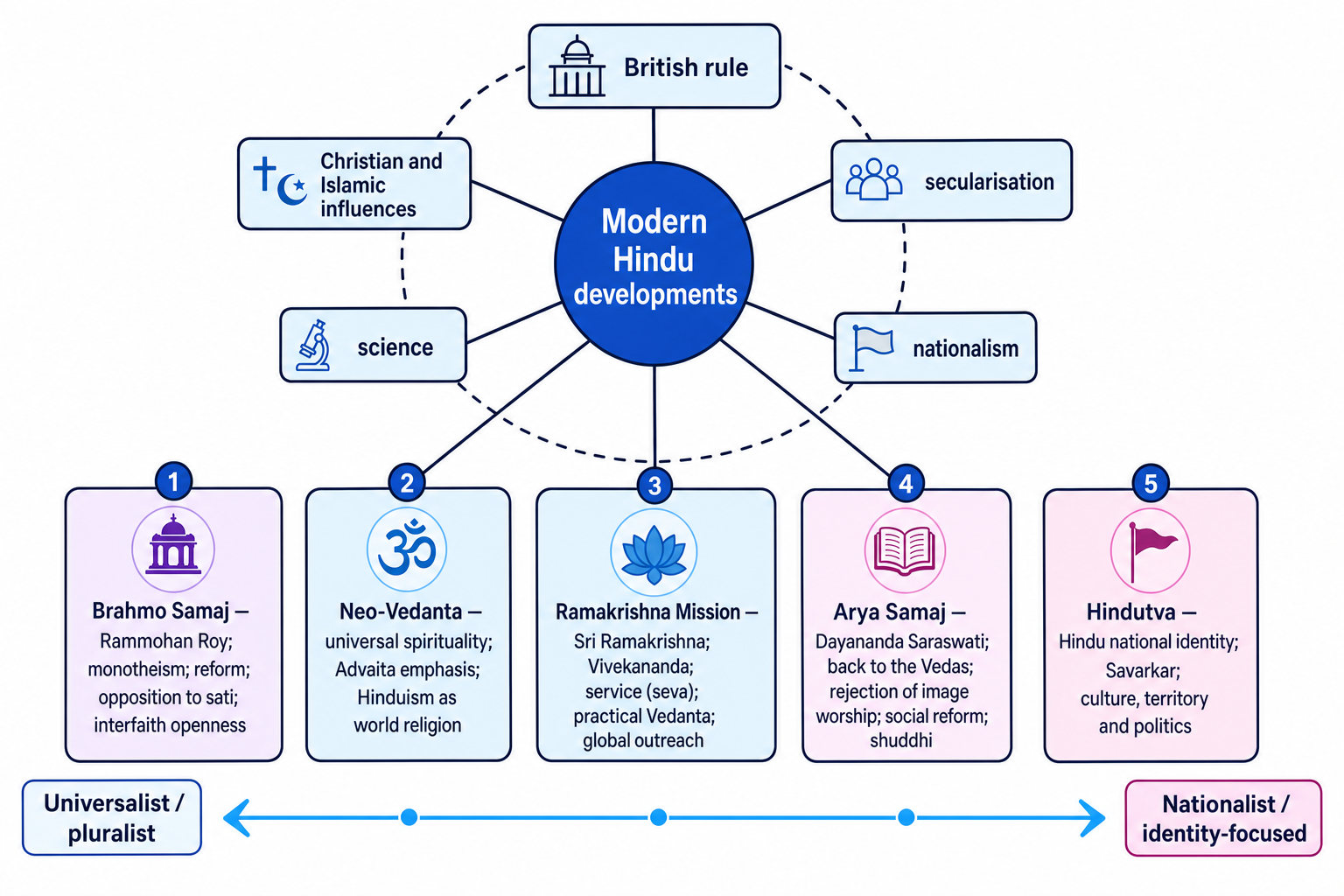
A useful way to see this topic is as a set of different Hindu responses to modernity.
Key Idea
Modern Hinduism is not one response
Modern Hindu developments include liberal reform, universal spirituality, social service, Vedic revivalism and Hindu nationalism. In essays, avoid treating “modern Hinduism” as if it means only one movement.
Brahmo Samaj and Ram Mohan Roy
Brahmo Samaj was a nineteenth-century reform movement founded in Bengal by Ram Mohan Roy in 1828. It emphasised belief in one supreme God, criticised image worship, and drew on the Upanishads, which are philosophical Hindu texts concerned with ultimate reality, the self and liberation.
Roy was influenced by Hindu scripture, Islamic monotheism and Christian Unitarian ideas. He admired the ethical teachings of Jesus but rejected doctrines such as the Trinity. Socially, he campaigned against sati and supported women’s education, rational debate and social reform.
This movement matters because it presented Hinduism as morally serious, rational and compatible with modern education. It also helped shape a new public idea of Hinduism as a reformable “religion” rather than just a loose collection of local practices.
Common Mistake
Making Roy simply Westernised
Roy was influenced by Western and Christian ideas, but he did not simply copy them. He argued from Hindu sources, especially the Upanishads, to reform Hindu society from within.
Neo-Vedanta: Hinduism as universal spirituality
Definition
Neo-Vedanta
Neo-Vedanta is a modern reinterpretation of Vedanta, especially Advaita Vedanta, presenting Hinduism as a universal, rational and tolerant spiritual tradition.
Advaita Vedanta is a non-dual Hindu philosophical tradition associated with Śaṅkara. It teaches that the deepest self, ātman, is ultimately identical with Brahman, the ultimate reality.
Neo-Vedanta became especially influential through Swami Vivekananda, the disciple of Sri Ramakrishna, who spoke at the World’s Parliament of Religions in Chicago in 1893. Vivekananda presented Hinduism as a world religion of tolerance, inner experience and spiritual unity. He also argued that religion should be practical: not just ritual, but service, discipline and transformation.
Neo-Vedanta helped Hinduism gain global recognition, especially through yoga, meditation, Vedanta societies and interfaith dialogue. However, critics argue that it can over-simplify Hindu diversity by making Vedanta appear to be the “essence” of all Hinduism.
Sri Ramakrishna and the Ramakrishna Mission
Sri Ramakrishna was a Bengali mystic associated with devotion to Kālī, a form of the Goddess. He is famous for practising different religious paths, including Hindu, Islamic and Christian disciplines, and for the idea often summarised as “as many faiths, so many paths”.
The Ramakrishna Mission, founded by Vivekananda in 1897, translated Ramakrishna’s spirituality into organised social service. Its motto is often expressed as working “for one’s own liberation and for the welfare of the world”. It runs schools, hospitals, relief work and global Vedanta centres.
Definition
Seva
Seva means selfless service. In the Ramakrishna Mission, serving human beings is understood as a way of serving God.
This matters for political and social systems because it challenged the idea that Hindu renunciation means withdrawal from society. Instead, service, education and healthcare became religious duties.
Arya Samaj and Dayananda Saraswati
Arya Samaj was founded by Dayananda Saraswati in 1875. Its slogan-like emphasis was a return to the Vedas, the oldest and most authoritative Hindu scriptures for Dayananda. He rejected image worship, pilgrimage, priestly corruption and later Purāṇic mythology, claiming that true Hinduism was rational, ethical and Vedic.
Dayananda supported social reform, including women’s education and opposition to caste by birth, though he accepted a form of varna based on qualities and conduct. Arya Samaj also developed shuddhi, a reconversion or purification movement bringing people back into the Hindu fold.
Its influence is mixed. On one hand, it promoted education, reform and confidence under colonial pressure. On the other, its sharp criticism of Christianity, Islam and some Hindu practices could strengthen religious boundaries and communal identity.
Tip
Arya Samaj in one sentence
Dayananda’s Arya Samaj is best remembered as Vedic revival plus social reform, not simply “traditional Hinduism”.
Hindutva: Hinduism and nationalism
Definition
Hindutva
Hindutva means “Hinduness” and refers to a cultural-political ideology that defines India primarily through Hindu civilisation, identity and national belonging.
Hindutva is associated especially with V. D. Savarkar, who argued that Hindu identity is not only religious but also cultural and territorial. In this view, India is the fatherland and holy land of Hindus. Later organisations such as the RSS, VHP and BJP have been linked in different ways to Hindutva politics.
Supporters argue that Hindutva gives Hindus unity after centuries of foreign rule and protects Hindu culture in a secular democratic state. Critics argue that it can marginalise Muslims, Christians and other minorities, and that it narrows Hinduism into a political identity rather than a diverse religious family.
Example
Comparing Neo-Vedanta and Hindutva
-
Start by identifying their different centres of gravity: Neo-Vedanta focuses on universal spiritual truth, while Hindutva focuses on national and cultural identity.
-
Apply evidence: Vivekananda presents Hinduism as globally valid and tolerant; Savarkar presents Hindu identity through shared civilisation, territory and national belonging.
-
Add nuance: both are modern responses to colonial pressure and both try to strengthen Hindu confidence, so they are not simply “modern” versus “ancient”.
-
Make a judgement: Neo-Vedanta is more useful for essays on interfaith and Hinduism as a world religion, while Hindutva is more useful for essays on nationalism, politics and contested identity.
Gandhi: non-violence, swaraj and pluralism
Mahatma Gandhi was central to Indian nationalism, but his nationalism was not the same as Hindutva. His politics were deeply religious, drawing on the Bhagavad Gītā, Jain and Hindu ideas of ahimsa, Christian ethics, and interfaith respect.
Definition
Ahimsa and swaraj
Ahimsa means non-violence or non-harm. Swaraj means self-rule, both as political independence and as personal moral self-discipline.
Gandhi developed satyagraha, meaning “truth-force” or non-violent resistance. This was not passive weakness: it involved disciplined civil disobedience, willingness to suffer, and refusal to dehumanise the opponent.
Gandhi’s influence extended far beyond Hinduism and India, shaping later non-violent movements such as the American Civil Rights movement. His interfaith approach supported tolerance and pluralism. However, evaluation should be balanced: critics argue that non-violence may not work against all forms of oppression, and Gandhi’s views on caste and village life remain contested.
Hinduism, science, astronomy and medicine
Modern Hindu movements also responded to science. In astronomy, modern scientific models challenged literal readings of mythic or Purāṇic cosmology. Some Hindus highlighted India’s historical achievements in astronomy and mathematics, while others interpreted Hindu cosmological cycles symbolically rather than literally.
In medicine, Hindu traditions include Ayurveda, a traditional system of health and healing. Modern Hindus may value Ayurveda’s holistic view of body, diet and balance, while also accepting evidence-based medicine, hospitals and public health. The Ramakrishna Mission’s medical work is a strong example of Hindu service using modern institutions.
Common Mistake
Do not overclaim science
It is weak evaluation to say “the Vedas already contain all modern science”. A stronger answer distinguishes between genuine historical Indian learning, symbolic religious cosmology, and modern scientific method.
Hindu renaissance and the idea of “Hinduism”
Some writers describe these developments as a Hindu renaissance, meaning a revival or renewal of Hindu confidence, learning and public influence. There is truth in this: reformers challenged social abuses, defended Hindu traditions, engaged globally and helped Hinduism become recognised as a world religion.
But the term is debated. “Hinduism” itself is complex. Unlike Christianity or Islam, Hinduism has no single founder, central creed or one universally binding scripture. It includes Vaiṣṇava, Śaiva, Śākta, Smārta, devotional, philosophical, local and caste-based traditions. Colonial census categories, law and education helped turn this diversity into a more unified public identity.
Example
Judging the claim of Hindu renaissance
-
Test the positive case: Roy, Vivekananda, Dayananda and Gandhi all renewed Hindu confidence by reforming social practice, defending scripture and engaging modern politics.
-
Test the critical case: the “renaissance” often reflected urban, educated and upper-caste voices, so it could marginalise local, folk, women’s and Dalit perspectives.
-
Weigh the concept of Hinduism: modern movements helped Hinduism function as a world religion, but they sometimes achieved this by simplifying its internal diversity.
-
Reach a balanced judgement: “renaissance” is useful if it means creative renewal, but misleading if it implies one single Hindu essence was simply recovered unchanged.
Bringing it together for essays
The strongest essays compare movements rather than listing them. For example, Roy and Dayananda both wanted reform, but Roy looked to monotheistic, ethical and interfaith dialogue, while Dayananda insisted on Vedic authority. Ramakrishna and Vivekananda support pluralism and global Hindu identity, while Hindutva uses Hindu identity for national politics. Gandhi offers a distinctive bridge: religiously Hindu, politically anti-colonial, but committed to interfaith non-violence.
Key Idea
The central debate
Modern Hindu movements can be read either as a confident renewal of Hindu tradition or as a reshaping of Hinduism under colonial, scientific and nationalist pressure. A top answer usually argues that both are partly true.
Exam technique
In the exam
-
Compare at least two movements directly: for example, Neo-Vedanta versus Hindutva, or Brahmo Samaj versus Arya Samaj.
-
Use named figures accurately: Roy for reformist monotheism, Ramakrishna for plural religious experience, Dayananda for Vedic revival, and Gandhi for ahimsa and swaraj.
-
Build a judgement around tension: universalism versus nationalism, reform versus revival, tolerance versus identity, and world religion versus internal diversity.
Self review
Check yourself
- Why might Neo-Vedanta be seen as both a global success and an oversimplification of Hinduism?
- How are Gandhi’s nationalism and Hindutva different?
- In what ways did colonial rule help create the modern idea of “Hinduism”?