Revision notes for Edexcel AS Level Religious Studies Works of scholars. Open the guide for explanations and worked examples. Written against the Edexcel AS Level Religious Studies specification, so the content matches what's examinable rather than general Religious Studies background.
Works of scholars
What you'll learn
- How Shankara and Ramanuja fit into the wider Vedanta tradition.
- Their key beliefs about atman, Brahman, samsara, moksha and dharma.
- Why their disagreement about bhakti and the Bhagavad Gita is so important.
- How to use P. Bowes and J. Hopkins in evaluative essay answers.
The big picture: one tradition, two powerful readings
This topic is about two major Hindu thinkers: Shankara and Ramanuja. Both interpret the same core Vedanta texts, but they reach very different conclusions about God, the self, the world and liberation.
Definition
Vedanta
Vedanta means “the end of the Veda”. It refers both to the final parts of the Vedas, especially the Upanishads, and to the philosophical schools that interpret them.
Edexcel wants you to compare their contexts, sources, key beliefs, influence, and the strengths and weaknesses of their ideas for understanding Hinduism. You should also connect this comparison to the modern scholars P. Bowes and J. Hopkins, whose work helps frame the debate philosophically and historically.
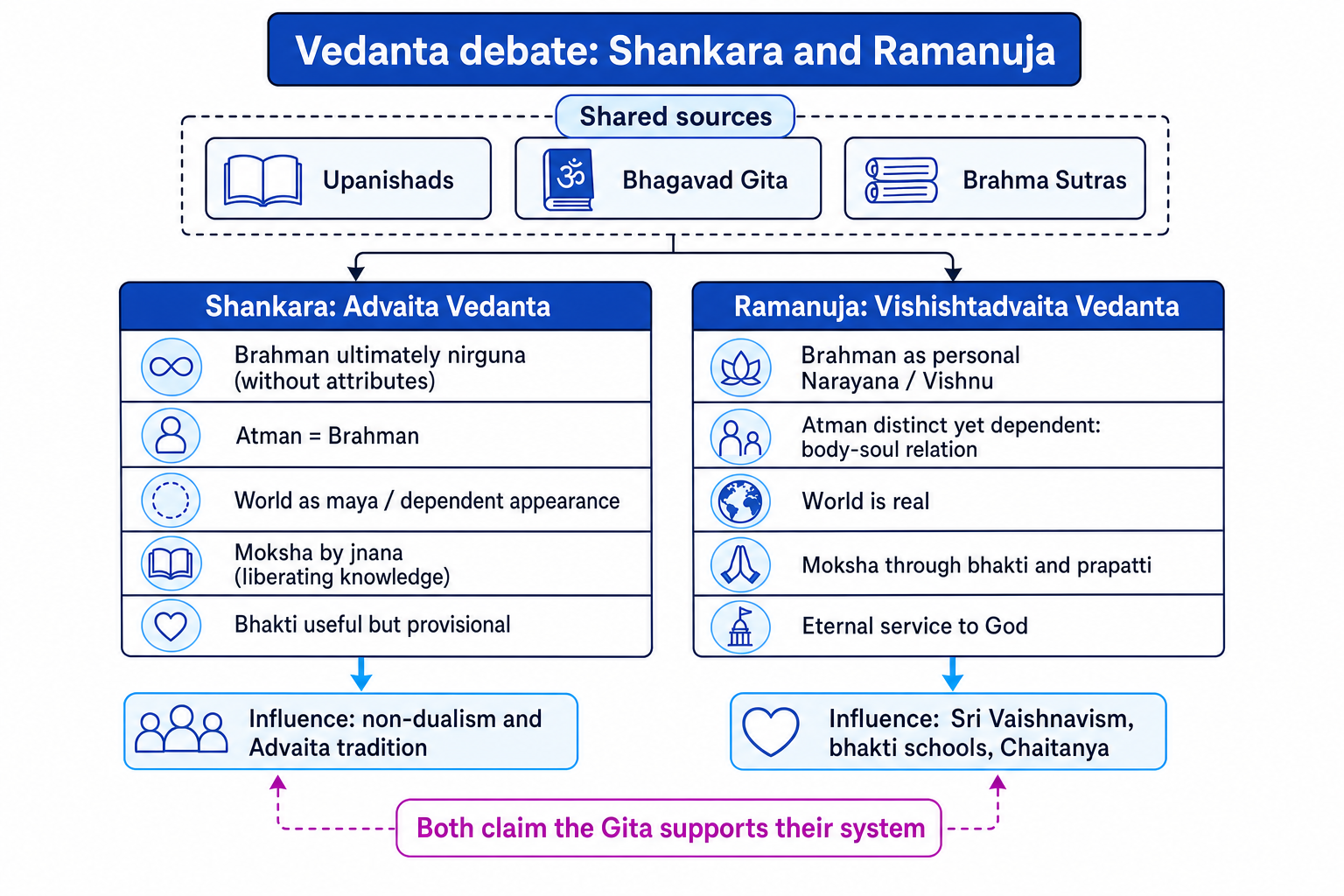
Their contexts in Vedanta
Shankara: Advaita Vedanta
Shankara is usually dated to the eighth century CE. He is associated with Advaita Vedanta, the “not-two” school of Vedanta.
Definition
Advaita
Advaita means “non-dualism”: the view that, at the deepest level, reality is not divided into separate things such as God, soul and world.
Shankara wrote commentaries on the Upanishads, the Bhagavad Gita and the Brahma Sutras. His context included debates with Buddhist thinkers, ritualist schools and other Hindu philosophical systems. He presents Hinduism as a rigorous philosophical tradition centred on liberating knowledge.
Ramanuja: Vishishtadvaita Vedanta
Ramanuja lived in the eleventh to twelfth centuries CE and is linked with Sri Vaishnavism, a devotional tradition focused on Vishnu or Narayana.
Definition
Vishishtadvaita
Vishishtadvaita means “qualified non-dualism”: there is one ultimate reality, Brahman, but Brahman is “qualified” by real souls and the real world.
Ramanuja also wrote major commentaries, including the Sri Bhashya on the Brahma Sutras and a commentary on the Bhagavad Gita. His context was strongly shaped by temple worship, devotional poetry and the bhakti tradition.
Key Idea
Same texts, different Hinduism
Shankara and Ramanuja both claim to be faithful Vedanta interpreters. The disagreement is not about whether the texts matter, but about what those texts ultimately mean.
Sources that influenced them
The main shared source-base is the prasthana-trayi, the “threefold foundation” of Vedanta:
- Upanishads — philosophical texts exploring Brahman, atman and ultimate reality.
- Bhagavad Gita — a dialogue between Krishna and Arjuna about duty, devotion and liberation.
- Brahma Sutras — short aphorisms systematising Vedanta teaching.
Shankara is especially influenced by Upanishadic statements such as “tat tvam asi” — “That you are” — which he reads as teaching the identity of the self with Brahman.
Ramanuja accepts the same texts but reads them through a Vaishnava devotional lens. He is also influenced by the Alvars, Tamil poet-saints devoted to Vishnu, and by earlier Sri Vaishnava teachers such as Yamuna.
Key beliefs compared
Atman and Brahman
Definition
Atman and Brahman
Atman means the true self or soul. Brahman means ultimate reality. In Vedanta, the central question is how atman and Brahman relate.
For Shankara, the deepest truth is that atman is Brahman. The individual self only appears separate because of avidya, meaning ignorance. Liberation comes when this ignorance is removed.
For Ramanuja, the individual self is real and distinct, but totally dependent on Brahman. The self is not identical with God. It belongs to God, lives through God and finds fulfilment in loving service to God.
Brahman: with or without attributes?
Shankara distinguishes between:
- Nirguna Brahman — Brahman “without qualities” or beyond all attributes.
- Saguna Brahman — Brahman “with qualities”, experienced as a personal God.
For Shankara, saguna Brahman is valid at the ordinary religious level, but nirguna Brahman is the highest truth.
Ramanuja rejects this hierarchy. For him, Brahman really is personal, full of perfect qualities, and identified with Narayana or Vishnu. God’s attributes are not lower-level appearances; they are eternally real.
Common Mistake
Maya does not mean nothing exists
For Shankara, maya is not simple non-existence. The world is experienced and matters at the empirical level, but it is not ultimately independent of Brahman.
Example
Comparing Brahman in an essay
-
Begin with the shared point: both thinkers accept Brahman as ultimate reality and both appeal to Vedanta scripture.
-
Then identify the key difference: Shankara prioritises nirguna Brahman, while Ramanuja argues that Brahman is truly personal and possesses real divine qualities.
-
Draw out the consequence: Shankara’s view supports non-dual liberation through knowledge; Ramanuja’s view supports lasting devotion and relationship with God.
Samsara, moksha and dharma
Definition
Samsara, moksha and dharma
Samsara is the cycle of birth, death and rebirth. Moksha is liberation from that cycle. Dharma means duty, righteousness and the moral order that sustains life.
For Shankara, samsara continues because people mistake the temporary self and world for ultimate reality. Moksha is the realisation that the true self is not separate from Brahman. This is achieved through jnana, meaning liberating knowledge.
For Ramanuja, samsara is real bondage affecting real individual souls. Moksha is not absorption into an impersonal absolute. It is release into the presence of God, where the soul enjoys eternal service and bliss.
Dharma is also treated differently. Shankara sees dharma and ritual action as useful for purifying the mind, but not as the direct cause of moksha. Ramanuja gives dharma a more positive devotional role: right action can become service to God.
Bhakti: the radical difference
Definition
Bhakti
Bhakti means loving devotion to a personal God. In many Hindu traditions, it includes worship, prayer, surrender, chanting and emotional attachment to the deity.
For Shankara, bhakti has value, but it is ultimately inferior to knowledge of absolute unity. Devotion belongs to the level where worshipper and God still seem separate. Once the truth of non-duality is realised, that separation is overcome.
This shows Shankara’s clear commitment to monism, the belief that there is ultimately one reality.
For Ramanuja, bhakti is not a lower stage to be left behind. It is central to the path of liberation. The soul becomes God-like in freedom and bliss, but it does not become God. It remains personally related to God.
Common Mistake
Do not erase Ramanuja’s personal relationship
Ramanuja does not teach that the liberated soul loses all relationship with God. His whole system protects the reality of personal devotion, dependence and service.
Ramanuja also emphasises prapatti, meaning surrender to God’s grace. This makes liberation depend not only on human effort but on divine compassion.
The Bhagavad Gita: both claim support
Both thinkers claim the Bhagavad Gita supports their own system.
Shankara reads the Gita as ultimately teaching renunciation, knowledge and freedom from ignorance. Karma and devotion prepare the seeker, but knowledge is the direct route to moksha.
Ramanuja reads the Gita as teaching devotion to Krishna as the Supreme Lord. For him, verses about surrender, worship and divine grace strongly support bhakti and prapatti.
Example
Using the Bhagavad Gita
-
Take the Gita’s command to “take refuge” in Krishna. Ramanuja can argue this naturally supports surrender to a personal God.
-
Shankara can reply that devotion to Krishna prepares the mind for higher knowledge of Brahman and the true self.
-
Evaluate the interpretations: Ramanuja seems closer to the Gita’s personal devotional language, while Shankara connects the Gita to broader Upanishadic non-dualism.
Influence
Shankara’s influence
Shankara gave Advaita Vedanta its classic philosophical form. His influence includes:
- strengthening Hindu non-dualism;
- giving a sophisticated account of ignorance and liberation;
- shaping monastic and philosophical traditions;
- allowing personal devotion, while placing it below ultimate knowledge.
P. Bowes is useful here because she highlights the philosophical sharpness of the Shankara-Ramanuja contrast: both are interpreting the same tradition, but Shankara pushes the unity of reality to its most radical conclusion.
Ramanuja’s influence
Ramanuja gave a powerful philosophical foundation to devotion to a personal God. His influence includes:
- strengthening Sri Vaishnava theology;
- defending the reality of the world and individual souls;
- making bhakti central to liberation;
- influencing later devotional Hinduism, including traditions associated with Chaitanya.
Chaitanya’s later Krishna-centred bhakti is not identical to Ramanuja’s system, but it shares the conviction that loving devotion to a personal God is spiritually central.
Tip
Using Bowes and Hopkins
Use Bowes to frame the philosophical contrast between non-dualism and qualified non-dualism. Use Hopkins to discuss the wider religious importance of devotional Hinduism and the growth of bhakti traditions.
Strengths and weaknesses for understanding Hinduism
Strengths
Shankara helps explain the importance of the Upanishadic search for ultimate reality. His system shows Hinduism as intellectually rigorous, metaphysical and concerned with liberation through insight.
Ramanuja helps explain the lived devotional side of Hinduism. His system makes sense of worship, grace, temple practice and emotional devotion to a personal deity.
Together, they show that Hinduism is not one simple belief system. It contains both highly abstract philosophy and intensely personal devotion.
Weaknesses
However, focusing on Shankara and Ramanuja can make Hinduism look too elite and philosophical. Many Hindus practise through ritual, festivals, family traditions, pilgrimage and local forms of worship rather than through Vedanta argument.
Shankara’s view can be criticised for making the world, ethics and devotion seem less ultimately important. If the highest truth is beyond all distinction, critics may ask whether ordinary religious life is devalued.
Ramanuja’s view can be criticised from an Advaita perspective for not taking non-dual Upanishadic claims seriously enough. If atman and Brahman are ultimately distinct, Shankara would argue that ignorance has not been fully overcome.
A balanced judgement might be that Shankara gives a stronger account of Hindu metaphysical unity, while Ramanuja gives a stronger account of Hindu devotion and lived religion.
Exam technique
In the exam
-
Compare constantly: avoid writing one mini-essay on Shankara followed by one mini-essay on Ramanuja.
-
Use the key terms accurately: Advaita, Vishishtadvaita, atman, Brahman, moksha, bhakti, jnana and prapatti.
-
Bring in Bowes and Hopkins for evaluation, not just name-dropping: link Bowes to philosophical contrast and Hopkins to devotional influence.
Self review
Check yourself
- Why does Shankara regard bhakti as valuable but ultimately inferior to jnana?
- How does Ramanuja’s idea of qualified non-dualism protect both unity and difference?
- Which thinker gives a stronger overall understanding of Hinduism, and why?