Revision notes for Edexcel AS Level Religious Studies Practices that shape and express religious identity. Open the guide for explanations and worked examples. Written against the Edexcel AS Level Religious Studies specification, so the content matches what's examinable rather than general Religious Studies background.
Practices that shape and express religious identity
What you'll learn
- How Sanatana dharma relates to varnashrama-dharma, and why this matters for Hindu social identity.
- How varna, ashrama and jati overlap but are not the same thing.
- How bhakti can transform social rules by prioritising devotion.
- How the main forms of yoga express different routes towards moksha.
Big picture: practice forms identity
This topic is about how Hindu identity is not only “what someone believes”, but also how they live: duties, community life, devotion, social roles and disciplined spiritual practice all shape what it means to be Hindu.
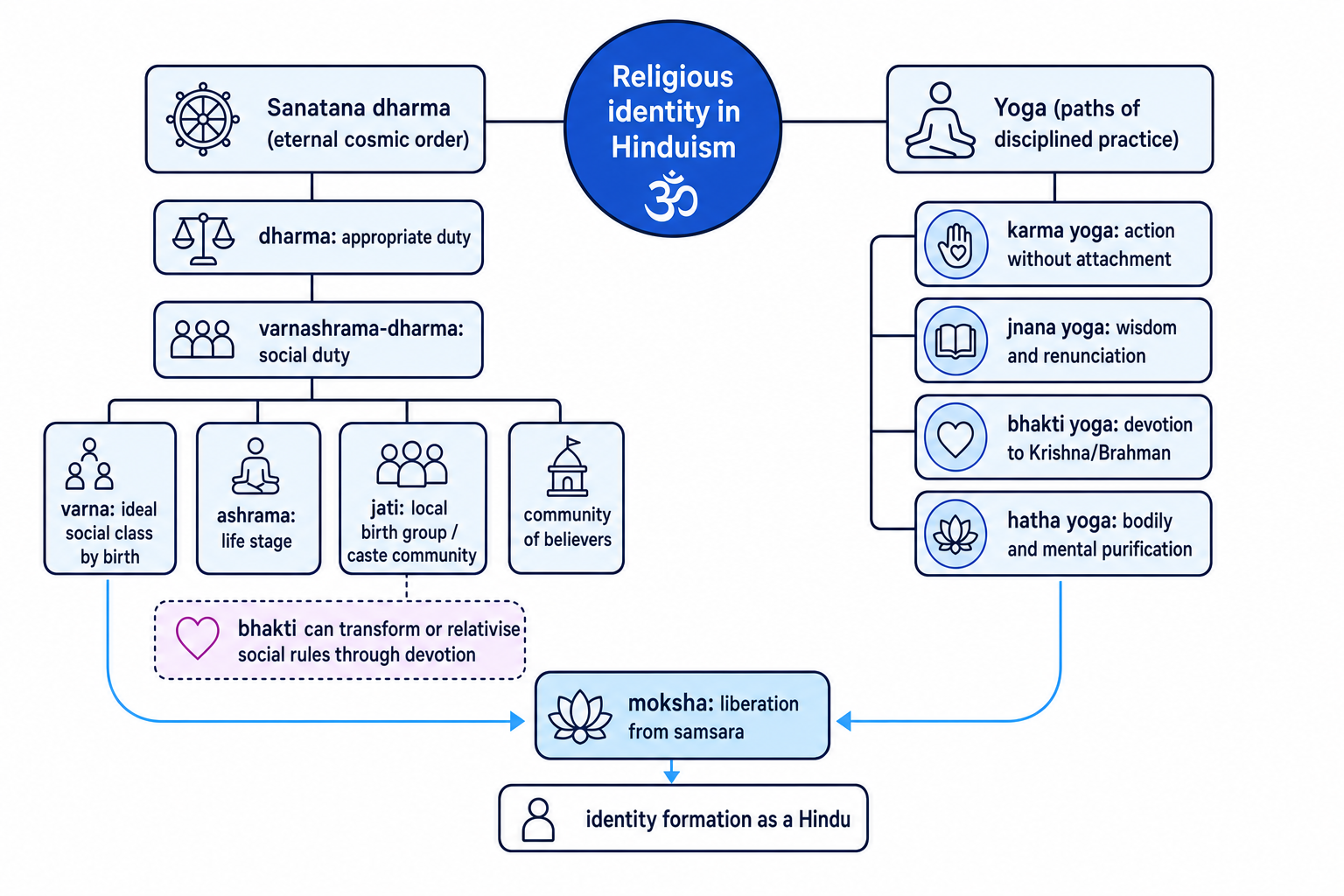
Sanatana dharma and varnashrama-dharma
Definition
Sanatana dharma
Sanatana dharma means “eternal dharma”. In Hinduism it refers to the eternal cosmic order, truth and way of life that sustains reality and gives human life moral direction.
Dharma means appropriate duty, law, order or right conduct. It can mean the cosmic order of the universe, but also a person’s specific duty in a particular situation.
Varnashrama-dharma is narrower than Sanatana dharma. It means the duties connected with a person’s varna and ashrama.
- Varna means the broad social class traditionally associated with birth and duty: Brahmin, Kshatriya, Vaishya and Shudra.
- Ashrama means a stage of life: student, householder, forest-dweller/retiree and renouncer.
- Varnashrama-dharma therefore gives a model of ideal social order: people contribute to society by fulfilling duties appropriate to their place and stage.
Key Idea
Two levels of dharma
Sanatana dharma is the eternal religious and cosmic order. Varnashrama-dharma is a social expression of dharma through class and life-stage duties.
The four ashramas
The four life stages show how cosmic order becomes practical social guidance:
- Brahmacharya: the student stage, focused on learning and discipline.
- Grihastha: the householder stage, focused on family, work, ritual and supporting society.
- Vanaprastha: the forest-dweller or retirement stage, involving gradual withdrawal from worldly life.
- Sannyasa: the renouncer stage, focused on liberation and detachment.
This does not describe every Hindu life in a simple way, but it gives an ideal pattern: worldly responsibility and spiritual liberation are both valued.
Example
Applying varnashrama-dharma to a householder
Imagine a married Vaishya considering whether to abandon business and family responsibilities for a life of renunciation.
- Identify the ashrama: as a householder, the person has duties to family, work, hospitality and religious support of the community.
- Identify the varna-related duty: Vaishyas are traditionally linked with commerce, agriculture and economic support, so honest work can be dharmic.
- Weigh the tension: renunciation is spiritually valuable, but leaving dependants without support may conflict with varnashrama-dharma at the householder stage.
- Reach a judgement: within this model, fulfilling household duty with detachment may be more appropriate than premature renunciation.
Bhakti and the transformation of social rules
Definition
Bhakti
Bhakti means loving devotion to a personal deity, such as Krishna, Vishnu, Shiva or Devi. It often involves worship, prayer, singing, service and surrender.
Bhakti can transform varnashrama-dharma because it places devotion above social status. In the Bhagavad Gita, Krishna teaches that sincere devotion is open to all, not only to those with ritual or social privilege. This makes bhakti especially important for groups historically excluded from elite religious learning.
Bhakti does not always abolish social hierarchy in practice. Some Hindu communities have kept caste customs while also practising devotion. However, theologically, bhakti can challenge the idea that birth status is the main marker of spiritual worth.
Tip
Useful evaluation
A strong essay can argue that bhakti both challenges and coexists with varnashrama-dharma: it offers direct access to the divine, but Hindu communities have not always abandoned caste-based structures.
Varna and jati
Definition
Jati
Jati means a birth group or caste community, usually linked to marriage, occupation, local identity and social belonging. There are thousands of jatis, unlike the fourfold varna model.
Varna and jati overlap because both are connected with birth, social identity and duties. But they are not identical.
- Varna is the broad ideal model: Brahmin, Kshatriya, Vaishya and Shudra.
- Jati is the lived social reality: many local caste communities with specific customs.
- A jati may claim a place within the varna system, but many jatis do not fit neatly into the fourfold scheme.
Modern Hinduism contains serious debates about jati. Some Hindus see caste identity as cultural and communal rather than spiritually essential. Others argue that caste hierarchy has caused deep injustice and must be rejected. B. R. Ambedkar, a major critic of caste and leader of Dalit liberation, argued that caste was not a harmless social division but a system of oppression. M. K. Gandhi opposed untouchability and called Dalits “Harijans”, but he was more willing than Ambedkar to defend a reformed idea of varna as a division of service.
Common Mistake
Varna and jati
Do not write as if varna and jati are exactly the same. Varna is a fourfold theoretical model; jati is the complex lived caste structure found in communities.
The role of the community of believers
Hindu identity is often formed through community: family, temple worship, festivals, pilgrimage, gurus, sampradayas and local customs.
A sampradaya is a religious tradition or lineage, often linked to a teacher, deity or philosophical school. Community matters because it teaches children how to practise dharma, celebrates rites of passage, transmits stories of the gods and gives social meaning to religious identity.
Community can preserve tradition, but it can also reform it. For example, devotional communities may challenge caste exclusion by welcoming devotees from many backgrounds.
Meaning and purpose of life
A key Hindu framework is the purusharthas, the four aims of human life:
- Dharma: living according to duty and moral order.
- Artha: material prosperity and security.
- Kama: pleasure, love and aesthetic enjoyment.
- Moksha: liberation from samsara.
Definition
Moksha and samsara
Samsara is the cycle of birth, death and rebirth. Moksha is liberation from that cycle and from ignorance, attachment and karma.
This means Hinduism does not simply reject worldly life. Family, work and pleasure can be legitimate when governed by dharma. Yet the final purpose of life is usually understood as moksha: freedom from bondage and realisation of ultimate truth.
Yoga: meaning and purpose
Definition
Yoga
Yoga means “yoking”, discipline or spiritual path. In Hinduism it refers to practices that discipline body, mind and action in order to move towards liberation and union, communion or identification with the transcendent.
Yoga is not just physical exercise. It is a range of paths for transforming the self. Different Hindu traditions emphasise different forms of yoga, but they often share the aim of overcoming ignorance, ego and attachment.
Karma yoga: the path of action
Karma yoga is the path of action. Its key idea is to perform dharma without attachment to the results. In the Bhagavad Gita, Krishna teaches Arjuna to act according to duty, but not to cling to success, failure, reward or reputation.
This is sometimes called nishkama karma, meaning desireless action. The aim is to purify the mind by reducing ego and selfish desire. Action becomes a spiritual discipline.
Example
Applying karma yoga to a difficult duty
Imagine someone must care for an elderly relative, but feels resentful because it limits their personal freedom.
- Identify the duty: care for a vulnerable family member can be understood as dharma within household life.
- Remove attachment to reward: karma yoga asks the person not to act for praise, gratitude or social approval.
- Reframe the action: the care becomes an offering or discipline that reduces ego and selfishness.
- Link to liberation: by acting without possessive attachment, the person purifies the mind and moves closer to the transcendent.
Jnana yoga: the path of wisdom
Jnana yoga is the path of wisdom or knowledge. It is associated with philosophical reflection, scriptural study, discrimination between the real and unreal, meditation and renunciation.
In some traditions it has been linked especially with Brahmins, because it requires access to sacred learning. In Advaita Vedanta, associated with Shankara, liberation comes through realising that atman, the true self, is identical with Brahman, ultimate reality. Ignorance creates bondage; wisdom removes it.
Jnana yoga links with raja yoga, the “royal” path of meditation and mental discipline. Patanjali’s Yoga Sutras define yoga as the stilling of the fluctuations of the mind, showing that meditation is central to liberation.
Bhakti yoga: the path of devotion
Bhakti yoga is the path of loving devotion. It is accessible to a wide range of people because it does not require advanced philosophical learning or high ritual status.
In the Bhagavad Gita, Krishna is presented as the supreme divine reality, identified with Brahman. Devotion to Krishna can therefore lead to moksha. In Vaishnava traditions, thinkers such as Ramanuja emphasise loving surrender to a personal God rather than purely impersonal knowledge.
Bhakti yoga is especially important for religious identity because it is visible and communal: singing, temple worship, pilgrimage, festivals and service all express devotion.
Hatha yoga: body, mind and modern culture
Hatha yoga uses bodily and mental disciplines, including posture, breath control and purification practices. Its aim is not merely fitness, but purification of the body and realisation of its divine potential.
In modern Western culture, hatha yoga has often evolved into a health, wellbeing or exercise practice. This has made yoga globally accessible, but it also raises questions: can yoga be separated from Hindu religious meaning, or does that remove its deepest purpose?
Yoga and Samkhya
Definition
Samkhya
Samkhya is an Indian philosophical tradition that distinguishes between purusha, pure consciousness, and prakriti, material nature. Classical yoga is strongly influenced by this distinction.
The link with Samkhya matters because it shows that yoga is not always simply about devotion to God. In some forms, liberation comes through disciplined insight: realising that consciousness is distinct from material nature and mental activity.
This creates diversity within Hindu yoga:
- Some traditions stress knowledge and meditation.
- Some stress devotion to a personal deity.
- Some stress ethical action in the world.
- Some stress bodily and mental purification.
Different purposes across traditions
Yoga can have different meanings depending on the tradition and context.
For Shankara, wisdom and realisation of Brahman are central. For Ramanuja, devotion and surrender to God are more important. For Patanjali, disciplined control of the mind is crucial. For modern figures such as Swami Vivekananda, yoga could be presented as a universal spiritual science, making it influential beyond India.
Across cultures, this diversity has major implications. In India and the Hindu diaspora, yoga may express Hindu identity and connection to tradition. In Western contexts, yoga may be practised as secular wellness. This can be seen positively as adaptability, or critically as commercialisation and loss of religious depth.
Key Idea
One tradition, many paths
Hindu practice is diverse: dharma shapes social identity, bhakti reshapes access to God, and yoga offers several paths towards moksha.
Exam technique
In the exam
- Distinguish carefully between Sanatana dharma, varnashrama-dharma, varna and jati; this is an easy place to gain precise AO1 credit.
- For evaluation, use named voices: Gandhi and Ambedkar work well for caste; Shankara, Ramanuja, Patanjali or Vivekananda work well for yoga.
- Avoid one-sided claims: bhakti may challenge caste, but it has not always removed caste practices; yoga may be spiritual liberation, but it can also function as health, identity and cultural practice.
Self review
Check yourself
- What is the difference between Sanatana dharma and varnashrama-dharma?
- How does bhakti transform the importance of birth-based social status?
- Why might Western hatha yoga be seen both positively and critically by Hindus?