Revision notes for Edexcel AS Level Religious Studies How should we live?. Open the guide for explanations and worked examples. Written against the Edexcel AS Level Religious Studies specification, so the content matches what's examinable rather than general Religious Studies background.
How should we live?
What you'll learn
- How Luke presents Jesus’ ethical teaching on poverty, wealth, outsiders and forgiveness.
- How the Sermon on the Plain and key parables shape Christian moral living.
- How Jesus’ teaching relates to first-century Judaism without falling into anti-Jewish stereotypes.
- How I. H. Marshall and Frank Matera can support balanced AO1 and AO2 essays.
The big picture: Luke’s ethical vision
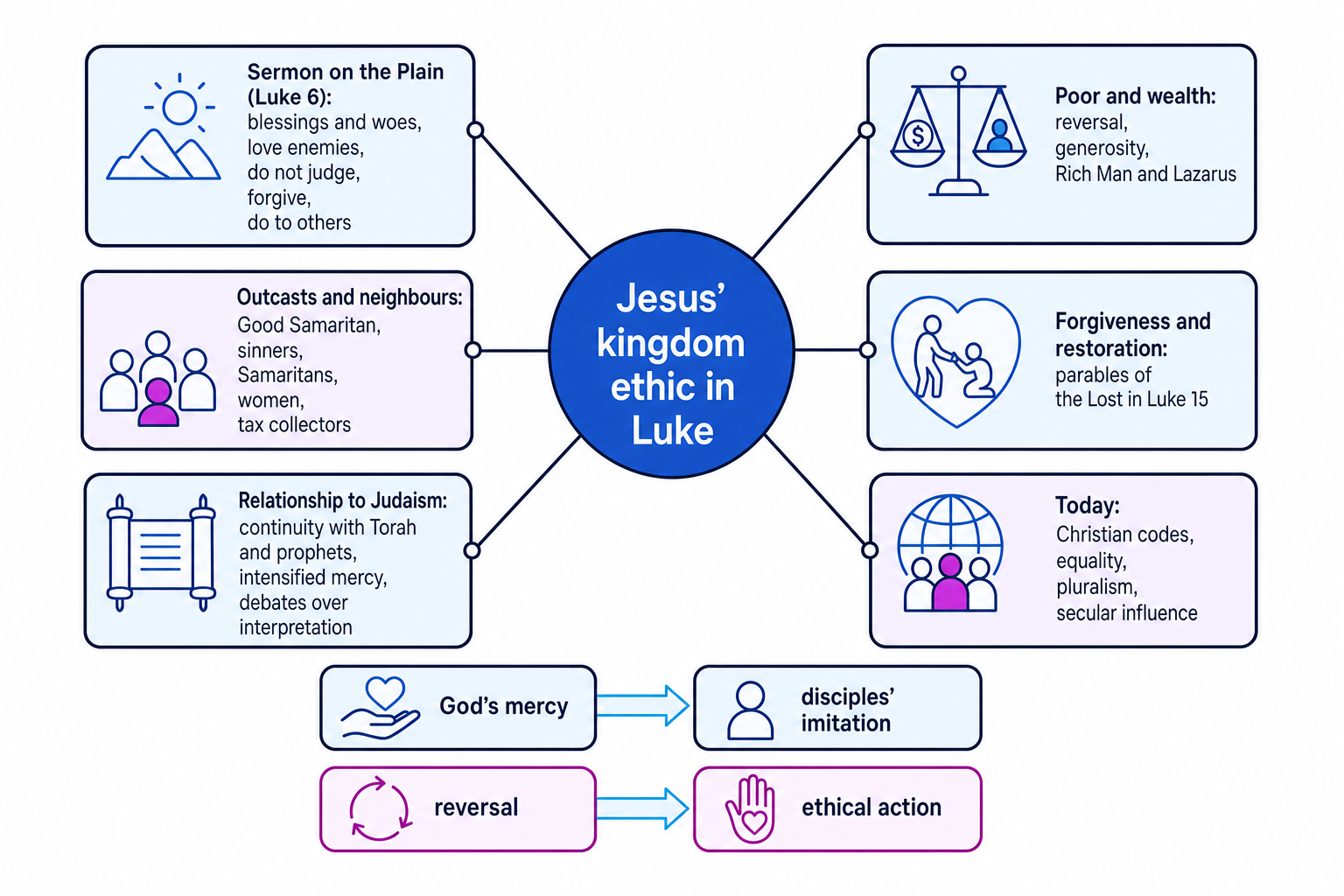
Luke’s Gospel presents Jesus as announcing the kingdom of God: God’s active rule breaking into human life. This is not just about private spirituality. In Luke, God’s kingdom creates a new way of living marked by mercy, generosity, forgiveness and concern for people pushed to the edges of society.
Definition
Kingdom of God
The kingdom of God means God’s reign or rule. In Luke, it is seen in Jesus’ teaching, healings, table fellowship and restoration of sinners and outsiders.
Luke’s ethics are often described as an ethic of reversal: those considered lowly, poor or rejected are lifted up, while the secure and self-satisfied are warned.
Definition
Reversal
Reversal is the Lukan theme that God overturns ordinary human rankings: the poor are blessed, the proud are brought down, the outsider becomes an example, and the rich are judged if they ignore the needy.
The Sermon on the Plain: Luke 6
The Sermon on the Plain is Jesus’ major block of ethical teaching in Luke 6. It is similar to Matthew’s Sermon on the Mount, but Luke’s version is shorter and more direct about poverty and wealth.
Jesus teaches:
- “Blessed are you who are poor.”
- “Blessed are you who hunger now.”
- “Blessed are you who weep now.”
- “Woe to you who are rich.”
- “Love your enemies.”
- “Do to others as you would have them do to you.”
- “Be merciful, just as your Father is merciful.”
- “Do not judge… forgive… give.”
The blessings and woes are important. In Matthew, Jesus says “poor in spirit”; in Luke, Jesus says “you who are poor”. That makes Luke’s version sound more socially and economically concrete.
Key Idea
Luke’s Sermon on the Plain
Luke presents Christian living as a life of mercy, enemy-love, forgiveness and practical generosity, rooted in the character of God.
This does not mean Luke teaches that poverty is automatically morally good or that all rich people are automatically evil. The issue is how people respond to God and to the needs of others. Wealth becomes spiritually dangerous when it produces comfort, pride and indifference.
Example
Interpreting the blessings and woes
- Start with Luke’s wording: Jesus blesses the poor, hungry and grieving, but warns the rich, full and socially praised.
- Link this to reversal: Luke suggests God’s kingdom overturns normal human assumptions about success, status and security.
- Evaluate carefully: this is not a simple hatred of wealth; it is a warning that comfort can make people blind to dependence on God and responsibility for others.
- Bring in Marshall: I. H. Marshall argues that Luke’s concern for the poor belongs within his wider theology of salvation, not merely a political programme.
The poor, wealth and social responsibility
Luke repeatedly shows Jesus taking the side of those in need. In Luke 4, Jesus reads Isaiah in the synagogue and announces good news to the poor, release for captives and freedom for the oppressed. This sets the tone for the whole Gospel.
Luke is especially challenging about possessions. Examples include:
- The rich fool in Luke 12, who stores wealth but is not “rich toward God”.
- The rich ruler in Luke 18, who cannot give up his possessions.
- Zacchaeus in Luke 19, whose repentance is shown by giving money to the poor and restoring what he has stolen.
The point is not that disciples must all live identically. It is that money must be used in a way that reflects God’s mercy and justice.
Definition
Repentance
Repentance means a turning back to God that changes a person’s attitude and behaviour. In Luke, genuine repentance often has visible social effects.
The Rich Man and Lazarus: Luke 16
A parable is a short story or comparison used by Jesus to provoke moral and spiritual reflection.
Definition
Parable
A parable is a teaching story that invites the listener to make a judgement, often before realising the judgement applies to themselves.
In the parable of the Rich Man and Lazarus, a wealthy man ignores a poor man called Lazarus who lies at his gate. After death, their situations are reversed: Lazarus is comforted, while the rich man suffers. The rich man asks for a warning to be sent to his brothers, but he is told that they already have “Moses and the prophets”.
This is not mainly a map of the afterlife. It is an ethical warning: Scripture already teaches care for the poor, so ignoring suffering is not due to lack of information but lack of mercy.
Key Idea
Wealth in Luke
Luke’s strongest criticism is not possession itself but self-protective wealth that refuses to see the poor at the gate.
Outcasts and neighbours: the Good Samaritan
In Luke 10, a lawyer asks Jesus, “Who is my neighbour?” Jesus replies with the parable of the Good Samaritan.
A man is attacked and left half-dead. A priest and a Levite pass by. A Samaritan, someone from a group despised by many Jews of the time, stops to help. Jesus then asks who “proved neighbour” to the wounded man.
The answer is: “The one who showed mercy.”
This matters because Jesus shifts the question. Instead of asking, “Who qualifies for my love?”, he asks, “How can I become a neighbour to the person in need?”
Definition
Samaritan
A Samaritan was a member of a community related to Judaism but religiously and ethnically distinct. Relations between Jews and Samaritans in the first century were often tense.
Example
Applying the Good Samaritan to pluralism
- Identify the original challenge: the lawyer wants to define the limits of “neighbour”.
- Notice Jesus’ reversal: the moral hero is not the expected religious insider but the Samaritan outsider.
- Apply this to pluralism: in a diverse society, moral goodness may be shown by people outside one’s own religious group.
- Evaluate the impact: Christians may use this parable to support interfaith respect and practical cooperation, while still grounding their ethic in Jesus’ teaching.
Forgiveness and restoration: the parables of the Lost
Luke 15 contains three connected parables:
- The Lost Sheep.
- The Lost Coin.
- The Lost Son, often called the Prodigal Son.
These stories are told because Pharisees and scribes complain that Jesus welcomes sinners and eats with them. Jesus’ answer is that God rejoices when the lost are restored.
The Lost Son is especially powerful. The younger son wastes his inheritance, returns home, and is welcomed by the father. The older son resents this mercy. The parable therefore challenges both obvious wrongdoing and self-righteous refusal to forgive.
Key Idea
Forgiveness in Luke
Forgiveness is not cheap approval of wrongdoing. It is restoration after repentance, and it reveals the generous mercy of God.
Common Mistake
Forgetting the older brother
Do not reduce the Lost Son to “God forgives bad people”. The older brother matters because Jesus is also challenging those who resent mercy being shown to outsiders.
Jesus and Judaism: continuity and challenge
It is vital to avoid saying, “Judaism was legalistic, but Jesus taught love.” That is historically unfair and examiners will not reward it.
Jesus was Jewish. His teaching stands in deep continuity with Jewish Scripture:
- Love of God comes from Deuteronomy 6.
- Love of neighbour comes from Leviticus 19.
- Care for the poor, widow, orphan and stranger is central to the Torah and prophets.
- The Rich Man and Lazarus explicitly says that “Moses and the prophets” already teach enough.
Definition
Torah
The Torah is the Jewish Law or instruction, especially the first five books of the Hebrew Bible. It includes worship, ethics, justice and community life.
At the same time, Jesus challenges some interpretations and social boundaries of his time. He eats with tax collectors and sinners, praises a Samaritan, heals on the Sabbath, and places mercy at the centre of obedience to God.
So the relationship is best described as continuity with intensification. Jesus does not reject Judaism; he interprets Israel’s Scriptures around God’s mercy, the kingdom and the restoration of the lost.
Tip
A strong comparison phrase
Try writing: “Jesus’ teaching is not a rejection of Judaism but a prophetic intensification of Jewish concerns for mercy, justice and covenant faithfulness.”
Marshall and Matera: two scholars to use
I. H. Marshall
I. H. Marshall sees Luke as a theologian of salvation. For Marshall, Jesus’ concern for the poor, sinners and outcasts is part of Luke’s wider message that God’s saving purpose reaches those who are excluded or despised.
Marshall is helpful because he avoids reducing Luke to a purely political text. The poor matter socially and economically, but Luke’s deeper concern is God’s saving action and the response of discipleship.
Frank Matera
Frank Matera emphasises New Testament ethics as a response to God’s action. In Luke, disciples are called to imitate God’s mercy: “Be merciful, just as your Father is merciful.”
Matera is useful because he shows that Jesus’ ethical teaching is not just a list of rules. It flows from a theological vision: God is merciful, therefore disciples must become merciful.
Example
Comparing Marshall and Matera
- Use Marshall to explain Luke’s overall message: Jesus brings salvation to the poor, sinful and excluded.
- Use Matera to explain the ethical demand: those who receive mercy must practise mercy toward enemies, outsiders and the poor.
- Evaluate the difference: Marshall helps with Luke’s theology of salvation, while Matera helps turn that theology into a practical moral pattern.
- Reach a judgement: together, they show that Luke’s ethics are both religiously grounded and socially demanding.
Interpretations for today
Religious interpretations
For Christians today, Luke’s teaching can shape codes of living such as:
- charity and service to the poor;
- forgiveness and reconciliation;
- hospitality to refugees, prisoners and social outsiders;
- concern for economic justice;
- non-violence or enemy-love in traditions such as Quakerism;
- interfaith respect inspired by the Good Samaritan.
It also influences ideas of equality: every person has dignity before God, including the poor, sinner, foreigner and socially rejected.
Secular interpretations
A secular view is a non-religious approach to ethics. Secular readers may not accept Jesus as Son of God, but they may still value Luke’s emphasis on compassion, equality, restorative justice and criticism of greed.
However, some secular critics may argue that Jesus’ teaching is too idealistic. Loving enemies, giving without expecting return, and forgiving serious wrongdoing can seem unrealistic or even dangerous if used to pressure victims into silence.
Definition
Pluralism
Pluralism means living positively with religious, cultural and moral diversity, rather than assuming one group has all wisdom or value.
Common Mistake
Forgiveness and abuse
Be careful: Christian forgiveness should not be used to excuse harm, protect abusers or deny justice. In a modern ethical answer, forgiveness and safeguarding must be held together.
Overall evaluation
Luke’s answer to “How should we live?” is radical but coherent. Jesus calls people to live from God’s mercy: to forgive, include outsiders, share wealth and cross social boundaries.
Marshall strengthens the view that this ethic belongs to Luke’s theology of salvation. Matera strengthens the view that discipleship means imitating God’s mercy in concrete action. Together, they help you avoid two weak extremes: treating Luke as only a social justice manifesto, or treating it as only private spirituality.
The strongest judgement is that Luke presents a demanding religious ethic with clear social consequences. It is rooted in Judaism, centred on Jesus, and still powerful in modern debates about poverty, equality and pluralism.
Exam technique
In the exam
- Anchor every point in a Lukan text: Luke 6, Luke 10, Luke 15 and Luke 16 are your core evidence.
- Compare Marshall and Matera directly: Marshall for salvation and outcasts; Matera for discipleship and imitating divine mercy.
- Avoid caricatures of Judaism: argue continuity, prophetic challenge and intensified mercy rather than simple opposition.
Self review
Check yourself
- How does Luke’s Sermon on the Plain differ from Matthew’s Sermon on the Mount?
- Why is the Samaritan, rather than the priest or Levite, central to the meaning of Luke 10?
- How could Marshall and Matera be used together in an essay on Christian ethical living?