Revision notes for Edexcel AS Level Religious Studies Works of scholars. Open the guide for explanations and worked examples. Written against the Edexcel AS Level Religious Studies specification, so the content matches what's examinable rather than general Religious Studies background.
Works of scholars
What you'll learn
- How N K Singh and D Jakobsh interpret women, gender and the feminine principle in Sikhism.
- Why Sikh scripture contains strong egalitarian themes, yet women’s roles have often been under-reported.
- How different scholarly methods — propositional and analytic or unitive and holistic — affect explanations of the Sikh understanding of the divine.
- How to turn this material into balanced essay arguments with clear comparison and judgement.
Why this topic matters
This Edexcel topic is about more than “women in Sikhism”. It asks you to compare two named scholars and to think about how methods of studying Sikhism shape conclusions about the divine, society and politics. A strong answer will usually distinguish between Sikh ideals and Sikh historical practice.
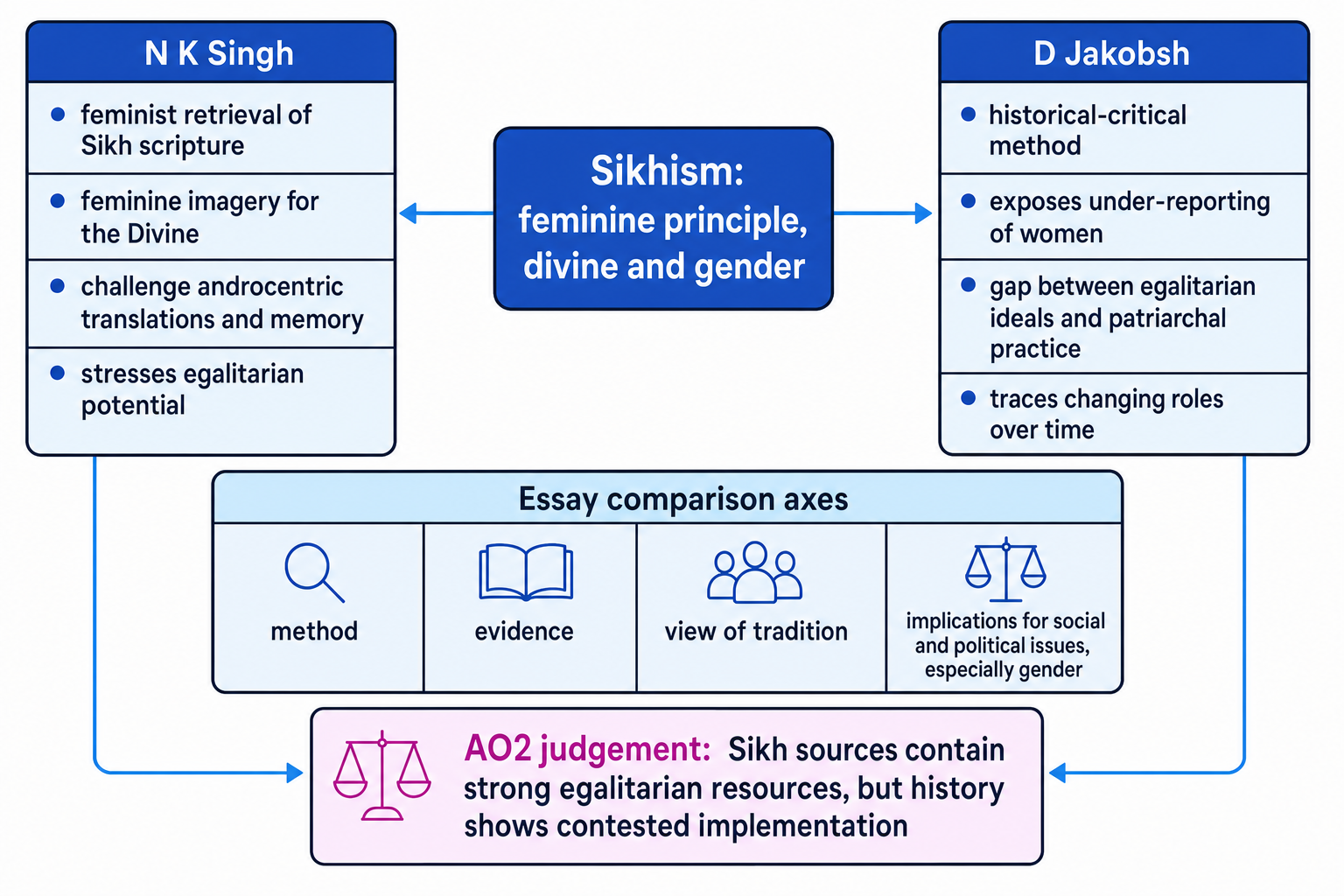
The map below gives you the basic comparison you need to keep returning to.
Key prerequisites: Sikh ideas about God and equality
The Sikh understanding of the divine
In Sikhism, the divine is commonly referred to as Waheguru, meaning something like “wonderful enlightener”. The opening of the Guru Granth Sahib, the Sikh scripture and eternal Guru, begins with the Mūl Mantar, which presents God as one, true, creator, without fear, without enmity, timeless, unborn, self-existent and known through the Guru’s grace.
Sikh thought often holds together two dimensions of God:
- Nirgun: God as beyond qualities, form and human categories.
- Sargun: God as present and knowable through creation, grace, the divine Name and lived devotion.
This matters for gender because, if God is beyond human categories, then God is not literally male. Sikh scripture can use many images — father, mother, bridegroom, friend, beloved — without reducing the divine to one human gender.
Definition
Feminine principle
The feminine principle means the presence and importance of feminine imagery, symbolism, experience and values in Sikh thought. It does not mean that Waheguru is biologically female; it means that Sikh scripture and tradition include feminine ways of expressing divine creativity, nurture, intimacy, embodiment and spiritual longing.
Gender, patriarchy and androcentrism
Gender refers to the social meanings, expectations and roles attached to being male or female. Patriarchy means a social system in which men tend to hold authority and women are subordinated. Androcentric means male-centred: treating male experience as normal, central or universal.
These terms are important because both N K Singh and D Jakobsh argue that Sikhism cannot be understood properly if women’s voices, bodies, experiences and historical roles are ignored.
Key Idea
The central tension
Sikh scripture gives powerful resources for equality, but Sikh history and institutions have often been shaped by patriarchal cultures. The best essays evaluate the gap between egalitarian theology and unequal practice.
N K Singh: retrieving the feminine principle
N K Singh, often cited as Nikky-Guninder Kaur Singh, is a Sikh feminist scholar who reads Sikh scripture as containing rich feminine and egalitarian resources. Her approach is often theological, literary and hermeneutical.
A hermeneutical approach means an approach concerned with interpretation: how texts are read, translated and applied.
Singh argues that Sikh scripture has often been interpreted through masculine assumptions. For example, English translations may use “He”, “Lord” or strongly male language for God, even where the original Sikh understanding of the divine is not literally male. For Singh, this matters because language shapes imagination: if God is always imagined as male, male authority can seem religiously natural.
She highlights feminine themes in the Guru Granth Sahib, including:
- God described through maternal as well as paternal imagery.
- Creation pictured through birth, nurture and intimacy.
- The human soul often described as a bride longing for union with the divine.
- Guru Nanak’s famous challenge to misogyny: “Why call her bad? From her kings are born” (Guru Granth Sahib, Ang 473).
For Singh, these are not decorative details. They reveal something deep about Sikh spirituality: the divine is not confined to male categories, and women’s bodies and experiences can be sources of theological meaning.
Evaluating Singh
Singh’s strength is that she offers an internal feminist reading of Sikhism. She does not simply import modern feminism from outside the tradition; she argues that Sikh scripture itself contains resources for resisting patriarchy.
However, a possible criticism is that her approach may emphasise the ideal vision of Sikh scripture more than the realities of Sikh history. If an essay only uses Singh, it may sound as if Sikhism has always been fully egalitarian in practice, which is too simple.
Common Mistake
Turning Singh into a slogan
Do not reduce N K Singh to “Sikhism says women are equal”. Her argument is more precise: Sikh scripture contains feminine and egalitarian resources, but these need to be recovered because interpretation and translation have often been male-centred.
D Jakobsh: exposing under-reported history
D Jakobsh, usually cited as Doris Jakobsh, is a historian of Sikhism. Her work is associated with a historical-critical method, meaning she studies sources, power, context and the way history has been recorded.
Jakobsh argues that women have often been under-reported in mainstream accounts of Sikhism. Sikh history is frequently told through male Gurus, male martyrs, male warriors, male reformers and male institutional leaders. Women appear, but often as mothers, wives, supporters or exceptional heroines rather than as central agents.
She does not deny that Sikh scripture has egalitarian elements. Instead, she asks a sharper question: if Sikhism is so often described as radically equal, why have women’s roles so often been marginalised in practice and in historical memory?
Important examples include:
- Bibi Nanaki, Guru Nanak’s sister, who recognised his spiritual greatness.
- Mata Khivi, associated with the development of langar, the communal kitchen.
- Mata Sahib Kaur, remembered in relation to the Khalsa.
- Mai Bhago, a warrior figure who challenged male cowardice and became a symbol of female courage.
- Maharani Jind Kaur, a political leader in the Sikh Empire period.
For Jakobsh, the issue is not that such women did nothing. The issue is that mainstream narratives have often not given women sustained attention.
Evaluating Jakobsh
Jakobsh’s strength is that she prevents romanticised answers. She shows that religious ideals do not automatically become social reality. She also helps explain why women can be praised symbolically while still being excluded from authority.
A possible limitation is that, if overused, her approach can make Sikh egalitarian theology seem merely theoretical. A balanced answer should combine Jakobsh’s historical caution with Singh’s insistence that Sikh scripture itself contains transformative resources.
Example
Comparing Sikh feminist scholarship
-
Start by identifying the issue being compared: Singh and Jakobsh are both concerned with gender, but Singh focuses more on recovering theological meaning, while Jakobsh focuses more on historical under-reporting and power.
-
Apply Singh to Sikh scripture: feminine imagery, the non-maleness of Waheguru and Guru Nanak’s challenge to misogyny support the view that Sikhism has strong feminist potential from within its own sources.
-
Apply Jakobsh to Sikh history: male-authored narratives, institutional exclusions and selective memory show that egalitarian ideals have not always shaped Sikh practice consistently.
-
Reach a balanced judgement: Sikhism can be argued to contain powerful feminist resources, but it is misleading to claim that the tradition has always embodied gender equality without tension.
Feminist themes in Sikh scripture and history
Scripture
Sikh scripture challenges many forms of hierarchy. The idea that the same divine light is present in all people undermines caste superiority, gender superiority and ritual purity systems. Guru Nanak’s teaching on women is especially important because it directly questions contempt for women.
The Guru Granth Sahib also challenges the idea that bodily processes make women spiritually inferior. Sikh teaching generally locates impurity in ego, falsehood and moral corruption rather than in women’s bodies.
History
Sikh history includes women involved in devotion, household leadership, education, langar, political resistance and martial courage. The institution of langar is especially significant because it enacts equality: people sit together and eat regardless of caste, status or gender.
The formation of the Khalsa in 1699 also has gender significance. Sikh men commonly take the name Singh, meaning lion, and Sikh women commonly take Kaur, often translated as princess. This can be read as a rejection of identity based purely on caste or male lineage.
Under-reporting
The problem is that these dimensions have often been under-reported. Reasons include:
- Historical sources were often written by men.
- Public leadership was more easily associated with male authority.
- Punjabi patriarchal culture influenced Sikh communities.
- Colonial and reform movements sometimes promoted respectable domestic womanhood.
- Translations and summaries of Sikhism often made male experience appear central.
Common Mistake
Scripture is not the same as society
Avoid writing as if one quotation from the Guru Granth Sahib proves complete gender equality in Sikh history. Use scripture as evidence of ideals, then test how far those ideals were realised in practice.
Feminist perspectives and movements over time
Sikh feminist perspectives have changed over time because Sikh communities have changed.
In the Guru period, women participated in devotional community life, and Sikh teaching challenged caste, ritualism and gender contempt. In later historical periods, some women became famous for courage or leadership, but the wider record still remained male-centred.
During the Singh Sabha and colonial reform periods, there were efforts to strengthen Sikh identity, education and social reform. These could support women’s education, but they could also reinforce ideals of women as respectable mothers and guardians of community honour.
In modern Sikh feminism, key concerns include:
- Women’s full participation in gurdwara leadership.
- Women as granthis, readers and interpreters of scripture.
- Debates about women performing kirtan, devotional singing, in major institutions.
- Opposition to dowry, domestic violence and sex-selective abortion.
- Re-reading Sikh history to recover women’s agency.
- Encouraging men to challenge patriarchal habits, not merely “allow” women equality.
This final point is important: changing gender roles are not only about women entering male spaces. They also involve men rethinking authority, domestic responsibility, seva, humility and partnership.
Methods of explaining the Sikh understanding of the divine
The spec also asks you to understand different methods of explaining Sikh beliefs about the divine.
Propositional and analytic method
Definition
Propositional and analytic
A propositional method explains religion through clear truth-claims, such as “God is one” or “God is beyond gender”. An analytic method breaks ideas down into concepts and categories so they can be examined logically.
Using this method, you might explain Sikh belief through the Mūl Mantar:
- God is one: Ik Onkar.
- God is creator: Karta Purakh.
- God is timeless: Akal Murat.
- God is unborn: Ajuni.
- God is self-existent: Saibhang.
- God is known through grace: Gur Prasad.
This method is useful because it gives clarity. It helps you say exactly what Sikhism teaches about God and why a literal male God would not fit Sikh theology.
Its weakness is that it can make Sikhism sound like a list of abstract doctrines. Sikh understanding of Waheguru is not only something to define; it is something to realise through devotion, ethical living and community.
Unitive and holistic method
Definition
Unitive and holistic
A unitive method stresses spiritual union, oneness and lived relationship with the divine. A holistic method explains Sikh belief by looking at the whole pattern of scripture, worship, ethics, community, history and practice together.
This method fits Sikhism well because Sikh spirituality is lived through nam simran, remembrance of the divine Name; seva, selfless service; sangat, the holy community; and hukam, the divine order or will.
On this view, belief in one divine reality should transform social life. If the same divine light is present in all, then gender injustice, caste prejudice and social domination contradict Sikh spirituality.
The weakness is that a holistic approach can become vague if it does not define concepts carefully. In essays, combine both methods: define the belief clearly, then show how it is lived.
Example
Applying methods to women’s religious leadership
-
Use the propositional method: if Waheguru is beyond gender and all people share the divine light, then there is no obvious theological reason to treat women as spiritually inferior.
-
Use the analytic method: compare the principle of equality with actual institutional roles, such as leadership, scripture reading or kirtan, and ask whether restrictions are doctrinal or cultural.
-
Use the holistic method: consider whether Sikh practices like sangat, seva and langar visibly embody equality, rather than merely stating it.
-
Form a judgement: women’s full participation can be defended as a more consistent expression of Sikh theology, while Jakobsh’s work reminds you that institutions may not change simply because ideals exist.
Different attitudes to social and political issues
Because Sikhism connects spirituality with social life, beliefs about the divine affect political and ethical issues. The Sikh idea of miri-piri links temporal responsibility and spiritual authority, so religion is not just private belief.
A propositional and analytic approach may argue:
- Sikh doctrine teaches equality.
- Therefore sexism, casteism and oppression contradict Sikh belief.
- Institutions should be tested against their own stated principles.
A unitive and holistic approach may argue:
- Real knowledge of Waheguru is shown through transformed living.
- Gender justice must appear in family life, worship, education and community power.
- Feminist reform is not separate from Sikh spirituality; it is part of living truthfully.
Tip
A strong judgement
A good final judgement might say: Singh shows that Sikhism contains deep feminist and feminine theological resources; Jakobsh shows that these resources have often been restricted by patriarchal history. Therefore, Sikhism is best understood as a tradition with powerful egalitarian potential and contested social implementation.
Exam technique
In the exam
-
Compare Singh and Jakobsh directly: method, evidence, view of scripture, view of history and implications for gender.
-
Keep the distinction between ideals and practice clear: scripture can support equality, while history may show under-reporting or exclusion.
-
Link theology to society: explanations of Waheguru, the feminine principle and divine oneness should lead into social and political issues, especially gender.
Self review
Check yourself
-
Can you explain the difference between Singh’s retrieval of the feminine principle and Jakobsh’s historical-critical approach?
-
Why is “Sikhism teaches equality, therefore Sikh women have always been equal” too simplistic?
-
How would a propositional and analytic method differ from a unitive and holistic method when explaining Waheguru and gender justice?