Revision notes for Edexcel AS Level Religious Studies Religion and society. Open the guide for explanations and worked examples. Written against the Edexcel AS Level Religious Studies specification, so the content matches what's examinable rather than general Religious Studies background.
Religion and society
How does a religious tradition respond when it develops in a society crowded with competing truth claims? In this topic, we will explore the Sikh response to religious pluralism, diversity, and freedom. Sikhism presents a unique theological stance: it simultaneously claims to be a distinct, direct revelation from God, while actively validating and protecting the spiritual paths of other religions.
What you'll learn
- How the inclusion of the bhagat bani in the Guru Granth Sahib establishes a scriptural foundation for religious pluralism.
- The nature of Guru Nanak's historic encounters with Hindus, Muslims, and yogis.
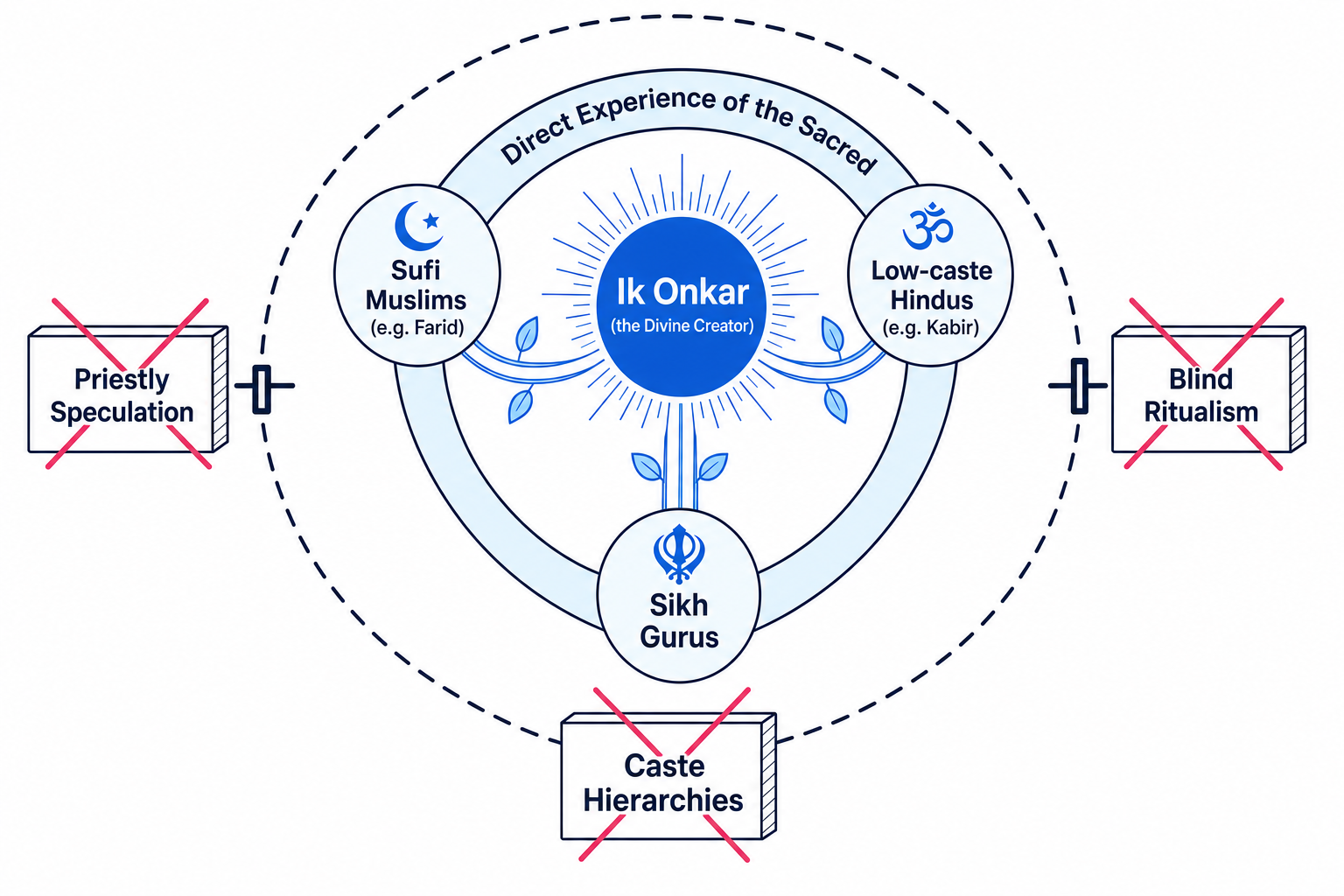
- How Sikhism prioritizes direct, personal experience of the sacred over priestly speculation and blind authority, utilizing reason as a guide for ethical living.
Pluralism and the Bhagat Bani
To understand how Sikhs view other religions, we must look at their primary scripture, the Guru Granth Sahib (GGS). Unlike scriptures of many other major world religions, the GGS contains not only the writings of the Sikh Gurus but also works by spiritual figures from outside the Sikh tradition.
Definition
Bhagat Bani
The bhagat bani (literally "utterances of the devotees") refers to the hymns and poetry composed by fifteen non-Sikh saints—both Hindu and Muslim—which were compiled directly into the Guru Granth Sahib by Guru Arjan.
These bhagats (devotees) came from a wide variety of socio-economic and religious backgrounds:
- Kabir: A weaver of low caste, associated with both Muslim and Hindu traditions.
- Baba Farid: A highly revered Sufi Muslim mystic.
- Namdev: A low-caste calico printer from Maharashtra.
- Ravidas: An untouchable cobbler.
By incorporating their writings into the eternal living Guru (the GGS), the Gurus made a radical theological statement: divine truth is not the exclusive property of one religion, country, or caste.
Key Idea
A Scripture of Ecumenical Pluralism
The inclusion of the bhagat bani shows that the Sikh scripture does not merely tolerate other religious voices; it elevates them to the status of divine word (gurbani). This is a foundational pillar of Sikh pluralism.
Scholarly Perspectives: N. K. Singh and S. B. Singh Dalawari
For your Edexcel exams, you must be able to deploy and evaluate the arguments of N. K. Singh and S. B. Singh Dalawari regarding how Sikhs handle pluralism.
- N. K. Singh argues that this scriptural inclusion represents a revolutionary model of interfaith harmony. He emphasizes that the Gurus did not edit or "Sikhize" the writings of the Bhagats; they preserved their original theological language. This demonstrates that God speaks through diverse cultural and religious vocabularies. For Singh, Sikhism is fundamentally non-exclusivist.
- S. B. Singh Dalawari takes a deeply spiritual and practical approach. He argues that the GGS is unique because it demands that its followers love and respect all of humanity. Dalawari highlights that, according to Sikh theology, salvation is not restricted to Sikhs. Anyone who genuinely loves God and lives a righteous life can achieve liberation (mukti). Thus, religious labels are secondary to genuine, heart-felt devotion.
Guru Nanak’s Interfaith Relations
The foundation of Sikh pluralism lies in the life and teachings of Guru Nanak (1469–1539). His travels (known as udasis) brought him into direct dialogue with the major religious communities of his day.
1. Dialogue with Hindus
Guru Nanak was born into a Hindu family but quickly challenged the empty rituals and social stratification (the caste system) of contemporary Hinduism.
- The Sacred Thread (Janeu): When offered the cotton thread that symbolized high-caste status, Nanak refused, arguing that a true thread of the soul should be made of "mercy, contentment, self-control, and truth."
- The Haridwar Incident: Seeing pilgrims throwing water eastward to feed the souls of their ancestors in heaven, Nanak began throwing water westward. When questioned, he replied that he was watering his fields in Punjab. If their water could reach heaven, surely his could reach Punjab.
Through these actions, Nanak was not rejecting the Hindus themselves, but rather challenging them to abandon superstition and find the inner, ethical reality of their faith.
2. Dialogue with Muslims
Guru Nanak lived in a region ruled by Muslim authorities and had close relationships with Muslim mystics (Sufis). His famous pronouncement upon emerging from his enlightenment experience at the River Bein was: "There is no Hindu, there is no Muslim."
Common Mistake
Misinterpreting 'No Hindu, No Muslim'
Do not interpret this as a rejection of the existence of these religions. Guru Nanak meant that in the eyes of God, external religious labels are meaningless. What matters is the moral character of the individual.
- True Prayer (Namaz): When visiting a mosque, Nanak pointed out that the religious leaders were merely going through the physical motions of prayer while their minds were on earthly matters (like buying horses or safety of their crops). He taught that to be a "true Muslim," one must make compassion their mosque, sincerity their prayer-carpet, and justice their Quran.
3. Dialogue with the Yogis (Sidhas)
The Sidh Gosht (Dialogue with the Sages) is a key composition in the GGS recording Nanak's discussions with the ascetic yogis who lived in the Himalayas.
- The Yogic Path: The yogis believed that the world was corrupt and that liberation could only be achieved by withdrawing from society, practicing severe asceticism, and performing physical self-mortification.
- Nanak's Response: Guru Nanak rejected this world-denying philosophy. He argued that one must remain actively engaged in society as a householder (grihastha), earning an honest living and sharing with others, whilst keeping one's mind focused on God.
Analogy
The Lotus Flower
Guru Nanak used the analogy of the lotus flower (which floats pristine on muddy water) and the duck (which swims across a river without wetting its feathers) to describe how a Sikh should live: fully engaged in the world, yet unaffected by its spiritual impurities.
Truth Claims: Experience vs. Speculation
How do Sikhs understand "truth"? In Sikh epistemology (the study of knowledge), divine truth is not something to be solved like a philosophical puzzle. It must be directly experienced.
Direct Experience (Anubhava) of the Sacred
For Sikhs, God (Ik Onkar) is both transcendent (beyond description) and immanent (present within all creation). Therefore, the ultimate goal of human life is to experience this divine presence directly.
This is achieved through Naam Simran (meditative remembrance of the Divine Name) and living in a state of Seva (selfless service). This direct, intuitive experience of the sacred is known as anubhava.
Rejection of Priestly Speculation and Philosophy
Sikhism is highly critical of the professional priestly class (such as the Brahmins in Hinduism or the Qazis in Islam). The Gurus argued that theological speculation, complex rituals, and scholastic philosophy are distractions.
- Intellectual Pride: The Gurus observed that priests and scholars often became arrogant due to their intellectual learning, creating barriers between ordinary people and God.
- Exploitation: Rituals were often used by priests to financially exploit the poor and maintain control over social hierarchies, such as the caste system.
Common Mistake
Confusing 'No Priests' with 'No Leaders'
Sikhism has no ordained priesthood (it is non-clerical). Anyone can read from the Guru Granth Sahib and lead congregation prayers. Do not confuse this with a lack of leadership; historical and local leadership exists (like the Granthis who care for the scriptures), but they do not possess special spiritual authority or act as mediators between you and God.
Reason, Evidence, and Ethical Action
While rejecting dry scholasticism, Sikhism is not an anti-intellectual faith. It places a high value on reason (vichaar) and evidence as tools for living a moral and virtuous life.
- Rational Living: The Gurus constantly appealed to common sense to dismantle superstitious practices (like astrology, fasting, and ritual bathing).
- Self-Determination: Individuals are expected to use their God-given intellect (budhi) to make ethical decisions, rather than blindly following religious or non-religious authorities.
W. O. Cole on Sikh Truth Claims
The prominent scholar W. O. Cole provides vital insights into this aspect of Sikhism:
- Rejection of Syncretism: Cole strongly argues against the popular Western view that Sikhism is merely a synthetic "blend" of Hinduism and Islam. He asserts that Sikhism is a unique, sovereign revelation given to Guru Nanak.
- The "Fruit" of Religion: Cole points out that according to Sikhism, the validity of any religion is judged by its ethical fruit. If a religion produces compassionate, truthful, and selfless human beings, then it is a valid path. If it produces arrogance, social division, or empty ritualism, it must be rejected.
- Universality: Cole emphasizes that because God is universal, the light of God can shine through any genuine seeker, regardless of their religious tradition.
Constructing a Comparative Scholarly Evaluation
In your Edexcel Paper 4 exam, you will need to construct analytical arguments (AO2) evaluating different perspectives on Sikhism's relationship with other religions. Below is a step-by-step walkthrough of how to build an analytical paragraph evaluating whether Sikhism is fundamentally pluralistic or exclusivist.
Example
Evaluating the nature of Sikh pluralism
- Define the core debate: Establish the tension between Sikhism's claim to be a unique, direct revelation and its highly inclusive attitude toward other faiths.
- Apply scriptural evidence (AO1): Point to the inclusion of the bhagat bani in the Guru Granth Sahib, showing that Hindu and Muslim voices are given equal scriptural status to the Sikh Gurus.
- Deploy scholar N. K. Singh to support pluralism (AO2 evaluation): Use Singh's argument that the preservation of the Bhagats' original theological vocabulary proves that Sikhism rejects religious exclusivism and views multiple paths as valid.
- Deploy scholar W. O. Cole to provide critical balance (AO2 counter-evaluation): Introduce Cole's warning against viewing Sikhism as a syncretic blend. Note that while Sikhism values other paths, it explicitly rejects their external structures (caste, asceticism, ritualism). Thus, Sikhism is pluralistic regarding spiritual experience, but exclusive regarding practice and social ethics.
- Formulate a justified judgement: Conclude that Sikhism is a "critical pluralism." It validates the inward, mystical core of other traditions while rejecting their outward dogmas and social injustices.
Exam technique
In the exam
- Avoid the Syncretism Trap: Always use W. O. Cole to argue that Sikhism is not a blend of Hinduism and Islam. Present it as an independent, sovereign revelation.
- Contrast Scholars effectively: Use N. K. Singh to champion the radical pluralism of the bhagat bani, and S. B. Singh Dalawari to ground your essay in the practical, lived reality of Sikh love and interfaith respect.
- Link Dialogue to Theology: When writing about Guru Nanak's dialogues with Muslims, Hindus, or Yogis, do not just tell the story. Explain why he acted this way: to emphasize direct experience over blind authority and ritual.
Self review
Check yourself
- Why is the inclusion of Baba Farid's and Kabir's poetry in the Guru Granth Sahib so theologically significant for Sikhism?
- How did Guru Nanak's dialogue with the Sidhas (yogis) highlight the Sikh rejection of ascetic world-withdrawal?
- What did W. O. Cole identify as the ultimate test of any religion's truth claim according to Sikh theology?