Revision notes for Edexcel AS Level Religious Studies Social and historical developments. Open the guide for explanations and worked examples. Written against the Edexcel AS Level Religious Studies specification, so the content matches what's examinable rather than general Religious Studies background.
Social and historical developments
What you'll learn
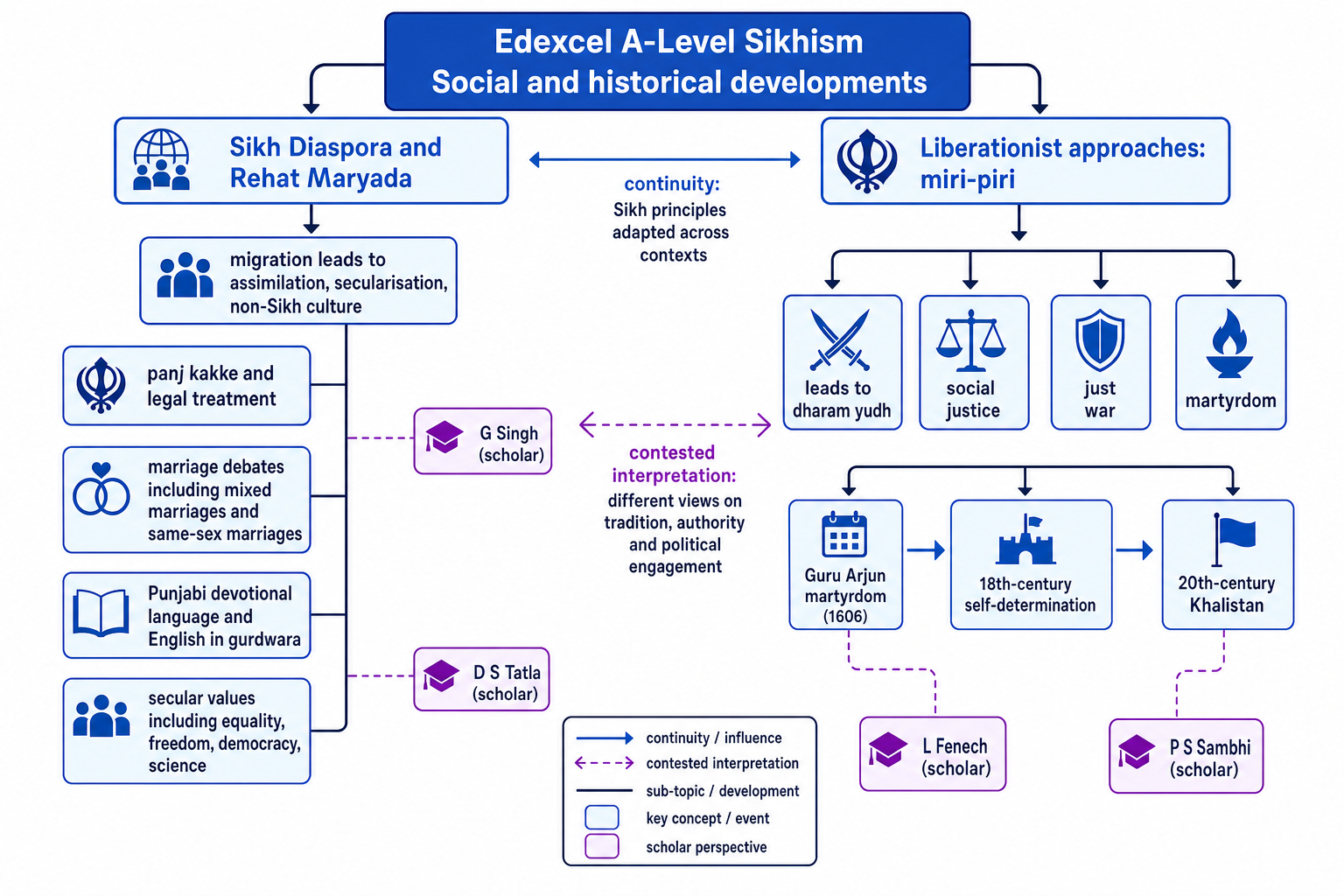
- How migration, secularisation and non-Sikh culture affect Sikh beliefs, values and practices in the Sikh diaspora.
- Why the Sikh Rehat Maryada, the panj kakke, marriage and language become debated outside Punjab.
- How Sikh liberationist ideas connect social justice, dharam yudh, just war and martyrdom.
- How to use G. Singh, D. S. Tatla, L. Fenech and P. S. Sambhi in evaluative essays.
The big picture
This topic is about how Sikh identity develops when Sikhs live as minorities in global societies, and how Sikh history has shaped ideas of justice, resistance and sacrifice.
Definition
Diaspora
A diaspora is a community living outside its traditional homeland while maintaining religious, cultural, emotional or political links with it. The Sikh diaspora includes Sikh communities in Britain, Canada, the USA, East Africa and elsewhere.
Migration, secularisation and non-Sikh culture
Migration and assimilation
Migration means movement from one country or region to another. Sikh migration has often been shaped by work, colonial links, political instability and family networks. In Britain, many Sikhs arrived from Punjab and also from East Africa, especially during the mid-to-late twentieth century.
Assimilation means becoming absorbed into the majority culture, sometimes by reducing or abandoning distinctive religious practices. For Sikhs, assimilation pressures may include cutting hair, not wearing visible Sikh symbols, using English only, or treating the gurdwara mainly as a cultural centre rather than a religious one.
Secularisation is the process by which religion becomes less influential in public life, institutions and personal decision-making. This does not simply mean “people stop believing”; it can mean religious authority has to compete with law, individual choice, education, science and liberal social values.
Key Idea
Diaspora identity is negotiated
The Sikh diaspora is not just a story of “tradition versus modernity”. It is a process of negotiation: Sikhs adapt to new contexts while trying to preserve core commitments such as devotion to the Guru Granth Sahib, equality, seva and communal identity.
G. Singh and D. S. Tatla on the Sikh diaspora
Gurharpal Singh and Darshan Singh Tatla are especially useful because they treat diaspora Sikhism as socially and politically active, not simply as a weakened version of Punjabi Sikhism.
In their work on British Sikhs, Singh and Tatla emphasise the importance of gurdwaras, which are Sikh places of worship and community institutions. Gurdwaras preserve religious practice, teach Punjabi and Sikh history, organise langar and provide social support. However, they can also become sites of dispute over generation, caste, gender, language and politics.
Tatla’s work on the Sikh diaspora also highlights transnationalism, meaning links across national borders. Diaspora Sikhs may live in Britain or Canada but still feel deeply connected to Punjab, especially through family, pilgrimage, media and political movements such as Khalistan.
The Sikh Rehat Maryada and diaspora issues
Definition
Sikh Rehat Maryada
The Sikh Rehat Maryada is the authoritative Sikh code of conduct, formally approved by the Shiromani Gurdwara Parbandhak Committee in the twentieth century. It gives guidance on Sikh identity, worship, ceremonies and discipline.
The Sikh Rehat Maryada matters because it tries to define shared Sikh practice. In the diaspora, however, Sikhs live under non-Sikh legal systems and within plural societies. This raises practical questions: how much adaptation is acceptable, and who has authority to decide?
The panj kakke and legal treatment
The panj kakke, or Five Ks, are the five visible signs of the Khalsa: kesh uncut hair, kangha a comb, kara a steel bracelet, kachera short undergarments and kirpan a ceremonial sword.
In diaspora contexts, these have raised legal questions. For example, the kirpan can conflict with laws about weapons and public safety. The kara may raise workplace or school uniform issues. Kesh often connects to the wearing of the turban, although the turban itself is not one of the Five Ks.
In Britain, Sikh identity has received legal recognition in significant cases such as Mandla v Dowell Lee in 1983, where the House of Lords recognised Sikhs as an ethnic group for the purposes of race relations law. There are also exemptions for turban-wearing Sikhs in some helmet and workplace contexts. These examples show law trying to balance equality, religious freedom and public safety.
Common Mistake
Treating accommodation as assimilation
If a Sikh school or workplace allows the turban, kara or kirpan, that is not assimilation. It is usually accommodation: the wider society adjusts so Sikhs can remain visibly Sikh.
Marriage: mixed marriages and same-sex marriages
The Anand Karaj is the Sikh marriage ceremony conducted in the presence of the Guru Granth Sahib, the Sikh scripture regarded as the living Guru. The Sikh Rehat Maryada presents marriage as a Sikh religious union centred on the laavan hymns and the Guru’s teaching.
This creates debate around mixed marriages, where one partner is Sikh and the other is not. Some gurdwaras refuse Anand Karaj unless both partners are Sikh, arguing that the ceremony only makes sense if both accept the Guru’s authority. Others take a more inclusive approach, especially in diaspora contexts where interfaith relationships are common.
Same-sex marriage is also debated. Many gurdwaras do not conduct same-sex Anand Karaj, partly because the Rehat Maryada assumes a heterosexual marriage framework. However, some Sikhs argue that Sikh principles of equality and human dignity should lead to greater acceptance. In Britain, religious organisations are not forced to conduct same-sex marriages, so this remains an area where law, conscience and community authority interact.
Punjabi, English and the gurdwara
Punjabi, especially in Gurmukhi script, is important for Sikh devotion because it gives access to gurbani, the hymns of the Guru Granth Sahib. However, the Guru Granth Sahib contains a range of languages and dialects, so it is more accurate to say Punjabi and Gurmukhi are central to Sikh religious learning, not that the scripture is “only Punjabi”.
The issue in the diaspora is whether English should be used more in the gurdwara. English translations, explanations and youth programmes can help younger Sikhs and converts understand Sikh teaching. But if Punjabi declines, Sikhs may lose direct access to gurbani, Sikh history and inherited forms of devotion.
Example
Evaluating English in the gurdwara
- Identify what English helps preserve: it can make the Guru’s teaching understandable for younger diaspora Sikhs who may not be fluent in Punjabi.
- Identify what English may weaken: over-reliance on translation can reduce motivation to learn Punjabi and Gurmukhi, creating distance from inherited devotional practice.
- Apply Singh and Tatla: diaspora institutions survive by adapting, but adaptation often creates disputes over authority, generation and identity.
- Reach a balanced judgement: English use is best seen as accommodation when it supports understanding, but it risks assimilation if it replaces rather than supports Punjabi learning.
Sikh values and secular values
Some secular values fit strongly with Sikh teaching. Equality connects with langar, anti-caste teaching and the belief that all humans share the same divine source. Freedom connects with Sikh resistance to oppression and the defence of conscience. Democracy can be linked to collective decision-making in the sangat, the Sikh congregation. Science is often treated as compatible with Sikhism because Sikh scripture is primarily spiritual and poetic rather than a literal science textbook.
However, secularisation also challenges Sikh authority. Individual choice may conflict with communal discipline. Scientific and liberal values may challenge traditional views on gender, sexuality, family and authority. A strong essay will avoid claiming either “Sikhism is completely secular” or “Sikhism rejects modern values”. The better argument is that Sikh responses are diverse and contested.
Tip
Useful distinction
Secularisation is a social process in which religious authority declines. Secular values are ideals such as equality, freedom and democracy, which Sikhs may support for specifically Sikh reasons.
Liberationist approaches in Sikhism
Liberation, social justice and miri-piri
In Sikhism, liberation can mean spiritual freedom from haumai, or ego-centredness, but it also has social and political dimensions. A Sikh should not seek private salvation while ignoring injustice.
Social justice means organising society according to fairness, dignity and the protection of the vulnerable. Sikh practices such as langar, seva and opposition to caste express this.
The idea of miri-piri is also important. It means the unity of temporal authority and spiritual authority. After the martyrdom of Guru Arjun, Guru Hargobind wore two swords symbolising miri and piri, showing that Sikh spirituality could include worldly responsibility and defence of justice.
Dharam yudh and just war
Definition
Dharam yudh
Dharam yudh means a righteous struggle or righteous war. In Sikh thought it is not aggression for power, but resistance to injustice when peaceful means have failed.
This connects to just war, the idea that war may be morally justified only under strict conditions, such as just cause, right intention, last resort and proportionate means. Sikh tradition is not simply pacifist, because it allows force in defence of the oppressed. But it is also not militaristic, because violence for revenge, pride or domination contradicts Sikh ethics.
P. S. Sambhi is helpful here because he presents Sikhism as a tradition of the saint-soldier: spiritual discipline and moral courage must come before the use of force. The famous line attributed to Guru Gobind Singh in the Zafarnama expresses this principle: when all other means have failed, it is righteous to take up the sword.
Common Mistake
Calling dharam yudh a simple holy war
Do not define dharam yudh as “religious violence”. It is better understood as righteous resistance governed by justice, restraint and defence of the oppressed.
Martyrdom and Guru Arjun
Martyrdom, or shaheedi, means faithful witness through suffering and death rather than abandoning truth. Guru Arjun, the fifth Guru, was executed in 1606 under the Mughal emperor Jahangir. The causes are debated, including political suspicion and refusal to compromise Sikh authority, but Sikh tradition remembers Guru Arjun as the first Sikh martyr.
Louis Fenech argues that martyrdom is central to Sikh memory and identity. His work shows that martyrdom is not merely a historical event; it becomes a story through which the community understands courage, loyalty and resistance. Guru Arjun’s death helped shape later Sikh ideas about suffering, sovereignty and the need to defend righteousness.
Eighteenth-century self-determination
Self-determination means the right of a people to govern themselves. In the eighteenth century, Sikhs experienced persecution under Mughal and Afghan powers. Martyr stories such as those of Banda Singh Bahadur, Bhai Mani Singh and Bhai Taru Singh became part of Sikh memory.
The Khalsa’s struggle developed into armed organisation through the misls, Sikh confederacies that eventually contributed to Sikh political power under Maharaja Ranjit Singh. This period matters because it links martyrdom, community survival and political sovereignty.
Khalistan in the twentieth century
Khalistan means a proposed independent Sikh homeland, usually imagined in Punjab. The movement became especially significant in the late twentieth century, shaped by grievances about political autonomy, religious identity, economic change, Operation Blue Star in 1984 and anti-Sikh violence.
Some Sikhs interpret Khalistan as a liberationist movement for self-determination and justice. Others reject it, arguing that Sikhism’s universal concern for sarbat da bhala — the welfare of all — should not be reduced to nationalism or violence. This makes Khalistan a strong evaluation topic: it can be examined through both Fenech’s focus on martyrdom-memory and Sambhi’s ethical criteria for righteous struggle.
Example
Testing a claim to dharam yudh
- Assess the aim: a Sikh claim to dharam yudh must be directed towards justice and protection of the oppressed, not revenge or ethnic domination.
- Assess last resort: Sambhi’s saint-soldier model requires peaceful options to have been exhausted before force is used.
- Assess the methods: violence against innocents would undermine the claim to righteousness, even if the political grievance were serious.
- Add Fenech’s insight: martyrdom narratives may inspire resistance, but the memory of martyrs does not automatically justify every later political movement.
- Form a judgement: a movement may use Sikh liberation language, but it only fits dharam yudh if its aims and methods meet Sikh ethical standards.
Comparing the named scholars
For diaspora questions, use Singh and Tatla to show that Sikh identity is shaped by migration, institutions and politics. Singh is especially useful for British Sikh community formation and public recognition. Tatla is especially useful for transnational links and the political imagination of the diaspora.
For liberation questions, use Fenech and Sambhi differently. Fenech explains how martyrdom becomes a powerful historical memory. Sambhi helps you judge whether force can be morally justified within Sikh ethics. Together, they let you analyse both emotion and ethics: why liberationist movements inspire Sikhs, and whether they are justified.
Exam technique
In the exam
- Start with the precise issue: diaspora adaptation, Rehat Maryada, language, marriage, secular values, dharam yudh, martyrdom or Khalistan.
- Use the named scholars for different jobs: Singh and Tatla for diaspora identity; Fenech and Sambhi for martyrdom, justice and righteous force.
- Evaluate, do not just describe: ask whether a development preserves Sikh principles, adapts them responsibly, or distorts them.
Self review
Check yourself
- Why might English in the gurdwara be seen as both helpful and risky?
- How does dharam yudh differ from aggressive religious violence?
- How could Fenech and Sambhi be used to evaluate the Khalistan movement?