Revision notes for Edexcel AS Level Religious Studies Sources of wisdom and authority. Open the guide for explanations and worked examples. Written against the Edexcel AS Level Religious Studies specification, so the content matches what's examinable rather than general Religious Studies background.
Sources of wisdom and authority
What you'll learn
- Why the Guru Granth Sahib is treated as the eternal Guru, not simply as a holy book.
- How the text was compiled, recognised as Guru, and debated by Gurinder Singh Mann and the Institute of Sikh Studies.
- How the ten Gurus, secondary texts and contemporary sants guide Sikh belief and practice.
- How to turn this material into balanced AO1 and AO2 essay paragraphs.
Starting point: authority in Sikhism
A source of wisdom is something Sikhs turn to for insight into truth, God, human life and right conduct. A source of authority is stronger: it has the right to shape belief, worship, ethics and community discipline.
In Sikhism, authority is centred on the Guru. The word Guru means spiritual teacher or enlightener, but in Sikh thought the Guru is not just a clever human teacher. The Guru is the channel of divine wisdom, especially through shabad, meaning the revealed Word or hymn.
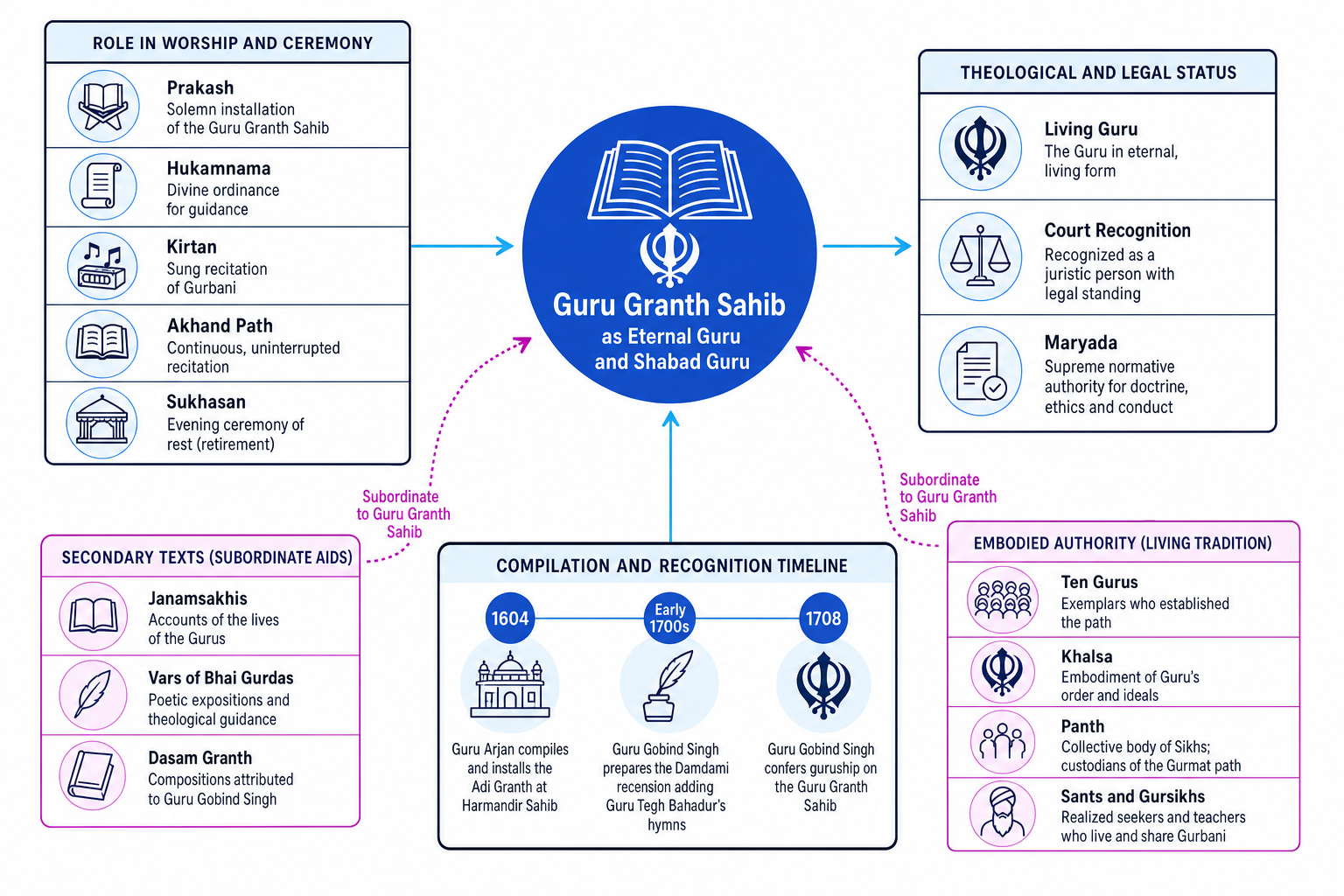
The map below gives you the big picture: Sikh authority is focused on the Guru Granth Sahib, while other sources are respected but subordinate.
Key Idea
The centre of Sikh authority
For Sikhs, the highest continuing authority is the Guru Granth Sahib as shabad Guru: the Guru present through revealed Word, song and teaching.
The Guru Granth Sahib: nature and status
Definition
Guru Granth Sahib
The Guru Granth Sahib is the Sikh scripture of 1430 ang — literally “limbs”, used instead of “pages” — containing hymns by Sikh Gurus and other holy figures, arranged mainly by musical raag.
The Guru Granth Sahib includes hymns from Guru Nanak and several later Gurus, as well as figures from Hindu and Muslim backgrounds such as Kabir, Ravidas, Namdev and Sheikh Farid. This matters because Sikh authority is not based on narrow communal identity. Truth is recognised wherever it expresses devotion to the one God.
The text is not mainly a storybook or a legal code. It is gurbani, meaning the Guru’s revealed utterance. Its authority is encountered through listening, singing, meditating and living by its teaching.
Role in worship and ceremony
In a gurdwara, meaning Sikh place of worship, the Guru Granth Sahib is placed on a raised platform under a canopy. Sikhs bow before it, not because they worship paper and ink, but because the Guru’s wisdom is present through the shabad.
Important practices include:
- Prakash: the ceremonial opening and installation of the Guru Granth Sahib each day.
- Sukhasan: the respectful evening “resting” ceremony.
- Kirtan: sung recitation of hymns from the Guru Granth Sahib.
- Hukamnama: a reading received as the Guru’s command or guidance.
- Akhand path: a continuous complete reading, often around major life events.
- Anand Karaj: the Sikh marriage ceremony, centred on the four Lavan hymns of Guru Ram Das.
Example
Linking ceremony to theological status
-
If a question asks why the Guru Granth Sahib is central in worship, begin with the practice: in a gurdwara it is enthroned, opened in prakash and heard through kirtan and hukamnama.
-
Explain the reasoning: these actions make sense because Sikhs regard the Guru Granth Sahib as the living Guru’s presence through shabad, not as an ordinary religious book.
-
Add a careful qualification: Sikhs are not worshipping a physical object; reverence is directed to the divine wisdom communicated through gurbani.
Theological and legal status
Theological status means its status in Sikh belief. The Guru Granth Sahib is the eternal Guru after the end of the line of human Gurus. Its authority is therefore final for doctrine, worship and ethics.
Legal status also matters. In Indian law, the Guru Granth Sahib has been recognised as a juristic person, meaning it can be treated as having legal standing in certain contexts, for example in relation to gurdwara property. This legal recognition reflects, though does not create, its religious status.
Common Mistake
Calling it the Sikh Bible
Avoid saying “the Sikh Bible” without explanation. It may help a beginner imagine “scripture”, but it misses the key point: for Sikhs, the Guru Granth Sahib is the living Guru, not merely a book of teachings.
Compilation and recognition as Guru
Definition
Canon
A canon is an accepted authoritative collection of sacred writings.
The Sikh canon developed through a process of collection, preservation and recognition.
Guru Nanak’s hymns were preserved by the early Sikh community and passed through the line of Gurus. Guru Angad promoted the Gurmukhi script, which became central to Sikh identity and scripture.
In 1604, Guru Arjan — also spelt Guru Arjun in some exam materials — compiled the Adi Granth, meaning “first scripture”. Bhai Gurdas acted as scribe, and the text was installed at Harmandir Sahib in Amritsar, with Baba Buddha as the first granthi.
In the early 1700s, Guru Gobind Singh prepared the final recension associated with Damdama Sahib, adding the hymns of Guru Tegh Bahadur. In 1708, before his death at Nanded, Guru Gobind Singh declared the Guru Granth Sahib to be the continuing Guru. This ended the succession of human Gurus.
Gurinder Singh Mann and the Institute of Sikh Studies
Gurinder Singh Mann approaches the formation of Sikh scripture through historical manuscript study. He emphasises that the Sikh canon developed through identifiable stages: early collections, Guru Arjan’s Adi Granth, and the final recension linked with Guru Gobind Singh. For Mann, this does not necessarily destroy authority; it shows that Sikh scripture was carefully formed within the living community of the Gurus.
The Institute of Sikh Studies is more protective of the traditional account. It stresses the authenticity, continuity and divine authority of the text, warning that some historical-critical approaches can appear to reduce revelation to ordinary editing or community construction.
Example
Evaluating the compilation debate
-
Use Mann to show that Sikh scripture has a traceable history: manuscripts, collections and recensions can be studied critically.
-
Use the Institute of Sikh Studies to show why many Sikhs defend the text’s continuity and authenticity as essential to its authority as Guru.
-
Reach a balanced judgement: historical development need not undermine religious authority, but for Sikhs the process must still be understood as guided by the Gurus, not as merely human invention.
Secondary texts: useful, but subordinate
Sikhism also has important secondary sources. They can illuminate Sikh history and devotion, but they do not equal the Guru Granth Sahib.
Janamsakhis
The janamsakhis are devotional life stories of Guru Nanak. They contain accounts of his birth, travels, miracles and teaching encounters. They are valuable because they show how Sikhs have remembered Guru Nanak as a teacher and exemplar.
However, they are hagiography, meaning devotional biography. That means they should not always be treated as neutral modern history.
Vars of Bhai Gurdas
The vars of Bhai Gurdas are poetic compositions by the early Sikh scholar and scribe of the Adi Granth. They are often called a “key” to understanding the Guru Granth Sahib because they explain themes such as the gurmukh, the person oriented towards the Guru, and the manmukh, the self-centred person.
Dasam Granth
The Dasam Granth is a collection traditionally associated with Guru Gobind Singh. Parts of it, such as Jaap Sahib and Tav-Prasad Savaiye, are used in Sikh daily prayer and Khalsa initiation.
Its status is debated. Some Sikhs give it great devotional importance, especially for understanding the Khalsa and the warrior-saint ideal. Others question the authorship or authority of parts of the collection. In mainstream Sikh practice, it remains subordinate to the Guru Granth Sahib.
The ten Gurus as teachers and exemplars
The Gurus are not only sources of doctrine. Their lives model how Sikhs should live.
Guru Nanak founded the Sikh path, teaching Ik Onkar, the oneness of God, and rejecting empty ritual, caste pride and religious hypocrisy. His life at Kartarpur modelled honest work, shared food and devotion.
Guru Angad strengthened the community through Gurmukhi. Guru Amar Das developed institutions such as langar, the free communal kitchen, and challenged caste and gender inequality. Guru Ram Das helped establish Amritsar and composed the Lavan hymns used in marriage.
Guru Arjan compiled the Adi Granth and was martyred in 1606. A martyrdom is a death endured for faith or justice. His death became a turning point, showing that Sikh commitment to truth could require suffering.
Guru Hargobind developed miri-piri, the unity of temporal and spiritual responsibility. Guru Har Rai modelled compassion. Guru Har Krishan is remembered for service during illness in Delhi. Guru Tegh Bahadur was martyred in 1675 after defending freedom of conscience, traditionally linked with protecting Kashmiri Pandits from persecution.
Guru Gobind Singh founded the Khalsa in 1699, the initiated Sikh community committed to discipline, equality and courage. He also confirmed the Guru Granth Sahib as eternal Guru in 1708.
Key Idea
Gurus as living examples
The Gurus teach through both words and actions: scripture gives Sikh teaching, but the Gurus’ lives show what that teaching looks like in history.
Guru Nanak and Guru Gobind Singh
Guru Nanak is significant because he establishes the core Sikh vision: one God, remembrance of the divine Name, equality, honest labour and sharing. These are often summarised as naam japna — remembering God’s Name, kirat karni — earning honestly, and vand chhakna — sharing with others.
Guru Gobind Singh is significant because he gives the community a disciplined collective form. At Vaisakhi 1699, he called for the Panj Pyare, the Five Beloved Ones, and initiated them into the Khalsa with amrit, sweetened water stirred with a double-edged sword. He then received initiation from them, showing mutual responsibility within the community.
His decisions in 1699 and 1708 are crucial: in 1699 he formed the Khalsa; in 1708 he ended the human Guru line and directed Sikhs to the Guru Granth Sahib.
N K Singh and W O Cole
N K Singh, often identified with Nikky-Guninder Kaur Singh, tends to emphasise the imaginative, devotional and egalitarian power of the Gurus’ lives. Her work highlights how Sikh identity is formed through memory, embodiment, gender-inclusive symbolism and the transformative birth of the Khalsa.
W O Cole offers a more historical and institutional account. He stresses the continuity of the ten Gurus and how each contributed to the shape of Sikhism: scripture, community, discipline, worship and identity.
Together, they are useful for evaluation. Singh helps you discuss the spiritual meaning of the Gurus as living models. Cole helps you explain the historical development of Sikh institutions.
Sants in contemporary Sikh life
Definition
Sant
A sant is a holy person or spiritual teacher respected for devotion, knowledge of gurbani and religious discipline.
In contemporary Sikh life, sants may teach scripture, lead kirtan, guide meditation, run deras or charitable institutions, and preserve forms of Sikh learning. They can make Sikh wisdom accessible and personal.
But there is a tension. Sikhism rejects any new living Guru after Guru Gobind Singh. Therefore, a sant may be a respected teacher, but cannot override the Guru Granth Sahib or become an object of ultimate authority.
Common Mistake
Authority of sants
A sant’s authority is always conditional. If devotion to a sant weakens loyalty to the Guru Granth Sahib, equality or the Khalsa Panth, many Sikhs would see that as spiritually dangerous.
Exam technique
In the exam
-
Keep returning to the hierarchy of authority: Guru Granth Sahib first, then secondary texts, teachers and traditions judged by that standard.
-
For the compilation debate, use both Gurinder Singh Mann and the Institute of Sikh Studies: one gives historical-critical development, the other defends continuity and sacred authority.
-
For the Gurus, connect biography to practice today: langar, equality, martyrdom, Khalsa identity, miri-piri and the end of human Guruship.
-
When using N K Singh and W O Cole, compare their lenses: spiritual-symbolic meaning in Singh and historical-institutional development in Cole.
Self review
Check yourself
- Why is the Guru Granth Sahib treated differently from an ordinary scripture?
- How does the Mann versus Institute of Sikh Studies debate affect Sikh claims about authority?
- In what ways do Guru Arjan, Guru Tegh Bahadur and Guru Gobind Singh shape Sikh identity today?