Revision notes for Edexcel AS Level Religious Studies Religious beliefs, values and teachings. Open the guide for explanations and worked examples. Written against the Edexcel AS Level Religious Studies specification, so the content matches what's examinable rather than general Religious Studies background.
Religious beliefs, values and teachings
What you'll learn
- How Sikh teaching describes Waheguru, the divine, through ideas such as Mool Mantar, nam, hukam and nadar.
- How Sikh ideas about the self, death and liberation use — but reshape — older Indic ideas such as karma, samsara and mukti.
- Why sangat, Panth and qaum matter for Sikh identity locally, globally and online.
- How Sikh moral life is expressed through nam japna, kirt karna, vand chakna, seva and miri-piri.
1. Sikhs and the divine
Waheguru and oneness
Definition
Waheguru
Waheguru means “Wonderful Lord” or “Wonderful Enlightener”. It is a Sikh name for the one divine reality: personal enough to be loved and addressed, but also beyond full human description.
The starting point of Sikh belief is Ik Onkar: there is one ultimate divine reality. This is not simply “one god among many gods”. It means that reality itself is grounded in one divine source, present throughout creation yet not limited by creation.
The opening of the Guru Granth Sahib is the Mool Mantar, the “root formula” of Sikh belief. It describes God as one, true, creator, without fear, without enmity, timeless, unborn, self-existent and known by the Guru’s grace. The word sat means truth or reality: Waheguru is not temporary or illusory, but the deepest truth of existence.
Definition
Mool Mantar
The Mool Mantar is the foundational statement of Sikh belief at the beginning of the Guru Granth Sahib. It summarises the nature of Waheguru and frames Sikh understanding of life, worship and liberation.
Shabad, nam, hukam and nadar
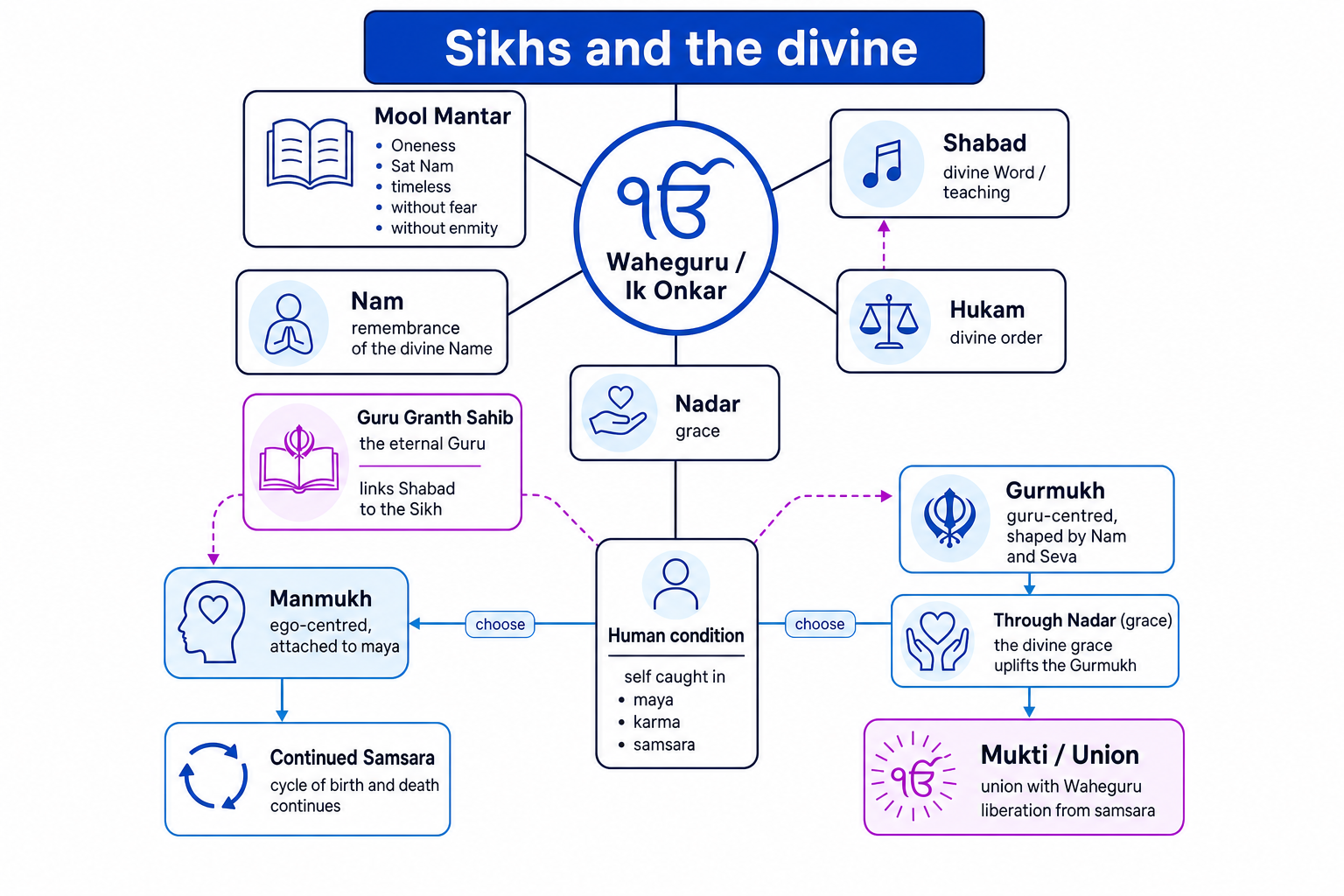
Shabad means the divine Word or revealed teaching, especially as encountered in the Guru Granth Sahib. It is not just written information; it is transformative wisdom that shapes the Sikh’s whole life.
Nam means the divine Name or presence of Waheguru. Nam japna is remembering, meditating on and living in awareness of that divine Name.
Hukam means divine order or command. To live well is to recognise that life is not centred on the ego, but unfolds within Waheguru’s order.
Nadar means grace: the gracious glance or favour of Waheguru. Sikhism does not teach that liberation is earned mechanically; human effort matters, but liberation depends on divine grace.
Key Idea
The path to union
Sikhs unite with Waheguru by becoming centred on the Guru’s teaching, remembering nam, accepting hukam, serving others and receiving nadar. Union is not escape from ordinary life, but transformation within it.
The diagram shows how these ideas fit together: Waheguru is central; the Guru’s shabad guides the Sikh; the human person can live as manmukh or gurmukh.
2. The self, life, death and liberation
Maya, karma and samsara
Maya means illusion or delusive attachment. It does not mean the world is evil. Sikhism values the created world as God’s creation, but warns that humans mistake wealth, status and ego for ultimate reality.
Karma means moral cause and effect: actions have consequences for the soul’s journey. Samsara means the cycle of birth, death and rebirth. Mukti means liberation from that cycle and freedom from ego-centred existence.
A manmukh is someone “self-facing” or ego-centred, ruled by attachment and haumai — ego or self-importance. A gurmukh is “Guru-facing”: someone shaped by the Guru’s teaching, nam, humility and service.
Common Mistake
Maya is not simply ‘the world is bad’
Do not write that Sikhism rejects ordinary life. Sikh teaching rejects attachment and ego, not family, work or society. The ideal Sikh path is lived in the world.
Death is therefore not just a biological event. It is part of the soul’s journey. Sikh teaching often presents human life as a precious opportunity to become gurmukh, receive nadar and move towards mukti. Liberation can also be understood as jivan mukti, liberation while alive: freedom from ego even before physical death.
3. Sikhism and earlier Indic thought
Continuity and contrast
Indic thought refers broadly to religious and philosophical traditions from the Indian subcontinent, including Hindu, yogic, bhakti and other traditions. Sikhism shares some vocabulary with these traditions: karma, samsara, maya, guru and mukti are all terms found in wider Indic religion.
However, Sikhism gives these ideas a distinctive shape. Guru Nanak rejected caste pride, empty ritual, religious hypocrisy and world-denying asceticism. Liberation is not achieved by withdrawing from society, but by truthful living, nam, honest work, sharing and grace.
The sant movement
The sant movement was a North Indian devotional movement associated with poet-saints such as Kabir, Ravidas and Namdev. It emphasised devotion to the divine Name, inner spirituality, criticism of caste and ritual, and the use of everyday language rather than elite religious language.
Sikhism has clear similarities with the sant tradition. The Guru Granth Sahib includes hymns by some sant figures. Yet Sikhism is not simply the sant movement under another name. It developed a Guru lineage, scripture as Guru, sangat, langar, Panth, Khalsa and miri-piri.
K. E. Nayar and J. S. Sandhu are useful here because they present Guru Nanak as emerging within a rich religious background while also transforming it. A strong essay avoids two weak extremes: “Sikhism is totally borrowed” and “Sikhism has no historical context”.
Example
Comparing Sikh and Indic ideas
- Start with a shared term, such as karma. In many Indic traditions, karma explains how moral action shapes future rebirth.
- Add the Sikh reinterpretation. Sikhism accepts moral responsibility but places karma under hukam and insists that nadar is needed for liberation.
- Link this to practice. Because liberation is not achieved by ritual purity or withdrawal, the Sikh path is lived through nam, work, sharing and seva.
- Reach a balanced judgement. This supports Nayar and Sandhu’s view that Guru Nanak used existing religious language but reshaped it into a distinctive Sikh vision.
4. The importance of sangat
Definition
Sangat
Sangat means the holy congregation or community of Sikhs gathered for worship, learning, kirtan, langar and mutual support.
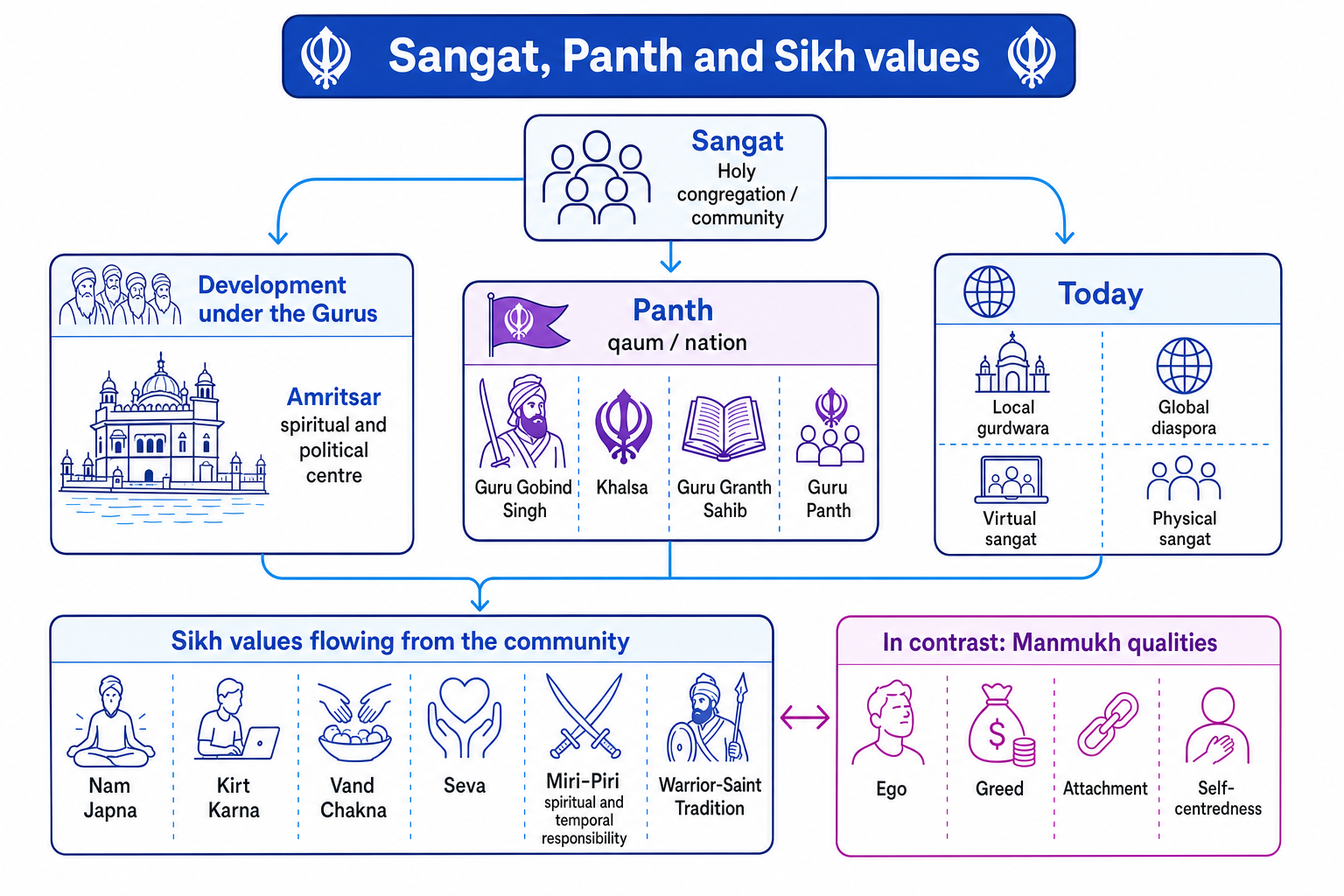
Sangat developed from the lives of the Gurus. Guru Nanak formed a community at Kartarpur based on worship, honest labour and sharing. Later Gurus strengthened Sikh communal structures. Guru Ram Das founded Ramdaspur, which became Amritsar. Guru Arjan developed the Harmandir Sahib and compiled the Adi Granth. Guru Hargobind established the Akal Takht, linking spiritual authority with temporal responsibility.
Amritsar therefore became both a spiritual and political centre: the Harmandir Sahib symbolised worship and openness, while the Akal Takht symbolised authority, justice and collective decision-making.
Panth as qaum and Guru
Panth means the Sikh path and the Sikh community walking that path. Qaum means a people or nation. Calling the Panth a qaum does not always mean a modern nation-state; it means Sikhs understand themselves as a distinct, translocal community with shared discipline, memory and responsibility.
From the lifetime of Guru Gobind Singh, the Panth gained special authority. In 1699 he founded the Khalsa, a disciplined community committed to courage, equality and service. Sikh tradition teaches that after Guru Gobind Singh, authority rests in the Guru Granth Sahib and the Guru Panth — the scripture as eternal Guru and the collective Panth guided by the Guru’s teaching.
Common Mistake
Panth does not mean any majority opinion
The Panth has authority only when guided by gurmat — the Guru’s wisdom — and by the Guru Granth Sahib. It is not simply whatever a group of Sikhs happens to decide.
Sangat today: local, global, virtual and physical
Locally, sangat is centred on the gurdwara, where Sikhs gather for kirtan, prayer, teaching, langar and life-cycle events. Globally, sangat is shaped by diaspora communities, pilgrimage, charities, political campaigns and shared media.
Virtual sangat has become increasingly important through livestreamed kirtan, online hukamnamas, discussion groups and diaspora networks. K. Nayar’s work on Sikh communities is useful for showing how Sikh identity is negotiated across migration, generations and global connections. N. K. Singh is useful for emphasising that Sikh spirituality is embodied and communal, not merely private belief.
A balanced evaluation would say that virtual sangat can widen access, especially for isolated Sikhs, but it cannot fully replace physical practices such as langar, shared seva and embodied presence before the Guru Granth Sahib.
5. Key moral principles and values
Nam japna, kirt karna and vand chakna
Nam japna means remembering and meditating on the divine Name. Kirt karna means earning honestly through truthful labour. Vand chakna means sharing what one has with others.
These three principles express a gurmukh lifestyle today. Sikh ethics is not just about private prayer. It joins devotion, work and social responsibility.
Example
Applying the three daily principles
- Consider a Sikh running a business. Nam japna shapes the person’s intention: business should not become an idol of ego, greed or status.
- Apply kirt karna to the method of earning. The Sikh should avoid exploitation, dishonesty, fraud or unfair treatment of workers.
- Apply vand chakna to the outcome. Profit is not purely private; it should be shared through family responsibility, community support, charity or dasvandh.
- Evaluate the lifestyle. The same activity — business — can become manmukh if driven by greed, or gurmukh if shaped by remembrance, honesty and sharing.
Seva
Definition
Seva
Seva means selfless service to God and to others. It should be done without pride, reward-seeking or superiority.
Seva can be physical, mental or material: cooking in langar, cleaning the gurdwara, teaching, giving money, helping in disaster relief or caring for vulnerable people. It is service to others because the divine is present in creation.
Miri-piri and the warrior tradition
Miri-piri means the joining of temporal and spiritual responsibility. It is associated especially with Guru Hargobind, who wore two swords: one for spiritual authority and one for worldly or political responsibility.
This is often treated as a unique and distinctive feature of Sikhism. Sikh spirituality is not meant to be detached from justice. The warrior tradition develops this through the ideal of the sant-sipahi, the saint-soldier: spiritually disciplined, but ready to defend the oppressed when necessary.
This does not mean violence is glorified. The Sikh warrior tradition is tied to justice, defence, discipline and protection, not aggression. Guru Gobind Singh’s Khalsa embodies this combination of devotion, equality and courage.
Manmukh qualities
Strictly, Sikh values are not expressions of manmukh; they are the cure for manmukh tendencies. The manmukh life is marked by ego, greed, anger, attachment and pride. Sikh values expose those tendencies and redirect the person towards the Guru.
N. K. Singh is helpful for showing that Sikh ethics is integrated: spiritual devotion, social equality and public responsibility belong together. J. Sandhu is useful for stressing Sikhism’s socially engaged path: the Sikh ideal is not withdrawal, but truthful, active life in the world.
Using the named scholars well
- Nayar and Sandhu: use them to compare Sikh ideas with Indic and sant backgrounds without reducing Sikhism to those backgrounds.
- N. K. Singh and K. Nayar: compare theological ideals of community with sociological realities of local, global and diaspora sangat.
- N. K. Singh and J. Sandhu: use them to evaluate Sikh values as lived, public and socially engaged rather than merely private devotion.
Exam technique
In the exam
- Define Sikh terms precisely before evaluating them: for AO1, words like hukam, nadar, gurmukh, Panth and miri-piri need clear explanation.
- Build comparison into your argument, not just the final paragraph: show how one named scholar supports, challenges or develops the other.
- For AO2, make a judgement on distinctiveness: is Sikhism best understood as continuous with Indic and sant traditions, or as a transformed and distinctive path?
- Use examples of practice — sangat, langar, seva, Khalsa, Amritsar — to show that Sikh beliefs become lived values.
Self review
Check yourself
- How do hukam and nadar qualify a simple “karma causes rebirth” explanation?
- In what ways is Sikhism similar to, but distinct from, the sant movement?
- Why is miri-piri important for understanding Sikh moral and political responsibility?