Revision notes for Edexcel AS Level Religious Studies Practices that shape and express religious identity. Open the guide for explanations and worked examples. Written against the Edexcel AS Level Religious Studies specification, so the content matches what's examinable rather than general Religious Studies background.
Practices that shape and express religious identity
What you'll learn
- How the Singh Sabha movements helped affirm a distinctive Sikh identity under British rule.
- How the Sikh Rehat Maryada, Anand Marriage Act 1909 and gurdwara reform made certain Sikh practices “official”.
- Why Oberoi and the Institute of Sikh Studies disagree about whether modern Sikh identity was “constructed” or “restored”.
- How Sikhs differ over Khalsa initiation, the 5 Ks and the practice of nam simaran.
Big picture: identity is lived, not just believed
In Sikhism, identity is expressed through belief, community, discipline and practice. A Sikh identity is not only “I believe in the Gurus”; it may also include worship in the gurdwara (“doorway to the Guru”, the Sikh place of worship), honouring the Guru Granth Sahib as the living Guru, practising seva (selfless service), and remembering God through nam simaran.
This topic asks a historically sensitive question: did late 19th- and early 20th-century reforms simply recover the identity taught by the Gurus, or did they sharpen and standardise Sikh identity in a new way?
The Singh Sabha movements
Definition
Singh Sabha movements
The Singh Sabha movements were Sikh reform associations beginning in the late 19th century, especially the Amritsar Singh Sabha in 1873 and Lahore Singh Sabha in 1879, which promoted Sikh education, Gurmukhi, publication, reform of practice and a clearer public Sikh identity.
The background matters. The British annexed Punjab in 1849. Under British rule, censuses, legal categories and print culture encouraged communities to define themselves more sharply: Hindu, Muslim, Sikh, Christian, and so on. At the same time, Christian missionary activity, Arya Samaj Hindu reform, and debates over shrine practices pushed many Sikhs to defend what made Sikhism distinctive.
The Tat Khalsa (“true” or “pure” Khalsa) wing, especially linked with Lahore, became highly influential. It stressed that Sikhism was not a branch of Hinduism, rejected idol worship and Brahmanical ritual, promoted the Guru Granth Sahib and Khalsa discipline, and encouraged Punjabi in Gurmukhi script.
Use this timeline to see how late-colonial reform aims became public institutions, laws and codes of practice:
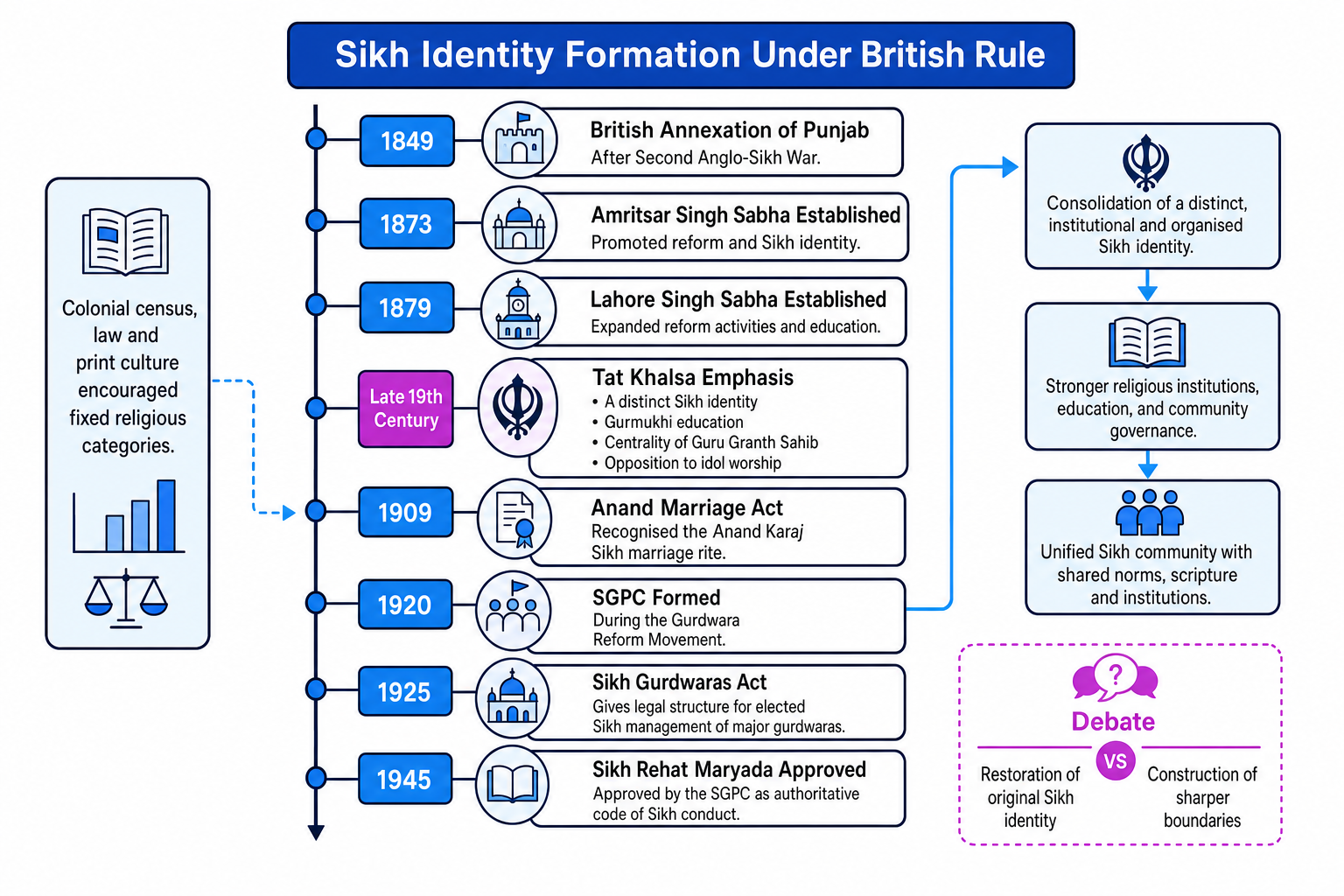
Three reforms that made a Sikh identity official
1. The Sikh Rehat Maryada
Definition
Sikh Rehat Maryada
The Sikh Rehat Maryada is the official Sikh code of conduct approved by the Shiromani Gurdwara Parbandhak Committee (SGPC) in 1945, setting out Sikh belief, worship, life-cycle rites, gurdwara conduct and Khalsa discipline.
Its process was gradual. After gurdwara reform created stronger Sikh institutions, SGPC committees worked through the 1930s and 1940s to produce a standard code. It defined a Sikh as someone who believes in one God, the ten Gurus, the Guru Granth Sahib, the teachings of the Gurus, and the initiation bequeathed by Guru Gobind Singh, and who owes allegiance to no other religion.
Its impact was major: it gave an authoritative form to Sikh worship and conduct. It strengthened unity, but it also made one variant — broadly Tat Khalsa, Khalsa-centred and anti-syncretic — more official than looser or more mixed forms of Sikh practice.
2. The Anand Marriage Act 1909
Anand Karaj is the Sikh marriage ceremony, centred on the couple’s relationship before the Guru Granth Sahib and the singing of the Lavan, four hymns by Guru Ram Das.
The Anand Marriage Act 1909 legally recognised this Sikh marriage rite under British rule. This mattered because it meant Sikhs did not need to rely on Hindu marriage forms or Brahmanical ritual for legal recognition.
Its impact was narrower than the Rehat Maryada, because it focused on marriage rather than the whole of Sikh life. But symbolically it was powerful: it gave Sikh marriage a distinct legal identity and made the Anand form the recognised Sikh norm.
3. Gurdwara reform
By the early 20th century, many important gurdwaras were controlled by hereditary mahants — shrine managers. Some were accused of corruption or of allowing practices reformers saw as non-Sikh, such as idol worship or ritual patterns closer to Hindu practice.
The Gurdwara Reform Movement of the 1920s, associated with Akali activism, aimed to bring gurdwaras under representative Sikh control. The SGPC was formed in 1920, and the Sikh Gurdwaras Act 1925 gave a legal structure for managing major gurdwaras.
Its impact was huge. It changed who controlled Sikh sacred spaces and standardised public worship around the Guru Granth Sahib. However, it also marginalised older, more plural shrine cultures.
Key Idea
The official variant
The Rehat Maryada, Anand Marriage Act and gurdwara reform did not invent Sikhism, but they gave legal and institutional authority to a more clearly bounded, Khalsa-oriented form of Sikh identity.
Oberoi and the Institute of Sikh Studies
Harjot Oberoi, in The Construction of Religious Boundaries, argues that earlier Punjabi religious life was often more fluid than modern categories suggest. Sikhs could share practices, festivals, shrines and social customs with Hindus and others. On this view, Singh Sabha reform constructed sharper religious boundaries by selecting some practices as properly Sikh and rejecting others as Hindu, superstitious or corrupt.
The Institute of Sikh Studies takes a more internal Sikh view. It argues that Sikhism was already a distinctive revealed tradition from Guru Nanak onwards, with the Khalsa as its developed form under Guru Gobind Singh. From this perspective, the Singh Sabha movements did not construct Sikh identity from nothing; they recovered and defended authentic Sikh teaching against distortion, Hinduisation and colonial misunderstanding.
Common Mistake
Construction does not mean fake
When Oberoi says Sikh boundaries were “constructed”, he does not simply mean “made up”. He means identity was historically shaped, standardised and made sharper through institutions, law, print and reform.
Example
Weighing restoration and construction
-
Take gurdwara reform as your evidence: Sikh activists removed many hereditary mahants and placed major gurdwaras under SGPC authority.
-
Apply Oberoi: because earlier shrine practice was diverse, reform selected one model of proper Sikh worship and gave it legal force, so boundaries became sharper.
-
Apply the Institute of Sikh Studies: because the Guru Granth Sahib and Khalsa discipline were already central to Sikh tradition, reform restored gurdwaras to authentic Sikh control.
-
Make a balanced judgement: the strongest answer can say reform drew on real Sikh sources, but gave one interpretation unprecedented institutional authority.
Initiation into the Khalsa and the 5 Ks
Definition
Khalsa
The Khalsa is the initiated Sikh order founded by Guru Gobind Singh at Vaisakhi 1699. Sikhs enter through amrit sanchar, an initiation ceremony using amrit, and commit to the Sikh Rehat Maryada and the 5 Ks.
The 5 Ks are:
- Kesh — uncut hair, expressing acceptance of God’s will and Sikh identity.
- Kangha — a comb, symbolising discipline and cleanliness.
- Kara — a steel bracelet, reminding the Sikh of God and moral restraint.
- Kirpan — a ceremonial sword, linked with justice and defence of the vulnerable.
- Kachera — short breeches, associated with self-control and readiness.
The main identity categories in this debate are mapped here:
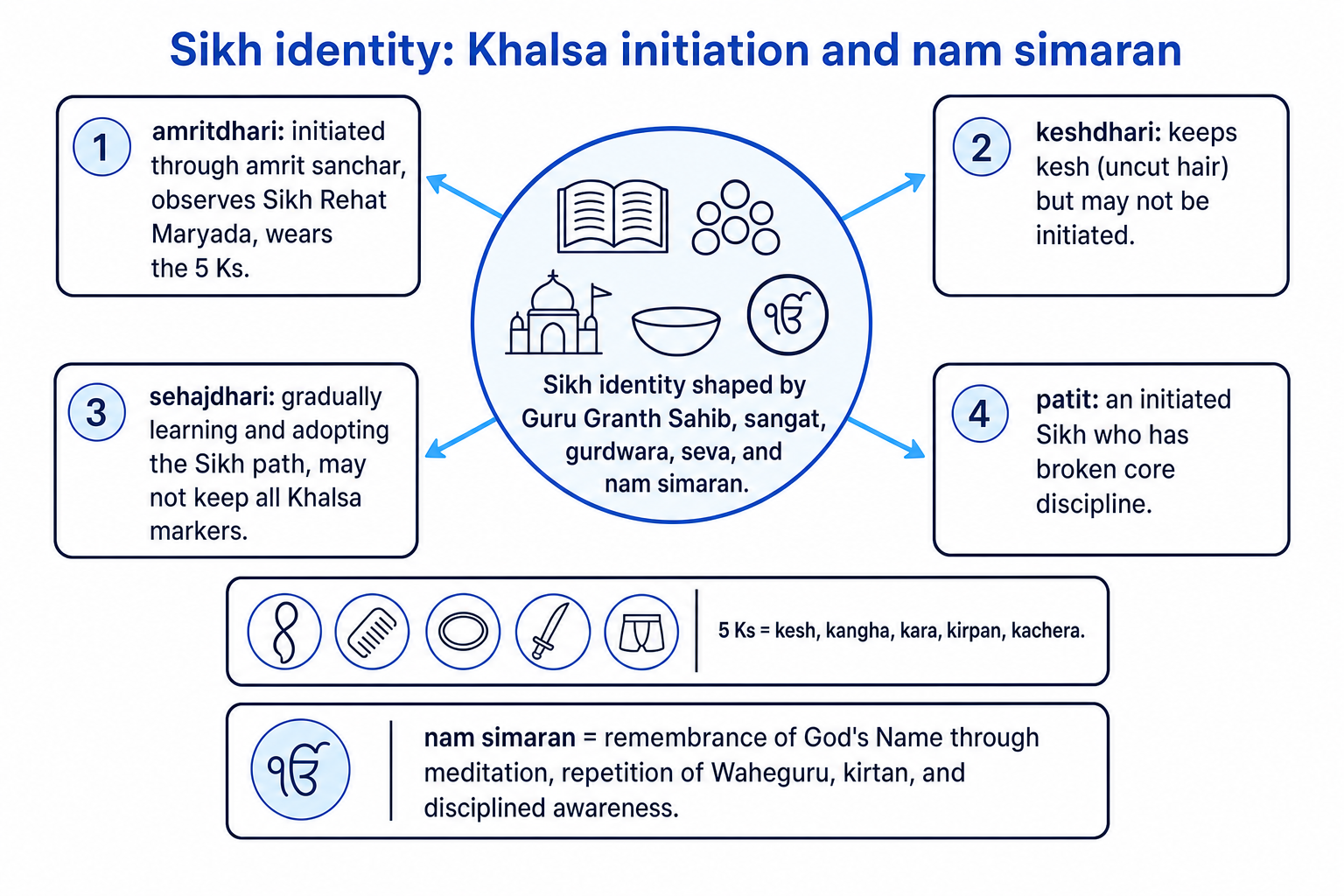
Different Sikh identity categories
- An amritdhari Sikh has taken amrit, belongs to the Khalsa and keeps the 5 Ks.
- A keshdhari Sikh keeps uncut hair but may not have taken amrit.
- A sehajdhari Sikh is often understood as someone gradually adopting the Sikh path, but not fully observing Khalsa discipline. This category is debated.
- A patit is an initiated Sikh who has broken core Khalsa discipline, for example by cutting kesh.
Example
Classifying Khalsa-related identity
-
A Sikh who keeps uncut hair but has not taken amrit is not amritdhari, because initiation through amrit sanchar is missing.
-
They are best described as keshdhari, because kesh is being maintained as a visible Sikh commitment.
-
If that same person later takes amrit and then deliberately cuts their kesh, strict Rehat-based language would describe them as patit, because the breach comes after initiation.
Different perspectives on Khalsa initiation
A strong Khalsa-centred view sees initiation as the fullest expression of Sikh identity. The 5 Ks are not just symbols; they are daily embodied discipline. This fits the Institute of Sikh Studies’ emphasis on the distinctiveness and continuity of Sikh tradition.
A more inclusive view notes that many committed Sikhs are not amritdhari. Some may practise seva, attend gurdwara, honour the Guru Granth Sahib and live ethically without taking amrit. Oberoi’s work helps explain why Sikh identity has often been more varied than official definitions suggest.
The best evaluation avoids a false choice. External discipline without inner devotion can become empty formalism, but inner devotion should not be used to dismiss the historical importance of Khalsa identity.
Tip
Useful essay judgement
You can argue that Khalsa initiation is the clearest public marker of Sikh identity, while nam simaran is the deeper spiritual practice that should animate every Sikh life.
Nam simaran
Definition
Nam simaran
Nam simaran means remembrance of the divine Name. In Sikhism, Naam is not just a word for God; it refers to God’s living reality and presence, remembered through meditation, prayer, singing and ethical awareness.
Nam simaran is central across Sikh traditions. It is linked with Naam japna — remembering and repeating God’s Name — one of the core Sikh duties alongside honest work and sharing with others.
Practices include silent meditation, repetition of Waheguru, recitation of the Mool Mantar, singing kirtan from the Guru Granth Sahib, and daily prayers such as nitnem. A mantra is a repeated sacred phrase used as a focus for meditation; in Sikh practice, Waheguru is often called the Gurmantar, the Guru-given mantra.
Its importance is spiritual and ethical. Nam simaran is meant to reduce haumai — ego-centredness — and form a person who lives in awareness of God, compassion and service.
There are different emphases. Some Sikhs focus on disciplined meditative repetition. Others stress that remembrance must be lived through honest work, seva and moral transformation. Most Sikh perspectives would reject the idea that mantra is a magic formula; it is a way of reorienting the self towards God.
Common Mistake
Opposing inner and outer practice too sharply
Do not write as if nam simaran is “real religion” and the 5 Ks are “only external”. In Sikh thought, inner remembrance and outward discipline are meant to support each other.
Bringing the topic together
For essays, think in three layers:
- Inner identity — nam simaran, devotion to God, overcoming ego.
- Embodied identity — Khalsa initiation, Rehat and the 5 Ks.
- Institutional identity — SGPC, gurdwara reform, Sikh Rehat Maryada and legal recognition through the Anand Marriage Act.
The strongest answers show that Sikh identity is both continuous and historically developed: rooted in the Gurus and Khalsa, but also clarified through modern reform movements and institutions.
Exam technique
In the exam
-
Use precise chronology: Singh Sabha in the late 19th century, Anand Marriage Act in 1909, SGPC in 1920, Sikh Gurdwaras Act in 1925, Rehat Maryada approved in 1945.
-
Compare Oberoi and the Institute of Sikh Studies directly: “constructed sharper boundaries” versus “restored authentic Sikh distinctiveness”.
-
Make a judgement on each reform’s impact: Anand Marriage Act was symbolically important, gurdwara reform was institutionally powerful, and the Rehat Maryada was the broadest code of identity and practice.
Self review
Check yourself
- How did the Sikh Rehat Maryada, Anand Marriage Act and gurdwara reform each make one form of Sikh practice official?
- What is the difference between amritdhari, keshdhari, sehajdhari and patit?
- Why might nam simaran be seen as both more universal and less visible than Khalsa initiation?