Revision notes for Edexcel AS Level Religious Studies Religion and society. Open the guide for explanations and worked examples. Written against the Edexcel AS Level Religious Studies specification, so the content matches what's examinable rather than general Religious Studies background.
Religion and society
What you'll learn
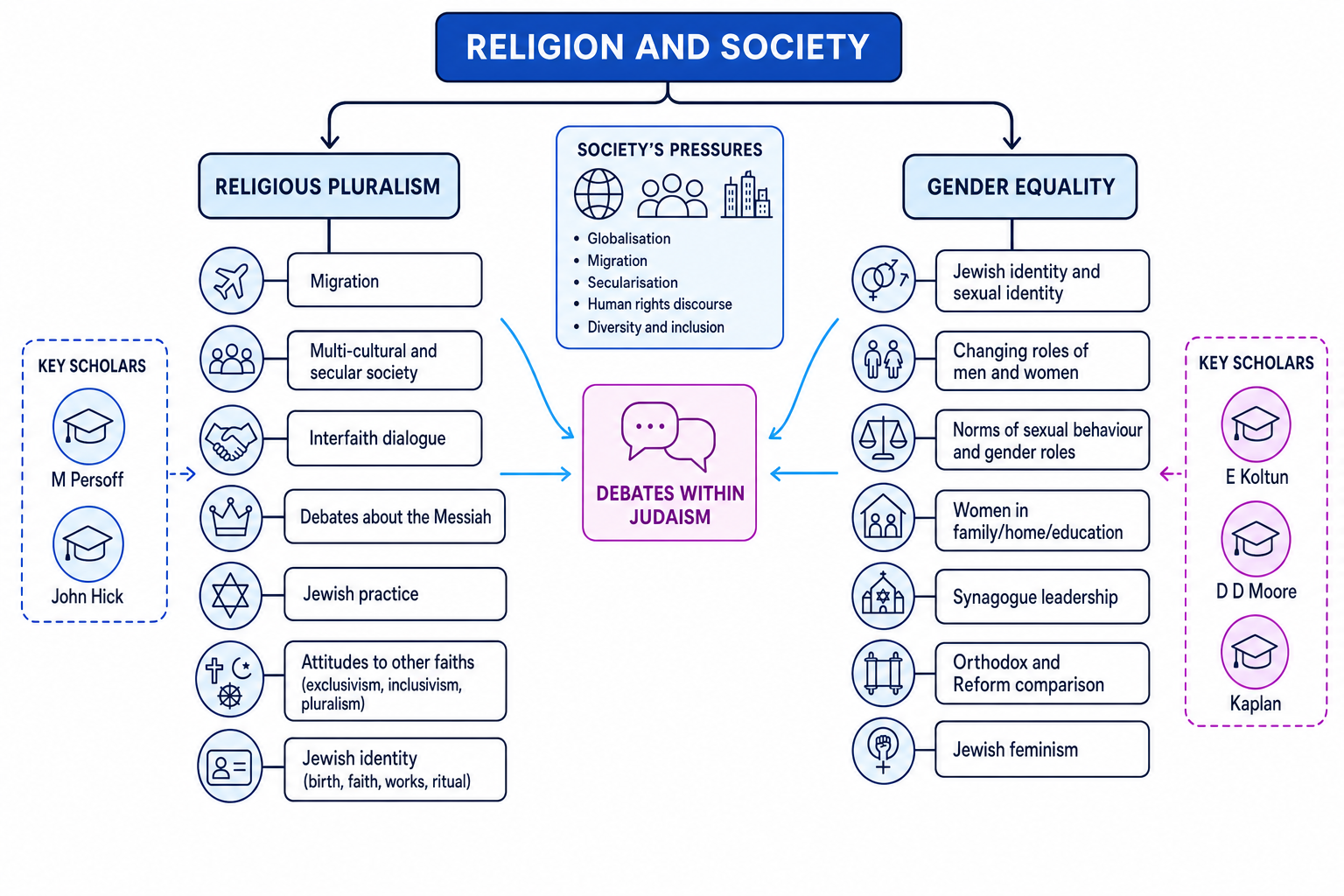
- How migration and secular multicultural societies affect Jewish practice and interfaith dialogue.
- How Jews may respond to other faiths through exclusivism, inclusivism and pluralism.
- Why Jewish identity can involve birth, belief, ethical action and ritual belonging.
- How gender equality is debated in family life, education and synagogue leadership.
This topic is about how Judaism responds when society changes: migration, secularism, religious diversity, feminism and debates about sexuality all raise questions about authority, identity and practice.
1. Religious pluralism
Definition
Religious pluralism
Religious pluralism can mean two things: the social fact that many religions exist side by side, and the philosophical view that more than one religion may contain genuine truth or a valid path to God.
In Judaism, pluralism is complicated because Judaism is not only a set of beliefs. It is also a people, a covenant community, a legal tradition and a way of life. A covenant is a binding relationship between God and the Jewish people, traditionally linked to Abraham and Moses.
Migration, multicultural society and practice
Migration has shaped Jewish life for centuries. The diaspora means Jewish communities living outside the land of Israel. In the UK, Jewish life includes Ashkenazi, Sephardi, Mizrahi, Israeli, Russian-speaking and other communities. In Israel, Jewish migration through aliyah — immigration to Israel — has created a Jewish-majority society with internal ethnic, religious and political diversity.
In a secular multicultural society, Jewish practice may need negotiation. Observant Jews may seek accommodation for Shabbat — the weekly day of rest from Friday evening to Saturday evening — and kashrut, the Jewish dietary laws. Schools and workplaces may need to consider Jewish festivals, kosher food, prayer, modest dress or an eruv, a symbolic boundary that helps some Orthodox Jews carry items on Shabbat.
Key Idea
Migration changes the questions
Migration does not simply “weaken” religion. It can make Jewish identity more visible, create new interfaith relationships, and force communities to decide which practices are essential and which can adapt.
Interfaith dialogue and the Messiah
Interfaith dialogue means purposeful conversation and cooperation between people of different faiths. Jewish-Christian dialogue became especially important after the Holocaust, and Jewish-Muslim dialogue is significant in both the UK and Israel.
One sensitive issue is the Messiah. In traditional Judaism, the Messiah is usually understood as a future human descendant of King David who will bring peace, justice, restoration and knowledge of God. Jews generally reject the Christian claim that Jesus is the Messiah because, from a Jewish perspective, the messianic age has not yet arrived. Reform Judaism often places more emphasis on a future Messianic Age than on a single personal Messiah.
Common Mistake
Pluralism is not the same as agreement
Interfaith dialogue does not mean all religions secretly teach the same thing. Jews can respect Christians and Muslims while still rejecting Christian claims about Jesus or disagreeing with Islamic claims about Muhammad.
Exclusivism, inclusivism and pluralism
Definition
Three responses to other faiths
Exclusivism says only one religion has saving or ultimate truth. Inclusivism says one religion is fullest or most authoritative, but others may contain truth. Pluralism says multiple religions may be valid responses to ultimate reality.
Judaism often has an inclusivist tendency. It does not normally teach that everyone must become Jewish. The Noahide laws are universal moral laws traditionally seen as binding on non-Jews. Rabbinic teaching that “the righteous among the nations have a share in the world to come” supports respect for non-Jewish moral and spiritual life.
At the same time, Judaism is strongly monotheistic and rejects idolatry, the worship of created things or false gods. So Jewish respect for other faiths has limits: not every truth claim can be accepted as equally true.
Persoff and Hick
John Hick argued for a pluralist “Copernican revolution” in religion: instead of placing one religion at the centre, we should see religions as different culturally shaped responses to “the Real”, Hick’s term for ultimate divine reality. For Hick, the key evidence is transformation from self-centredness to Reality-centredness.
Meir Persoff, writing on modern British Judaism and religious pluralism, is useful because he shows that pluralism is not only about Jews and non-Jews. It is also about recognition between Jewish denominations. Orthodox, Reform and Liberal Jews may cooperate socially, but they often disagree sharply over authority, conversion, marriage and who can speak for Judaism.
Example
Using Hick and Persoff in evaluation
-
Apply Hick first: his pluralism fits Jewish non-missionary attitudes because Judaism can affirm that righteous non-Jews may relate to God without becoming Jewish.
-
Add a Jewish limit: Hick’s idea may flatten distinctive Jewish claims about covenant, Torah and mitzvot, because Judaism is not just one symbolic route to a generic “Real”.
-
Use Persoff to sharpen the judgement: even within Judaism, pluralism is contested, since Orthodox authorities may respect Progressive Jews as people while not recognising Progressive conversions or rabbinic authority.
2. Jewish identity
Jewish identity may include birth, faith, works and ritual.
- Birth: Orthodox Judaism usually defines Jewish status through a Jewish mother or valid conversion. Some Reform and Liberal communities may recognise a person with one Jewish parent if they are raised and identify as Jewish.
- Faith: Belief in one God matters, but Judaism is not only a creed. A secular Jew may still be ethnically, culturally or communally Jewish.
- Works: Mitzvot are commandments or religious duties. Ethical action, charity, justice and keeping commandments can express Jewish identity.
- Ritual: Circumcision, naming ceremonies, bar or bat mitzvah, Shabbat, festivals, prayer and synagogue life all mark belonging.
Example
Assessing Jewish identity in a case
-
If someone has a Jewish mother but does not believe in God, an Orthodox view would usually still regard them as Jewish by birth, though not religiously observant.
-
If someone has no Jewish parent but lives ethically and believes in God, most Jewish traditions would respect them, but would not count them as Jewish without conversion.
-
If someone has one Jewish parent and is raised in synagogue life, a Progressive community may recognise their Jewish identity more readily than an Orthodox authority.
3. Gender, sexual identity and equality
Definition
Halakhah
Halakhah means Jewish religious law, including Torah, rabbinic interpretation and later legal rulings. Orthodox Judaism generally treats halakhah as binding; Reform and Liberal Judaism usually give more weight to ethical development and informed personal autonomy.
Definition
Sexual identity
Sexual identity refers to how a person understands and lives their sex, gender and sexuality. In essays, be clear whether you mean gender roles, same-sex relationships, or transgender and non-binary identity.
Jewish teaching traditionally sees sex positively within marriage, linked to love, holiness and family life. However, traditional halakhah restricts sexual behaviour, including prohibitions on male same-sex intercourse in Leviticus. Orthodox communities often maintain these norms, though pastoral approaches vary. Reform, Liberal and some Masorti communities are usually more affirming of LGBTQ+ relationships and may conduct same-sex marriages.
Equality: equal worth or equal roles?
A major debate is whether equality means equal dignity with different roles or equal access to the same religious roles. Orthodox Jews may argue that men and women have equal spiritual worth but different obligations. For example, women are traditionally exempt from some time-bound positive commandments. Progressive Jews often argue that this becomes discriminatory if it excludes women from public religious leadership.
Tip
A strong comparison phrase
You can write: “The disagreement is not simply whether women matter, but whether inherited role-difference is a valid form of equality.”
4. Women in family life, home and education
Women have often had central roles in the Jewish home: lighting Shabbat candles, maintaining kashrut, shaping children’s Jewish education and preserving festival practice. In Orthodox Judaism, women also have a key identity role because Jewish status is traditionally matrilineal.
Education has changed significantly. Historically, advanced Torah study was mainly male, but modern Jewish education for girls expanded dramatically. Orthodox girls’ schools, women’s seminaries and higher Jewish learning are now common, even where synagogue roles remain restricted. Progressive communities usually educate boys and girls equally for bat and bar mitzvah and adult leadership.
Common Mistake
Do not oversimplify Orthodoxy
It is inaccurate to say Orthodox Judaism “does not educate women”. Many Orthodox women are highly educated in Jewish texts; the sharper debate is about authority, public ritual obligation and leadership.
5. Women in synagogue leadership
A synagogue is a Jewish house of prayer, study and community. A rabbi is a teacher and religious leader trained in Jewish law and tradition. A minyan is the quorum traditionally required for certain public prayers; in Orthodox practice it usually means ten adult Jewish men.
Orthodox synagogues generally do not ordain women as rabbis in the same way as men, do not count women in a traditional minyan, and often separate men and women with a mechitzah, a partition. Some Modern Orthodox communities have developed women’s leadership roles, such as female scholars, advisers in family purity law, or “maharat”-style roles, but these remain debated.
Reform and Liberal Judaism are usually egalitarian. Women may be rabbis, cantors, Torah readers, synagogue chairs and members of the minyan. Regina Jonas was ordained in Germany in 1935 and is widely recognised as the first woman rabbi. Julia Neuberger is a major British example of female rabbinic leadership in Liberal Judaism.
Jewish feminism: Koltun, Moore and Kaplan
Elizabeth Koltun is associated with Jewish feminist thought that challenges women’s exclusion from public ritual, leadership and interpretation. Her work supports the idea that women should not merely be “included” in existing structures but should help reshape Jewish life.
Deborah Dash Moore and Marion Kaplan, as historians of gender and Jewish history, argue that gender changes how we tell Jewish history. If we only study male rabbis, institutions and public authority, we miss the home, migration, education, work, family and women’s agency.
Example
Comparing Orthodox and Reform views on women rabbis
-
Start with authority: Orthodox arguments usually prioritise halakhah and inherited communal practice, while Reform arguments prioritise equality, ethical development and changing religious consciousness.
-
Apply this to leadership: Orthodox communities may expand women’s learning and advisory roles without ordaining women as rabbis; Reform communities see ordination as a necessary expression of equal dignity.
-
Evaluate with feminism: Koltun supports transformation of Jewish structures, while Moore and Kaplan show that women’s roles have always shaped Jewish survival, even when official histories ignored them.
Key Idea
The central gender debate
The question is not whether women are important in Judaism. The real debate is whether importance in home, family and education is enough, or whether equality requires full public religious authority.
6. Pulling the topic together
For essays, avoid writing as if “Judaism” has one view. The strongest answers compare Orthodox, Reform and Liberal approaches, and also notice the difference between Jewish life in Israel and in the UK.
Religious pluralism asks: how can Jews respect other faiths while preserving covenant, Torah and distinctive identity? Gender equality asks: how can Jews honour tradition while responding to modern claims about justice, sexuality and leadership?
Exam technique
In the exam
-
Define your key term early: pluralism, inclusivism, halakhah, feminism or equality.
-
Compare named scholars directly: use Hick with Persoff for pluralism, and Koltun with Moore and Kaplan for gender.
-
Reach a judgement that recognises diversity within Judaism rather than claiming one simple “Jewish view”.
Self review
Check yourself
- Why might Judaism be described as inclusivist rather than fully pluralist?
- How do birth, faith, works and ritual each contribute to Jewish identity?
- What is the strongest Orthodox argument against women rabbis, and how might a Reform feminist respond?