Revision notes for Edexcel AS Level Religious Studies Works of scholars. Open the guide for explanations and worked examples. Written against the Edexcel AS Level Religious Studies specification, so the content matches what's examinable rather than general Religious Studies background.
Works of scholars
What you'll learn
- How the different historical contexts of Maimonides and Moses Mendelssohn shaped their thought.
- The key teachings, works and controversies linked to each scholar.
- How to compare their strengths and weaknesses within Judaism.
- How to use D. Cohn-Sherbok and G. Robinson in an Edexcel essay.
Why this topic matters
This topic is about how two major Jewish thinkers used reason to defend and explain Judaism in very different worlds.
Maimonides, also known as Rabbi Moses ben Maimon or the Rambam, lived in the medieval Islamic world. He tried to show that Jewish law and belief could stand alongside serious philosophy.
Moses Mendelssohn lived in Enlightenment Europe. He tried to show that Jews could remain faithful to Judaism while participating in wider modern society.
Key Idea
The big comparison
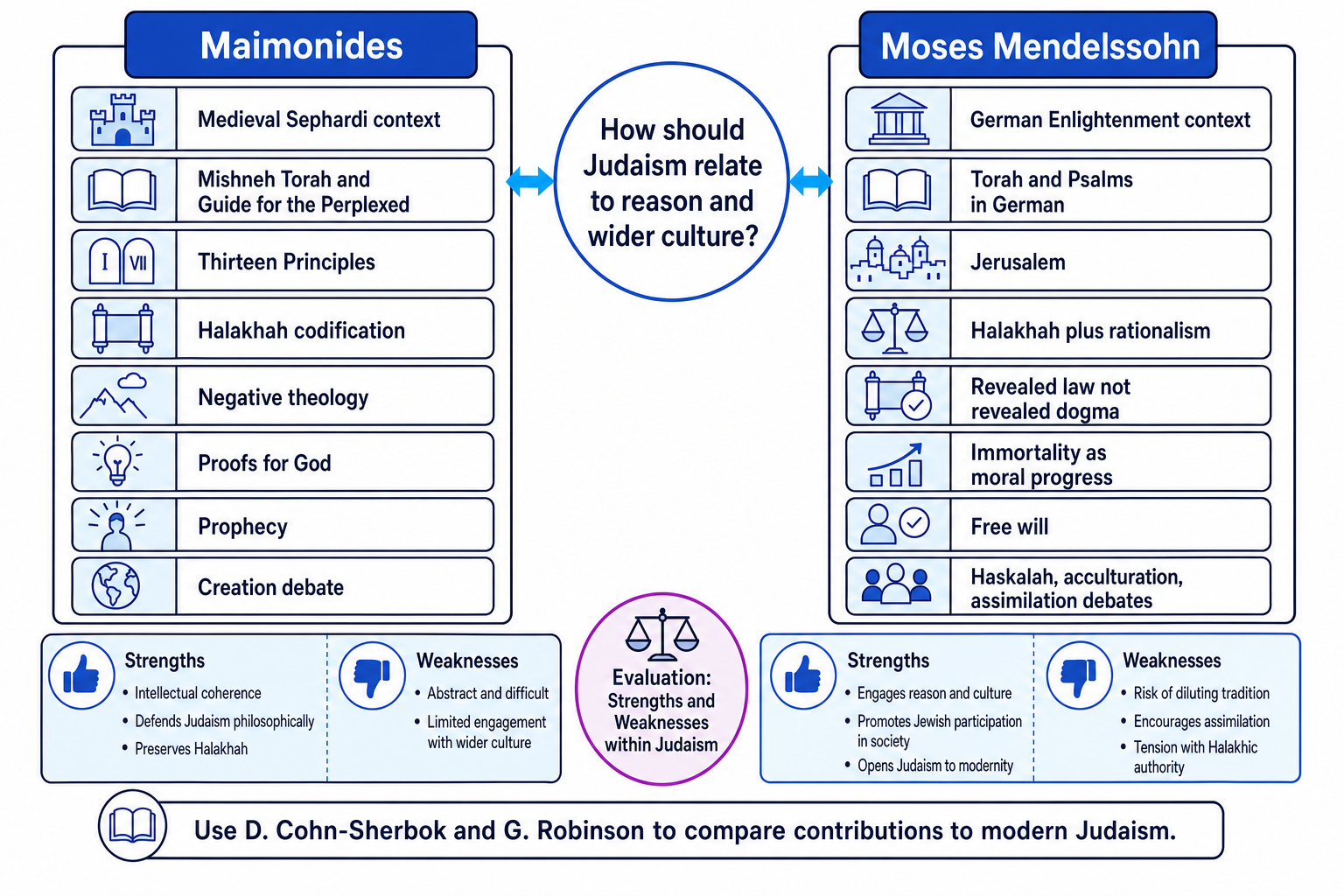
Both scholars defend Judaism through reason, but Maimonides mainly systematises Jewish belief and law from within the medieval rabbinic tradition, while Mendelssohn argues that Judaism can remain observant while engaging with modern European culture.
Key terms you need first
Definition
Halakhah
Halakhah means Jewish religious law: the practical rules governing worship, ethics, diet, festivals, family life and community life. It comes from the Torah, rabbinic interpretation, the Mishnah and the Talmud.
Definition
Rationalism
Rationalism is the view that human reason is a reliable route to truth. In this topic, it means using philosophical argument to defend Jewish belief, practice and identity.
Definition
Haskalah
Haskalah means the Jewish Enlightenment: a movement encouraging Jews to engage with European education, language, philosophy and civic society while rethinking Jewish identity.
Different contexts
Maimonides: medieval Judaism and philosophy
Maimonides was born in Córdoba in 1138 and later lived in North Africa and Egypt. He belonged to the Sephardi Jewish world, shaped by Islamic civilisation, Arabic philosophy and rabbinic learning.
He lived at a time when Jewish communities were under pressure from persecution, migration and intellectual challenge. Educated Jews encountered Greek philosophy, especially Aristotle, through Arabic thinkers. This raised difficult questions: could Judaism survive philosophical scrutiny? Could Torah and reason be harmonised?
Maimonides’ answer was largely yes, but with limits. Philosophy could clarify Jewish belief, but it must not overturn revealed truth.
Mendelssohn: Enlightenment Europe
Moses Mendelssohn lived from 1729 to 1786 in Germany. His context was the European Enlightenment, which emphasised reason, tolerance, education and individual freedom.
Jews in Europe were often socially and legally restricted. Mendelssohn wanted Jews to be accepted as citizens without abandoning Jewish observance. His thought is therefore linked to emancipation, meaning the gaining of civil rights, and acculturation, meaning adapting to the language and culture of the wider society.
Common Mistake
Treating their contexts as the same
Do not simply say “both used reason”. Maimonides used reason in a medieval rabbinic and Islamic philosophical setting; Mendelssohn used reason in a modern European debate about citizenship, tolerance and Jewish integration.
Maimonides: main works and teachings
His legal and rabbinic works
Maimonides was not only a philosopher. He was also one of Judaism’s greatest legal scholars.
His major works include:
- Commentary on the Mishnah: written in Arabic, explaining the early rabbinic law code known as the Mishnah.
- Mishneh Torah: a systematic codification of Talmudic law, designed to make the whole of Jewish law clear and accessible.
- The Guide for the Perplexed: a philosophical work for educated Jews troubled by apparent conflict between Torah and philosophy.
- Juridical works on the Pentateuch, meaning the first five books of the Hebrew Bible.
Definition
Codification
Codification means arranging laws into a clear, systematic code. Maimonides’ Mishneh Torah gathered complex Talmudic material into an organised legal structure.
G. Robinson presents Maimonides as a towering figure because he shaped both Jewish law and Jewish philosophy. D. Cohn-Sherbok similarly highlights his importance as a thinker who gave Judaism a systematic intellectual form.
The Thirteen Principles of Faith
Maimonides’ Thirteen Principles of Faith are a summary of core Jewish beliefs. They include belief in:
- The existence and unity of God.
- God’s incorporeality, meaning God has no physical body.
- The truth of prophecy.
- The superiority of Moses’ prophecy.
- The divine origin of the Torah.
- Reward and punishment.
- The coming of the Messiah.
- The resurrection of the dead.
These principles became extremely influential, although Judaism has not always defined itself through creeds in the same way as Christianity.
Key Idea
Maimonides and belief
Maimonides strengthened the role of correct belief in Judaism by setting out principles that define orthodox Jewish faith.
God, proofs and negative theology
Maimonides believed that reason could support belief in God. Influenced by Aristotelian philosophy, he argued that the existence and order of the world point towards a necessary first cause.
However, he also insisted that God is beyond ordinary human description. This led him to negative theology.
Definition
Negative theology
Negative theology is the view that we can speak more accurately about what God is not than what God is. For example, saying “God is not physical” is safer than saying “God is powerful” in a human-like sense.
This protects Jewish monotheism because it avoids making God sound like a larger version of a human being.
Creation and Greek philosophy
Maimonides engaged deeply with Greek philosophy but did not simply accept it. Aristotle argued that the universe was eternal. Maimonides rejected the claim that Aristotle had proved this.
Maimonides defended Jewish belief in creation, while recognising that some biblical language may need interpretation rather than crude literalism.
Common Mistake
Do not overstate the rejection of philosophy
Maimonides did not reject all Greek philosophy. He rejected philosophical claims that contradicted Judaism when he thought they were unproven, such as the eternity of the universe.
Prophecy and ethics
For Maimonides, prophecy was not irrational. It involved intellectual and moral perfection, where a person’s developed mind could receive divine truth.
This matters ethically because Judaism is not just about abstract beliefs. Maimonides’ legal writing links belief, worship and moral discipline. The commandments train Jews to live in obedience to God.
Evaluating Maimonides
Strengths within Judaism
Maimonides’ strengths include:
- He gave Judaism an intellectually serious defence.
- His legal codification made Halakhah more accessible.
- His Thirteen Principles helped clarify Jewish belief.
- He showed that faith and reason need not be enemies.
Cohn-Sherbok’s treatment of Maimonides is useful here because it presents him as central to Jewish intellectual history: a figure who brought together law, philosophy and theology.
Weaknesses within Judaism
Some criticisms are also important:
- His approach may seem too philosophical and abstract for ordinary Jewish life.
- His emphasis on correct belief can look unusual in a tradition often centred on practice.
- Some Jews objected to his Aristotelian influence.
- His negative theology may make God seem too distant for prayer and personal relationship.
Robinson’s presentation helps you balance this: Maimonides is hugely influential, but his intellectualised Judaism is not the whole of Jewish life.
Example
Evaluating Maimonides’ use of reason
- Start with the issue: Maimonides wants to defend Judaism using philosophy, especially in The Guide for the Perplexed.
- Weigh the strength: this helps educated Jews remain committed to Torah because apparent conflicts between reason and revelation can be addressed rather than ignored.
- Weigh the weakness: if Judaism is presented too philosophically, it may appear to depend on elite intellectual argument rather than covenant, worship and communal practice.
- Reach a judgement: Maimonides is strongest when reason serves Jewish revelation, but more controversial when philosophical categories seem to reshape the tradition itself.
Mendelssohn: main works and teachings
Translation and education
Mendelssohn translated the Torah and the Psalms into German. This was significant because many Jews spoke Yiddish and lived culturally separate from German society.
His translations encouraged Jews to learn German and participate more fully in European culture. This supported the Haskalah.
However, it also raised fears. If Jews moved too easily into wider society, would they lose Hebrew, Halakhah and distinct Jewish identity?
Halakhah plus rationalism
Mendelssohn did not argue that Jews should abandon Jewish law. He supported observance of Halakhah while also defending rational religion.
His key idea was that Judaism is not mainly a set of compulsory dogmas. Rather, Judaism is a revealed law: God gave commandments that shape Jewish life.
Key Idea
Mendelssohn’s balance
Mendelssohn argued that Jews could be loyal to Halakhah and also use reason, speak the language of wider society and participate in civic life.
Revealed law and reason
In Jerusalem, Mendelssohn argued for harmony between revealed law and reason. He thought universal religious truths, such as God’s existence, could be supported by reason. Judaism’s distinctiveness lay in its commandments and practices.
This means Jewish practices are not meaningless rituals. They sustain Israel’s loyalty to God by keeping Jewish memory, identity and obedience alive.
God, free will and immortality
Mendelssohn defended belief in God using rational argument. He also supported free will, meaning human beings are genuinely able to make moral choices.
He argued for immortality, often understood as the soul’s continuing progress. For Mendelssohn, immortality supports moral development: human life is not a closed, meaningless episode, but part of an ongoing journey towards perfection.
Definition
Immortality as moral progress
For Mendelssohn, immortality is not merely “living forever”; it is linked to the soul’s continuing moral and rational development beyond earthly life.
Evaluating Mendelssohn
Strengths within Judaism
Mendelssohn’s strengths include:
- He offered a way for Jews to remain observant while entering modern society.
- He defended Judaism as rational and ethical.
- His translations promoted education.
- He challenged the idea that Jews had to choose between faithfulness and citizenship.
Cohn-Sherbok links Mendelssohn with the Haskalah and the transformation of modern Jewish life. Robinson also treats him as crucial for understanding the shift from traditional Jewish separation towards modern Jewish engagement with wider culture.
Weaknesses and criticisms
The major weakness is that Mendelssohn’s programme could lead to assimilation, meaning the loss of distinct Jewish identity within the majority culture.
A key critic was Hatam Sofer, also known as Moses Schreiber, a major Orthodox rabbi. He opposed reforms and innovations that he believed threatened Torah observance. He is associated with the phrase “the new is forbidden by the Torah”, expressing suspicion of religious change.
Common Mistake
Calling Mendelssohn anti-Halakhah
Mendelssohn was not simply a liberal reformer rejecting Jewish law. He defended Jewish observance, but he also encouraged cultural and intellectual engagement with wider society.
Comparing their contributions to modern Judaism
Similarities
Both scholars show that Judaism has a strong intellectual tradition. Neither presents Judaism as blind obedience without thought.
Both also connect belief and practice. Maimonides codifies law and defines belief; Mendelssohn defends commandments as practices that preserve Jewish loyalty to God.
Both are therefore useful for modern Judaism because modern Jews often ask: how can ancient covenantal faith survive in a world shaped by philosophy, science, politics and pluralism?
Differences
Maimonides’ contribution is mainly the systematisation of Judaism. He strengthens Jewish law, theology and philosophical defence.
Mendelssohn’s contribution is mainly modernisation without total abandonment. He helps open Judaism to European culture, education and civic life.
Tip
Simple comparison phrase
Maimonides helps Judaism answer the philosopher; Mendelssohn helps Judaism answer modern society.
Using Cohn-Sherbok and Robinson
For Edexcel, you should not just name-drop D. Cohn-Sherbok and G. Robinson. Use them to support comparison.
You can use them like this:
- Cohn-Sherbok: useful for showing how both thinkers fit into the historical development of Judaism. He helps you explain Maimonides as a medieval systematiser and Mendelssohn as a key figure in the Jewish Enlightenment.
- Robinson: useful for showing their lasting religious significance. He helps you discuss how Maimonides shaped belief and law, while Mendelssohn shaped modern Jewish identity and engagement with wider culture.
Overall judgement
Maimonides arguably had the deeper impact on traditional Judaism because his legal and theological works became embedded in Jewish learning. His Mishneh Torah and Thirteen Principles still shape Orthodox belief and practice.
Mendelssohn arguably had the deeper impact on modern Jewish identity because he addressed the problem of how Jews could live faithfully in a non-Jewish modern state.
The best judgement is not that one simply “wins”. They answer different Jewish problems. Maimonides asks how Judaism can be intellectually coherent. Mendelssohn asks how Judaism can survive and flourish in modern civic society.
Exam technique
In the exam
- Compare throughout: use phrases such as “whereas”, “similarly” and “in contrast” rather than writing two separate mini-essays.
- Link each scholar to context: medieval philosophy for Maimonides; Enlightenment, Haskalah and emancipation for Mendelssohn.
- Make a judgement about contribution: Maimonides is stronger for law and doctrine, while Mendelssohn is stronger for modern Jewish identity and acculturation debates.
Self review
Check yourself
- Why did Maimonides’ use of philosophy cause both admiration and criticism within Judaism?
- How did Mendelssohn try to combine Halakhah with Enlightenment rationalism?
- In what ways do Cohn-Sherbok and Robinson help you compare the two scholars rather than just describe them?