Revision notes for Edexcel AS Level Religious Studies Social and historical developments. Open the guide for explanations and worked examples. Written against the Edexcel AS Level Religious Studies specification, so the content matches what's examinable rather than general Religious Studies background.
Social and historical developments
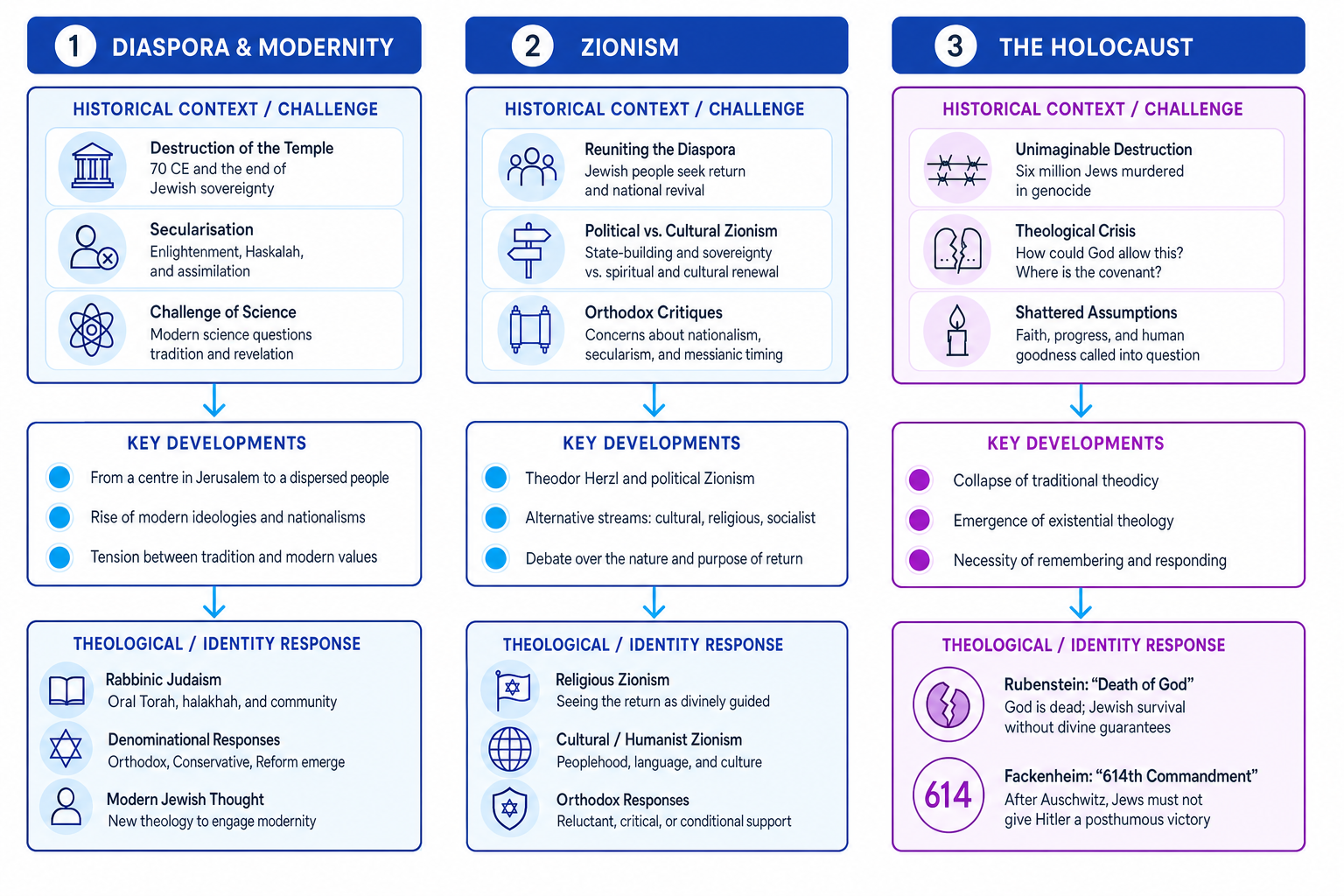
Modern Judaism is not a static set of beliefs, but a living tradition shaped by historical crises, intellectual revolutions, and geographical shifts. To master this topic for your Edexcel A-Level, you must understand how historical events—such as the destruction of the Temple, the rise of modern science, secularisation, the development of Zionism, and the trauma of the Holocaust—have challenged traditional Jewish beliefs about God, the covenant, and Jewish identity.
What you'll learn
- How the destruction of the Temple and the Diaspora transformed Jewish identity and views on revelation.
- How modern Jewish thinkers have responded to the twin challenges of secularisation and scientific development.
- The origins, varieties, and theological debates surrounding Zionism and the State of Israel.
- The profound theological crises and responses emerging from the Holocaust (Shoah).
1. Context to Modern Jewish Identity: Diaspora, Science, and Secularisation
Modern Judaism was birthed from historical displacement and intellectual challenge. To understand how Jewish identity is constructed today, we must trace it back to its first major historical rupture.
The Temple and the Diaspora
In 70 CE, the Roman Empire destroyed the Second Temple in Jerusalem, ending Jewish sovereignty in the Land of Israel and scattering the Jewish people across the globe. This scattering is known as the Diaspora.
Definition
Diaspora
Diaspora (from the Greek for 'scattering' or 'dispersion') refers to the communities of Jewish people living outside the historical Land of Israel.
Before 70 CE, Judaism was a temple-centric religion focused on animal sacrifices performed by a hereditary priesthood. The loss of the Temple threatened the very survival of the faith.
How did Judaism survive? It underwent a radical transformation led by key figures like Rabbi Yochanan ben Zakkai, who established an academy at Yavneh. Sacrificial worship was replaced by prayer, ethical deeds (mitzvot), and the study of the Torah. This shift birthed Rabbinic Judaism.
Key Idea
The Yavneh Shift
The destruction of the Temple shifted the "home" of Jewish identity from a physical building (the Temple) to a portable text (the Torah) and localized communities (the synagogue).
In modern scholarship, Isaiah Gafni explores the complex relationship between the Land of Israel and the Diaspora. Gafni highlights that the Diaspora was not merely a passive state of "waiting" for return, but a highly creative and dynamic environment. Over centuries, Jewish communities in Babylon, Spain, and Eastern Europe developed distinct cultural, legal, and theological traditions. Gafni shows that Diaspora identity was often self-sustaining, challenging the simplistic view that Jewish life outside Israel is inherently incomplete or spiritually bankrupt.
Conversely, secular thinkers like R. Kogel offer alternative interpretations of Jewish identity and revelation. For Kogel and secular humanistic Jews, the "authentic voice" of Judaism does not stem from a supernatural revelation at Mount Sinai, but from the historical, cultural, and ethical experience of the Jewish people. In this view, Jewish identity is defined by historical continuity and humanistic values rather than dogmatic obedience to divine law.
The Challenge of Secularisation and Liberationist Thinking
The European Enlightenment of the 18th century brought about the Haskalah (Jewish Enlightenment). Led by thinkers like Moses Mendelssohn, the Haskalah encouraged Jews to integrate into European society, learn secular languages, and adopt scientific education.
Definition
Haskalah
The Haskalah was the Jewish Enlightenment of the 18th and 19th centuries, which promoted integration, secular education, and the rational adaptation of Jewish practice to the modern world.
While the Haskalah opened doors, it also triggered a massive wave of secularisation (the decline in religious belief and practice) and assimilation. Jewish communities split into distinct movements to handle this challenge:
- Reform Judaism adapted Jewish law (halakhah) to align with modern Western values, viewing revelation as progressive rather than static.
- Orthodox Judaism rejected these adaptations, asserting that the Torah is the immutable, literal word of God.
- Conservative Judaism carved a middle path, viewing halakhah as binding but evolving over time.
In response to secularisation, some Jewish thinkers turned to Jewish Liberation Theology. Drawing on the prophetic tradition of Isaiah and Amos, these thinkers argue that the core purpose of Judaism in a secular world is to defend the poor and oppressed. They interpret the concept of Tikkun Olam (repairing the world) not just as spiritual mysticism, but as an active, political duty to fight systemic injustice.
The Challenge of Science
Unlike some Christian denominations that have faced intense, public clashes with scientific theories, modern Judaism has largely maintained a highly compatible relationship with scientific thinking.
Scholars G. Cantor and M. Swetlitz, in their analysis of the Jewish relationship with science, point out several key reasons for this compatibility:
- Orthopraxy over Orthodoxy: Judaism prioritizes correct action (halakhah) over dogmatic, philosophical creeds. Science rarely interferes with daily ritual life, meaning scientific discoveries do not inherently threaten Jewish observance.
- Non-Literal Interpretation: Since the Rabbinic period, Jewish commentators (such as Maimonides in the 12th century) have argued that if a biblical text contradicts established reason or physical reality, the text must be interpreted allegorically.
- Cooperative Theology: Many modern Jewish theologians see science as a tool to uncover the majestic mechanics of God's creation. For instance, the evolutionary theories of Charles Darwin have been embraced by thinkers like Rabbi Abraham Isaac Kook, who argued that evolution perfectly mirrors the spiritual progression of humanity toward holiness.
Common Mistake
Assuming a universal Jewish view of science
Do not assume that all Jewish movements view science the same way. While Reform, Conservative, and Modern Orthodox Jews fully embrace scientific consensus (including evolution and cosmology), some Ultra-Orthodox (Haredi) communities reject certain aspects of modern science (like the age of the universe or evolution) in favor of a literal reading of Genesis.
2. Zionism
Zionism is one of the most powerful and complex forces in modern Jewish history, radically reshaping Jewish identity and global geopolitics.
Origins: Haskalah, Assimilation, and Antisemitism
Initially, the Haskalah led many European Jews to believe that integration and assimilation would end discrimination. However, the 19th century saw a devastating rise in modern, racial antisemitism in Europe, manifested in violent Russian pogroms and the political demonization of Jews in Western Europe (such as the Dreyfus Affair in France).
This convinced key thinkers like Theodor Herzl that assimilation was a dangerous illusion. Jews would never be truly safe or accepted as equals in Europe. The only solution was the establishment of a sovereign Jewish state.
Definition
Zionism
Zionism is the nationalist movement that emerged in the late 19th century supporting the re-establishment of a homeland for the Jewish people in the historic Land of Israel (Zion).
Varieties of Zionism
Zionism is not a monolith; it contains several competing ideologies:
| Type of Zionism | Key Focus | Major Figures |
|---|---|---|
| Political Zionism | Securing legal, international recognition for a sovereign Jewish state to escape antisemitism. | Theodor Herzl |
| Cultural Zionism | Creating a spiritual and cultural center in Palestine to revitalize Hebrew language and Jewish identity, rather than just a political state. | Ahad Ha'am |
| Practical Zionism | Establishing physical foundations through land purchase, agricultural settlement, and building communities on the ground. | Chaim Weizmann |
| Religious Zionism | Viewing the return to the Land of Israel and the establishment of the State as a key stage in the divine process of messianic redemption. | Rabbi A.I. Kook |
Debates over the Covenant and the Promised Land
The creation of the State of Israel in 1948 brought theological debates about the Abrahamic Covenant and the 'Promised Land' into sharp focus.
Yosef Gorny explores the deep ideological conflicts within Zionism, particularly the tension between the "particularist" goal of national survival and the "universalist" ethical demands of Judaism. Gorny highlights the debate over how a Jewish state should treat non-Jewish minorities (such as Palestinians) while remaining true to the biblical commands to "love the stranger."
Jacob Neusner, writing from a late 20th-century perspective, offers a critical analysis of Zionism’s claim to be the exclusive center of Jewish life. Neusner challenges the Zionist doctrine of Shlilat Ha'Golah (the "negation of the Diaspora"), which argues that authentic Jewish life is only possible in Israel. Neusner points out that Jewish life in the Diaspora—particularly in the United States—is highly creative, secure, and spiritually vibrant. For Neusner, the Diaspora is not an exile to be escaped, but a permanent, valid partner to Israel.
Common Mistake
The Orthodox Rejection of Zionism
You must remember that some Orthodox Jews reject political Zionism. Ultra-Orthodox groups like the Satmar Hasidim believe that establishing a Jewish state by human, secular means is a grave sin. They argue that the Jewish people must wait for God to send the Messiah to restore the Kingdom. To force the hand of God through human politics is seen as a betrayal of the covenant.
3. The Holocaust (Shoah)
The Holocaust—the systematic, state-sponsored murder of six million Jews by Nazi Germany—is the most profound trauma in modern Jewish history. It shattered classical theological frameworks and forced a total re-evaluation of the covenant relationship.
Definition
The Covenant
The Covenant (Brit) is the sacred, reciprocal treaty between God and the Jewish people, established with Abraham and renewed at Sinai. In traditional theology, God promises protection and the Land of Israel in exchange for the Jewish people's obedience to the Torah.
Traditional Theodicies Put to the Test
Confronted with the scale of the Holocaust, traditional Jewish explanations for suffering (theodicies) collapsed for many:
- Punishment for sin (Mipnei Chata'einu): The traditional view that Jewish suffering is a divine punishment for violating the Torah was rejected by almost all modern theologians. To claim that the one and a half million children murdered in the Holocaust died because of Jewish assimilation or secularisation was seen as morally obscene and blasphemous.
- The Suffering Servant: Some drew on Isaiah 53, suggesting the Jewish people act as a "suffering servant" carrying the sins of the world. However, many felt this romanticized innocent slaughter and excused God's silence.
- Resurrection and Afterlife: While Orthodox theology maintained that victims would be rewarded in the Olam Ha-Ba (the World to Come), many felt this did not solve the ethical question of why God allowed such absolute evil to happen in history in the first place.
Key Theological Responses: Rubenstein vs. Fackenheim
You are required to contrast the radically different responses of Richard Rubenstein and Emil Fackenheim.
Richard Rubenstein: The "Death of God"
In his groundbreaking work After Auschwitz (1966), Richard Rubenstein argued that the Holocaust made it impossible to believe in the traditional, omnipotent God of history who acts in a covenantal relationship with Israel.
Key Idea
Rubenstein's 'Death of God'
For Rubenstein, if God is all-powerful and active in history, then God must have willed or permitted Auschwitz. This would make God a monstrous cosmic demon. Therefore, the covenantal God is dead.
Rubenstein did not advocate for a total abandonment of Judaism. Instead, he argued that:
- Jews must accept a form of religious naturalism: there is no divine plan, no chosen people, and no ultimate purpose to history.
- Synagogues and Jewish rituals are more important than ever, not because they please a heavenly deity, but because they offer community, comfort, and psychological structure in a cold, indifferent universe.
- The State of Israel is vital as a secular haven of self-reliance, ensuring Jews are never again helpless victims.
Emil Fackenheim: The "614th Commandment"
In direct opposition to Rubenstein, philosopher Emil Fackenheim argued that to declare God "dead" and abandon traditional faith is to surrender to the aims of Nazism.
Fackenheim famously formulated the 614th Commandment:
Key Idea
The 614th Commandment
"The commanding voice of Auschwitz: Jews are forbidden to hand Hitler posthumous victories. They are commanded to survive as Jews, lest the Jewish people perish."
Fackenheim’s response entails:
- Sacred Survival: Jews have a moral duty to survive, maintain their Jewish identity, and raise Jewish children. To assimilate or abandon God now is to complete the work of Auschwitz.
- Relational Faith: While we cannot rationally explain or comprehend God's silence during the Shoah, we must remain in a state of protest and dialogue with God, refusing to let the secular world erase the Jewish voice.
Scholar Comparison Grid
To score highly on AO2 (analysis and evaluation) essay questions, you must compare and contrast the scholars. Use this grid to study their key positions:
| Scholar | Topic | Key Position | Evaluation / Critique |
|---|---|---|---|
| Isaiah Gafni | Diaspora | Diaspora was a creative, self-sustaining, and legitimate expression of Jewish identity, not just a tragic exile. | Critiques strict, classical Zionist claims that Jewish life in the Diaspora is empty or incomplete. |
| Richard Kogel | Revelation & Identity | True Jewish authenticity is cultural and humanistic; revelation is not a supernatural, divine event. | Rejected by Orthodox scholars who argue that removing divine revelation hollows out the core of Judaism. |
| G. Cantor & M. Swetlitz | Science | Judaism has a highly compatible relationship with science due to its focus on action (halakhah) and non-literal text interpretation. | Criticized by some Ultra-Orthodox factions who reject modern science when it conflicts with Torah literalism. |
| Yosef Gorny | Zionism | Zionism suffers from an internal tension between particularist national survival and universalist Jewish ethics. | Shows the ethical difficulty of maintaining a Jewish state that must also be a modern democracy. |
| Jacob Neusner | Zionism | The Western Diaspora is a flourishing, spiritually rich home; Zionism is wrong to negate the value of the Diaspora. | Opposed by classical Zionists who believe Jews can only achieve full self-determination in Israel. |
| Richard Rubenstein | Holocaust | The covenant is dead; God is no longer active in history. Jews must live in a post-theological world. | Criticized for being too pessimistic, stripping Judaism of its divine hope, and bordering on nihilism. |
| Emil Fackenheim | Holocaust | Jews must respond to Auschwitz with the "614th Commandment": survive and stay Jewish to deny Hitler a posthumous victory. | Highly influential, but critics ask if "survival out of spite" is a deep enough spiritual foundation for faith. |
Example
Constructing an AO2 Argument
Evaluating the Theological Impact of the Holocaust
Here is a step-by-step walkthrough of how to write a high-scoring AO2 paragraph evaluating whether the Holocaust destroyed the Jewish Covenant, contrasting Rubenstein and Fackenheim.
-
State your thesis clearly, linking back to the question: "While the scale of the Holocaust undoubtedly shattered classical, simplistic understandings of the covenant, it did not destroy the covenant entirely; rather, it forced a shift from passive obedience to active, defiant engagement."
-
Introduce the first scholar (AO1) and evaluate their position (AO2): "Richard Rubenstein argues persuasively that the traditional covenant is obsolete. He asserts that if God is the master of history who chose the Jews, then God must be held morally responsible for Auschwitz. Rubenstein’s 'Death of God' theology provides a highly logical response to the problem of evil, avoiding the offensive claim that the Holocaust was a punishment for sin. However, his view can be evaluated as too radical; by reducing Judaism to a purely psychological and cultural coping mechanism, he strips the faith of its transcendent moral authority."
-
Introduce the counter-perspective (AO1) to build a debate: "In contrast, Emil Fackenheim offers a more robust framework with the '614th Commandment.' Fackenheim recognizes the horror of the Shoah but insists that abandoning the covenant in response to tragedy acts as a 'posthumous victory' for Hitler. By commanding Jews to survive and remain Jewish, Fackenheim transforms the covenant from a passive expectation of divine rescue into an active, human commitment to ethical resistance."
-
Reach a justified, nuanced judgment (AO2): "Ultimately, Fackenheim’s approach is more successful. While Rubenstein correctly identifies the collapse of classical, interventionist theology, Fackenheim’s response preserves the unique spiritual integrity of Judaism. It allows modern Jews to voice their protest against divine silence while maintaining the ethical framework of the covenant, proving that the Holocaust transformed, rather than destroyed, Jewish faith."
Tip
Essay Writing Tip: Integrate the Scholars
In Edexcel Paper 4, essay prompts often demand that you evaluate a statement (e.g., "Assess the claim that Zionism has split rather than united global Judaism"). Never list scholar opinions one after the other. Instead, make them 'talk' to each other. Use Neusner to critique classical Zionists, or use Fackenheim to expose the limits of Rubenstein's naturalism.
Exam technique
In the exam
- Watch the AO split: Remember that 50% of the marks in your extended essays are for AO2 (analysis and evaluation). Do not just write a history essay about the Holocaust or Zionism. Constantly ask: What is the theological impact of this? How does this change beliefs about God or the covenant?
- Anchor your arguments in the Anthology: Refer directly to the ideas of the prescribed scholars (Gafni, Kogel, Cantor, Swetlitz, Gorny, Neusner, Rubenstein, Fackenheim). Using their names and key concepts (like the '614th Commandment' or the 'negation of the Diaspora') is essential for top-band marks.
- Show nuance within movements: Avoid using generic phrases like "Jews believe..." Instead, show examiner-level precision by specifying: "While Reform Jews might interpret... Orthodox thinkers would reject this because..."
Self review
Check yourself
- Why does Richard Rubenstein argue that keeping the traditional covenantal model after Auschwitz makes God "a monstrous demon"?
- What is the difference between Political Zionism (Theodor Herzl) and Cultural Zionism (Ahad Ha'am)?
- According to G. Cantor and M. Swetlitz, why has Judaism generally found it easier to integrate scientific theories like evolution than some Christian denominations?