Revision notes for Edexcel AS Level Religious Studies Sources of wisdom and authority. Open the guide for explanations and worked examples. Written against the Edexcel AS Level Religious Studies specification, so the content matches what's examinable rather than general Religious Studies background.
Sources of wisdom and authority
What you'll learn
- How the Tenakh is structured: Torah, Nevi’im and Ketuvim.
- Why the Torah has distinctive authority as God’s revelation to Israel.
- How Jewish traditions differ in interpreting scripture for study and worship.
- How Rashi, the Tosafists and Judah Halevi shaped Rabbinic Judaism.
Big picture: authority in Judaism
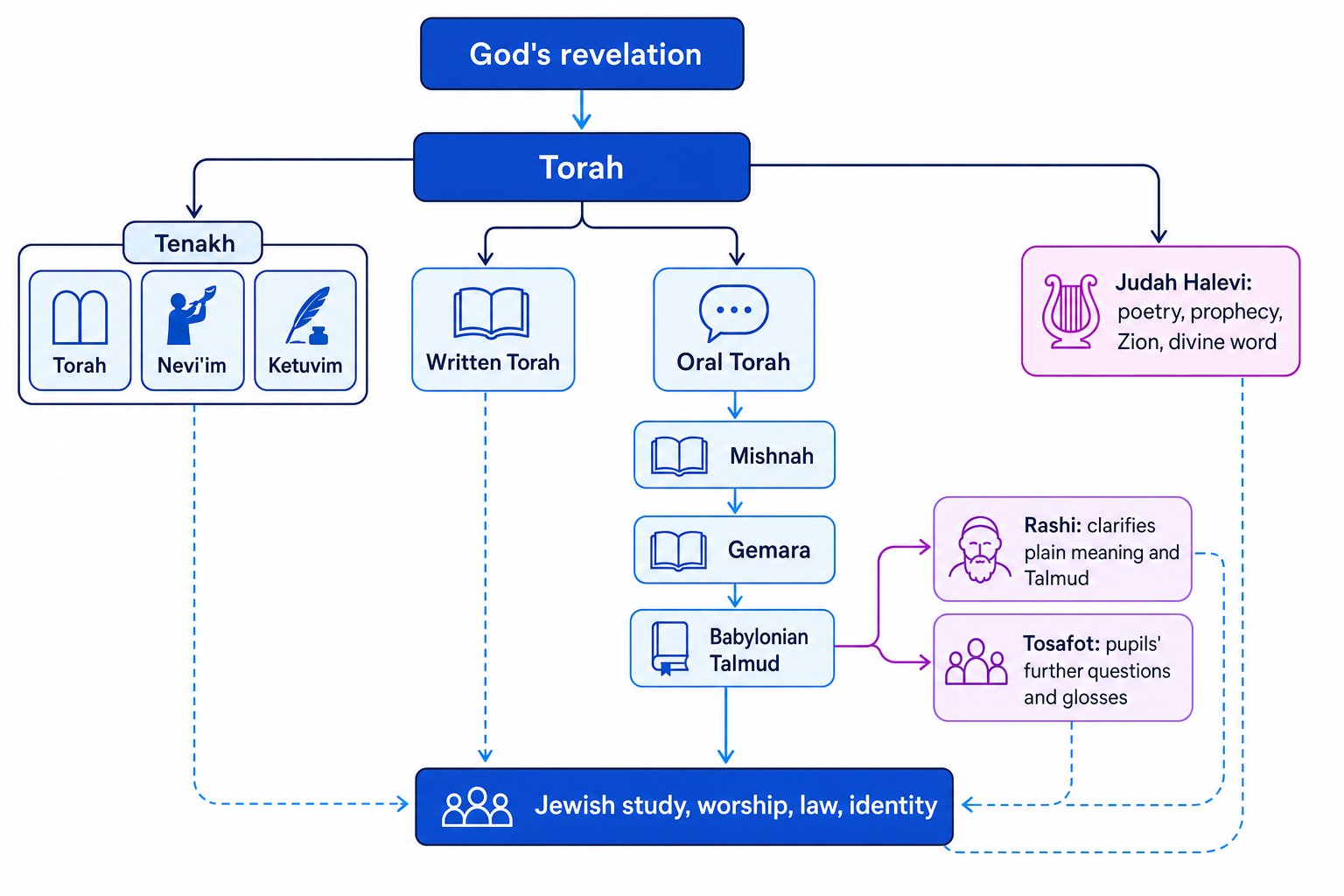
A source of wisdom and authority is something Jews may look to for truth, guidance, identity and practice. In Judaism, authority is not found in scripture alone. It is layered: revealed text, rabbinic interpretation, worship, community practice and lived Jewish history all matter.
Key Idea
Layered authority
For this topic, remember: Judaism treats the Torah as foundational revelation, but that revelation is studied, interpreted and lived through rabbinic tradition and Jewish community life.
The Tenakh: Torah, Nevi’im and Ketuvim
Definition
Tenakh
Tenakh is the Jewish Bible. The name comes from three sections: Torah meaning “teaching” or “instruction”, Nevi’im meaning “Prophets”, and Ketuvim meaning “Writings”.
Torah
The Torah is the first five books: Genesis, Exodus, Leviticus, Numbers and Deuteronomy. It contains creation, the patriarchs, the Exodus, the Sinai covenant and many mitzvot — commandments.
Its authority is distinctive because Jews understand God as revealing Himself to His people through it. This is not only information about God; it is covenantal instruction. God makes Israel a people and gives them a way of life.
George Robinson is useful here because he stresses that “Torah” can mean more than a book. It can mean the five books of Moses, the scroll read in synagogue, and more broadly the whole tradition of Jewish teaching. That helps explain why Torah is both a text and a way of life.
Nevi’im and Ketuvim
Nevi’im contains prophetic books. These include historical narratives and the words of prophets who call Israel back to covenant faithfulness.
Ketuvim contains writings such as Psalms, Proverbs, Job, Daniel and the Five Scrolls. These texts shape Jewish prayer, wisdom, festival life and reflection on suffering.
The Torah has priority, but the other sections are still sacred and authoritative. For example, Psalms are central in worship, and prophetic readings are linked to Torah readings.
Common Mistake
Reducing Torah to ‘law’
Do not write as if Torah simply means “law”. It is better to call it teaching or instruction, because it includes narrative, covenant, ethics, worship and commandments.
How scripture is used in study and worship
Study
Jewish study is often communal and interpretive. A rabbi is a Jewish teacher and scholar of Torah. Traditional study may involve chavruta, paired learning where students question and challenge each other.
Scripture is rarely treated as isolated. It is read with commentaries, midrash and rabbinic discussion. Midrash means interpretation that explores meaning beyond the obvious surface of the text.
This matters because Jewish authority is not just “the Bible says it”. It is also “how has the community, through learned interpretation, understood and applied it?”
Worship
In synagogue, the Torah scroll is treated with deep reverence. It is kept in the ark, read publicly on Shabbat and festivals, and divided into weekly portions.
The Haftarah is a selected reading from Nevi’im connected to the Torah portion. Ketuvim also appears in worship: Psalms are widely used, and the Five Scrolls are read at particular festivals, such as Esther at Purim and Lamentations at Tisha B’Av.
D. Cohn-Sherbok is especially helpful for showing that Jewish movements interpret scriptural authority differently. Orthodox, Conservative/Masorti, Reform and Liberal Judaism may use the same sources but understand their binding force in different ways.
Range of interpretation across Jewish traditions
Orthodox Judaism
Orthodox Jews usually affirm Torah min ha-shamayim, meaning “Torah from heaven”. The Written Torah and Oral Torah are understood as divinely rooted and binding. Halakhah means Jewish law, literally the “way” or “path”, and is authoritative for practice.
Conservative or Masorti Judaism
Conservative or Masorti Judaism often sees revelation as real but historically developed. Halakhah remains important, but change can occur through responsible rabbinic interpretation.
Reform and Liberal Judaism
Reform and Liberal Judaism often understand Torah as inspired and spiritually authoritative rather than verbally dictated by God. Ethical teachings may be emphasised more than ritual obligations. Individual conscience has a larger role.
Example
Applying Torah authority across traditions
- Begin with a commandment, such as keeping Shabbat. In the Torah, Shabbat is linked with creation, Exodus and covenant identity, so it has strong scriptural authority.
- An Orthodox response will normally treat the commandment as binding through halakhah, interpreted through the Oral Torah and later rabbinic rulings.
- A Reform response may treat Shabbat as spiritually and ethically important, while allowing adaptation where strict observance is not seen as binding.
- The judgement is that the same Torah source can function differently: Robinson helps you show the breadth of “Torah”, while Cohn-Sherbok helps you compare Jewish traditions fairly.
The development of Rabbinic Judaism
Definition
Rabbinic Judaism
Rabbinic Judaism is the form of Judaism centred on Torah study, rabbinic interpretation, synagogue worship, prayer and halakhah, especially after the destruction of the Second Temple in 70 CE.
After the Temple was destroyed, sacrifice could no longer be the centre of Jewish religious life. Authority increasingly moved towards scripture, prayer, study and rabbinic interpretation.
The Mishnah is an early written collection of Oral Torah, compiled around 200 CE. The Gemara is later rabbinic discussion of the Mishnah. Together, Mishnah and Gemara form the Talmud. The Babylonian Talmud became especially influential in Jewish law and study.
Rashi and the Tosafists
Rashi stands for Rabbi Shlomo Yitzhaki, an 11th-century French Jewish commentator. He wrote hugely influential commentaries on the Hebrew Bible and the Babylonian Talmud.
Rashi aimed to clarify difficult texts. He often focused on peshat, the plain or contextual meaning, while also using midrash when it solved a problem in the text. His comments are brief, practical and designed to help readers understand.
Rashi and his school sometimes used examples from everyday medieval life, including Old French words, to explain Hebrew or Aramaic terms. This shows interpretation happening within a real historical context, not in a vacuum.
His pupils and descendants helped develop the Tosafot, meaning “additions”. The Tosafists wrote further glosses on the Talmud, asking questions, comparing passages and resolving apparent contradictions. In many printed Talmud editions, Rashi appears on one side of the page and Tosafot on the other. The page itself becomes a conversation.
Chaim Potok is useful here because he presents Jewish history as sustained by study and interpretation. On this view, Rashi’s authority is not mainly political or prophetic. It comes from making the inherited tradition understandable and teachable for later generations.
Key Idea
Rashi’s authority
Rashi’s importance is that he made scripture and Talmud accessible, while the Tosafists turned his work into an ongoing method of questioning, comparison and debate.
Judah Halevi: poetry, prophecy and Zion
Judah Halevi was a medieval Spanish Jewish poet and thinker. He is famous for the Kuzari, a dialogue defending Judaism, and for his piyyutim, meaning liturgical poems used in worship, especially for festivals and Sabbath.
Halevi also wrote Songs of Zion, poems expressing longing for the Land of Israel while living in the diaspora, meaning Jewish communities living outside the ancestral land.
Halevi’s main ideas
Halevi emphasised the unity between God and the People of Israel. This does not mean Israel is divine. It means Israel has a unique covenantal relationship with God, shown through history, Torah, prophecy and the land.
He valued prophecy, meaning inspired communication from God, above abstract philosophy. For Halevi, Judaism rests on public, historical revelation: God acted for Israel in events such as the Exodus and Sinai. This is stronger than a philosopher’s argument about God, because it is rooted in communal experience.
Halevi also taught the supremacy of the divine word in nature and the Law. Nature shows God’s wisdom, but Torah gives direct covenantal instruction. The Law is therefore not merely human custom; it is the divine word shaping Jewish life.
He rejected Aristotelian philosophy where it made God too abstract or treated religion as something reached mainly by reason. He also rejected Christianity and Islam as final replacements for Judaism, arguing that Judaism has the original covenantal revelation.
Hillel Halkin presents Halevi as both poet and thinker. Halkin highlights that Halevi’s longing for Zion was not just symbolic: it expressed a deep conviction that Jewish faith is tied to peoplehood, land, worship and lived experience.
Common Mistake
Misreading chosenness
When discussing Halevi, avoid saying “Jews are better than everyone else.” His point is about covenant, prophecy and vocation, not a simple claim of moral superiority.
Comparing Rashi and Halevi
Rashi and Halevi show two different kinds of Jewish authority.
Rashi represents textual and interpretive authority. His work shapes how Jews study scripture and Talmud. Halevi represents theological, poetic and experiential authority. His work shapes how Jews understand revelation, peoplehood and Zion.
Example
Comparing Rashi and Halevi
- If the question asks who contributed more to Rabbinic Judaism, first decide what “contributed” means: legal study, worship, identity or theology.
- Rashi has a stronger claim if your criterion is daily study of scripture and Talmud, because his commentaries became standard tools for Jewish learning.
- Halevi has a stronger claim if your criterion is Jewish self-understanding, because his poetry and Kuzari defend covenant, prophecy and the link to Zion.
- A balanced judgement could argue that Rashi shaped the method of Rabbinic Judaism, while Halevi shaped its spiritual and national imagination.
Evaluation: why this topic matters
The strength of Jewish authority is its continuity. Torah provides a foundation, while rabbinic interpretation allows application across changing historical situations. This helps explain how Judaism could survive Temple destruction, diaspora and social change.
However, diversity creates a challenge. If Orthodox, Masorti and Reform Jews interpret Torah authority differently, it becomes harder to speak of one simple Jewish view. That is not a weakness in an essay — it is an opportunity to show nuance.
Rashi supports the idea that authority develops through interpretation. Halevi supports the idea that authority is grounded in divine revelation, historical experience and covenant identity. Together, they show that Jewish sources of wisdom are both ancient and actively interpreted.
Exam technique
In the exam
- Start with Torah as foundational revelation, then widen out to Tenakh, worship, study and rabbinic interpretation.
- Use named scholars purposefully: Robinson for the breadth of Torah, Cohn-Sherbok for denominational range, Potok for interpretive continuity, and Halkin for Halevi’s Zion-focused religious vision.
- Make your judgement precise: say whether authority is mainly textual, rabbinic, communal, experiential or a combination.
Self review
Check yourself
- Why does the Torah have a distinctive authority within the Tenakh?
- How do Orthodox and Reform views of Torah authority differ?
- In what ways do Rashi and Judah Halevi represent different kinds of authority?