Revision notes for Edexcel AS Level Religious Studies Practices that shape and express religious identity. Open the guide for explanations and worked examples. Written against the Edexcel AS Level Religious Studies specification, so the content matches what's examinable rather than general Religious Studies background.
Practices that shape and express religious identity
What you'll learn
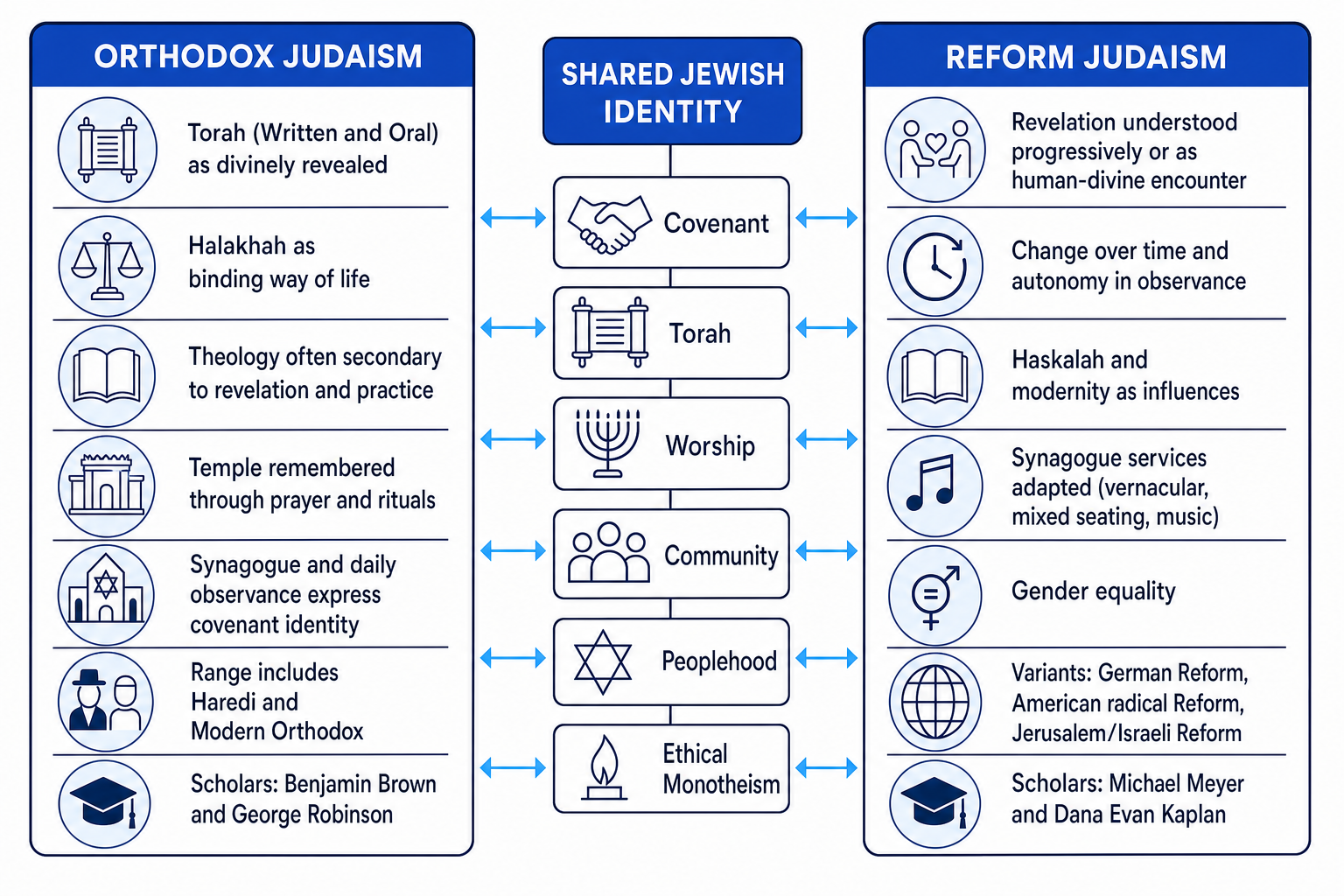
- How Orthodox Judaism understands Torah, revelation, Halakhah, Temple memory and daily practice.
- How Reform Judaism understands change, modernity, revelation, synagogue worship and gender equality.
- How to use Benjamin Brown, George Robinson, Michael Meyer and Dana Evan Kaplan in essay answers.
- How to compare practices as expressions of Jewish identity, not just list differences.
The big picture: practice shapes identity
In Judaism, religious identity is often expressed through practice: worship, food laws, Sabbath observance, prayer, festivals, study, family life and community belonging. Belief matters, but Judaism is not only a creed. It is also a lived way of life.
A practice is a repeated religious action, such as keeping Shabbat or praying in a synagogue. Religious identity means the way a person or community understands who they are in relation to God, Torah, Jewish history and the Jewish people.
The core contrast in this topic is between Orthodox and Reform approaches to authority, change and religious practice.
Key Idea
Identity through practice
For Edexcel, do not treat Orthodox and Reform Judaism as merely “strict versus relaxed”. The better contrast is about authority: Orthodox Judaism gives binding authority to divine revelation and Halakhah, while Reform Judaism gives greater importance to historical development, moral autonomy and changing contexts.
Orthodox Judaism: meanings and interpretations
Orthodox Judaism is a broad label for Jewish movements that regard the Torah and rabbinic tradition as divinely authoritative and see Halakhah, meaning Jewish law or “the way to walk”, as binding.
The word “orthodox” can be misleading because it literally means “right belief”. In Judaism, however, Orthodox identity is often more about orthopraxy, meaning “right practice”. This means living faithfully through commandments, prayer, study and communal observance.
There are different forms of Orthodoxy. Haredi Judaism is usually more separatist and cautious about modern culture. Hasidic Judaism is a spiritual movement within Orthodoxy that emphasises devotion, charismatic leadership and joy in worship. Modern Orthodox Judaism accepts more engagement with wider society, university education and professional life, while still treating Halakhah as binding.
Benjamin Brown is useful here because he stresses that Orthodoxy is not simply “unchanged ancient Judaism”. It developed as a self-conscious movement in response to modernity, Reform and secularisation. That does not mean Orthodox Jews see their religion as invented; rather, Brown helps you explain that Orthodoxy claims continuity with Sinai while also having a modern historical form.
George Robinson is useful for explaining the lived character of Orthodox Judaism: Torah, mitzvot, synagogue life, prayer, food laws and Sabbath practice form a whole pattern of identity. Robinson’s approach helps you avoid reducing Orthodoxy to abstract doctrine.
Common Mistake
Orthodox does not mean one single group
Avoid writing as if all Orthodox Jews are identical. Haredi, Hasidic and Modern Orthodox Jews may differ sharply over education, Zionism, gender roles and engagement with secular culture, even though they share commitment to Torah and Halakhah.
Written Torah, Oral Torah and Halakhah
The Torah can mean the Five Books of Moses, the wider Hebrew Bible, or Jewish teaching as a whole. The Written Torah means the revealed scriptural text, especially Genesis, Exodus, Leviticus, Numbers and Deuteronomy. The Oral Torah means the oral traditions believed to have been given alongside the written text and later recorded in rabbinic literature such as the Mishnah and Talmud.
In Orthodox Judaism, both Written and Oral Torah are normally understood as divinely inspired. This supports the authority of Halakhah. Halakhah covers obvious religious duties, such as prayer and festivals, but also everyday life: business ethics, food, family purity, charity, dress and speech.
The mitzvot are commandments. Orthodox Jews traditionally speak of 613 mitzvot in the Torah, though not all can be practised today because some relate to the Temple, priesthood or ancient agricultural life.
Definition
Halakhah
Halakhah is Jewish law, literally connected with the idea of “walking” or “the path”. It is not just a legal code; it is a complete pattern of life through which Orthodox Jews express covenant faithfulness.
Revelation compared with theology
Revelation means God making divine truth known. Theology means reasoned reflection about God, belief and doctrine.
In Orthodox Judaism, revelation usually has a higher status than speculative theology. The key question is not simply “What theory of God do I prefer?” but “What has God revealed, and how should Israel live in response?” This is why practices such as Shabbat, kashrut and prayer are central to identity.
Some Orthodox Jews take a strongly literal view of Torah, especially regarding Mosaic authorship and the historical reliability of biblical events. Others, especially in some Modern Orthodox circles, may accept limited historical or literary approaches while still affirming Torah as sacred and Halakhah as binding.
The Torah can also be read as a Jewish philosophy of history. This means it is not only a record of events but a theological interpretation of history: creation, covenant, slavery, exodus, land, exile, suffering, repentance and redemption all show how Jewish identity is understood through God’s relationship with Israel.
The Temple, synagogue and daily observance
The Temple was the central sanctuary in Jerusalem. The First Temple was destroyed by the Babylonians in 586 BCE, and the Second Temple was destroyed by the Romans in 70 CE. Since then, Judaism has developed without sacrificial worship.
For Orthodox Jews, the Temple still matters deeply. It is remembered in daily prayers, festivals, mourning practices and hopes for future restoration. The Amidah, a central standing prayer, includes themes of restoration. Tisha B’Av mourns the destruction of the Temples. At many Jewish weddings, the breaking of a glass recalls the destruction of Jerusalem even in a moment of joy.
A synagogue is a Jewish house of assembly, prayer and study. In Orthodox synagogues, there is usually a mechitzah, meaning a physical separation between men and women during prayer. A traditional minyan, the quorum for public prayer, consists of ten adult Jewish males. The Torah scrolls are kept in the ark, and the congregation faces Jerusalem.
Daily observances also shape identity: keeping Shabbat from Friday evening to Saturday night, wearing tefillin during weekday morning prayer, following kashrut or Jewish dietary laws, giving tzedakah or charity, and studying Torah.
Example
Using synagogue practice to show religious identity
- Choose a concrete practice: an Orthodox synagogue may use a mechitzah and count a traditional male minyan for public prayer.
- Link the practice to authority: this expresses the view that inherited Halakhah is binding, not merely optional custom.
- Connect it to identity: the worshipper’s Jewish identity is formed by obedience to Torah and rabbinic tradition within a covenant community.
- Add evaluation: a Reform Jew may argue that mixed seating better expresses equality and modern Jewish values, while an Orthodox Jew may reply that continuity with Halakhah is itself a deeper form of faithfulness.
Reform Judaism: change over time
Reform Judaism is a movement that developed in modern Europe and became especially influential in America. It argues that Judaism has changed throughout history and should continue to develop in response to new knowledge, ethical insight and social conditions.
For Reform Jews, many traditional practices are meaningful but not automatically binding in the same way as in Orthodoxy. A central Reform idea is informed autonomy: individuals should learn about Jewish tradition and then make responsible choices about observance.
Reform views of revelation usually reject the idea that the Torah was dictated word-for-word by God to Moses. Instead, revelation may be seen as progressive, ongoing, or as a human encounter with the divine. This allows Reform Judaism to distinguish between permanent ethical values and ancient ritual laws that may no longer be binding.
Michael Meyer is a key scholar for this topic. He presents Reform Judaism as a “response to modernity”: not simply a collapse into secularism, but an attempt to preserve Judaism by reshaping it for modern Jews living in emancipated societies.
Dana Evan Kaplan is useful for contemporary Reform Judaism, especially in America. He emphasises autonomy, diversity, inclusion and the way Reform Judaism has re-engaged with rituals that earlier Reform thinkers sometimes rejected.
Tip
Good comparison phrase
A strong essay sentence might say: Brown helps explain Orthodoxy as a modern defence of continuity, while Meyer helps explain Reform as a modern theology of change.
Haskalah and rationalism
The Haskalah was the Jewish Enlightenment, a movement influenced by European Enlightenment thought. It encouraged rationalism, wider education, integration into society, critical study and engagement with modern culture.
This influenced Reform Judaism because many Jews were asking how Judaism could survive and flourish after emancipation, citizenship and modern science. Reform thinkers often wanted worship to be intelligible, dignified and ethically focused. This led to changes such as sermons in the vernacular, shorter services, choirs, organs in some communities, and less emphasis on prayers for restoring sacrifices.
Reform synagogue practice and gender
Reform synagogue services often differ from Orthodox services. They may include mixed seating, greater use of the local language, musical instruments, shorter liturgy and equal participation of women and men. Reform Judaism has ordained women as rabbis and cantors and usually supports Bat Mitzvah, egalitarian Torah reading and inclusive participation.
Gender issues are especially important because they show how practice expresses theology. If revelation is progressive and moral insight develops, then equality can be seen as a religious value. Reform Jews may argue that excluding women from leadership reflects historical patriarchy rather than God’s eternal will.
Orthodox Jews may respond that gender-differentiated practice is not necessarily inequality; it may reflect divinely commanded roles within Halakhah. This is where AO2 evaluation becomes important: you should compare the assumptions behind the practice, not just the visible difference.
Germany, America and Jerusalem
Reform Judaism began in Germany in the nineteenth century. Early German Reform was often relatively cautious. It aimed to make services more accessible and dignified while maintaining continuity with Jewish tradition. Figures such as Abraham Geiger promoted historical study and argued that Judaism had always developed.
American Reform became more radical in the late nineteenth century. The 1885 Pittsburgh Platform described Judaism as a progressive religion and rejected many ritual laws, such as dietary restrictions, when they were seen as unsuitable for modern life. Later American Reform became less anti-ritual: the 1937 Columbus Platform and the 1999 Pittsburgh Principles showed renewed interest in Hebrew, peoplehood, Israel, spirituality and mitzvot.
Reform in Jerusalem and Israel has a different context. It is a minority movement in a state where Orthodox institutions have often controlled marriage, conversion and public religious authority. Therefore, Reform practice in Jerusalem can be radical because it challenges Orthodox monopoly, especially through egalitarian worship, recognition of women rabbis and campaigns for pluralism at holy sites such as the Western Wall.
Key Idea
Reform is not simply less religious
The best Reform argument is not “rules do not matter”. It is that Judaism remains faithful by developing historically, prioritising ethical monotheism, and allowing informed Jews to choose practices that speak meaningfully in the present.
Evaluating the contrast
A strong judgement will recognise strengths on both sides.
Orthodoxy has the strength of continuity. Practices such as Shabbat, kashrut, daily prayer and Torah study create a thick communal identity that survives social change. Brown’s work supports the idea that Orthodoxy is historically complex, but this does not necessarily weaken Orthodox claims. It may show that defending tradition in modernity is itself a serious religious achievement.
However, Orthodoxy can be criticised if its commitment to inherited authority appears to limit gender equality, historical criticism or personal autonomy. Reform thinkers may argue that a living Judaism must respond to moral progress.
Reform has the strength of adaptability. Meyer shows that Reform was a serious attempt to respond to modernity, while Kaplan shows how contemporary Reform can combine autonomy with renewed ritual life. This flexibility can make Judaism accessible and ethically engaged.
However, Reform can be criticised for risking fragmentation. If each individual chooses which practices are meaningful, it may become harder to sustain shared obligation and communal boundaries. Orthodox critics may argue that autonomy cannot replace commandedness.
Exam technique
In the exam
- Always connect practices to beliefs about authority: Torah, Halakhah, revelation, autonomy, modernity and historical development.
- Use the named scholars directly: Brown and Robinson for Orthodox diversity and lived observance; Meyer and Kaplan for Reform as response to modernity and contemporary autonomy.
- Make your judgement comparative: explain what each movement preserves, what each risks, and which gives the stronger account of Jewish identity.
Self review
Check yourself
- How does Halakhah shape Orthodox Jewish identity in daily life?
- Why did the Haskalah influence the development of Reform Judaism?
- How could gender equality in synagogue worship be used as evidence for a Reform view of revelation?