Revision notes for Edexcel AS Level Religious Studies Religious beliefs, values and teachings. Open the guide for explanations and worked examples. Written against the Edexcel AS Level Religious Studies specification, so the content matches what's examinable rather than general Religious Studies background.
Religious beliefs, values and teachings
What you'll learn
- How ethical monotheism is the foundation of Jewish belief, worship and moral life.
- Why Torah, Talmud, covenant and chosenness shape Jewish identity and practice.
- How different Jewish traditions understand the soul, afterlife, judgement and purpose.
- How Jewish values such as love, justice, holiness and loving-kindness come from revelation and apply universally.
This map shows how the main ideas in this topic connect: belief in one God leads into revelation, covenant, obligations, values, community identity and purpose.
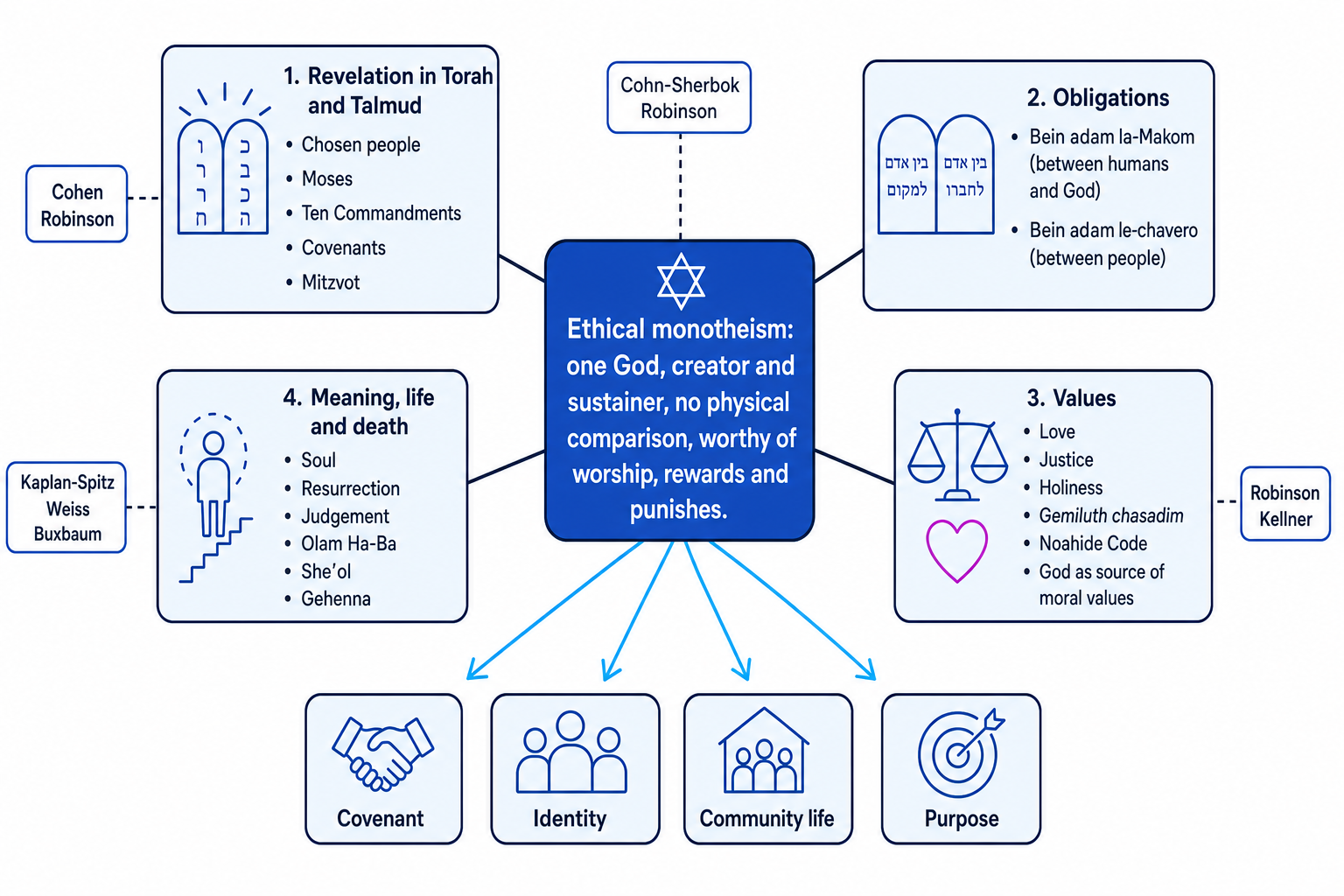
1. Ethical monotheism
Definition
Ethical monotheism
Ethical monotheism is the belief that there is one God and that this one God is the source of moral values and moral obligations.
In Judaism, God is the Creator of all things and the Sustainer of all creation. “Sustainer” means that God does not merely start the universe and leave it alone; existence continues to depend on God. God is also transcendent, meaning beyond the physical world, and immanent, meaning involved with the world and with human history.
The core statement of Jewish monotheism is the Shema: “Hear, O Israel: the LORD our God, the LORD is one” (Deuteronomy 6:4). This teaches the oneness of God. God has no equal, no rival and no physical form.
Definition
No physical comparison
To say God has no physical comparison means God is not a body and cannot be represented literally by an image. Human descriptions of God, such as “God’s hand”, are usually understood as metaphorical.
This is why Judaism strongly rejects idolatry, which means worshipping created things as if they were divine. God alone is worthy of worship. Jewish prayer, festivals and commandments are therefore directed towards the one God, not towards saints, images or lesser divine beings.
God also rewards and punishes. This does not mean every good or bad event is easy to explain. The Hebrew Bible includes texts such as Job, which challenge simplistic views of suffering. However, Judaism generally holds that human actions matter morally and that God is just.
Obligations to God and to other people
Jewish law and ethics often distinguish between two kinds of obligation:
- Bein adam la-Makom: duties “between a person and God”, such as prayer, Shabbat observance and dietary laws.
- Bein adam le-chavero: duties “between a person and another person”, such as honesty, charity, justice and avoiding harmful speech.
Key Idea
Belief becomes practice
In Judaism, belief in one God is not just a theory about reality. It creates a way of life: worship God alone, live justly, and sanctify ordinary life through the commandments.
Dan Cohn-Sherbok is useful for explaining ethical monotheism as the basis of Jewish belief: Judaism is centred on the one God who creates, commands and enters covenant with Israel. George Robinson is useful for showing that Judaism is often less about abstract creed and more about lived practice: the one God is known through Torah, mitzvot and communal life.
Different Jewish traditions
Different Jewish traditions interpret these beliefs with different emphases:
| Tradition | Typical emphasis |
|---|---|
| Orthodox Judaism | Torah and halakhah are divinely given and binding; God’s oneness, covenant and commandments are central. |
| Conservative/Masorti Judaism | Torah and halakhah are authoritative, but Jewish law develops historically through rabbinic interpretation. |
| Reform/Liberal Judaism | Ethical monotheism and prophetic values are central; individuals and communities may adapt ritual law. |
| Hasidic Judaism | God’s presence is found in all aspects of life; worship may stress joy, prayer and closeness to God. |
Common Mistake
Reducing Judaism to belief only
Do not write as if Judaism is mainly a list of doctrines. Jewish belief is inseparable from practice, community, law, worship and ethical living.
2. God reveals himself in Torah and Talmud
Definition
Revelation
Revelation means God making himself, his will or his teaching known to human beings.
The Torah can mean the first five books of the Hebrew Bible, but more broadly it means “teaching” or divine instruction. The Talmud is the vast collection of rabbinic discussion made up of the Mishnah and Gemara. It explains, debates and applies Torah to life.
In Orthodox Judaism, the Written Torah and Oral Torah are closely linked with revelation at Sinai. Other traditions may see the Talmud more as inspired human interpretation. Either way, Torah and Talmud are central to Jewish identity because they shape worship, law, family life, festivals, business ethics, food, mourning and community discipline.
Chosen people and covenant
Definition
Covenant
A covenant is a binding relationship involving promises and obligations. In Judaism, covenant is the relationship between God and his people.
Jews are often described as the chosen people. This should not be understood as simple superiority. It means Israel has a particular vocation: to live according to God’s will and witness to ethical monotheism.
Key covenants include:
| Covenant | Significance |
|---|---|
| Noahide covenant | Universal covenant with humanity; linked to basic moral law for all people. |
| Abrahamic covenant | Promise of descendants, land and relationship with God; circumcision becomes a sign. |
| Mosaic/Sinai covenant | Torah and mitzvot are given; Israel becomes a covenant community. |
| Davidic covenant | Linked to kingship and later messianic hope. |
Moses has a unique status as the great prophet and lawgiver. The Ten Commandments, or Aseret ha-Dibrot (“Ten Utterances”), are foundational covenant teachings, but they are not the whole of Jewish law.
A. Cohen, especially through his work on the Talmud, is useful for showing how rabbinic Judaism sees the Oral Law as essential to understanding and applying revelation. Robinson helps you explain how Torah and Talmud preserve Jewish identity by turning revelation into daily practice.
Example
Interpreting chosenness as responsibility
-
Start with the covenant idea: if God chooses Israel at Sinai, the choice creates obligations, not merely privilege.
-
Connect this to practice: mitzvot require Jews to worship God, keep Shabbat, act justly and shape the whole community around God’s will.
-
Add the universal dimension: the Noahide covenant shows that non-Jews also stand under moral expectations, so chosenness does not mean God has no concern for the rest of humanity.
-
Evaluate with scholars: Robinson supports the idea that Jewish identity is lived through practice, while Kellner is useful for rejecting any interpretation of election as innate Jewish superiority.
3. Life, death and purpose
The nature of the soul
Definition
Soul
The soul is the spiritual aspect of the person. Jewish texts use several terms, including nefesh for life or living being and neshamah for the God-given breath or soul.
Judaism often treats human beings as embodied persons rather than souls trapped in bodies. Life in this world matters deeply. However, many Jewish traditions also teach that the soul survives death and that God’s justice extends beyond earthly life.
Life after death
Jewish teaching on the afterlife is diverse and less systematised than in some other religions. Important ideas include:
- Resurrection: God raises the dead. Orthodox liturgy strongly affirms this, especially in the Amidah prayer.
- Spiritual survival: the soul continues after bodily death.
- Judgement: God evaluates human life and moral responsibility.
- Olam Ha-Ba: the “World to Come”, often associated with future blessedness.
- Gan Eden: paradise or heavenly reward.
- She’ol: in earlier biblical thought, a shadowy realm of the dead rather than a developed “hell”.
- Gehenna: a place or process of punishment or purification; often not seen as eternal for most people.
Common Mistake
Do not make Gehenna identical to Christian hell
“Gehenna” is sometimes translated as “hell”, but Jewish traditions often understand it as temporary purification or judgement, not necessarily eternal torment.
E. Kaplan-Spitz and B. L. Weiss are useful for explaining the range of Jewish afterlife beliefs, including the survival of the soul, resurrection and the comfort these beliefs can give. Y. Buxbaum is especially useful for the purpose of life in Jewish spirituality: ordinary actions, prayer and mitzvot can become ways of drawing close to God.
Meaning and purpose of life
Jewish thought usually places strongest emphasis on this life. The purpose of life is to serve God, study Torah, perform mitzvot, build family and community, pursue justice and practise holiness. The afterlife matters, but it is not normally the main motivation for ethical living.
Example
Comparing resurrection and spiritual survival
-
Identify the difference: resurrection means God restores life to the dead, while spiritual survival means the soul continues beyond bodily death.
-
Apply this to traditions: Orthodox Judaism usually maintains resurrection more explicitly, while Reform or Liberal Judaism may place greater emphasis on spiritual immortality, memory, influence or ethical legacy.
-
Link to purpose: both views can support moral seriousness, but Jewish teaching still tends to stress living rightly now rather than speculating about the next world.
4. Values: Torah, community and universal ethics
Jewish values are rooted in revelation. The Torah does not deal only with “religious” rituals; it covers every aspect of life, including food, money, sexuality, work, rest, courts, family, charity and speech.
A key text here is Pirkei Avot, usually translated Ethics of the Fathers. It is a tractate of the Mishnah, found in the order Nezikin, which deals broadly with damages, courts and civil responsibility. This context matters: Jewish ethics is not detached from law and social order.
Definition
Gemilut chasadim
Gemilut chasadim, sometimes written gemiluth chasadim, means acts of loving-kindness. It includes practical care for others, not just giving money.
Pirkei Avot teaches that the world stands on Torah, worship and acts of loving-kindness. This makes kindness foundational, not optional.
Jewish distinctiveness and universal values
Judaism holds together two ideas:
- Jews have a distinctive covenant identity as the people of the Almighty.
- God’s moral concern extends to all humanity.
The Noahide Code expresses universal values. It is traditionally summarised as seven laws for all humanity: prohibitions of idolatry, blasphemy, murder, theft, sexual immorality and eating flesh from a living animal, plus the requirement to establish courts of justice.
M. Kellner is especially useful here. He argues against the idea that Jews are naturally or metaphysically superior to non-Jews. On his reading, Jewish distinctiveness is a covenantal mission, while moral truth is universal.
Love, justice and holiness
The qualities of God are reflected in Jewish values:
- Love: God’s covenant love calls Jews to love neighbour and stranger.
- Justice: God’s justice requires fair courts, honest business and concern for the vulnerable.
- Holiness: God’s holiness calls Israel to sanctify life: “You shall be holy, for I the LORD your God am holy” (Leviticus 19:2).
God is therefore the source of moral values. But Jewish tradition also insists that moral values must be lived out socially, not merely admired privately.
Key Idea
The heart of Jewish values
Jewish ethics is both particular and universal: Jews are called to a distinctive covenant life, but the values of justice, kindness and holiness express God’s concern for all humanity.
Robinson helps you show how values are embedded in everyday Jewish practice. Kellner helps you evaluate whether Jewish distinctiveness conflicts with universal ethics; his answer is that it should not, because election means responsibility rather than superiority.
Scholar comparison quick guide
| Topic | Scholar use |
|---|---|
| Ethical monotheism | Cohn-Sherbok explains one God, covenant and Jewish belief; Robinson stresses belief expressed through practice. |
| Revelation | Cohen supports the importance of Talmud and Oral Law; Robinson shows how revelation shapes whole-life Judaism. |
| Life and death | Kaplan-Spitz and Weiss show the diversity of afterlife beliefs; Buxbaum stresses spiritual purpose in ordinary life. |
| Values | Robinson links Torah to daily values; Kellner emphasises universal ethics and rejects Jewish superiority. |
Exam technique
In the exam
-
Build essays from belief to practice: explain the doctrine, then show its impact on identity, community, worship and ethics.
-
Use the named scholars for comparison, not decoration: for example, compare Robinson’s focus on lived practice with Kellner’s focus on universal values.
-
Avoid one-sided claims: Jewish traditions vary, especially on Torah authority and life after death, so qualify your answer with Orthodox, Conservative/Masorti, Reform or Liberal perspectives where relevant.
Self review
Check yourself
-
Why is “chosen people” better understood as responsibility than superiority?
-
How do Torah and Talmud preserve Jewish identity across different communities?
-
How can Jewish ethics be both distinctive to Jews and universal for all humanity?