Revision notes for Edexcel AS Level Religious Studies Religion and society. Open the guide for explanations and worked examples. Written against the Edexcel AS Level Religious Studies specification, so the content matches what's examinable rather than general Religious Studies background.
Religion and society
How does an ancient, text-based faith adapt to a globalised, secular, and pluralistic world? This unit explores how contemporary Muslims interpret their faith in response to modern social pressures, diverse societies, and shifting gender roles.
By engaging with key texts and the ideas of modern scholars, you will discover that Islam is not a monolith, but a dynamic tradition with diverse theological and social viewpoints.
What you'll learn
- How Islam views other religions, from exclusive truth claims to pluralistic interfaith dialogue.
- The internal debate over gender, traditionalism, and Islamic feminism.
- The impact of secularisation, migration, and the diverse interpretations of Shari'a law.
1. Pluralism, Religious Freedom, and Interfaith Dialogue
To understand how Islam interacts with other faiths, we must start with the foundational texts: the Qur'an and the Hadith. Islam has a unique historical relationship with other monotheistic traditions, but modern realities have sparked intense debate about how these texts should be applied today.
The Qur'an: People of the Book vs. Disbelievers
The Qur'an categorises non-Muslims into different groups, establishing a theological and social hierarchy:
Definition
Ahl al-Kitab (People of the Book)
Monotheists who received prior revelations from Allah through recognized prophets. This term primarily refers to Jews and Christians, who are seen as possessing a portion of divine truth, albeit corrupted over time (tahrif).
The Qur'an encourages respectful engagement with the Ahl al-Kitab:
"And do not argue with the People of the Book except in a way that is best... and say, 'We believe in that which has been revealed to us and revealed to you. And our God and your God is one.'" (Qur'an 29:46)
Historically, this status granted them dhimmi (protected) status in Islamic states, allowing them religious freedom in exchange for a tax (jizya).
In contrast, the Qur'an takes a much stricter stance toward polytheists and those who actively reject the truth:
Definition
Kuffar (Disbelievers / Infidels)
Those who cover up or reject the truth of Islam (literally "those who cover/deny"). This term historically referred to the pagan Quraysh of Mecca who actively persecuted early Muslims.
Verses addressing the kuffar often carry warning of divine punishment and forbid close alliances if they seek to undermine the Muslim community (e.g., Qur'an 9:5, known as the "Sword Verse").
Common Mistake
Historical Context vs. Universal Command
Students often make the mistake of reading harsh Qur'anic verses about "disbelievers" as permanent commands to violence. In academic essays, you must explain that modern scholars contextualise these verses as applying specifically to the warring pagan tribes of 7th-century Arabia who broke peace treaties, rather than as a universal mandate against all non-Muslims.
Interpretations of the Hadith
The Hadith (sayings and actions of Prophet Muhammad) present a complex picture:
- Inclusivity and Respect: Hadiths record the Prophet standing up out of respect for a passing Jewish funeral procession, reminding his companions, "Is it not a human soul?" (Sahih al-Bukhari).
- Exclusivity: Other Hadiths emphasize that salvation is found only through the final message of Islam, warning that those who hear of the Prophet but reject him will not enter Paradise.
Modern Perspectives on Truth Claims
Modern Islamic theology navigates these texts through three main lenses:
- Exclusivism: The belief that salvation is exclusive to practicing Muslims. Prior revelations (Ahl al-Kitab) have been completely abrogated (naskh) by the final revelation of the Qur'an.
- Inclusivism: The belief that while Islam is the full and final truth, virtuous non-Muslims (especially monotheists) who did not receive the message of Islam in its pure form may still receive Allah's mercy and salvation.
- Pluralism: The belief that multiple religions are valid paths to God. Pluralists frequently cite Qur'an 5:48: "Had Allah willed, He would have made you one nation... so compete with one another in good works."
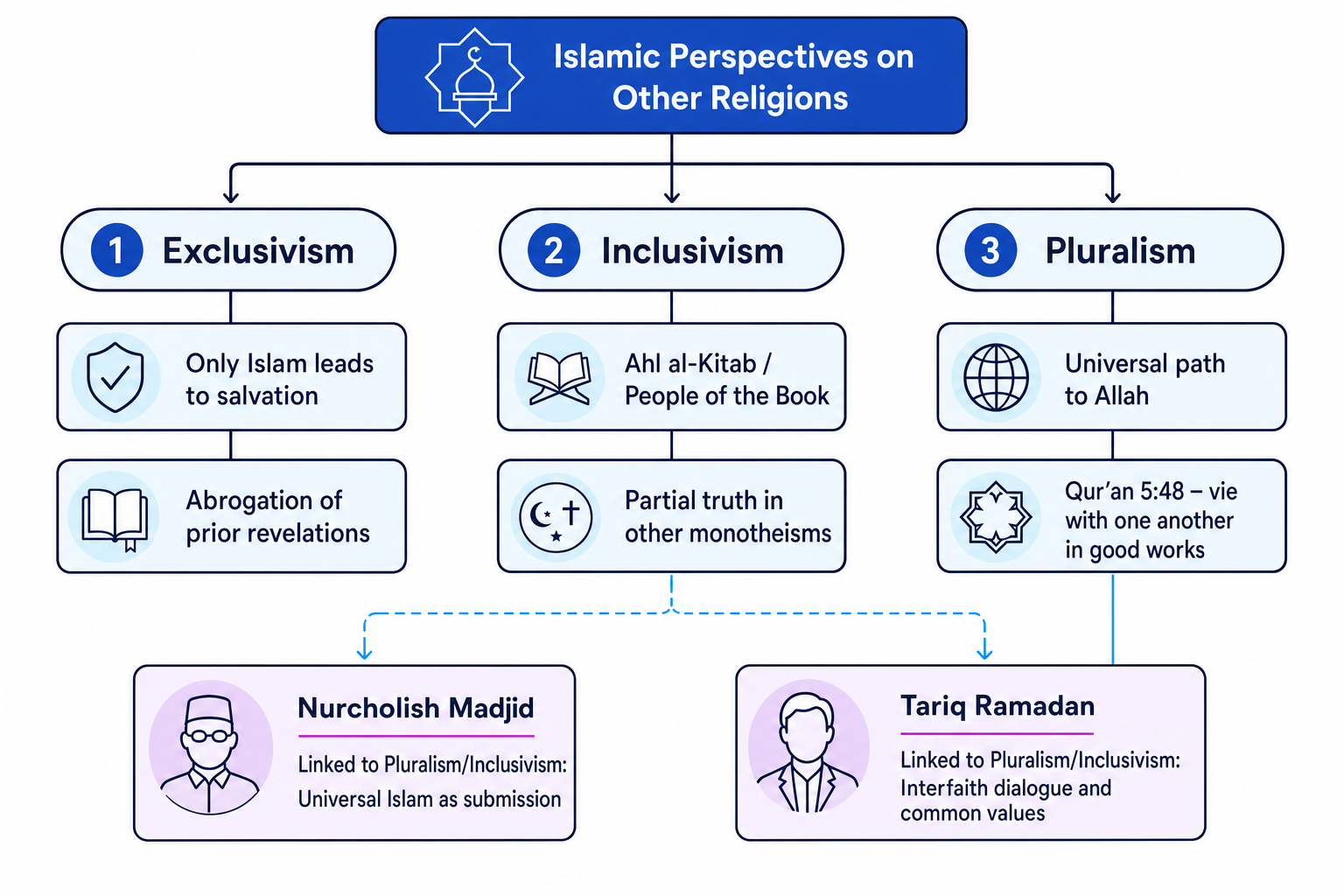
2. Key Thinkers: Nurcholish Madjid and Tariq Ramadan
To explore modern pluralism, the Edexcel specification requires you to contrast the Indonesian scholar Nurcholish Madjid and the Swiss-intellectual Tariq Ramadan.
Nurcholish Madjid (1939–2005): "Universal Islam"
Madjid was a highly influential Indonesian neo-modernist thinker who argued that pluralism is built into the very fabric of Islamic theology.
- Etymological Definition of Islam: Madjid argued that the word islam (with a lowercase 'i') means "submission to God" (from the root s-l-m). Therefore, anyone who genuinely submits to the One God—including virtuous Jews, Christians, and others—is practicing islam in its generic sense.
- Theology of Pluralism: He rejected the idea that pluralism is just "tolerance". Instead, he argued that genuine pluralism is an active engagement with diversity, ordained by Allah as a means for humanity to grow through moral competition.
Tariq Ramadan (1962–Present): "The Abode of Testimony"
Ramadan focuses on the practical and ethical challenges faced by Muslims living as minorities in Western secular democracies.
- Reforming the Geography of Islam: Classical Islamic jurisprudence divided the world into Dar al-Islam (Abode of Islam, where Shari'a rules) and Dar al-Harb (Abode of War). Ramadan completely rejects this binary as outdated.
- Dar al-Shahada (Abode of Testimony): Ramadan proposes that the West is the "Abode of Testimony". In this space, Muslims are fully citizens and have a duty to "testify" to their faith not by converting others, but by working alongside non-Muslims to promote common ethical values: social justice, equality, and human dignity.
- Interfaith Dialogue as Mutual Enrichment: For Ramadan, interfaith dialogue should not be about compromising one's theological truths, but about discovering shared civic and moral values to improve society.
Key Idea
Comparing Madjid and Ramadan
While Madjid uses deep etymological and metaphysical arguments to establish a theological pluralism from within the Islamic tradition, Ramadan focuses on the sociopolitical reality of Muslims in the West, advocating for practical, ethical, and civic pluralism.
3. Rejection of Pluralism, Restrictions, and Scriptural Reasoning
While scholars like Madjid and Ramadan champion pluralism, other movements and nations reject these ideas.
Rejectionist Movements: The Nation of Islam
Founded in 1930s America by Wallace Fard Muhammad and led by Elijah Muhammad, the Nation of Islam (NoI) is a black nationalist organization.
- Theology: Unlike orthodox Islam, early NoI taught that black people were the original human beings and that white people were "devils" created by a rogue scientist named Yakub.
- Rejection of Integration: The NoI rejected integration with white, Christian-dominated American society and dismissed mainstream interfaith dialogue.
- Orthodox View: Mainstream Sunni Muslims reject NoI's racial theology as entirely un-Islamic, pointing to the Prophet’s Farewell Sermon, which explicitly declared that no race is superior to another.
State-Level Restrictions on Religious Freedom
In several Muslim-majority nations, religious pluralism is legally restricted:
- Saudi Arabia: The public practice of any religion other than Islam is strictly prohibited. No churches or temples are permitted to be built.
- Pakistan: Blasphemy laws are frequently used to target religious minorities, such as the Ahmadiyya community (who are legally declared non-Muslims) and Christians.
Scriptural Reasoning and Grassroots Dialogue
In contrast to these restrictions, projects like Scriptural Reasoning bring Jews, Christians, and Muslims together to read their respective sacred texts. Rather than seeking a lowest-common-denominator agreement, participants discuss their differences openly, fostering deep mutual respect while honoring the unique truth claims of each tradition.
4. Gender and Islam
Gender in Islam is a highly debated topic, focusing on the tension between classical patriarchal interpretations and contemporary Islamic feminism.
Textual Roots: Qur'an and Hadith
The primary sources of Islam contain teachings that can support both egalitarian and hierarchical views of gender.
The Egalitarian Thread (Spiritual Equality)
The Qur'an clearly asserts that men and women are spiritually equal before Allah, sharing the same moral obligations and rewards:
"Indeed, the Muslim men and Muslim women, the believing men and believing women... for them Allah has prepared forgiveness and a great reward." (Qur'an 33:35)
The Hierarchical Thread (Functional Inequality)
Conversely, several passages lay out distinct gender roles and legal differences, reflecting the social structures of 7th-century Arabia:
- Guardianship (Qiwamah): Qur'an 4:34 states that "Men are the caretakers of women, because Allah has made some of them excel others, and because they spend from their wealth."
- Inheritance: Women generally inherit half the share of men (Qur'an 4:11), justified historically by the fact that men bear the sole financial responsibility for the family, while a woman’s wealth is entirely her own.
- Legal Testimony: In certain financial matters, the testimony of two women is equated to that of one man (Qur'an 2:282).
5. Key Thinkers: Leila Ahmed and Seyyed Hossein Nasr
The debate over these texts is sharpest when comparing Islamic feminist Leila Ahmed and Traditionalist philosopher Seyyed Hossein Nasr.
Leila Ahmed: The Dual Voices of the Qur'an
In her landmark book Women and Gender in Islam, Ahmed argues that the Islamic revelation contains two distinct, competing voices:
            ┌────────────────────────────────────────┐
            │        The Revelation of Islam         │
            └───────────────────┬────────────────────┘
                                │
         ┌──────────────────────┴──────────────────────┐
         ▼                                             ▼
┌──────────────────┐                          ┌──────────────────┐
│  Ethical Voice   │                          │Hierarchical Voice│
│                  │                          │                  │
│ Absolute gender  │                          │ Pragmatic social │
│ equality before  │                          │ structures for   │
│ Allah (33:35)    │                          │ 7th-century law  │
└────────┬─────────┘                          └────────┬─────────┘
         │                                             │
         │      ┌──────────────────────────────┐       │
         ├─────►│  Patriarchal Interpretation  │◄──────┘
         │      │                              │
         │      │ Classical male jurists       │
         │      │ institutionalised hierarchy  │
         │      │ while silencing the ethical  │
         │      └──────────────┬───────────────┘
         │                     │
         ▼                     ▼
┌──────────────────┐  ┌──────────────────┐
│ Islamic Feminist │  │  Traditionalist  │
│      Reform      │  │    Submission    │
└──────────────────┘  └──────────────────┘
- The Ethical Voice: This voice preaches absolute moral and spiritual equality between men and women.
- The Hierarchical Voice: This voice established gendered social hierarchies (such as polygyny and unequal inheritance) to regulate society in 7th-century Arabia.
Ahmed’s core argument is that after the death of the Prophet, male elite jurists institutionalised the hierarchical voice into Shari'a law, while systematically silencing the ethical, egalitarian voice. For Ahmed, true Islamic feminism involves recovering this ethical voice and dismantling patriarchal laws that are mistakenly viewed as divine.
Seyyed Hossein Nasr: Spiritual Complementarity
Nasr, representing the Traditionalist School, strongly critiques modern Western feminism, arguing that it secularises and devalues the spiritual nature of gender.
- Complementarity, Not Equality: Nasr argues that men and women are spiritually equal but functionally and psychically complementary. They have different, divinely designed roles that reflect cosmic archetypes (yin and yang, active and receptive).
- Critique of Feminism: Nasr claims that Western feminism errs by trying to make women identical to men, forcing them to compete in a aggressive, secular marketplace. This, he argues, destroys the sacred structure of the family and devalues the vital, sacred role of women as mothers and nurturers.
- The Sacred Family: For Nasr, the traditional home is a sanctuary from the spiritual decay of the modern world. Preserving traditional gender roles is essential to maintaining the spiritual ecology of the Islamic community (Ummah).
6. Worked Example: Evaluating Textual Interpretation
To achieve top marks in AO2 (evaluation) essays, you must demonstrate how scholars use specific interpretive methods (hermeneutics) to analyse difficult texts.
Example
Applying Ahmed's Hermeneutical Framework
Using Leila Ahmed’s framework of the "ethical" versus "hierarchical" voices, analyze how a reformer and a traditionalist would evaluate Qur'an 4:34 ("Men are the caretakers of women...").
- Deconstruct the text using Ahmed's framework: Identify that Qur'an 4:34 belongs to the hierarchical voice, as it establishes a structural social inequality based on financial responsibility ("because they spend from their wealth").
- Apply the Islamic Feminist (Reformist) interpretation: Under Ahmed’s framework, a feminist would argue that this verse is contextual and contingent. Because modern women now earn their own wealth and share financial responsibilities, the socio-economic conditions that justified qiwamah (male guardianship) in 7th-century Arabia no longer exist. Therefore, the ethical voice of absolute equality (Qur'an 33:35) must take precedence over this obsolete social hierarchy.
- Apply the Traditionalist (Nasr) counter-argument: A traditionalist like Nasr would argue that qiwamah is not a temporary economic arrangement but a divinely ordained, unchanging cosmic reality. They would argue that the husband’s role as protector and provider reflects the divine attribute of Majesty (Jalal), while the wife's role within the home reflects Beauty (Jamal). Attempting to abolish this hierarchy disrupts the metaphysical balance of the family.
7. Secularisation, Migration, and the Shari'a
The final section of this unit examines how Muslims navigate modern Western societies, particularly the challenges of secularisation and migration.
Definition
Secularisation
The process by which religious beliefs, practices, and institutions lose their social and political significance.
For Muslims migrating to the West, secularisation poses severe challenges to maintaining an Islamic identity, particularly regarding Shari'a, modesty, and entertainment.
Shari'a Law: Static Code or Living Path?
The term Shari'a literally means "the path to the water hole"—the source of life. In modern scholarship, there is a crucial distinction between Shari'a (divine law) and Fiqh (human jurisprudence).
- Traditional/Literalist View: Shari'a is a complete, unalterable code of law governing every aspect of life, which must be implemented politically to establish an Islamic state.
- Modern/Liberationist View: Shari'a is a dynamic ethical framework. Liberationist thinkers argue that the core purpose of Shari'a is to establish justice ('adl) and protect human rights. Where classical legal rulings conflict with justice today, those rulings must be reformed.
Modern Challenges: Modesty and Entertainment
Living in a secular environment forces Muslims to negotiate traditional concepts of modesty (Haya):
- Modesty: The practice of wearing the hijab, burqa, or modest clothing is viewed by traditionalists like Nasr as a vital shield against the hyper-sexualised, consumerist culture of the modern West. For some Muslim feminists, reclaiming the hijab is an active, political choice to reject the "Western gaze".
- Entertainment: Traditional Islamic jurisprudence restricts certain forms of music, alcohol consumption, and free mixing of genders. In secular societies, young Muslims must actively choose how to balance religious boundaries with integration into mainstream social life.
8. Key Thinkers: Seyyed Hossein Nasr and Mona Siddiqui
The debate over secularisation is perfectly captured in the clash between the Traditionalism of Seyyed Hossein Nasr and the liberal academic approach of Mona Siddiqui.
Seyyed Hossein Nasr: The Critique of the Modern West
Nasr views secularisation as a spiritual catastrophe.
- The Loss of the Sacred: Nasr argues that the Western Enlightenment made the mistake of placing human reason above divine revelation. This led to a secularised worldview that stripped the cosmos of its sacred character, leading directly to moral decay and the ecological crisis.
- Rejection of Modernity: He urges Muslims not to adapt to the modern world. Instead, they must offer a radical critique of Western modernity and protect their traditional way of life from being diluted by secular values.
Mona Siddiqui: Dialogue and Pragmatic Engagement
Siddiqui, a contemporary British Muslim scholar, offers a much more optimistic and integrative approach.
- Shari'a as an Ethical Compass: Siddiqui argues that Shari'a is not a static set of rules to be blindly imposed. It is a dynamic, internalised ethical compass.
- Integration and Christian-Muslim Relations: Living as a Muslim in the West should not involve isolation. Siddiqui actively champions interfaith dialogue, particularly Christian-Muslim relations, arguing that both faiths share a commitment to hospitality, public service, and love of neighbor.
- Agency of the Individual: Unlike Nasr's insistence on traditional structures, Siddiqui emphasizes the moral responsibility of individual Muslims to navigate modernity, making personal, ethical choices that preserve the core spirit of Islam while actively contributing to secular, pluralistic societies.
Common Mistake
Do not mix up Shari'a and Fiqh
In your essays, always show off your higher-level terminology by making a distinction between Shari'a (the unchanging, divine intent of God's law) and Fiqh (the fallible, human legal reasoning used by scholars to interpret that law). This distinction is the foundation of Mona Siddiqui’s argument for reform.
Exam technique
In the exam
- Always use the named scholars in pairs: The Edexcel exam expects you to contrast viewpoints. For pluralism, pair Madjid with Ramadan. For gender, pair Ahmed with Nasr. For secularism and Shari'a, pair Nasr with Siddiqui.
- Balance AO1 and AO2: Do not just list what the scholars believe (AO1). You must evaluate why their arguments might be weak or strong (AO2). For instance, does Leila Ahmed's historical reading of the Qur'an undermine the orthodox belief in its perfect, eternal nature? Does Nasr's romanticised traditionalism ignore the real, lived oppression of women under patriarchal laws?
- Use Textual Evidence: Weave specific Qur'anic concepts (like Ahl al-Kitab, Kuffar, Qiwamah) into your essays to anchor your scholarship in theological reality.
Self review
Check yourself
- How does Nurcholish Madjid's etymological definition of islam allow him to argue that other monotheistic religions are valid paths to salvation?
- What are the "two voices" of the Qur'an according to Leila Ahmed, and how does she explain the historical dominance of patriarchal laws?
- Why does Seyyed Hossein Nasr believe that Western secularisation is a spiritual catastrophe, and how does his view of Shari'a differ from Mona Siddiqui's?