Revision notes for Edexcel AS Level Religious Studies Works of scholars. Open the guide for explanations and worked examples. Written against the Edexcel AS Level Religious Studies specification, so the content matches what's examinable rather than general Religious Studies background.
Works of scholars
What you'll learn
- What jihad means beyond the common phrase “holy war”.
- How Tariq Ramadan and Majid Khadduri differ in their treatment of greater and lesser jihad.
- Why the nafs matters for understanding submission to Allah.
- How to use Qur’anic passages and S. H. Nasr in evaluation.
1. The starting point: what does “jihad” mean?
Definition
Jihad
Jihad comes from the Arabic root j-h-d, meaning to strive, exert effort or struggle. In Islamic thought it can refer to inward moral struggle, public effort for justice, and, in limited contexts, armed struggle “in the path of Allah”.
The first exam skill is to avoid flattening jihad into one meaning. The Qur’an uses language of striving in several ways: striving with oneself, striving with wealth, striving through the Qur’an, and fighting when a community is under threat.
Definition
Qital
Qital means fighting or combat. It is narrower than jihad, so a Qur’anic command about fighting should not automatically be treated as a definition of all jihad.
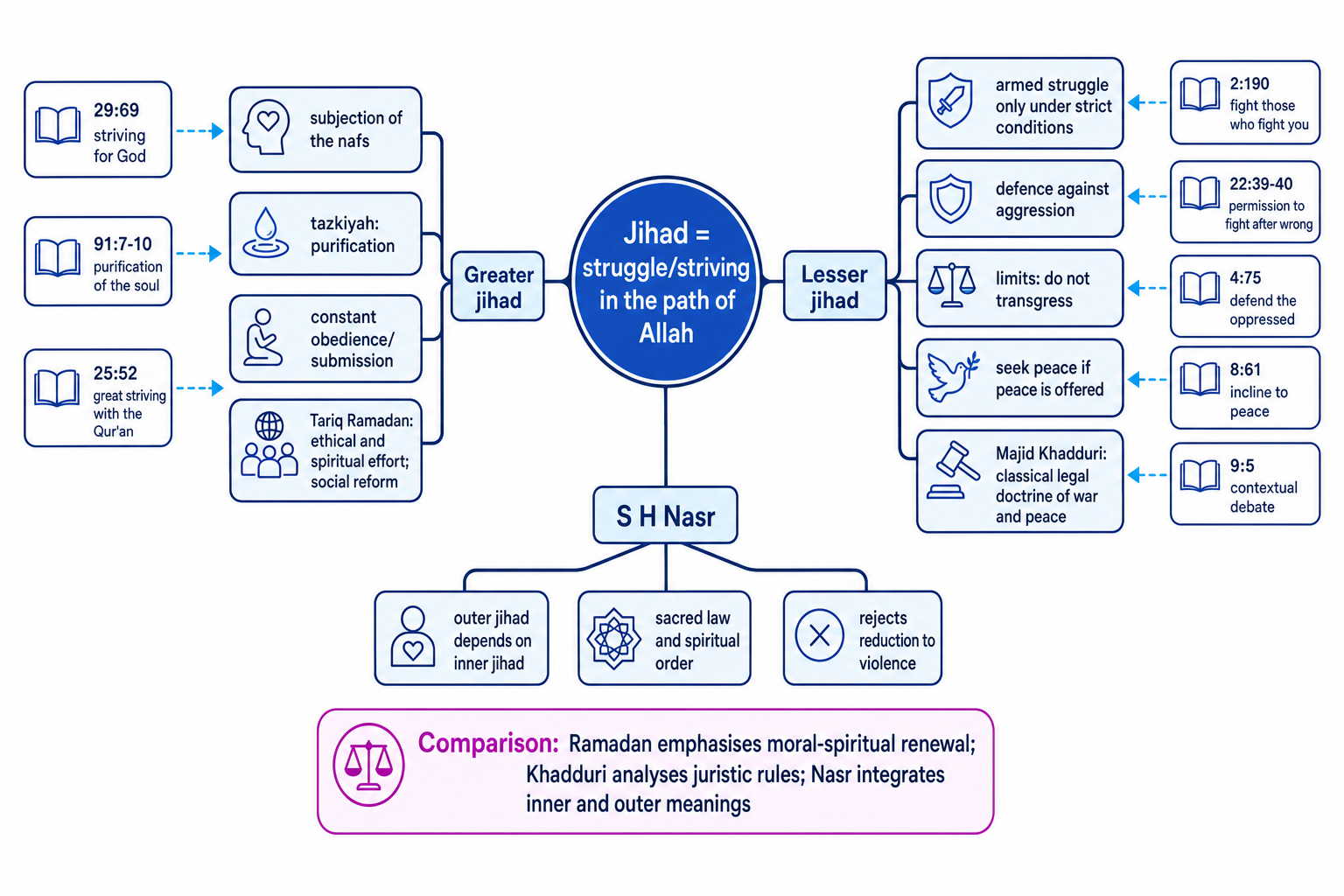
The classic distinction is between greater jihad and lesser jihad. Greater jihad is the inward struggle to discipline the self before Allah. Lesser jihad is outward struggle, which may include armed defence under strict moral and legal conditions.
The map below keeps the three scholars separate while showing where they overlap.
Key Idea
The big distinction
Greater jihad is about the transformation of the self in submission to Allah; lesser jihad is about outward struggle, including armed struggle, but only within ethical and legal limits.
Common Mistake
Calling jihad simply “holy war”
The phrase “holy war” is too blunt. It hides the difference between jihad as striving and qital as fighting, and it ignores Qur’anic limits on violence.
2. Greater jihad: the nafs and submission to Allah
Definition
Nafs
Nafs means the self, soul or ego. In this topic it usually refers to the lower self: the desires, pride, anger and selfishness that must be disciplined so that a person can live in submission to Allah.
The word Islam itself is linked to submission or surrender to Allah. Greater jihad is therefore not an optional extra for unusually “spiritual” Muslims. It is the constant struggle to align the whole self with Allah’s will.
This includes resisting greed, arrogance, hatred, laziness in worship, injustice towards others, and the temptation to use religion for ego or power. The Qur’an supports this moral struggle: for example, 91:7–10 links success with purifying the soul, while 29:69 says that those who strive for Allah will be guided.
Seyyed Hossein Nasr is especially useful here. Nasr argues that the most fundamental jihad is the struggle against the lower self. For him, outward action becomes spiritually dangerous if the inward self is ruled by anger, revenge or pride.
Tariq Ramadan also gives great weight to this inner and ethical meaning. In his contemporary writing, jihad is not primarily aggression but disciplined effort: reforming oneself, resisting injustice, and living faithfully in modern society.
Example
Using the nafs in an essay
- Define the nafs as the self or ego that can pull a person away from obedience to Allah.
- Connect this to greater jihad: the believer must struggle against selfish desires so that worship and moral action become sincere.
- Use Nasr to deepen the point: outward jihad without inner purification risks becoming violence driven by ego rather than service to Allah.
- Compare with Ramadan: Ramadan’s stress on ethical self-reform fits Nasr’s view that the inner struggle is foundational.
Common Mistake
The greater/lesser saying
The famous report about returning from the “lesser jihad” to the “greater jihad” has disputed authenticity. In essays, you can mention the distinction’s influence, but do not make that report your only evidence.
3. Lesser jihad: armed struggle under limits
Lesser jihad can include armed struggle, but Islamic scholars do not treat this as unlimited violence. It is tied to intention, authority, justice and restraint.
Majid Khadduri is important because he writes as a scholar of Islamic law and international relations. In works such as War and Peace in the Law of Islam, he analyses jihad as a classical legal doctrine. He is especially interested in how Muslim jurists understood war, peace, treaties and the political duty of the Islamic state.
Definition
Fard kifayah
Fard kifayah means a collective duty: if enough members of the community fulfil it, the obligation is lifted from the rest. Classical jurists often treated military jihad in this way, except in direct defence, where the duty could become individual.
Khadduri’s account is not the same as Ramadan’s. Ramadan writes as a contemporary Muslim thinker concerned with spiritual renewal, justice and Muslim life in plural societies. Khadduri reconstructs the classical juristic framework, including ideas such as dar al-Islam and dar al-harb, the “abode of Islam” and the “abode of war”. These were legal-political categories used by some jurists, not simple Qur’anic labels for all non-Muslims.
This matters because Khadduri prevents an essay from becoming too soft or one-sided. Lesser jihad has genuinely been treated as a legal and military doctrine in Islamic history. However, Ramadan and Nasr remind you that this cannot be separated from ethics, restraint and spiritual intention.
Common Mistake
Lesser does not mean unimportant
“Lesser” does not mean “irrelevant”. It means lesser in spiritual rank than the inner struggle, not that questions of defence, oppression and justice do not matter.
4. Close Qur’anic interpretation
For Edexcel, you should be able to use Qur’anic passages closely, not just drop references into an essay.
Qur’an 2:190
This verse says to fight in the way of Allah those who fight you, but not to transgress. The wording supports a limited and defensive reading: fighting is directed against aggressors, and even then it is morally bounded.
Example
Reading Qur’an 2:190
- Start with the phrase “in the way of Allah”: the intention cannot be revenge, nationalism or personal power.
- Notice the object of the command: “those who fight you” restricts the command to opponents already engaged in aggression.
- Apply the limit “do not transgress”: even justified fighting must obey moral boundaries.
- Link the scholars: Ramadan stresses the ethical restraint, Khadduri sees a source for legal rules of warfare, and Nasr insists that without inner discipline the outward action is spiritually corrupted.
Qur’an 22:39–40
This passage gives permission to fight to those who have been wronged and driven from their homes. It also mentions the protection of monasteries, churches, synagogues and mosques. This is significant because the aim is not simply Muslim dominance; the passage can be read as defending worship and resisting persecution.
Qur’an 4:75
This verse asks why believers would not fight for oppressed men, women and children. It gives lesser jihad a humanitarian dimension: defence of the vulnerable, not merely defence of territory.
Qur’an 8:61
This verse says that if the enemy inclines to peace, Muslims should also incline to peace and trust in Allah. It is a key text against endless war.
Qur’an 9:5
This is often called the “sword verse”, but it needs careful context. It appears in a discussion of treaty-breaking groups. The same passage exempts those who honoured treaties, and 9:6 grants protection to anyone seeking asylum to hear the word of Allah.
Some classical jurists gave this verse a very strong role in the law of war. Many modern Muslim scholars, including those closer to Ramadan’s approach, argue that it cannot be taken as a timeless command to attack all non-Muslims.
Tip
A strong textual move
When discussing 9:5, mention the surrounding verses. Context helps you avoid both extremes: ignoring the verse completely or treating it as a blank cheque for violence.
5. Comparing Ramadan, Khadduri and Nasr
| Focus | Tariq Ramadan | Majid Khadduri | S. H. Nasr |
|---|---|---|---|
| Main approach | Contemporary ethical and reformist | Historical and legal | Traditionalist and spiritual |
| Greater jihad | Central to Muslim self-discipline and moral renewal | Acknowledged, but not his main focus | Foundational struggle against the lower self |
| Lesser jihad | Legitimate only as ethical resistance to oppression | Classical legal doctrine of war, peace and state duty | Permitted only within sacred law and spiritual discipline |
| Main strength | Shows jihad as relevant to everyday submission and justice | Shows the real juristic and political tradition | Integrates inner and outer meanings |
| Possible weakness | May underplay some classical military-legal interpretations | Can sound reductionist if isolated from spirituality | Gives less detailed legal analysis than Khadduri |
Ramadan and Khadduri are not simply “right” and “wrong”. They are doing different things. Ramadan asks what jihad means for Muslims seeking to live faithfully and ethically today. Khadduri asks how classical Islamic law understood war and peace. Nasr helps you evaluate both by insisting that outward struggle must be rooted in inward purification.
Example
Building a comparison paragraph
- Choose a clear axis of comparison: for example, spiritual-ethical emphasis versus legal-political emphasis.
- Explain Ramadan first: jihad is striving for self-reform and justice, so lesser jihad must be morally constrained.
- Contrast Khadduri: classical jurists treated military jihad as a legal duty of the community or state, shaped by rules about war, peace and treaties.
- Evaluate using Nasr: Khadduri is useful for legal realism, but Nasr supports Ramadan’s claim that without the greater jihad, lesser jihad loses its spiritual legitimacy.
6. Forming a balanced judgement
A strong judgement will avoid two weak extremes.
The first weak extreme is to say jihad is only inner self-improvement. That ignores Khadduri’s evidence that lesser jihad has been a serious part of Islamic jurisprudence and political history.
The second weak extreme is to say jihad is mainly violent warfare. That ignores the broader meaning of striving, the Qur’anic language of restraint, and the importance of the nafs in Ramadan and Nasr.
The most balanced conclusion is that jihad is a layered doctrine. Greater jihad is foundational because submission to Allah begins with the purification of the self. Lesser jihad has significance as defence of the oppressed and protection of the community, but only when governed by justice, restraint and legitimate authority. Nasr is especially helpful because he links these two levels: the outer struggle must never be separated from the inner struggle.
Exam technique
In the exam
- Compare the two named scholars directly: Ramadan’s ethical-spiritual emphasis and Khadduri’s legal-historical emphasis.
- Use Qur’anic passages closely: explain key phrases such as “those who fight you”, “do not transgress” and “incline to peace”.
- Reach a judgement: argue that jihad cannot be reduced either to private self-improvement or to armed conflict.
Self review
Check yourself
- How would you explain the difference between jihad and qital?
- Why is the nafs central to greater jihad?
- How might Nasr help you evaluate both Ramadan and Khadduri?