Revision notes for Edexcel AS Level Religious Studies Social and historical developments. Open the guide for explanations and worked examples. Written against the Edexcel AS Level Religious Studies specification, so the content matches what's examinable rather than general Religious Studies background.
Social and historical developments
What you'll learn
- Why Sunni and Shi’a Islam developed differently after the death of the Prophet Muhammad.
- How the Rightly Guided Caliphs, the Umayyads and the Abbasids shaped Muslim history.
- Why Husain’s martyrdom at Karbala is central to Shi’a identity and Muharram rituals.
- How Sufism and debates about science developed within Muslim traditions.
Why this topic matters
This topic is about how Islam developed historically after the Prophet Muhammad. You are not just learning dates: you are learning how questions of authority, leadership, memory, spirituality and knowledge shaped different Muslim communities.
Key starting point: authority after the Prophet
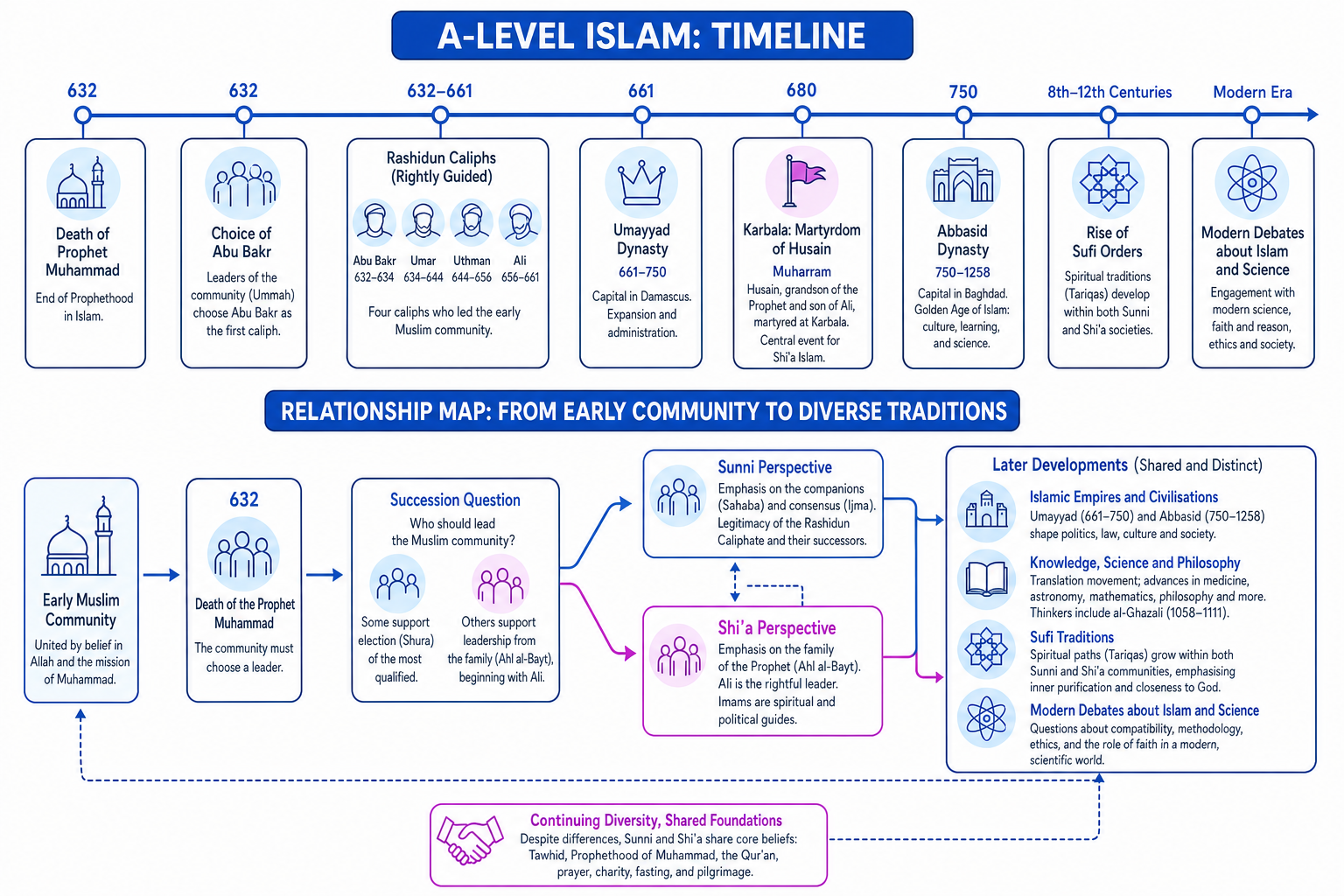
The Prophet Muhammad died in 632 CE. Muslims agreed that he was the final prophet, but there was disagreement about who should lead the community after him.
Definition
Ummah, caliph and Imam
The ummah is the worldwide Muslim community. A caliph is a successor or deputy leader after the Prophet, usually understood in Sunni Islam as a political and religious guardian of the community. In Shi’a Islam, an Imam is a divinely guided leader from the Prophet’s family, beginning with Ali, with special authority to interpret Islam.
Two groups became especially important:
- The companions of the Prophet, including Abu Bakr, who had supported Muhammad closely during his lifetime.
- The family of the Prophet, known as the Ahl al-Bayt, including Ali, the Prophet’s cousin and son-in-law.
Sunni Islam gives major importance to the companions and the consensus of the community. Shi’a Islam gives special importance to the family of the Prophet, especially Ali and his descendants.
Key Idea
The root issue
The Sunni-Shi’a division began as a dispute about succession, but it became a deeper religious disagreement about where divine authority is located after Muhammad: in the community and caliphate, or in the divinely guided Imams.
Sunni and Shi’a views of succession
| Issue | Sunni emphasis | Shi’a emphasis |
|---|---|---|
| First leader after Muhammad | Abu Bakr, chosen by leading members of the community | Ali should have been the rightful successor |
| Source of authority | The Qur’an, Sunnah, community consensus and qualified leadership | The Qur’an, Sunnah and divinely guided Imams from the Prophet’s family |
| Leadership model | Caliphate | Imamate |
| Early history | The Rightly Guided Caliphs are honoured | The first three caliphs are often viewed as having displaced Ali |
Example
Explaining the succession dispute
- Begin with the shared belief: Muhammad is the final prophet, so no new prophet can succeed him.
- Identify the disputed question: should leadership pass through community choice and consultation, or through divine designation of Ali and the Prophet’s family?
- Apply this to Sunni Islam: Abu Bakr’s leadership is accepted because he was a close companion and was recognised by the community.
- Apply this to Shi’a Islam: Ali’s leadership is seen as uniquely legitimate because of his relationship to Muhammad and his spiritual authority.
- Draw the judgement: the disagreement was both political and theological, because it concerned how Allah’s guidance continues after prophecy.
Armstrong and Nasr on Sunni-Shi’a development
Karen Armstrong gives a strongly historical reading. She presents the split as developing from real political pressures in the early Muslim community: leadership, tribal loyalties, civil conflict and the trauma of Karbala. For Armstrong, later doctrinal differences grew out of these historical wounds.
Seyyed Hossein Nasr gives a more theological and traditional account. He stresses that Shi’a Islam sees the Imamate as a continuation of spiritual guidance, while Sunni Islam focuses more on the caliphate as guardianship of the community and law. Nasr helps you explain why the issue is not merely “who got power”, but what kind of authority Islam needs after the Prophet.
Tip
Using Armstrong and Nasr together
A strong essay can use Armstrong for historical causes and Nasr for religious meaning. That gives balance: the split was shaped by politics, but Muslims interpreted it through theology.
The Rightly Guided Caliphs and the spread of Islam
The Rightly Guided Caliphs, or Rashidun, are the first four caliphs in Sunni tradition:
- Abu Bakr: preserved unity after Muhammad’s death, including during the Ridda wars.
- Umar: oversaw major expansion into Syria, Iraq, Egypt and Persia.
- Uthman: associated with the standardisation of the Qur’an, but also with accusations of favouring relatives.
- Ali: revered by all Muslims, but especially central in Shi’a Islam; his rule was marked by civil war.
Their period matters because Islam moved from a small Arabian community to a wider civilisation. Expansion was helped by migration, trade routes, military campaigns, new garrison towns, taxation systems and social organisation. Conversion was often gradual, so it is too simple to say Islam spread only by force.
After the Rashidun came the Umayyad dynasty from 661 to 750, ruling from Damascus. The Umayyads made the caliphate more hereditary and imperial. Then the Abbasid dynasty ruled from 750, with Baghdad becoming a centre of learning, law, philosophy, science and culture.
Later examples of the caliphate include:
- The Abbasid caliphs, who often had symbolic religious authority even when practical power shifted to local rulers.
- The Fatimid caliphate, a Shi’a Ismaili dynasty based eventually in Egypt.
- The Ottoman sultans, who later claimed caliphal authority and presented themselves as protectors of Sunni Islam.
Common Mistake
Oversimplifying the caliphate
Do not write as if “the caliphate” always meant the same thing. Sometimes the caliph had real political power; at other times the title was more symbolic, representing unity, legitimacy and religious guardianship.
Husain, Karbala and Muharram
The most important event for Shi’a historical memory is the martyrdom of Husain, the son of Ali and grandson of Muhammad.
In 680 CE, Husain refused to give allegiance to Yazid, the Umayyad caliph. Husain travelled towards Kufa after receiving promises of support, but he and his small group were intercepted at Karbala. Husain, his family members and companions were denied water and killed. For Shi’a Muslims, this became the supreme example of faithful resistance to tyranny.
Definition
Martyrdom
Martyrdom means dying as a witness to faith and truth. In Shi’a Islam, Husain’s martyrdom shows obedience to Allah and moral courage against unjust power.
During Muharram, especially the first ten days leading to Ashura, many Shi’a Muslims remember Karbala through:
- Recitations of the suffering of Husain and his family.
- Mourning gatherings, often called majalis.
- Processions and chest-beating, known as matam or latm.
- Passion plays or dramatic retellings in some cultures.
- Forms of self-mortification, although these are controversial and many scholars prefer symbolic mourning or blood donation.
- Pilgrimage to Karbala, especially around Arba’in, forty days after Ashura.
Heinz Halm argues that Karbala became central to Shi’a identity because ritual mourning makes the past present. It is not just remembering an event; it is entering a sacred story of suffering, loyalty and injustice.
N Ahmed emphasises the ethical and communal meaning of Husain’s death. Karbala is not only sectarian grief: it becomes a wider symbol of protest against oppression and a call to moral responsibility.
Key Idea
Why Karbala matters
For Shi’a Islam, Karbala turns historical defeat into spiritual victory: Husain loses politically, but wins morally because he witnesses to justice against tyranny.
The rise and development of Sufism
Sufism, also called tasawwuf, is the mystical and devotional dimension of Islam. It focuses on purification of the self, love of Allah, remembrance of Allah and direct spiritual awareness.
Definition
Sufism
Sufism is a movement within Islam that seeks inner closeness to Allah through practices such as repentance, discipline, love, remembrance, guidance by a spiritual teacher and purification of the heart.
Sufism developed partly because some Muslims wanted a more personal and inward relationship with Allah. As the Muslim world grew wealthier and more politically powerful, some believers reacted against luxury and formalism. They stressed humility, asceticism, prayer and love.
Important Sufi ideas and practices include:
- Dhikr: remembrance of Allah, often through repeated prayer or divine names.
- Tariqa: a Sufi order or spiritual path.
- Shaykh or pir: a spiritual guide.
- Fana: the passing away of selfish ego in awareness of Allah.
- Baraka: blessing or spiritual power associated with holy people or places.
Sufism spread widely through Muslim-majority societies. Sufi orders built lodges, taught local communities, offered charity and education, and helped spread Islam in places such as South Asia, West Africa and Southeast Asia. Poetry, music and shrine devotion also made Sufi practice accessible to ordinary people.
Sunni and Shi’a responses have varied. Many Sunni Muslims accepted Sufism, especially when it remained obedient to Islamic law. Al-Ghazali helped integrate Sufi spirituality with Sunni orthodoxy. Some reformist Sunni movements, however, have criticised shrine practices, music or seeking intercession through saints. Shi’a Islam also has mystical traditions, sometimes called irfan, but some Shi’a scholars have been cautious about Sufi orders if they appear to challenge clerical authority.
Ron Geaves helps you see Sufism sociologically: it is lived through communities, teachers, migration, institutions and adaptation. William Chittick stresses the theological depth of Sufism, especially its grounding in the Qur’an, the Sunnah and the search for knowledge of Allah.
Example
Deciding whether Sufism is a separate tradition
- Consider belief: Sufis usually affirm core Islamic beliefs such as tawhid, prophethood, prayer and the Qur’an.
- Consider practice: Sufis may use distinctive practices such as dhikr circles, spiritual music or shrine devotion.
- Consider authority: Sufis often follow a shaykh, but this does not necessarily replace Islamic law or the Qur’an.
- Weigh the evidence: Sufism is best described as a movement or dimension within Islam, although some expressions appear highly distinctive.
Islam and science
In the medieval period, Muslim societies made major contributions to science, medicine, mathematics, astronomy and philosophy. Under the Abbasids, Baghdad became a major centre of translation and learning. Muslim thinkers engaged deeply with Greek philosophy, especially Aristotle and Plato.
A key figure is Abu Hamid al-Ghazali. He criticised some philosophers in The Incoherence of the Philosophers, especially when they made metaphysical claims that seemed to contradict Islam, such as the eternity of the world or denial of bodily resurrection. However, al-Ghazali did not simply reject science. He accepted useful disciplines such as mathematics, medicine and observation, but rejected the idea that reason alone could overrule revelation.
Common Mistake
Blaming al-Ghazali for the end of science
It is inaccurate to claim that al-Ghazali “destroyed Islamic science”. His criticism was mainly of philosophical overreach, not of medicine, mathematics or careful observation.
In the modern period, Muslims have responded in different ways to European science and the scientific method. The scientific method means gaining knowledge through observation, hypothesis, testing and revision. Some Muslims argue that science fits Islam because the Qur’an encourages reflection on the signs of Allah in creation. Others worry that modern science can become scientism, the belief that science is the only valid form of knowledge.
Creation is a major debate. Some Muslims read Qur’anic creation language more literally; others interpret terms such as “days” as long periods or symbolic language. Evolution is accepted by some Muslims, especially for non-human life, but rejected or qualified by others when it seems to conflict with beliefs about Adam, human dignity and divine purpose.
Seyyed Hossein Nasr is especially important here. He does not reject science as knowledge, but he criticises modern secular science for treating nature as spiritually empty. Nasr argues that traditional Islamic civilisation saw nature as a sign of Allah, not merely raw material to control.
Key Idea
Islam and science is not one debate
The issue is not simply “Islam versus science”. The real debates are about creation, method, revelation, human origins, secularism and whether nature should be understood as sacred.
Bringing the topic together
A strong essay on this topic should show development over time. Islam did not remain static after 632 CE. It developed through leadership disputes, empire-building, mourning rituals, mystical movements and intellectual encounters with philosophy and science.
For evaluation, avoid one-sided claims. Sunni and Shi’a Islam share core beliefs, but differ deeply over authority. Sufism is not outside Islam by default, but some Muslims challenge particular Sufi practices. Science is not automatically rejected in Islam, but Muslim thinkers disagree over how far modern scientific assumptions should shape interpretation of revelation.
Exam technique
In the exam
- Anchor every answer in the key issue: authority, leadership, identity, spirituality or knowledge.
- Use named scholars accurately: Armstrong for historical development, Nasr for theological tradition and sacred science, Halm and Ahmed for Karbala, Geaves and Chittick for Sufism.
- Make a judgement rather than listing facts: explain which factor was most significant and why.
- Keep Sunni and Shi’a perspectives balanced, and avoid writing as if one is simply “normal Islam” and the other is a later add-on.
Self review
Check yourself
- Why did the question of succession after Muhammad become both political and theological?
- How does Karbala shape Shi’a identity and Muharram practice?
- In what ways can Sufism be seen as both within Islam and distinctive?
- Why is Nasr critical of modern secular science without simply rejecting science?