Revision notes for Edexcel AS Level Religious Studies Sources of wisdom and authority. Open the guide for explanations and worked examples. Written against the Edexcel AS Level Religious Studies specification, so the content matches what's examinable rather than general Religious Studies background.
Sources of wisdom and authority
What you'll learn
- How the life of the Prophet Muhammad gained religious, social and political significance.
- Why the Qur’an, Hadith and Sunnah are central sources of Muslim belief and practice.
- How scholars such as Karen Armstrong, Martin Lings, S. H. Nasr and F. R. Malik help you evaluate Islamic authority.
- How sources are used in Shari’ah rulings such as halal, haram and makruh.
1. What is a “source of wisdom and authority”?
In Islam, ultimate authority belongs to Allah. Human beings do not invent truth for themselves; they receive guidance through revelation, prophets and religious tradition.
Definition
Source of wisdom and authority
A source of wisdom and authority is something Muslims look to for guidance about belief, worship, morality and community life. In Islam, the highest sources are the Qur’an, the Sunnah and the Hadith, all centred on Allah’s guidance.
A key point for Edexcel essays is that Islamic authority is both historical and transcendent. It appears in real seventh-century Arabian events, but Muslims believe its source is beyond history: Allah.
Key Idea
Big picture
Muhammad’s life matters not just because he founded a community, but because Muslims understand him as the final messenger through whom Allah’s guidance was delivered and embodied.
2. The life of the Prophet Muhammad
The Prophet Muhammad was born in Makkah around 570 CE. He was orphaned young and raised within the Quraysh tribe. As a young adult he gained a reputation as al-Amin, meaning “the trustworthy”, and worked as a merchant.
He married Khadijah, a wealthy widow and businesswoman. She became the first person to support him when he received the first revelation during the Night of Power.
Definition
Night of Power
The Night of Power or Laylat al-Qadr is the night when Muslims believe the first revelation of the Qur’an came to Muhammad through the angel Jibril. It marks the beginning of his prophethood.
The main events in Muhammad’s life form a useful timeline for essays.
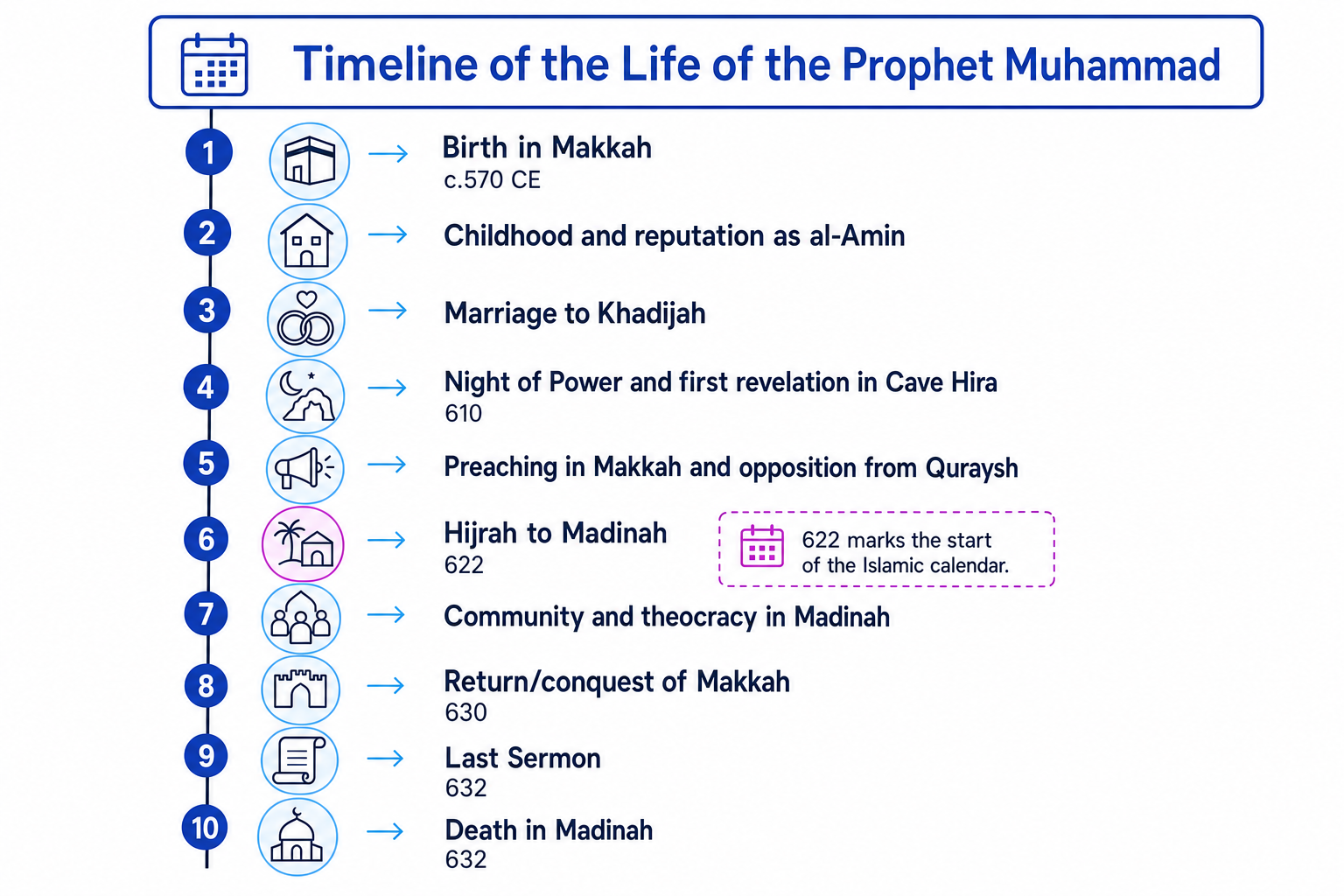
Makkah: revelation and opposition
In Makkah, Muhammad preached tawhid, the oneness of Allah. This challenged the existing religious and economic order. The Quraysh benefited from Makkah’s status as a pilgrimage and trade centre, especially because the Ka‘bah contained many tribal idols.
Muhammad’s message also attacked social injustice: neglect of the poor, exploitation, tribal arrogance and the mistreatment of vulnerable people.
Hijrah and Madinah
Definition
Hijrah
The Hijrah was Muhammad’s migration from Makkah to Madinah in 622 CE. It marks the beginning of the Islamic calendar and the move from persecuted preaching to organised Muslim community life.
In Madinah, Muhammad became not only a religious teacher but also a political and legal leader. The Muslim community, or ummah, developed laws, worship and social structures under divine guidance.
Definition
Theocracy
A theocracy is a form of community or government where authority is understood to come from God. In Madinah, Muhammad’s leadership united religious, legal and political authority.
The return to Makkah in 630 CE showed both power and mercy: idols were removed from the Ka‘bah, but many former enemies were forgiven. In the Last Sermon in 632 CE, Muhammad emphasised equality, the sacredness of life and property, and accountability before Allah. He died later that year in Madinah.
3. Arabia before Islam: why context matters
Pre-Islamic Arabia is often described in Islamic tradition as jahiliyyah, meaning ignorance of divine guidance. This does not mean there was no culture; it means society was seen as lacking full submission to Allah.
Important background factors include:
- Polytheism: belief in many gods, especially through tribal idols.
- Animism: belief that spirits or sacred power could be connected with places, objects or natural forces.
- Jinn: unseen spiritual beings; Islam accepts their existence but rejects worship of them.
- Festivals and sacrifices: religious gatherings and offerings connected with local deities.
- Christian, Jewish and Zoroastrian traditions: Arabia was not isolated; monotheistic and Persian religious ideas were present nearby.
- Makkah’s status: the Ka‘bah made Makkah religiously prestigious and economically powerful.
- Poetry and oral literature: poets were major cultural authorities, so the Qur’an’s powerful recited Arabic challenged existing literary prestige.
Muhammad rejected many features of this context, especially idolatry, tribal injustice and exploitation. However, he also transformed some practices: for example, pilgrimage to the Ka‘bah was reinterpreted as worship of Allah alone.
Common Mistake
Reducing Muhammad to context
Do not write as if Muhammad was only a social reformer produced by Arabian politics. Context explains why his message mattered, but Muslim belief says his authority comes from revelation.
4. Armstrong and Lings: two ways of reading Muhammad
Karen Armstrong stresses historical and social context. She presents Muhammad as a prophet who challenged the greed, tribalism and violence of his society. For Armstrong, Islam offered a moral and social revolution based on compassion, justice and submission to Allah.
Martin Lings gives a more traditional and spiritual account. He draws heavily on early Muslim sources and presents Muhammad’s life as providential: events are meaningful because they reveal his role as the chosen final messenger.
Both are useful, but they do different jobs. Armstrong helps explain why Muhammad’s message confronted Makkah so strongly. Lings helps explain why Muslims see Muhammad as more than a political leader.
Example
Balancing context and prophethood
- Start with the historical factor: Makkah’s economy and prestige were linked to pilgrimage and idols, so Muhammad’s monotheism threatened Quraysh power.
- Add the religious claim: for Muslims, the Night of Power means Muhammad’s message is revelation from Allah, not merely social criticism.
- Compare scholars: Armstrong explains the social force of the message, while Lings explains its sacred meaning for believers.
- Reach a judgement: context helps explain the form and reception of Muhammad’s mission, but it does not fully explain his status as final prophet for Muslims.
5. Hadith and Sunnah as a basis for Muslim living
Definition
Hadith and Sunnah
The Sunnah is the example or “way” of the Prophet Muhammad. A Hadith is a report about what Muhammad said, did or approved.
The Qur’an gives primary revelation, but it does not always give detailed instructions. For example, it commands prayer, but the Sunnah shows how Muslims pray.
Hadith were transmitted, memorised and later compiled. Scholars tested them by examining the isnad, the chain of transmitters, and the matn, the content of the report. Sunni collections include Sahih al-Bukhari and Sahih Muslim; Shi‘a Muslims also have their own respected collections.
Common Mistake
Not all hadith have equal authority
Hadith are classified by reliability, such as sahih meaning sound, hasan meaning good, and da‘if meaning weak. A weak hadith should not be used in the same way as a strong one.
The Hadith and Sunnah shape Muslim living in worship, family life, charity, business ethics, diet, modesty and character. They make Muhammad a living model, not just a historical figure.
6. The Qur’an: revealed word of Allah
Definition
Qur’an
The Qur’an is the revealed word of Allah, delivered to Muhammad in Arabic over about 23 years. The word Qur’an is linked to “recitation”.
Muslims believe the Qur’an is not simply inspired human writing. It is Allah’s guidance revealed through Jibril to Muhammad. Historically, it was memorised, recited and written down; after Muhammad’s death it was collected and standardised, traditionally associated with the caliphs Abu Bakr and Uthman.
The Qur’an is treated with deep respect: it is recited in Arabic, kept clean, often handled after ritual washing, and placed respectfully. Translations are useful, but many Muslims regard them as interpretations rather than the Qur’an itself.
Surah al-Fatiha 1
A surah is a chapter of the Qur’an. Surah al-Fatiha, the opening chapter, is central in daily prayer. It declares Allah as Lord, Merciful, Master of the Day of Judgement, and the one from whom guidance is sought.
Its message is submission: “You alone we worship, and You alone we ask for help.”
Surah al-Baqarah 2
Surah al-Baqarah is the longest surah and summarises many Qur’anic themes: faith, unbelief, hypocrisy, Adam, Ibrahim, the Children of Israel, prayer, fasting, charity, law, moral discipline and trust in Allah. It includes major passages such as Ayat al-Kursi and “There is no compulsion in religion” at 2:256.
Key Idea
Purpose of the Qur’an
The Qur’an is not just information about Allah; it is guidance that calls human beings to submission, worship, justice and moral transformation.
7. Nasr and Malik: interpreting the Qur’an
S. H. Nasr emphasises the sacred, eternal authority of the Qur’an. For Nasr, the Qur’an is the centre of Islamic life: recited, lived and interpreted within tradition. He warns against reducing it to a merely historical document.
F. R. Malik, usually known as Fazlur Rahman Malik, emphasises the moral purposes of revelation. His “double movement” approach moves from the Qur’an’s original context to its general ethical principles, then applies those principles to new situations.
Nasr protects the holiness and continuity of the Qur’an. Malik helps explain how Muslims can apply Qur’anic guidance in changing societies. A balanced essay can argue that Islamic authority needs both: fidelity to revelation and thoughtful interpretation.
8. Qur’an, Hadith and Shari’ah
Definition
Shari’ah and fiqh
Shari’ah means the divine path or way of life willed by Allah. Fiqh is human legal understanding of Shari’ah, developed by scholars through interpretation.
The Qur’an and Sunnah/Hadith are the main foundations for Shari’ah. Scholars then interpret them through legal reasoning, so different schools may express rulings differently while still aiming to remain faithful to Allah’s guidance.
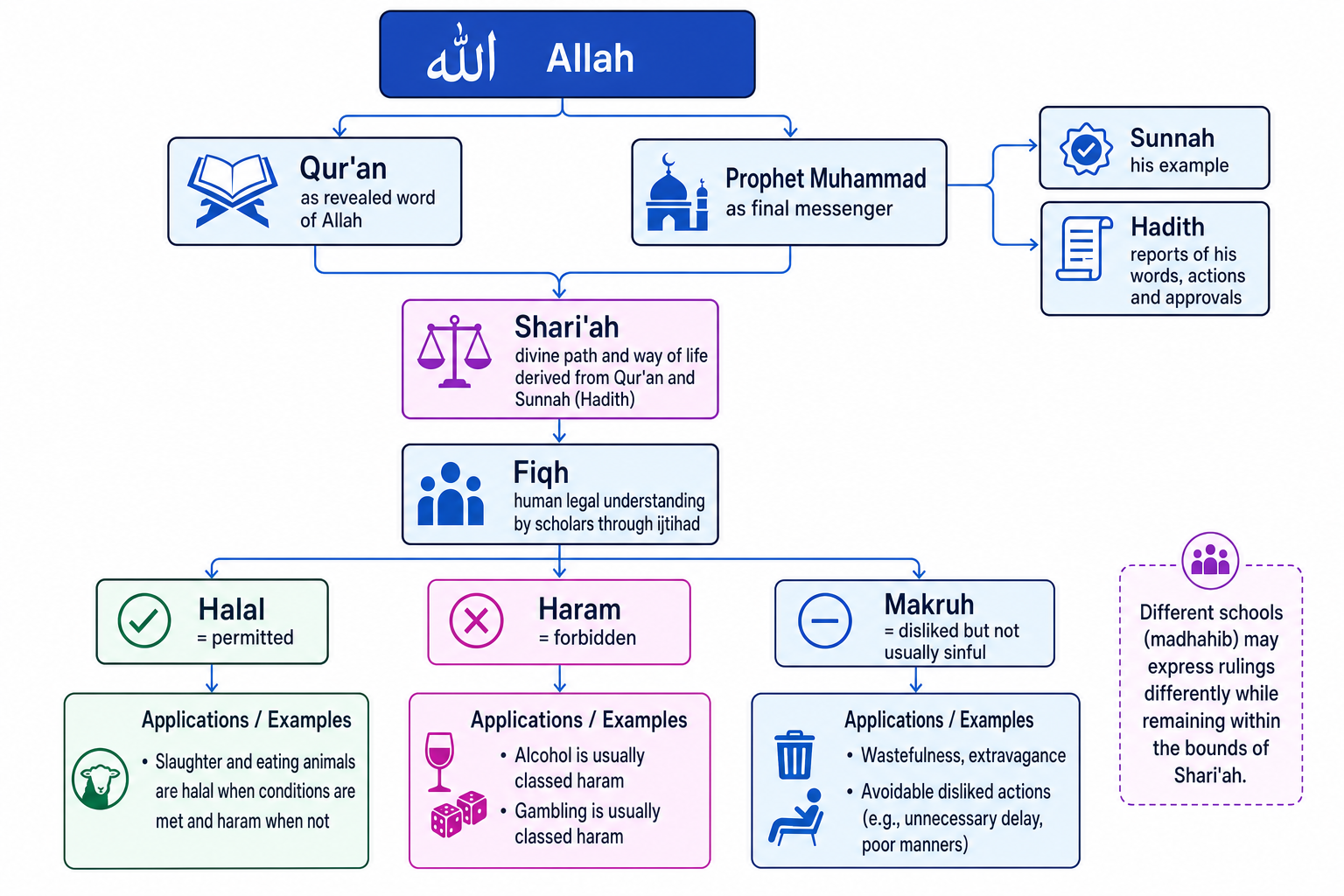
Important categories include:
- Halal: permitted.
- Haram: forbidden.
- Makruh: disliked or discouraged, but usually not as serious as haram.
Applications include alcohol and gambling, usually classed as haram; modesty, derived from Qur’an and Hadith but interpreted with some variation; and killing/eating animals, which is halal when rules of slaughter and permitted species are followed, but haram when they are not.
Example
Applying sources to alcohol
- Begin with the Qur’an: passages move from warning about intoxicants to strong prohibition, linking alcohol with harm and moral disorder.
- Add Hadith: reports that “every intoxicant” is forbidden extend the ruling beyond one specific drink.
- Classify the action: most scholars therefore treat alcohol as haram, not merely makruh.
- Evaluate interpretation: Nasr would stress obedience to sacred authority, while Malik’s approach can extend the principle to modern drugs and other intoxicants.
Tip
Scholar comparison shortcut
Use Armstrong and Lings mainly for Muhammad’s life and significance. Use Nasr and Malik mainly for the Qur’an, interpretation and authority.
Exam technique
In the exam
- Link facts to significance: do not just narrate Muhammad’s life; explain why events such as the Night of Power, Hijrah and Last Sermon matter for Muslim authority today.
- Compare named scholars directly: Armstrong and Lings are not just names to drop; use them as contrasting lenses on context and transcendence.
- For Qur’an and Shari’ah questions, distinguish clearly between Qur’an, Sunnah, Hadith, Shari’ah and fiqh so your evaluation stays precise.
Self review
Check yourself
- Why is the Hijrah more than just a journey from one city to another?
- How do Armstrong and Lings differ in their understanding of Muhammad’s significance?
- What is the difference between Shari’ah and fiqh, and why does it matter for halal, haram and makruh?