Revision notes for Edexcel AS Level Religious Studies Religious beliefs, values and teachings. Open the guide for explanations and worked examples. Written against the Edexcel AS Level Religious Studies specification, so the content matches what's examinable rather than general Religious Studies background.
Religious beliefs, values and teachings
Welcome to your study notes for Option 4D: Islam. In this section, we explore the theological core of Islam: the Six Beliefs (al-Iman). This is not just a list of dry doctrines; it is a dynamic, interconnected system of thought that shapes every aspect of a Muslim's daily life, spiritual journey, and worldview.
We will break down these beliefs, look at how different traditions within Islam interpret them, and engage with the insights of two critical contemporary scholars: Seyyed Hossein Nasr and William Chittick.
What you'll learn
- The foundational nature of the Six Beliefs in Sunni Islam and how they interconnect as a unified system.
- The differences in core creed between Sunni and Shi'a traditions, focusing on the Five Roots of Religion (Usul ad-Din).
- The theological tension between free will and predestination (Al-Qadr), and how divine justice (Adalat) is understood.
- How scholars Seyyed Hossein Nasr and William Chittick explain these beliefs in the context of modern challenges and spiritual experience.
1. The Six Beliefs as the Basis of Islam
In Sunni Islam, the Six Beliefs (often called the Articles of Faith, or al-Iman) are derived directly from the Qur'an and the Hadith (specifically the famous Hadith of Gabriel, where the Prophet Muhammad defines faith). They constitute the essential theological framework that a person must accept to be considered a believer.
Definition
Al-Iman
Al-Iman literally means "faith" or "belief". In Islamic theology, it refers to the deep internal conviction and intellectual acceptance of the core truths revealed by Allah, which must then manifest in outer actions.
These six beliefs are not isolated items on a checklist. Instead, they form a cohesive web where each belief relies on and reinforces the others.
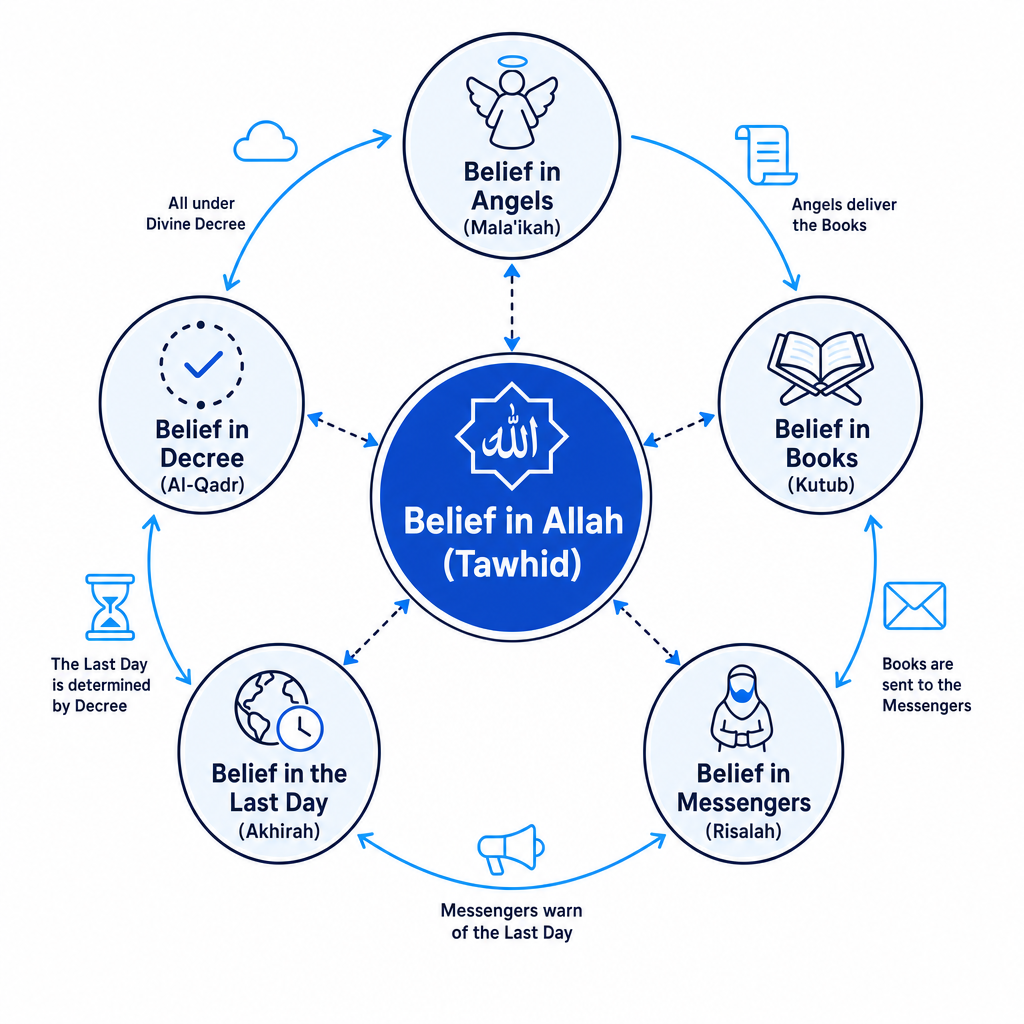
At the absolute center of this system is Tawhid (the oneness of Allah). Every other belief radiates from this single truth:
- Because Allah is one and transcendent, He must communicate His guidance to humanity through intermediate beings (Angels).
- These angels deliver His literal words in written form (Holy Books).
- These books are received and lived out by human exemplars (Prophets).
- Humanity is held accountable for how they respond to this guidance on the Day of Judgment.
- This entire cosmic narrative—from creation to final judgment—is planned and sustained by Allah's ultimate decree (Predestination).
Key Idea
The Golden Thread of Tawhid
If you pull out any single thread of the Six Beliefs, the entire tapestry of Islam unravels. You cannot believe in the Qur'an (Holy Books) without believing in Angel Jibril (Angels) or Prophet Muhammad (Prophets). Everything is an extension of Tawhid.
2. Sunni and Shi'a Frameworks: Core Differences
While both Sunni and Shi'a Muslims share the same essential practices (like daily prayer and fasting) and respect the same core theological concepts, they structure their foundational creeds differently.
For Sunni Muslims, the structural backbone is the Six Beliefs. For Shi'a Muslims (specifically Twelver Shi'as), the foundation is the Five Roots of Religion (Usul ad-Din).
The Five Roots of Religion (Usul ad-Din) in Shi'a Islam
- Tawhid (Oneness of God): Absolute monotheism.
- Adlah or Adalat (Divine Justice): The belief that God is inherently just and fair, and does not act with caprice.
- Nubuwwah (Prophethood): Belief in the prophets sent to guide humanity.
- Imamah (Divine Leadership): Belief that after the Prophet Muhammad, Allah appointed twelve infallible leaders (Imams) from the Prophet's household (Ahl al-Bayt) to preserve the true meaning of the message.
- Mi'ad (Resurrection/Day of Judgment): Belief in life after death and ultimate accountability.
Key Points of Departure
- Imamah: This is the most significant theological difference. For Shi'a Muslims, the spiritual and political authority of the Imams is a fundamental article of faith (Usul). For Sunnis, the leadership of the early Caliphs was a historical and practical matter, not a divinely ordained theological dogma.
- Adalat: While both Sunni and Shi'a Muslims believe Allah is just, they define this justice differently. Shi'as elevate Adalat to a core root of faith, influenced by the rationalist theology of the Mu'tazilites, arguing that justice is an objective reality that God always upholds. Sunnis (particularly Ash'arite theologians) argue that whatever God wills is, by definition, just—there is no external standard of justice to which God must conform.
Common Mistake
Confusing Roots and Pillars
Do not confuse the Five Roots of Religion (Usul ad-Din), which are the core beliefs of Shi'a Islam, with the Five Pillars (Arkan al-Islam), which are the physical actions (like prayer and fasting) practiced by Sunnis.
3. Deep Dive into the Individual Beliefs
Let us examine the specific theological nuances, variations in interpretation, and existential purposes of each of the Six Beliefs.
I. Belief in Allah as the One (Tawhid)
Tawhid is the absolute, uncompromising monotheism of Islam. It is divided into three dimensions:
- Tawhid al-Rububiyyah (Oneness of Lordship): Believing Allah is the sole creator, sustainer, and master of the universe.
- Tawhid al-Uluhiyyah (Oneness of Worship): Directing all acts of worship, devotion, and obedience exclusively to Allah.
- Tawhid al-Asma wa al-Sifat (Oneness of Names and Attributes): Affirming the names and attributes Allah has described Himself with in the Qur'an, without comparing Him to creation (tashbih) or denying His attributes (ta'til).
II. Belief in Angels (Mala'ikah)
Angels are created from light (nur), do not possess free will, and obey Allah's commands flawlessly.
- Key Angels: Jibril (Gabriel - the messenger of revelation), Mika'il (Michael - the guardian of nature and sustenance), Israfil (who blows the trumpet to announce the Day of Judgment), and Malak al-Mawt (the Angel of Death).
- Significance: For believers, angels reinforce the concept of an unseen spiritual world (al-Ghayb) and remind them that their deeds are constantly recorded by the honorable scribes (Kiraman Katibin).
III. Belief in Holy Books (Kutub)
Allah sent scriptures to various prophets to guide humanity.
- The Books: The Sahifah (Scrolls of Abraham), the Tawrat (Torah of Moses), the Zabur (Psalms of David), the Injeel (Gospel of Jesus), and the final, incorruptible revelation: the Qur'an.
- Interpreting Authority: While Muslims respect the earlier scriptures in their original, divine forms, they believe those texts were historically altered or lost over time. The Qur'an is held to be the direct, literal, and perfectly preserved word of Allah.
IV. Belief in the Prophets (Risalah)
Risalah is the channel of communication between Allah and humanity.
- Nabi vs. Rasul: A Nabi is a prophet sent to guide people using an existing law, while a Rasul is a messenger given a new divine book or law (shari'ah).
- The Finality: All Muslims accept Muhammad as the Khatam an-Nabiyyin (Seal of the Prophets), marking the completion of divine revelation.
V. Belief in the Day of Judgment (Akhirah)
Akhirah (the afterlife) gives life ultimate meaning and moral structure.
- The Process: After death, the soul enters Barzakh (a barrier/waiting state). On the Last Day, the universe will be destroyed, all humans will be resurrected (Mi'ad), and their deeds will be weighed on the scales (Mizan). They must cross the Sirat bridge over the fires of Hell (Jahannam) to reach Paradise (Jannah).
- Purpose of Life: Life is a temporary testing ground (dar al-imtihan). Without Akhirah, suffering would have no resolution, and moral choices would have no ultimate consequence.
VI. Belief in Predestination (Al-Qadr)
Al-Qadr is the belief that everything in the universe—past, present, and future—is governed by Allah’s divine decree and foreknowledge.
Common Mistake
The Free Will Paradox
This is one of the most intellectually challenging concepts in Islamic theology. If Allah has already written down everything that will happen, how can humans have free will? And if we do not have free will, how can Allah justly judge us on the Day of Judgment?
Different schools of Islamic thought resolve this tension differently:
- The Sunni (Ash'arite) View: They propose the doctrine of Kasb (acquisition). Allah creates all possible actions, but humans "acquire" or choose these actions through their intention. Allah's foreknowledge is descriptive (knowing what we will choose) rather than prescriptive (forcing us to choose it).
- The Shi'a (Imami) View: They reject absolute determinism (jabr) and absolute free will (tafwid). Instead, they argue for a middle path: "an option between two options." Human choices are genuine, but they operate entirely within the parameters of power that Allah has granted us.
4. The Nature of Allah: Adalat, Tawhid, and the 99 Names
Understanding the nature of Allah is the highest intellectual and spiritual pursuit in Islam.
The 99 Beautiful Names (Al-Asma al-Husna)
The 99 Names are divided by theologians into two main categories:
- Attributes of Majesty (Jalal): Names that invoke awe, fear, and distance, such as Al-Qahhar (The Subduer) and Al-Muta'ali (The Supreme).
- Attributes of Beauty (Jamal): Names that invoke intimacy, love, and mercy, such as Al-Rahman (The Most Merciful) and Al-Wadud (The Loving).
By contemplating these names, a Muslim experiences the creative tension of being simultaneously in awe of God’s absolute power and comforted by His infinite love.
Tawhid and Adalat
- Sunni Emphasis: Focuses heavily on the absolute sovereignty of Allah. For Sunnis, Tawhid means nothing can limit Allah's will. Therefore, Adalat (justice) is defined by whatever Allah does. He does not conform to human rational ideas of "fairness".
- Shi'a Emphasis: Elevates Adalat to a standalone root of faith. For Shi'as, because Allah is perfect, His justice must be rational and objective. He cannot commit evil, and He is bound by His own nature to act justly toward His creation.
5. Scholar Focus: Seyyed Hossein Nasr and William Chittick
To score highly in your AO2 evaluation, you must bring in the ideas of the two prescribed scholars, S.H. Nasr and W. Chittick. Both are prominent contemporary traditionalist scholars who have written extensively on Islamic cosmology, metaphysics, and Sufism.
                  +---------------------------------------+
                  |         The Nature of Tawhid          |
                  +---------------------------------------+
                                      |
                 +--------------------+--------------------+
                 |                                         |
                 v                                         v
     +-----------------------+                 +-----------------------+
     | Seyyed Hossein Nasr   |                 | William Chittick      |
     | (Traditionalist /     |                 | (Sufi Metaphysician / |
     |  Metaphysical Focus)  |                 |  Cosmological Focus)  |
     +-----------------------+                 +-----------------------+
     | * Tawhid as the       |                 | * Focuses on the      |
     |   sacred, unifying    |                 |   experiential study  |
     |   principle of all    |                 |   of Allah's Names.   |
     |   reality.            |                 |                       |
     |                       |                 | * The universe is a   |
     | * Critique of modern  |                 |   mirror reflecting   |
     |   secularism for      |                 |   the divine Names.   |
     |   sacrificing sacred  |                 |                       |
     |   metaphysics.        |                 | * True faith requires |
     |                       |                 |   transforming the    |
     | * The Six Beliefs are |                 |   soul (microcosm)    |
     |   living spiritual    |                 |   to align with God.  |
     |   realities.          |                 |                       |
     +-----------------------+                 +-----------------------+
Seyyed Hossein Nasr: Tawhid as Metaphysical Unity
Nasr emphasizes that Tawhid is not merely a dry monotheistic formula, but the ultimate principle of unity that governs the cosmos, science, art, and philosophy.
- The Sacred vs. Secular: Nasr critiques modern Western secularism for separating knowledge from the sacred. He argues that the Six Beliefs are designed to keep humans connected to the transcendent source of reality.
- On Beliefs: For Nasr, the belief in prophets, books, and angels shows that the universe is hierarchical and sacred. Human beings are "pontifical" creatures—they act as a bridge (pontifex) between heaven and earth. Rejecting the Six Beliefs leads to environmental crisis and spiritual alienation because humanity forgets its divine responsibility.
William Chittick: The Experiential Reality of the Names
Chittick focuses on how these beliefs are lived and realized internally. He argues that modern interpretations of Islam often reduce it to a political ideology or a rigid legal code, ignoring its inner, spiritual dimensions (Sufism/Ihsan).
- The Mirror of the Soul: Chittick explains that the cosmos is a mirror reflecting Allah's 99 Names and Attributes. Humans, as the ultimate creation, possess all these attributes potentially.
- Understanding Al-Qadr: Chittick views predestination through the lens of divine love. It is not a restriction of freedom, but an invitation to submit our limited, flawed will to the perfect, loving will of Allah. He emphasizes that "knowing God" through the Six Beliefs is an ongoing, experiential journey of transforming the self (nafs).
Example
Evaluating the Doctrine of Al-Qadr (Predestination)
Develop a coherent theological evaluation analyzing whether the belief in Al-Qadr (Predestination) fundamentally undermines human moral responsibility on the Day of Judgment.
- Establish the theological dilemma (AO1): State clearly that if Allah has predetermined all actions, holding humans accountable on the Day of Judgment appears unjust. This creates a logical tension between Al-Qadr and Adalat (Divine Justice).
- Apply the Sunni (Ash'arite) solution of 'Kasb' (AO1/AO2): Explain that Sunnis resolve this through the concept of acquisition. Allah creates the path, but the human intends the deed. Argue that this preserves moral responsibility because intentions (niyyah) are free, and Allah judges the heart’s intent.
- Apply the Shi'a rationalist critique (AO2): Counter this by arguing that from a Shi'a perspective, Kasb is still too close to determinism (jabr). Shi'as argue that Allah grants humans genuine causal power within their sphere of action. This means humans are fully responsible for their choices, aligning perfectly with the root of Adalat.
- Synthesize using scholarly perspectives (AO2): Introduce S.H. Nasr or William Chittick. Chittick would argue that this debate is often over-rationalized. From a spiritual perspective, Al-Qadr is about recognizing that we are not the ultimate creators of our destiny, which humbles the ego, while moral action remains a vital expression of loving submission.
- Formulate a justified conclusion (AO2): Conclude that while Al-Qadr appears to undermine free will when viewed through a modern, secular framework of absolute autonomy, within Islamic theology it serves to balance absolute divine sovereignty with human moral agency, ensuring that accountability on the Day of Judgment remains metaphysically coherent.
Exam technique
In the exam
- Always link to Tawhid: Whatever question you get on the Six Beliefs (whether on angels, books, or prophets), start your essay by explaining how that specific belief is an essential branch of Tawhid.
- Contrast Sunni and Shi'a: If an essay asks about the "importance" of these beliefs, compare the Sunni structure (Six Beliefs) with the Shi'a framework (Five Roots of Religion/Usul ad-Din). Highlighting this distinction shows top-tier knowledge.
- Deploy Nasr and Chittick: Use S.H. Nasr when discussing how modern secularism has lost the sacred worldview that the Six Beliefs preserve. Use William Chittick when discussing the inner, experiential reality of the 99 Names, the soul, and spiritual transformation.
Self review
Check yourself
- How does the belief in Mala'ikah (angels) connect directly to the belief in Kutub (holy books) and Risalah (prophets)?
- Why do Shi'a Muslims elevate Adalat (justice) to a core root of religion (Usul ad-Din), whereas Sunni Muslims do not include it as a standalone article of faith?
- How would Seyyed Hossein Nasr explain the spiritual consequence of a human being rejecting the belief in Akhirah (the afterlife)?