Revision notes for Edexcel AS Level Religious Studies Practices that shape and express religious identity. Open the guide for explanations and worked examples. Written against the Edexcel AS Level Religious Studies specification, so the content matches what's examinable rather than general Religious Studies background.
Practices that shape and express religious identity
What you'll learn
- How the Five Pillars express the Muslim purpose of life: submission to Allah.
- Why intention matters as much as outward action in Islamic worship.
- How Sunni, Shi’a and Sufi emphases can be similar but not identical.
- How the ummah developed historically and why it remains central to Muslim identity today.
The starting point: Islam as submission
The word Islam is commonly understood as “submission” or “surrender” to the will of Allah, the Arabic word for God. A Muslim is therefore one who submits to Allah.
This topic is about how that submission becomes visible. Islam is not only a set of beliefs held privately in the mind; it is a way of life expressed through worship, discipline, charity, fasting, pilgrimage and communal belonging.
Definition
Tawhid
Tawhid means the oneness and uniqueness of Allah. It is the foundation of Islamic belief: worship belongs to Allah alone, and all religious practice should direct the believer back to Allah.
The Qur’an presents worship as the purpose of human life: “I did not create jinn and humankind except to worship Me” (51:56). For Muslims, the Five Pillars are not random duties. They are structured ways of living out tawhid.
The Five Pillars: one pattern of Muslim identity
The Five Pillars are the central acts of Islamic practice, especially in Sunni Islam. They are often called arkan al-Islam, meaning the “pillars” or supports of Islam.
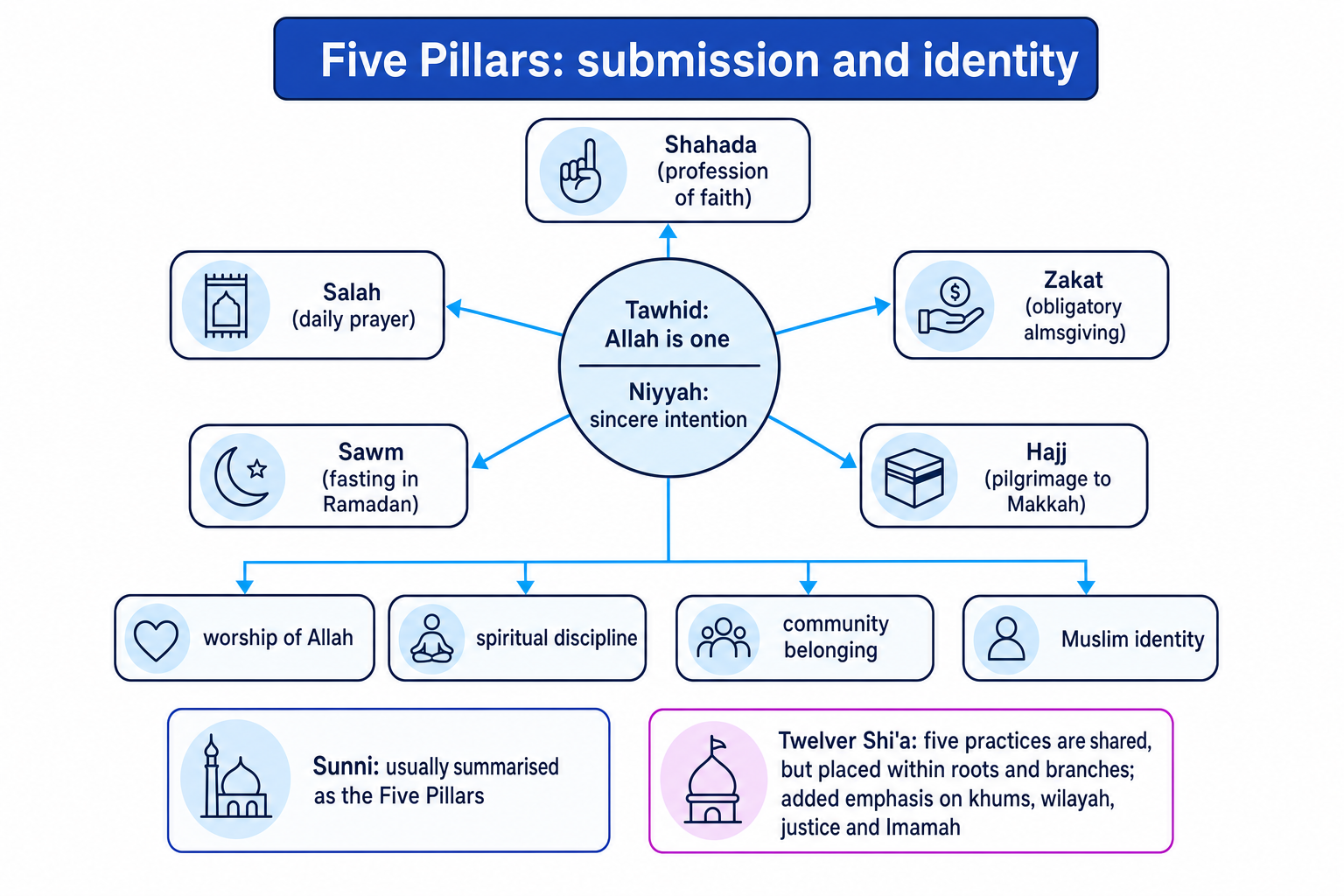
Shahada: profession of faith
The Shahada is the declaration: “There is no god but Allah, and Muhammad is the Messenger of Allah.” It expresses both tawhid and belief in Muhammad as the final prophet.
For Sunni Muslims, the Shahada is the basic entry point into Islam. Shi’a Muslims affirm the same core declaration, though many also add a statement about Ali as the wali of Allah, meaning friend, guardian or divinely favoured authority. This addition expresses Shi’a devotion to the Ahl al-Bayt, the family of the Prophet, but should not be simplistically treated as replacing the shared Shahada.
Salah: daily prayer
Salah is formal ritual prayer. Muslims pray facing the qiblah, the direction of the Ka’bah in Makkah. Prayer structures the day around remembrance of Allah.
Sunni Muslims usually speak of five daily prayers at five distinct times. Twelver Shi’a Muslims also perform the five prayers but often combine them into three prayer periods. Many Shi’a Muslims pray on a small clay tablet called a turbah, often associated with Karbala.
Zakat: obligatory almsgiving
Zakat means purification and growth. It is obligatory giving from wealth, traditionally calculated on certain forms of surplus wealth above a minimum threshold called the nisab. It purifies wealth by reminding Muslims that possessions are ultimately entrusted by Allah.
Sadaqah is voluntary charity. In Twelver Shi’a Islam, khums is also important: a one-fifth levy on certain surplus income, used for religious and community purposes.
Sawm: fasting in Ramadan
Sawm is fasting, especially during Ramadan, the month in which the Qur’an is believed to have been revealed. Muslims abstain from food, drink and sexual relations from dawn until sunset, unless exempt because of reasons such as illness, pregnancy, travel or age.
Fasting develops taqwa, meaning God-consciousness. It also creates empathy with the poor and strengthens self-control.
Hajj: pilgrimage to Makkah
Hajj is the pilgrimage to Makkah, required once in a lifetime for Muslims who are physically and financially able. Pilgrims enter a state of consecration called ihram, perform rituals including tawaf around the Ka’bah, standing at Arafat, and symbolic stoning of the pillars at Mina.
Hajj powerfully expresses equality: social status, nationality and ethnicity are relativised before Allah.
Key Idea
Why the pillars belong together
The pillars unite belief, body, time, wealth and community. Shahada gives the faith-content; salah orders daily life; zakat orders wealth; sawm orders desire; hajj orders the whole life-journey towards Allah.
Nasr and Siddiqui on the Five Pillars
Seyyed Hossein Nasr sees Islamic practice as deeply spiritual, not merely legal or social. For Nasr, the pillars draw the believer into a sacred rhythm of life. Salah, fasting and pilgrimage are ways of remembering Allah and recovering the human person’s proper orientation towards the divine.
Mona Siddiqui gives strong attention to the lived, ethical and communal nature of Islam. The pillars do not only mark a person as “Muslim”; they train moral character. Zakat forms concern for justice, Ramadan cultivates self-restraint and compassion, and prayer links the individual to the wider community.
The difference is useful for essays. Nasr helps you explain the metaphysical and spiritual depth of practice. Siddiqui helps you explain how practice forms character and community in real Muslim life today.
Example
Evaluating intention and action
-
Begin with the Islamic principle that worship is not only external performance. Niyyah, meaning sincere intention, directs an act towards Allah.
-
Apply this to fasting. A person may outwardly avoid food and drink, but if the motive is only social pressure or showing off, the spiritual purpose of taqwa is weakened.
-
Balance this by noting that Islam is not pure inwardness. The bodily act still matters because discipline, hunger and shared Ramadan practice train the believer.
-
Use scholarship: Nasr supports the view that ritual action transforms the soul, while Siddiqui supports the view that practice shapes ethical and communal responsibility.
-
Reach a judgement: in Islam, intention and action are interdependent. Intention gives worship its direction; action gives intention embodied reality.
Similarity and diversity within Islam
There is strong unity across Islam: Muslims worship one Allah, honour the Qur’an, recognise Muhammad as Prophet, pray, fast, give and make pilgrimage where able.
But there is also diversity.
Sunni Islam
Sunni Islam is the largest branch of Islam. It gives authority to the Qur’an, the Sunnah — the example of Muhammad — and the inherited legal traditions of the community. Sunni identity often summarises practice through the Five Pillars.
Shi’a Islam
Shi’a Islam gives special authority to the Prophet’s family and to the Imams, divinely guided leaders in Shi’a belief. Twelver Shi’a Islam often organises belief through the roots of religion and practice through the branches of religion, which include prayer, fasting, zakat and hajj, but also khums, jihad, commanding right and forbidding wrong, and loyalty to the Imams.
Sufi spirituality
Sufism, or tasawwuf, is Islamic mysticism: the pursuit of closeness to Allah through purification of the heart. A Sufi order is called a tariqa. Sufis may be Sunni or Shi’a. Practices such as dhikr, the remembrance of Allah, emphasise the inward meaning of the pillars.
Common Mistake
Treating diversity as division only
Do not write as if Sunni and Shi’a Muslims practise completely different religions. They share core beliefs and many practices. The main contrasts are about authority, interpretation, emphasis and some legal details.
Historical and contemporary influence of the pillars
Historically, the pillars helped form a distinctive Muslim community after Muhammad’s preaching in Makkah and leadership in Madinah. Shared prayer, fasting and charity created a disciplined community that was not based simply on tribe.
In the contemporary world, the pillars still shape identity in visible ways. Ramadan changes family routines, work patterns and public life in Muslim-majority societies. Hajj gathers Muslims globally. Zakat funds welfare projects, mosques, education and disaster relief. In minority contexts such as Britain, salah, halal routines, Ramadan and Eid can become especially important markers of identity.
There are also modern challenges: work schedules, poverty, state regulation of zakat, commercialisation of hajj, sectarian politics, and the pressure to reduce religion to private belief. These challenges make the link between practice and identity even more significant.
The ummah: Islamic identity as community
Definition
Ummah
The ummah is the worldwide Muslim community, united by faith in Allah, recognition of Muhammad, and shared religious responsibilities. It is both a spiritual ideal and a lived social reality.
The ummah expresses the idea that Muslim identity is not limited by ethnicity, tribe, class or nationality. The Qur’an says: “This community of yours is one community, and I am your Lord, so worship Me” (21:92).
Historical development of the ummah
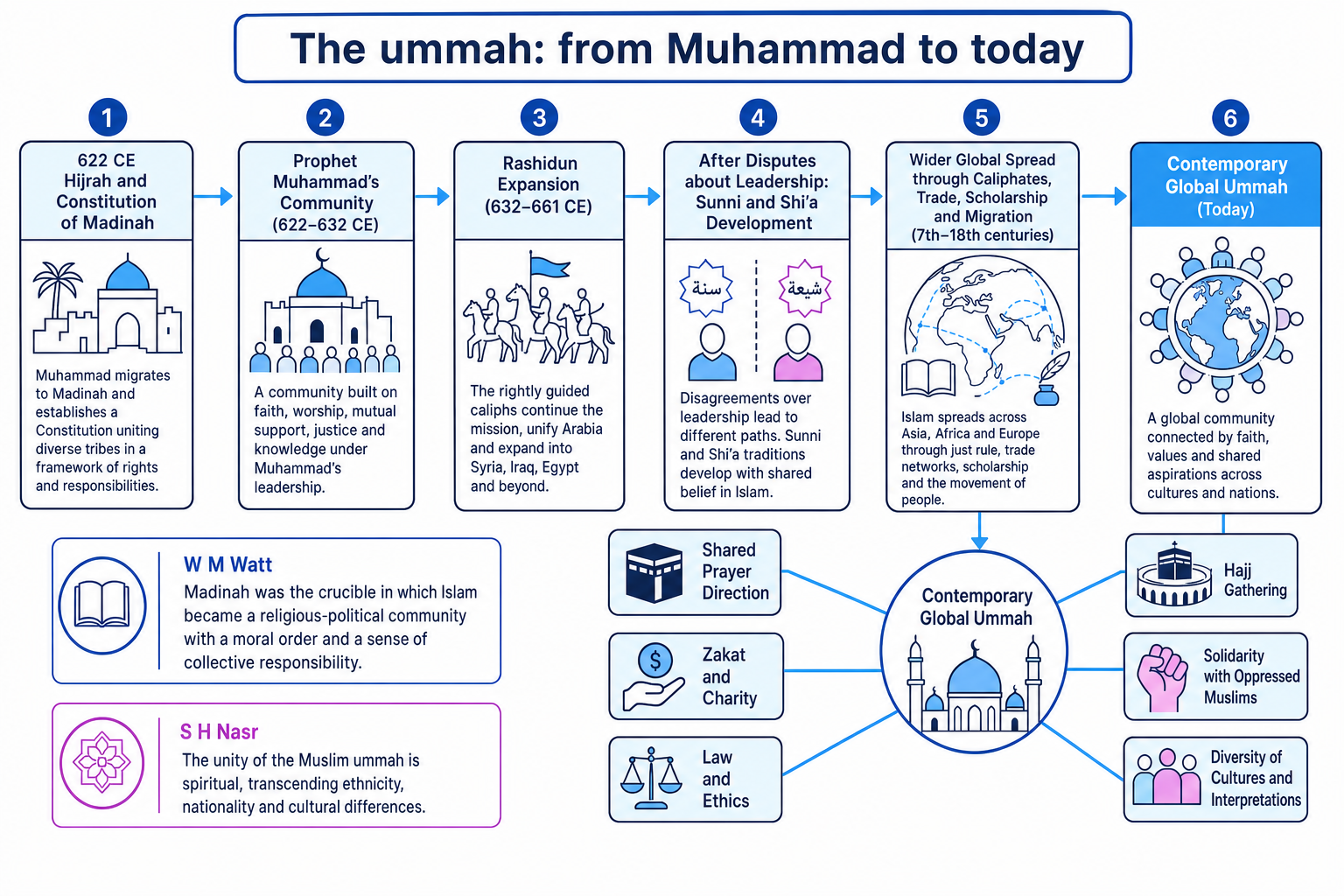
The ummah developed decisively after the Hijrah, Muhammad’s migration from Makkah to Madinah in 622 CE. In Madinah, Muhammad was not only a preacher but also a community leader and judge.
The Constitution of Madinah created a new form of community that crossed tribal boundaries and included agreements with Jewish groups in the city. This was historically significant because loyalty was no longer based only on bloodline; it was shaped by covenant, worship, justice and shared responsibility.
After Muhammad’s death, the Muslim community expanded under the Rashidun caliphs, the “rightly guided” successors recognised in Sunni Islam. Disputes over rightful leadership eventually contributed to the Sunni-Shi’a division. Sunni Islam generally emphasised the caliphate and community consensus, while Shi’a Islam emphasised the Imamate and the authority of Ali and his descendants.
Watt and Nasr on the ummah
W. Montgomery Watt, a historian of early Islam, stresses the social and political importance of Madinah. He presents Muhammad as a prophet and statesman whose leadership transformed Arabian tribal society into a religious-political community with shared moral order.
S. H. Nasr approaches the ummah more spiritually. For Nasr, the ummah is not simply a political organisation. It is a sacred community grounded in tawhid, the Qur’an, the Prophet and the Shari’ah — the divinely guided path of Islamic life.
Example
Comparing Watt and Nasr on the ummah
-
Identify Watt’s focus: he explains the ummah historically, especially through Muhammad’s leadership in Madinah and the movement beyond tribal identity.
-
Identify Nasr’s focus: he explains the ummah spiritually, as a community united by divine truth and shared submission to Allah.
-
Apply both to the modern world. Watt helps explain institutions, leadership disputes and political development. Nasr helps explain why Muslims can feel solidarity across nationality and culture.
-
Evaluate the limits. Watt may underplay the inner religious meaning of the ummah; Nasr may sound idealised when modern Muslims are divided by nation, class, law and politics.
-
Judge carefully: the strongest answer uses both. The ummah is historically formed, socially organised and spiritually meaningful.
The ummah today: Sunni and Shi’a understandings
For Sunni Muslims, the ummah is commonly understood as the global community united by the Qur’an, Sunnah, prayer, fasting, hajj and broad consensus. Although there is no single caliphate today, the ideal of Muslim solidarity remains powerful.
For Shi’a Muslims, the ummah also includes all Muslims, but religious authority is often understood through the Imams and, in contemporary Twelver Shi’a Islam, through learned scholars called maraji. Some Shi’a political thought, especially in Iran, uses the idea of Wilayat al-Faqih, the guardianship of the jurist, though not all Shi’a Muslims interpret authority in the same political way.
In contemporary society, the ummah can inspire charity, education, humanitarian aid, campaigns for justice and solidarity with oppressed Muslims. However, it can also be challenged by nationalism, sectarianism, racism, political conflict and different interpretations of Islamic law.
Tip
A strong evaluative line
A balanced judgement is not “the pillars unite Muslims” or “Muslims are divided.” A stronger judgement is: the pillars and the ummah create a shared grammar of Islamic identity, but that grammar is interpreted through different histories, authorities and communities.
Exam technique
In the exam
-
Anchor your answer in the key concepts: tawhid, submission, niyyah, the Five Pillars and the ummah.
-
Use the named scholars actively: Nasr for spiritual unity and sacred practice; Siddiqui for lived ethical practice; Watt for the historical formation of the ummah.
-
Include Sunni-Shi’a comparison precisely. Focus on authority, emphasis and practice rather than vague claims about “different beliefs.”
-
Build a judgement: show how practices both shape inner spirituality and express public Muslim identity.
Self review
Check yourself
- How does niyyah change the meaning of an outward act such as fasting or prayer?
- In what ways do Sunni and Shi’a Muslims share the pillars, and where do their emphases differ?
- Why might Watt and Nasr give different but complementary accounts of the ummah?