Revision notes for Edexcel AS Level Religious Studies Religion and society. Open the guide for explanations and worked examples. Written against the Edexcel AS Level Religious Studies specification, so the content matches what's examinable rather than general Religious Studies background.
Religion and society
What you'll learn
- How Hinduism can be understood as a plural family of traditions, not one simple system.
- How Hindu identity changes in India, migration and the UK diaspora.
- How debates about jati, Harijans/Dalits and gender affect Hindu belief and practice.
- How to use F. Hardy and G. Flood in balanced essay evaluation.
The big picture: Hinduism and society
This topic asks you to connect Hindu beliefs and practices with real social questions: diversity, community identity, caste, gender and equality. In Edexcel essays, the strongest answers do not treat “Hinduism” as one voice. They compare traditions, social contexts and scholars.
The map below shows how the main parts of this topic fit together.
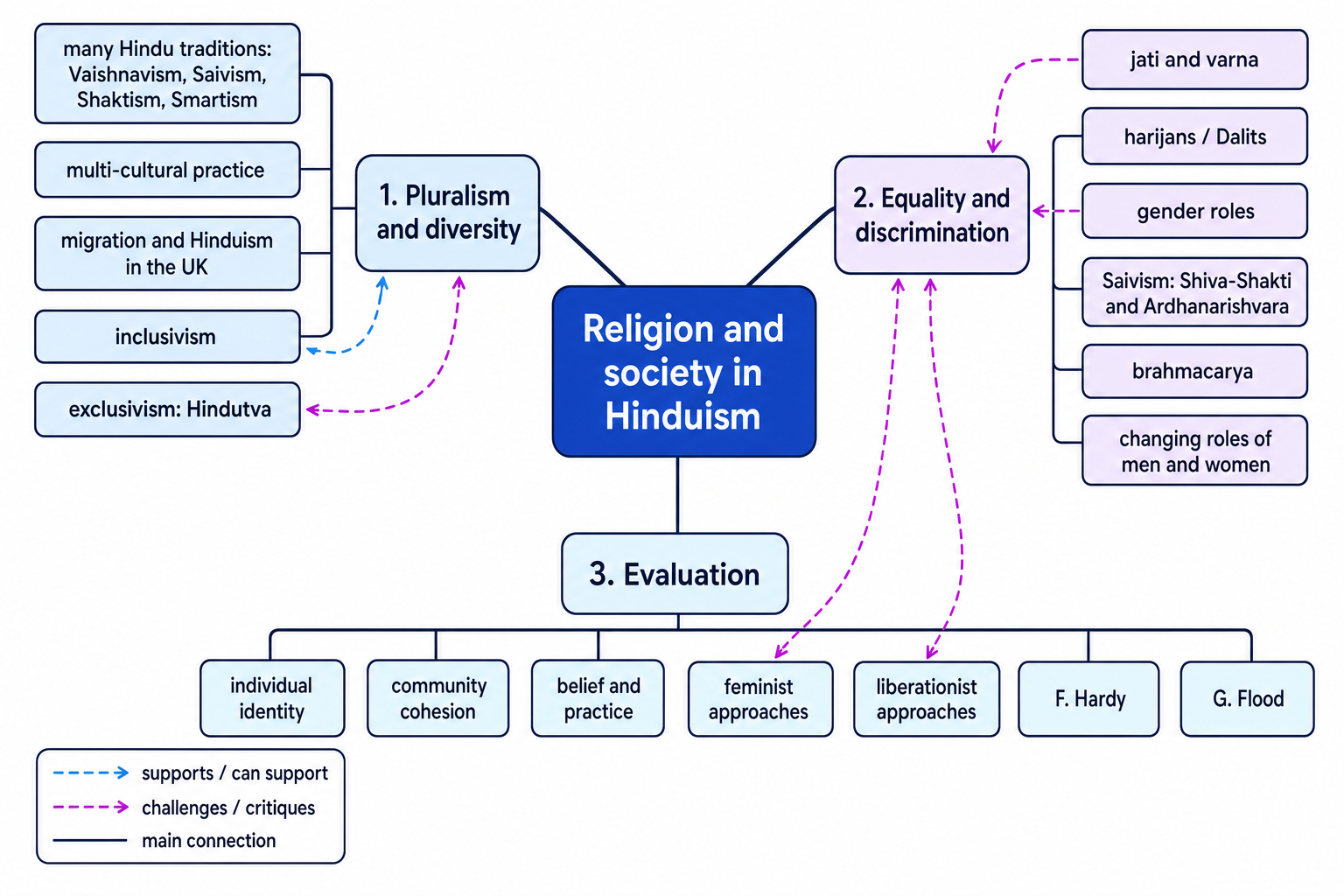
1. Pluralism and diversity
Religious pluralism
Definition
Religious pluralism
Religious pluralism is the recognition that more than one religious tradition, path or form of practice exists within a society. In Hinduism, it can also mean recognising diversity inside Hinduism itself.
Hinduism is often described as a group of related traditions rather than a single religion with one founder, one creed and one institution. Major Hindu traditions include Vaishnavism devotion to Vishnu and his avatars, Saivism devotion to Shiva, Shaktism devotion to the Goddess or Shakti, and Smartism, which often worships several deities as forms of one ultimate reality.
Gavin Flood is especially useful here. Flood presents Hinduism as a polythetic category: a family of traditions with overlapping features, rather than one essence shared by every Hindu. These features may include dharma, karma, samsara, moksha, puja, sacred texts, temple worship, pilgrimage and family ritual — but not every Hindu tradition gives these the same importance.
F. Hardy also helps because he stresses the richness of lived Hindu religion: devotion, stories, temple culture, regional practice and emotional bhakti. Hardy’s work challenges a narrow view of Hinduism as mainly elite philosophy.
Key Idea
Hinduism as a family of traditions
For essays, avoid writing “Hindus believe…” as if all Hindus are identical. A better phrase is: “Many Hindu traditions…” or “In some Hindu contexts…”
Inclusivism and exclusivism
Definition
Inclusivism and exclusivism
Inclusivism is the view that other paths may contain truth, but are fulfilled or best understood within one’s own tradition. Exclusivism is the view that one religious or cultural identity is uniquely valid and others are rejected or marginalised.
Hindu inclusivism can be seen in the idea that different deities are forms of one ultimate divine reality, or that people may approach the divine through different paths. The Bhagavad Gita is often used inclusively because Krishna says that however people approach him, he responds to them.
However, Hinduism is not always socially pluralist. Hindutva means “Hindu-ness” and is associated with Hindu nationalist thinkers such as V. D. Savarkar. It can treat India primarily as a Hindu civilisation and may marginalise Muslims, Christians and other minorities. This is an example of religious or cultural exclusivism.
Common Mistake
Equating Hindutva with all Hinduism
Do not present Hindutva as simply “what Hindus believe”. It is a political and cultural ideology, not the same thing as Hindu religious diversity as a whole.
Example
Assessing whether Hinduism is pluralist
-
Start with internal diversity: Hinduism includes Vaishnava, Saiva, Shakta, Smarta, devotional, philosophical, temple-based and domestic forms of practice, so Flood’s “family resemblance” approach supports a pluralist reading.
-
Add a challenge: Hindutva can push Hindu identity towards exclusivism by defining national belonging in Hindu cultural terms, which may conflict with India’s multi-religious reality.
-
Reach a balanced judgement: Hinduism has strong resources for pluralism, especially through multiple paths and deities, but social and political forms of Hindu identity can still become exclusionary.
2. Hindu practice in multicultural society
India as a diverse Hindu context
Within India, Hindu practice varies by region, language, caste, class, family tradition and local deity. A village goddess cult, a Tamil Saiva temple, a Gujarati Vaishnava community and an Advaita Vedanta study group may all be Hindu, but they may look very different in practice.
This matters because “religion and society” is not only about doctrine. It is about how religion is lived through marriage customs, festivals, pilgrimage, food, purity rules, temple authority, family duties and public identity.
Migration and Hinduism in the UK
Definition
Diaspora
A diaspora is a community living outside its ancestral homeland while keeping some connection with that homeland’s culture, religion or identity.
Hindu migration to the UK includes communities from India, East Africa, Sri Lanka and elsewhere. In Britain, Hindu practice is shaped by multicultural society. Mandirs often become community centres as well as places of worship. They may host language classes, youth groups, wedding ceremonies, festivals, food distribution and interfaith events.
UK examples include large public celebrations of Diwali, the BAPS Shri Swaminarayan Mandir in Neasden, and ISKCON at Bhaktivedanta Manor. These show adaptation: Hindu practice can become more public, more organised and sometimes more “pan-Hindu” in diaspora, because different regional groups share common spaces.
Tip
Diaspora evaluation point
Migration can both preserve and change religion. A mandir may protect Hindu identity, but it may also adapt rituals, language, gender roles and caste customs to fit British society.
3. Equality, jati and Harijans/Dalits
Spiritual equality and social hierarchy
Hinduism contains resources for equality. The idea of atman, the true self, can support the view that all beings have spiritual value. Many bhakti movements also emphasise devotion over birth status.
But Hindu society has also been shaped by hierarchy. Varna is the fourfold model of social order: brahmin, kshatriya, vaishya and shudra. Jati refers to birth-groups or caste communities that structure marriage, occupation and social status in everyday life.
Definition
Jati and Harijan
Jati means a birth-based social group, often translated as caste. Harijan, meaning “children of God”, was Gandhi’s term for those formerly treated as “untouchable”; many now prefer Dalit, meaning oppressed or broken, because “Harijan” can sound patronising.
Untouchability was legally abolished in India, but caste discrimination has not disappeared. This creates a major tension: Hindu ideas can support the sacred worth of all people, yet social practice has often denied equality to Dalits.
Gandhi opposed untouchability and used the term Harijan, but he did not fully reject varna. B. R. Ambedkar, a Dalit leader and architect of the Indian Constitution, argued much more radically that caste was built into Hindu social order and needed to be rejected. His eventual conversion to Buddhism shows a liberationist challenge to Hindu hierarchy.
Example
Building a judgement on caste and equality
-
Present the equality argument: Hindu ideas such as atman, karma, bhakti and the presence of the divine in all beings can be used to argue that discrimination is contrary to deeper religious truth.
-
Present the critique: jati-based exclusion, untouchability and restrictions on marriage or temple access show that social Hinduism has often contradicted spiritual equality.
-
Evaluate with scholars: Flood’s stress on Hindu diversity helps explain why caste practice differs across contexts, while Hardy’s focus on lived religion reminds you to examine actual communities, not only abstract doctrine.
4. Gender and sexual equality
Saivism and gender symbolism
Definition
Saivism
Saivism is a Hindu tradition in which Shiva is worshipped as the supreme deity.
Saivism can be significant for sexual equality because Shiva is often understood in relation to Shakti, divine power or energy, which is frequently feminine. The image of Ardhanarishvara, Shiva as half male and half female, symbolises the interdependence of masculine and feminine principles.
This can support the view that Hinduism contains powerful symbols of gender balance. However, symbolism does not automatically produce social equality. A tradition may honour feminine divine power while still limiting women’s roles in priesthood, leadership, education or family life.
Common Mistake
Confusing goddess imagery with women’s equality
Do not assume that worship of goddesses or feminine energy means women have equal social power. You need to ask how beliefs affect actual practice.
Brahmacarya and changing roles
Definition
Brahmacarya
Brahmacarya means disciplined control of sexual energy. It can refer to the student stage of life, traditionally involving celibacy, or more generally to sexual restraint and self-control.
Traditionally, brahmacarya was often linked to male education and the life of the twice-born student. This can raise questions about gender: were men given religious education and discipline while women were expected to focus on marriage and domestic duty?
Modern Hindu communities may reinterpret brahmacarya as a discipline for all people, not only men. Changing roles of men and women are visible in education, professional life, temple participation, women gurus, women priests in some communities, and diaspora settings where women often play major roles in preserving religion at home and in community organisations.
5. Feminist and liberationist approaches
Feminist approaches
A feminist approach asks how religion affects women’s status, authority and bodily autonomy. In Hinduism, feminist questions might include:
- Who interprets scripture?
- Can women lead rituals?
- Are menstruation, marriage and widowhood treated fairly?
- Do goddess traditions empower women socially?
- Are women expected to carry religious culture without equal authority?
Feminist scholars and practitioners may recover female saints, goddess traditions and women’s ritual authority. They may also criticise patriarchal readings of dharma and family duty.
Liberationist approaches
A liberationist approach starts with the experience of oppressed people and asks whether religion supports or challenges injustice. In this topic, liberationist approaches focus especially on Dalits and caste discrimination, but they can also address gender and poverty.
A liberationist Hindu approach might reinterpret bhakti as anti-caste because devotion is open to all. A more radical Dalit critique may argue that caste hierarchy is too deeply connected to Hindu social structures and must be rejected, as Ambedkar argued.
Key Idea
Belief must be tested in practice
In this topic, the central evaluation question is: Do Hindu beliefs about divine reality, dharma and spiritual worth actually transform social inequality?
Using Hardy and Flood well
| Scholar | Useful idea | How to apply it |
|---|---|---|
| G. Flood | Hinduism is diverse and best understood as overlapping traditions, not one essence. | Use him to avoid overgeneralising and to explain pluralism, diaspora adaptation and differences between traditions. |
| F. Hardy | Hindu religion is lived through devotion, emotion, story, temple practice and regional culture. | Use him to show that social Hinduism is not just philosophy; it is embodied in communities, festivals, caste, gender and bhakti. |
A strong comparison is that Flood gives you a careful academic framework for Hindu diversity, while Hardy pushes you to look at lived religious culture. Together, they help you evaluate whether Hinduism’s pluralism and equality are theoretical ideals, social realities, or contested mixtures of both.
Exam technique
In the exam
-
Define the key issue early: for example, pluralism, inclusivism, Hindutva, jati, brahmacarya or feminism.
-
Use both named scholars, not as add-ons but as part of your judgement: Flood for diversity and classification; Hardy for lived devotional and social religion.
-
Keep evaluating the gap between belief and practice: Hindu traditions may teach spiritual equality, but caste, gender and nationalist politics can complicate that claim.
Self review
Check yourself
- How does Flood’s view of Hinduism help explain religious pluralism?
- Why is Hindutva an example of exclusivism rather than simple Hindu identity?
- How could a feminist or liberationist approach challenge traditional Hindu social practice?