Revision notes for Edexcel AS Level Religious Studies Sources of wisdom and authority. Open the guide for explanations and worked examples. Written against the Edexcel AS Level Religious Studies specification, so the content matches what's examinable rather than general Religious Studies background.
Sources of wisdom and authority
What you'll learn
- How early Hindu traditions emerged from contested historical evidence and Vedic religion.
- The difference between shruti and smriti, and why that matters for authority.
- How the Vedas, Upanishads, epics and Puranas shape worship, ethics and philosophy.
- How to use J. Brockington and W. O’Flaherty in evaluation.
Why “sources of authority” are complicated in Hinduism
Hinduism is not based on one founder, one church, or one single scripture. It is better understood as a family of traditions, with many texts, rituals, stories, philosophies and regional practices.
This means authority in Hinduism is layered. Some sources are treated as timeless revelation; others are remembered tradition, story, law, myth, ethical teaching or devotional inspiration.
Definition
Authority
In Religious Studies, authority means the recognised power of a source, person, text or tradition to guide belief, worship and behaviour.
Key Idea
The big picture
For essays, avoid saying “Hindus believe the scripture says…” as if Hinduism has one book. A stronger answer explains how different kinds of scripture carry different kinds of authority.
Prerequisite: the emergence of Hindu traditions
Before looking at scripture, you need the historical background. Hindu traditions did not appear suddenly; they developed over a long period from ancient cultures, ritual practices, oral recitation, philosophical reflection and narrative traditions.
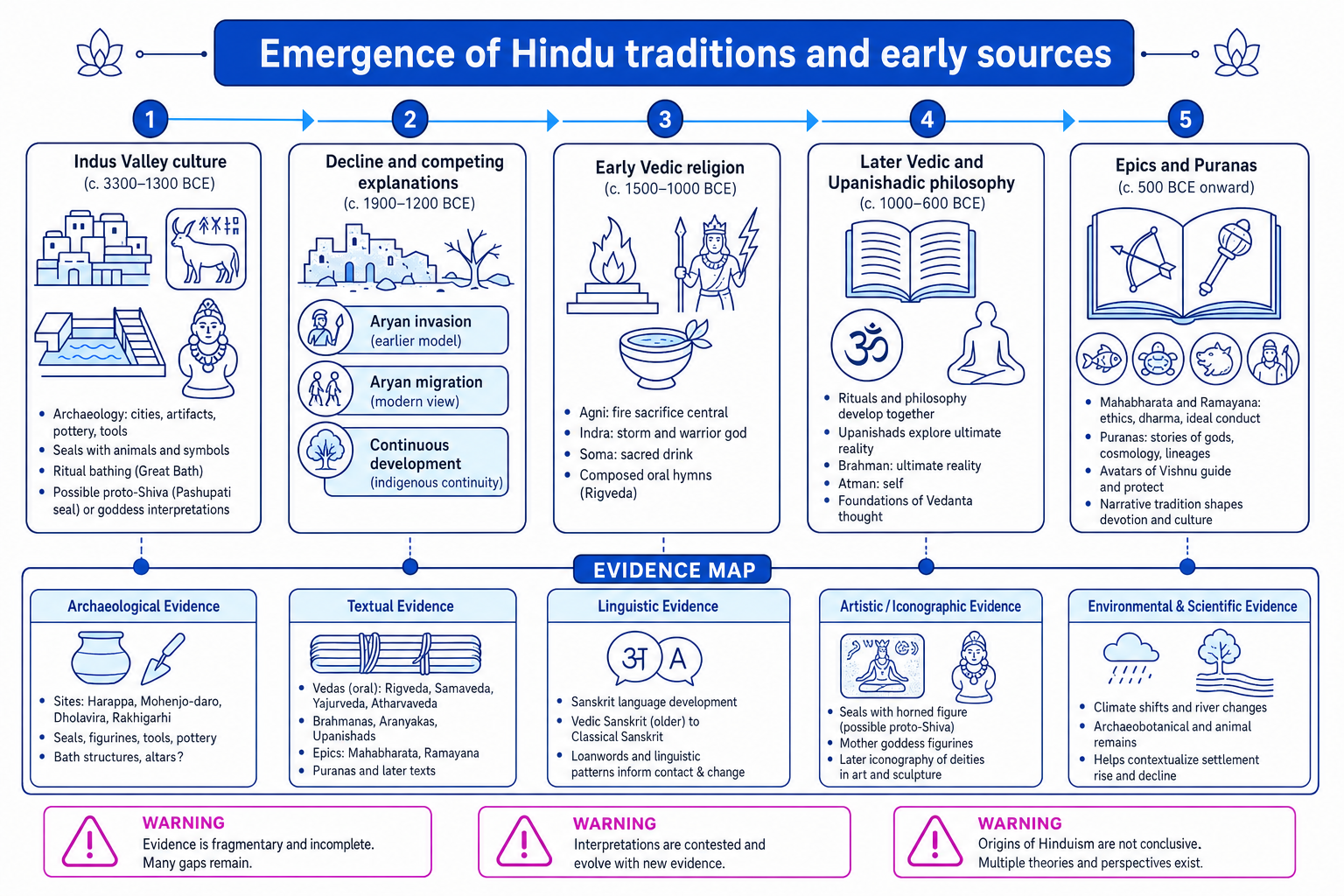
Indus Valley culture
The Indus Valley civilisation was an urban culture in north-west India and present-day Pakistan, associated with sites such as Harappa and Mohenjo-Daro. Archaeologists have found cities, seals, pottery, bathing areas and figurines.
Some scholars have suggested possible links with later Hinduism, such as ritual bathing, goddess imagery, animal symbolism, or a “proto-Shiva” interpretation of the so-called Pashupati seal. However, this is not conclusive.
Common Mistake
Evidence is fragmentary
Indus Valley writing has not been securely deciphered, so links with later Hinduism are possible but not proven. In essays, use cautious language such as “may suggest”, “possibly”, and “some scholars argue”.
Aryan invasion, migration or continuous development?
Older scholarship often spoke of an Aryan invasion, where Indo-Aryan speakers supposedly entered India by force and displaced earlier cultures. Many modern scholars prefer Aryan migration, suggesting gradual movement and cultural interaction. Others stress continuous development, arguing that later Hindu traditions emerged significantly from indigenous Indian culture.
The key exam point is not to “solve” the debate. It is to show that Hindu origins are complex and contested.
Early Vedic religion: sacrifice, Agni, Indra and soma
The early Vedic tradition centred on sacrifice, especially yajna, a ritual offering made into sacred fire. Agni was the fire god and acted as a mediator, carrying offerings from humans to the gods. Indra was a major warrior god, associated with storms, power and victory. Soma was a sacred drink, probably connected with ritual inspiration and divine energy.
These themes matter because later Hindu worship still gives importance to ritual sound, sacred fire, offerings, priestly recitation and the relationship between humans and divine reality.
Example
Handling Indus-to-Hindu links
-
Start with the type of evidence: Indus Valley evidence is mainly archaeological, such as seals, bathing structures and figurines, not clear written theology.
-
Compare the evidence with later Hindu practice: ritual bathing might link with later ideas of purification, but similar practices can exist in many cultures.
-
Reach a careful judgement: the evidence may show possible continuity, but it cannot prove a direct, uninterrupted line from Indus religion to later Hinduism.
Shruti and smriti: the two key categories
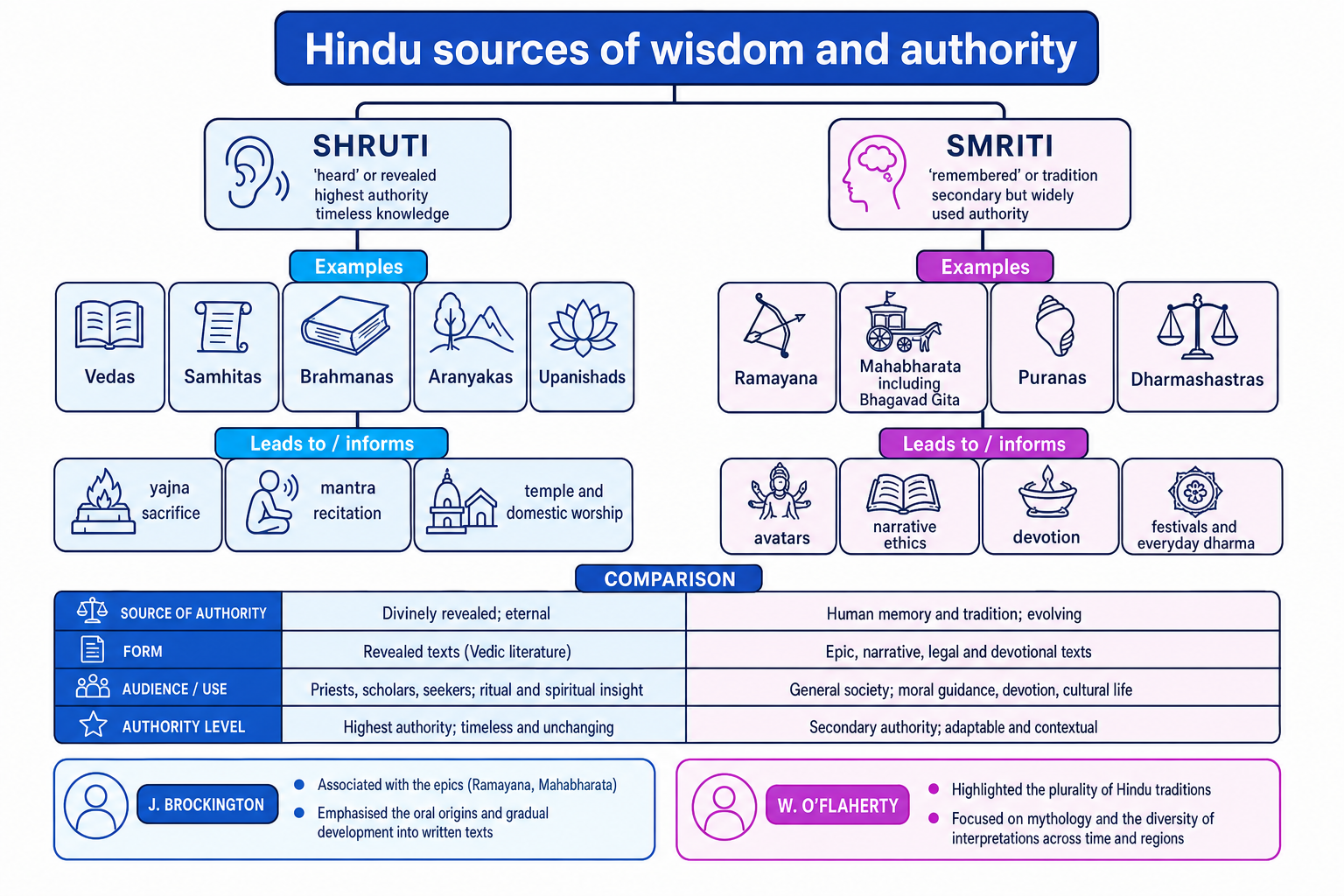
Hindu scriptures are often divided into shruti and smriti. This distinction is essential for Edexcel because it affects how you discuss authority.
Definition
Shruti
Shruti means “heard”. It refers to texts understood as revealed or directly perceived by ancient seers. Shruti has the highest scriptural authority because it is regarded as timeless sacred knowledge.
Definition
Smriti
Smriti means “remembered”. It refers to tradition remembered, composed and passed on by human communities. Smriti has secondary authority, but it is often more accessible and more influential in everyday religious life.
Quick comparison
| Feature | Shruti | Smriti |
|---|---|---|
| Meaning | “Heard” | “Remembered” |
| Status | Highest authority | Secondary but highly influential authority |
| Main examples | Vedas, including Upanishads | Ramayana, Mahabharata, Puranas, Dharmashastras |
| Main form | Hymn, ritual instruction, philosophical teaching | Epic, myth, story, law, ethical teaching |
| Worship link | Mantras, fire ritual, priestly recitation | Festivals, drama, storytelling, devotional practice |
Common Mistake
Secondary does not mean unimportant
Do not write as if smriti texts are “less important” simply because they are secondary. In lived Hinduism, the Ramayana, Mahabharata and Puranas often shape devotion, ethics and festivals more directly than the Vedas.
Shruti: the Vedas as books of knowledge
The word Veda means “knowledge”. The four Vedas are the Rig Veda, Sama Veda, Yajur Veda and Atharva Veda. They contain hymns, chants, ritual formulas and sacred knowledge.
The Vedas include several layers:
- Samhitas: collections of hymns and mantras.
- Brahmanas: explanations of sacrificial rituals.
- Aranyakas: “forest texts”, often linked with reflection beyond public ritual.
- Upanishads: philosophical texts exploring ultimate reality, self and liberation.
The Upanishads and philosophical traditions
The Upanishads mark a major development from ritual religion towards philosophical reflection. They explore ideas such as Brahman, the ultimate reality; Atman, the deepest self; and moksha, liberation from the cycle of rebirth.
They are especially significant for Vedanta, meaning “end of the Veda”. Vedanta schools build on Upanishadic ideas, though they interpret them differently. For example, Advaita Vedanta stresses non-duality, while other Vedanta traditions give more emphasis to personal devotion and distinction between God and the soul.
Key Idea
Shruti and timeless knowledge
Shruti is authoritative because it is not mainly valued as human opinion or historical record. It is treated as sacred knowledge that reveals the deepest structure of reality.
Smriti: epics, avatars and narrative ethics
Smriti texts are vast and varied. They include the Ramayana, the Mahabharata, the Bhagavad Gita, the Puranas and texts on law and duty.
The Ramayana and Mahabharata
The Ramayana tells the story of Rama, often understood as an avatar, meaning a divine “descent” into the world, especially of Vishnu. Rama becomes a model of dharma, duty, kingship and moral conduct.
The Mahabharata is a huge epic about conflict, family, kingship, war and duty. Its most famous section is the Bhagavad Gita, where Krishna teaches Arjuna about dharma, devotion, disciplined action and spiritual insight.
The Puranas
The Puranas are narrative collections containing myths, genealogies, cosmology, stories of gods and goddesses, pilgrimage traditions and ethical teachings. They are especially important for devotional Hinduism because they present divine reality through memorable stories.
Why narrative form matters
Smriti often teaches through story rather than abstract doctrine. This matters because stories are memorable, emotionally powerful and open to interpretation. A narrative can show moral tension rather than simply giving a rule.
J. Brockington is useful here. He argues that the Sanskrit epics developed over long periods through oral recitation, expansion and redaction. This supports the view that smriti authority is dynamic: the epics are not just fixed books but living traditions that developed with communities.
W. O’Flaherty also helps because she stresses the plurality and richness of Hindu myth. Myths may contain tensions, alternatives and multiple voices. For O’Flaherty, this diversity is not merely a weakness; it is part of how Hindu traditions explore difficult questions about desire, duty, gender, violence, devotion and divine action.
Example
Ranking authority in a worship practice
-
Imagine a Hindu festival focused on Rama. The story and devotional meaning mainly come from the Ramayana, so the immediate source is smriti.
-
The ritual may also involve Vedic mantras or fire offerings, which connect the ceremony to shruti authority.
-
A balanced judgement says shruti has higher theoretical authority, but smriti may have greater practical influence because the narrative gives worshippers a concrete model of devotion and dharma.
The implications of having many scriptures
The breadth of Hindu scripture means Hinduism is difficult to reduce to one creed. There are ritual texts, philosophical texts, epics, myths, law codes and devotional stories. There are also different sectarian emphases, such as Vaishnava, Shaiva and Shakta traditions.
This breadth has two major implications.
First, it allows Hinduism to be adaptable. Different communities can find authority in different texts while still belonging within a broad Hindu framework.
Second, it creates tension. If texts differ in emphasis, which should guide belief and practice? Shruti may be timeless and supreme, but smriti may be more widely known, emotionally powerful and practically useful.
Tip
Best evaluation line
A strong judgement is: “Shruti is usually highest in formal authority, but smriti is often highest in practical influence.”
Brockington and O’Flaherty: how to use them
Brockington is especially helpful for historical-critical analysis. His work on the epics shows that texts such as the Ramayana and Mahabharata developed over time. This challenges any simplistic idea that Hindu scriptures dropped fully formed from heaven. It also helps explain why smriti texts contain layers of heroic, ethical, devotional and theological material.
O’Flaherty is especially helpful for myth and interpretation. She highlights the diversity of Hindu stories and the way myths can hold together conflicting perspectives. This supports an understanding of Hinduism as plural, imaginative and interpretive rather than strictly dogmatic.
Together, they help you evaluate the relative authority of scripture. Brockington shows that remembered tradition develops historically; O’Flaherty shows that plurality can be religiously meaningful. Both scholars support a nuanced view: Hindu authority is not only about fixed texts, but also about interpretation, transmission and lived practice.
Exam technique
In the exam
-
Define shruti and smriti early, then give accurate examples of each.
-
Link scripture to practice: mention yajna, Agni, mantras, festivals, avatars, narrative ethics or devotional worship.
-
Use Brockington for the historical development of the epics and O’Flaherty for plurality, myth and interpretation, then reach a clear judgement about authority.
Self review
Check yourself
-
Why is it risky to claim that Indus Valley religion was definitely “early Hinduism”?
-
How does the authority of shruti differ from the authority of smriti?
-
Why might a smriti text be less authoritative in theory but more influential in practice?