Revision notes for Edexcel AS Level Religious Studies Religious beliefs, values and teachings. Open the guide for explanations and worked examples. Written against the Edexcel AS Level Religious Studies specification, so the content matches what's examinable rather than general Religious Studies background.
Religious beliefs, values and teachings
What you'll learn
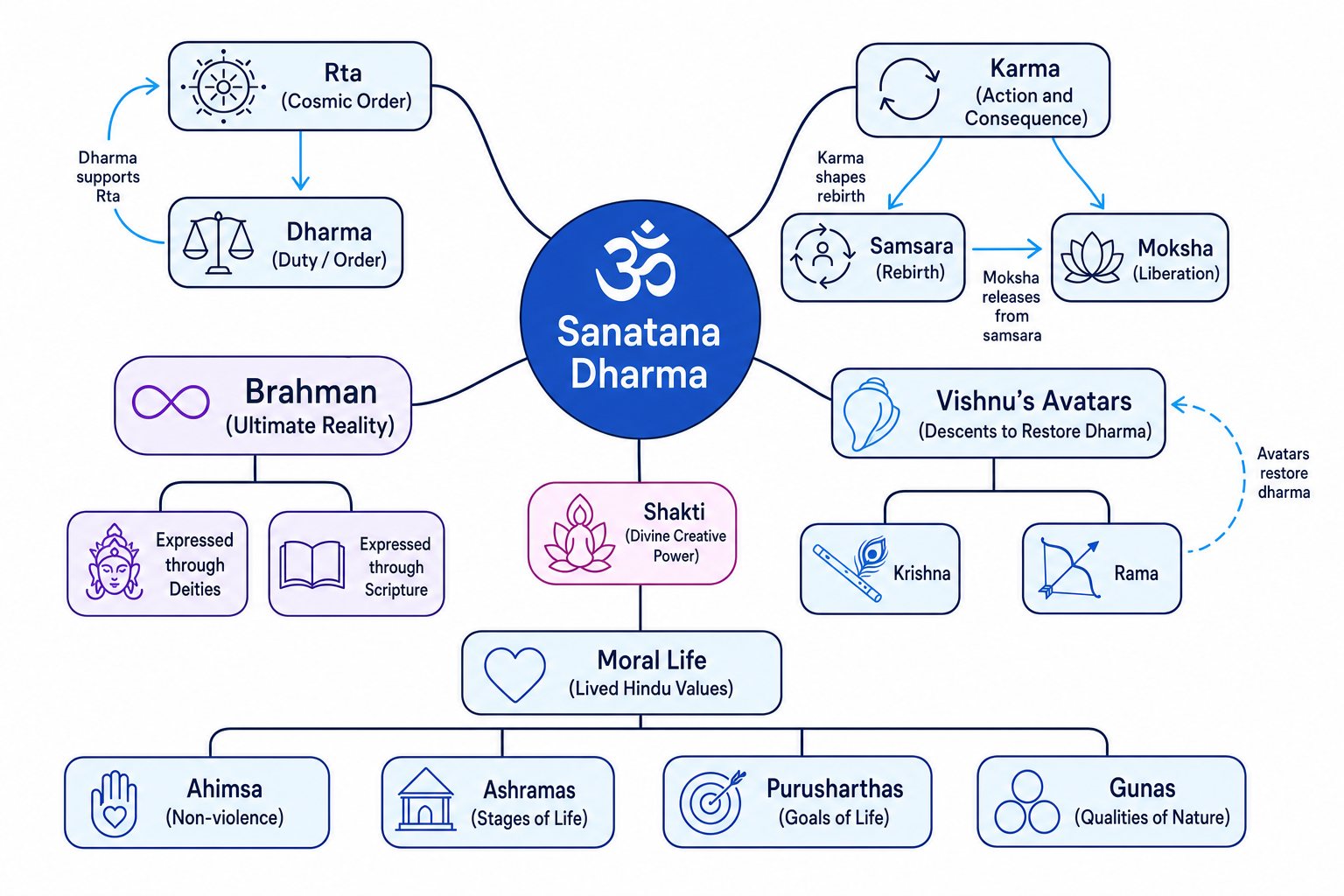
- How Sanatana Dharma, rta, karma, samsara and moksha connect into one worldview.
- How Hindus understand Brahman, Vishnu’s avatars, Krishna, Rama and Shakti.
- How Hindu moral life is shaped by dharma, ahimsa, the ashramas and the gunas.
- How to use Zaehner, Jamieson, Lipner, Sivananda and Bilimoria in extended answers.
Hindu belief is best understood as a network rather than a single creed. Ideas about cosmic order, moral action, rebirth, divine reality and everyday duty all overlap.
Sanatana Dharma and rta
Definition
Sanatana Dharma
Sanatana Dharma means “eternal dharma” or “eternal way”. Many Hindus use it to describe Hindu tradition as a timeless pattern of truth, duty, worship and moral order rather than simply a “religion” in the Western sense.
Definition
Rta
Rta — often written ṛta — is the Vedic idea of cosmic order: the deep structure that keeps the universe, seasons, ritual, truth and moral life in harmony.
In early Vedic religion, rta was closely linked with yajna — sacrificial ritual offered to the gods to maintain order. Over time, the idea developed into the broader concept of dharma, meaning duty, law, righteousness and the right ordering of life.
This matters because Hindu belief is not only about private faith. It shapes practice: worship, festivals, family duties, pilgrimage, food choices, life-cycle rites and social responsibilities. Historically this included varna-ashrama-dharma, duties connected with social role and life stage. In the contemporary world, many Hindus reinterpret dharma more universally, emphasising service, non-violence, environmental care and community responsibility.
R. C. Zaehner is useful here because he highlights the long historical development of Hinduism: Vedic ritual order, Upanishadic speculation, devotional theism and later practice all sit within one complex tradition. I. Jamieson is helpful for showing that Hindu beliefs are interconnected in lived religion: dharma, karma, worship and community practice cannot be separated neatly.
Key Idea
Order is lived, not just believed
Sanatana Dharma joins together cosmic order, moral responsibility and everyday practice. For many Hindus, to live well is to live in harmony with the structure of reality.
Common Mistake
Treating Hinduism as one simple creed
Do not write as if all Hindus believe exactly the same thing. Hinduism is internally diverse, with philosophical, devotional, ritual and regional forms.
Karma, samsara and moksha
Definition
Karma
Karma means “action” or “deed”, but in Hindu thought it also refers to the moral law of action and consequence: actions shape future experience, character and rebirth.
Karma is linked with the idea of an eternal and universal order. It applies to all people, not only to those who believe in it. It is not usually understood as random divine punishment. Rather, it is a moral structure built into reality.
This gives Hindu ethics a serious sense of responsibility: thoughts, intentions and actions matter. Righteous living means acting according to dharma, reducing selfish attachment and avoiding harm.
Definition
Samsara
Samsara is the cycle of birth, death and rebirth in which beings continue to live because of karma, desire and ignorance.
Rebirth may be into different forms or states of existence. Hindu traditions often speak of human birth as especially precious because it gives the opportunity for moral reflection and liberation. Other rebirths may include animal existence, heavenly states or hellish states, but these are not usually final. They are temporary within samsara.
Definition
Atman and moksha
Atman is the true self or soul, distinct from the temporary body. Moksha is liberation from samsara: freedom from rebirth and from ignorance of ultimate reality.
Beliefs about death and the afterlife vary, but many Hindus hold that the atman or jiva — the living self — continues after bodily death, carrying karmic tendencies. Funeral rites such as cremation and ancestor rituals help mark the transition and support the deceased within the wider community.
Moksha is the highest spiritual goal. In Advaita Vedanta, it is often understood as realising the identity of atman and Brahman. In devotional traditions, moksha may be understood as eternal loving relationship with God rather than absorption into an impersonal absolute.
Key Idea
Karma is not fatalism
Karma explains moral consequence, but it does not mean “nothing can change”. Present action still matters, and spiritual practice can transform the future.
Brahman and divine reality
Definition
Brahman
Brahman is ultimate reality: the infinite, eternal ground of all existence. Brahman may be understood as nirguna — without qualities — or saguna — with qualities, accessible through personal divine forms.
Brahman is represented in the world through creation, through deities, through sacred texts and through worship. Important scriptures include the Vedas, Upanishads, Bhagavad Gita, Ramayana and Puranas. A murti is a sacred image used in worship, not merely an “idol”; it can be treated as a focus for divine presence.
Julius Lipner describes Hinduism as polycentric: it has many centres of meaning rather than one single authority, founder or creed. This helps explain why devotion to Vishnu, Shiva, Devi or Krishna can all be authentically Hindu. Swami Sivananda, by contrast, writes as an insider teacher, stressing the unity of divine truth behind many names and forms. For him, worship, yoga and devotion are practical routes to realisation.
Common Mistake
Confusing Brahman and Brahma
Brahman is ultimate reality. Brahma is the creator god within the Trimurti. They are not the same term.
Vishnu’s avatars: Krishna and Rama
Definition
Avatar
An avatar is a “descent” of God into the world. In Vaishnava traditions, Vishnu descends when dharma is threatened and cosmic order needs restoring.
The Bhagavad Gita expresses this clearly: when dharma declines and adharma rises, the divine appears to protect the good, destroy evil and re-establish dharma. This gives avatars moral and cosmic significance.
Krishna
Krishna is often seen as an ideal avatar of Vishnu, though in some traditions — especially Gaudiya Vaishnavism — he is understood as the supreme form of God himself. In the Bhagavad Gita, Krishna guides Arjuna through a crisis of duty, teaching karma yoga, bhakti and disciplined action without selfish attachment.
Krishna is also central to bhakti, meaning loving devotion to a personal God. ISKCON — the International Society for Krishna Consciousness, founded by A. C. Bhaktivedanta Swami Prabhupada — places Krishna at the heart of worship through chanting, devotion, scripture study and disciplined living.
Rama
Rama, the hero of the Ramayana, is another avatar of Vishnu. He is often called the ideal man or ideal king because he models loyalty, courage, self-control and obedience to dharma.
Rama’s story shows that dharma can be difficult. He must balance duties as son, husband, ruler and warrior. This makes Rama especially useful in essays because he shows dharma as practical and sometimes tragic, not just a simple rulebook.
Shakti
Definition
Shakti
Shakti means divine power or energy, often worshipped as the Goddess. In Shakta traditions, the Goddess is not secondary but the true form of the Divine.
Shakti may appear as Durga, Kali, Lakshmi, Saraswati or Parvati. She represents creativity, protection, wisdom, destruction of evil and the dynamic power of reality. This challenges any overly male picture of Hindu theology.
Key Idea
Many forms, one divine reality
Lipner helps you explain Hindu diversity; Sivananda helps you explain Hindu unity. Together, they let you evaluate whether many deities create contradiction or express one ultimate truth.
Key moral principles
The three key principles are dharma, karma and ahimsa.
Definition
Ahimsa
Ahimsa means non-violence or non-harm. It includes physical restraint, compassionate speech, respect for life and the avoidance of cruelty.
Ahimsa influences vegetarianism, attitudes to animals, social ethics and spiritual discipline. However, Hindu ethics is not always absolute pacifism. The Bhagavad Gita shows that a warrior may have a duty to fight if the action is righteous, disciplined and not motivated by hatred.
Example
Balancing dharma, karma and ahimsa
-
Identify the moral tension: Arjuna wants to avoid violence, which reflects ahimsa, but he is also a warrior with a duty to protect justice and social order.
-
Apply dharma: Krishna teaches that Arjuna must consider his svadharma, his own role-specific duty, rather than choosing inaction simply because the situation is painful.
-
Apply karma: The moral quality of action depends not only on the outward deed but also on intention and attachment. Acting selfishly binds the person more deeply to karma; acting without attachment can become a spiritual discipline.
-
Reach a balanced judgement: Hindu ethics cannot be reduced to “never act” or “always follow rules”. It requires wise judgement about duty, consequence, intention and spiritual growth.
Ashramas, values and moksha
Definition
Ashramas
The ashramas are four ideal stages of life: student, householder, forest-dweller or retiree, and renouncer.
The ashramas link moral values to different phases of life:
| Ashrama | Main focus | Linked values |
|---|---|---|
| Brahmacharya | Student life and discipline | Learning, self-control, dharma |
| Grihastha | Householder life | Family, work, ritual duty, artha and kama guided by dharma |
| Vanaprastha | Gradual withdrawal | Reflection, service, detachment |
| Sannyasa | Renunciation | Vairagya and pursuit of moksha |
Artha means wealth, livelihood or worldly success. Kama means pleasure, desire and aesthetic fulfilment. These are not automatically wrong; they are legitimate when governed by dharma. Vairagya means detachment or dispassion, especially important as a person turns more directly towards moksha.
Tip
A helpful moral formula
In Hindu ethics, artha and kama are good when disciplined by dharma and eventually loosened through vairagya in the pursuit of moksha.
Common Mistake
Assuming every Hindu literally follows the four ashramas
The ashrama model is an ideal pattern, historically linked especially with upper-caste male life. Modern Hindus may interpret it flexibly rather than literally.
The gunas and moral character
Definition
Gunas
The gunas are three qualities or strands of nature: sattva, rajas and tamas. They shape personality, behaviour and spiritual progress.
| Guna | Meaning | Moral qualities |
|---|---|---|
| Sattva | Clarity, harmony, purity | Wisdom, calmness, truthfulness, compassion |
| Rajas | Energy, passion, restlessness | Ambition, desire, attachment, activity |
| Tamas | Darkness, inertia, ignorance | Confusion, laziness, delusion, resistance to truth |
The aim is not simply to “hate” rajas or tamas. Rajas can be useful for action, and ordinary life requires energy. But spiritual development involves cultivating sattva and ultimately moving beyond all three gunas towards liberation.
P. Bilimoria is important for Hindu ethics because he resists the idea that Hindu moral thought is vague or merely ritualistic. He presents Hindu ethics as a sophisticated system in which dharma, karma, ahimsa, virtue and context interact. This is very useful for evaluation: Hindu ethics is flexible and realistic, but critics may ask whether contextual dharma can excuse hierarchy or injustice if not challenged.
Pulling the scholars together
For strong essays, use scholars to create debate rather than simply name-dropping them.
| Scholar | Useful emphasis | Evaluation angle |
|---|---|---|
| Zaehner | Historical development and diversity within Hinduism | Shows richness, but may systematise a very varied tradition |
| Jamieson | Interconnection of belief and lived practice | Helps link doctrine to community life |
| Lipner | Hinduism as polycentric and internally diverse | Avoids oversimplification |
| Sivananda | Unity of divine truth, devotion and practice | Gives an insider spiritual perspective |
| Bilimoria | Contextual Hindu ethics shaped by dharma, karma and ahimsa | Shows moral sophistication but raises questions about flexibility |
Exam technique
In the exam
-
Link beliefs together: do not write separate mini-paragraphs on karma, samsara and moksha without explaining how each depends on the others.
-
Use named scholars for debate: for example, contrast Lipner’s polycentric diversity with Sivananda’s emphasis on divine unity.
-
Evaluate fairly: Hinduism’s flexibility can be a strength because it fits different contexts, but it can also create tensions over caste, gender, violence and authority.
Self review
Check yourself
- How does rta develop into the broader idea of dharma?
- Why is karma different from fatalism?
- How might Krishna, Rama and Shakti each show a different way of understanding divine reality?