Revision notes for Edexcel AS Level Religious Studies Religion and society. Open the guide for explanations and worked examples. Written against the Edexcel AS Level Religious Studies specification, so the content matches what's examinable rather than general Religious Studies background.
Religion and society
What you'll learn
- How to distinguish multiculturalism from philosophical religious pluralism.
- The main Christian responses to other religions: particularism, inclusivism and pluralism.
- How Karl Rahner and John Hick shape modern Christian debate about other faiths.
- How Christians debate gender equality, especially the ordination of women.
The big picture
This topic is about how Christianity exists within modern society: a society with many religions, many Christian denominations, and serious debates about equality. For Edexcel, you need both secure knowledge and a balanced judgement: not just “what Christians think”, but why different Christians disagree and how significant those disagreements are today.
Pluralism and diversity
Multicultural societies: the sociological reality
A modern society such as the UK contains people from many religious, cultural and ethnic backgrounds. This is a sociological point: it describes what society is like.
Definition
Multicultural society
A multicultural society is a society in which different cultural, ethnic and religious communities live alongside one another, often sharing public institutions such as schools, workplaces and law.
For Christians, multiculturalism raises practical questions: How should Christians relate to Muslims, Hindus, Sikhs, Jews, Buddhists, atheists and people of no fixed religion? Should Christians evangelise, dialogue, cooperate, or simply tolerate?
Philosophical pluralism: a claim about truth
Multiculturalism is a social fact. Philosophical pluralism is stronger: it makes a claim about religious truth.
Definition
Philosophical religious pluralism
Philosophical religious pluralism is the view that the major world religions may be equally valid responses to, or routes towards, the same ultimate reality.
This distinction matters. A Christian can accept that society is multicultural without accepting that all religions are equally valid.
Key Idea
The key distinction
Multiculturalism says, “Many religions exist in one society.” Philosophical pluralism says, “Many religions may be valid paths to ultimate reality.” Do not treat these as the same claim.
Three Christian responses to other religions
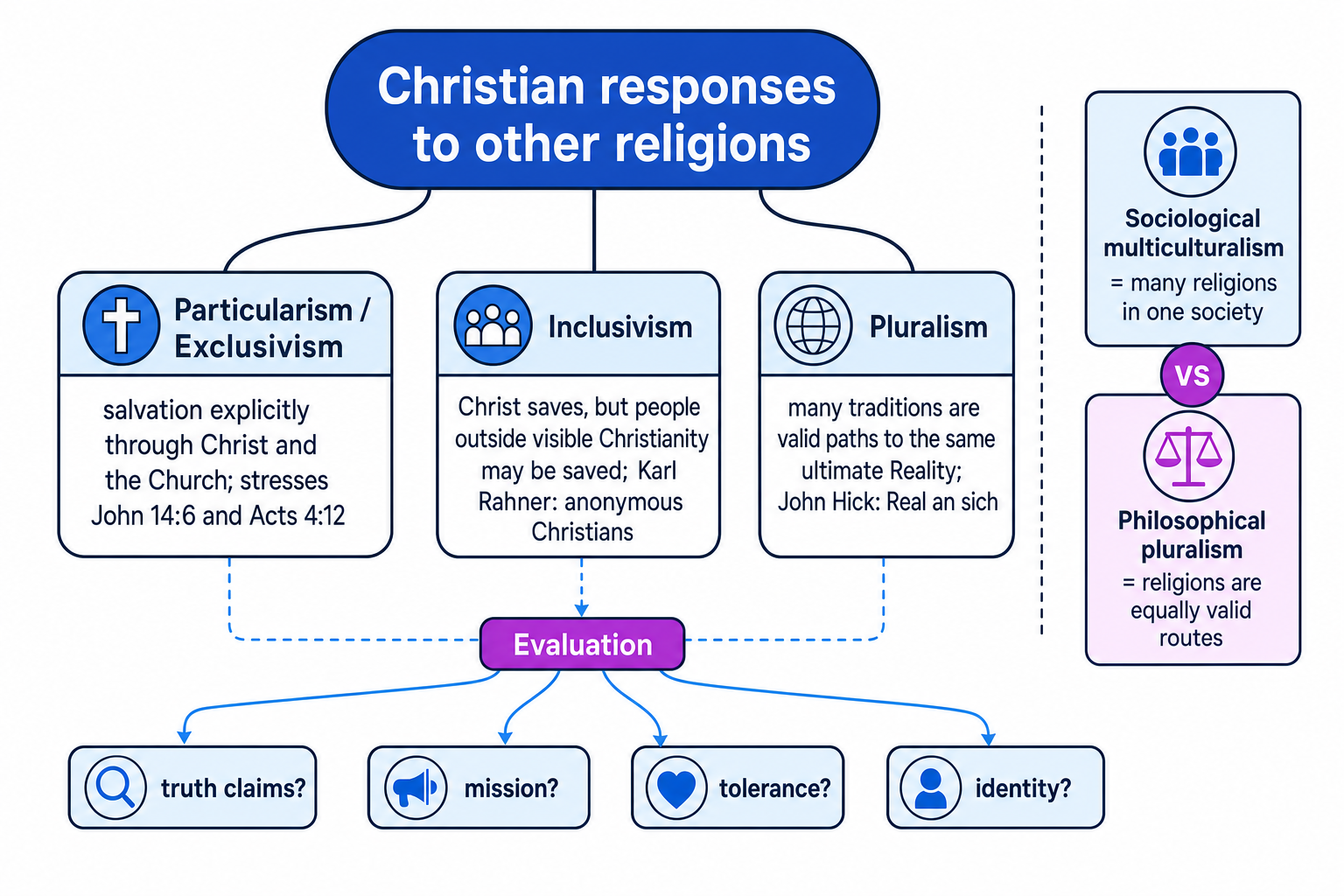
Christian thinkers usually discuss three broad approaches: particularism, inclusivism and pluralism.
Definition
Particularism, inclusivism and pluralism
- Particularism, sometimes called exclusivism, holds that salvation is found uniquely and explicitly through Christ.
- Inclusivism holds that salvation is still through Christ, but people outside visible Christianity may be saved by Christ’s grace.
- Pluralism holds that Christianity is one valid path among several, rather than the single final route to salvation.
Particularism or exclusivism
Particularist Christians emphasise biblical passages such as John 14:6, where Jesus says, “I am the way, and the truth, and the life,” and Acts 4:12, which says there is “no other name” by which people are saved.
The strength of this view is that it preserves traditional Christian claims about the uniqueness of Christ, the importance of mission and the seriousness of Christian truth. It fits well with the Great Commission in Matthew 28:19: “Go therefore and make disciples of all nations.”
Its weakness is that it can seem harsh or intolerant in a multicultural society, especially if it appears to condemn sincere non-Christians who have never had a meaningful chance to accept Christianity.
Inclusivism: Karl Rahner
Karl Rahner was a Roman Catholic theologian associated with twentieth-century Catholic renewal and the context of the Second Vatican Council. His view is usually described as inclusivist.
Rahner argued that Christ is still the unique saviour, but God’s grace can be present outside the visible Church. A person who responds sincerely to grace, conscience and love may be saved through Christ even if they do not explicitly know Christ.
Definition
Anonymous Christian
Rahner’s phrase anonymous Christian describes a person who is not outwardly Christian but who, by responding to God’s grace, is saved through Christ without explicitly recognising this.
This fits with Roman Catholic teaching after Vatican II, especially the idea that other religions may contain “rays” or elements of truth. It also reflects the belief that God wills the salvation of all people.
Rahner’s strength is balance: he protects the centrality of Christ while avoiding the claim that all non-Christians are simply lost. However, critics argue that calling non-Christians “anonymous Christians” can sound patronising, as if other religions only matter when they are secretly Christian.
Pluralism: John Hick
John Hick developed a more radical pluralist view. He argued for a “Copernican revolution” in theology: Christianity should stop placing itself at the centre and instead place ultimate reality at the centre.
Hick used the idea of the Real an sich, meaning the Real “in itself”. Influenced by Kant, he argued that the ultimate reality cannot be known directly as it is in itself. Different religions experience and interpret the Real through their own cultural and historical “lenses”.
For Hick, salvation is not mainly about belonging to the correct institution. It is the transformation from self-centredness to Reality-centredness. Different religions can produce this transformation.
Hick’s strength is that his view promotes tolerance, interfaith dialogue and respect. It makes sense of the fact that many religions produce morally serious and spiritually transformed people.
Its weakness is that many Christians think it weakens central doctrines such as the Incarnation, Trinity and resurrection. If Jesus is only one expression of the Real, then traditional claims about Christ as God incarnate are significantly reinterpreted.
Example
Comparing Rahner and Hick
-
Start with their theological centre. Rahner begins with Christ as the unique saviour and asks how non-Christians may still receive Christ’s grace. Hick begins with religious diversity and asks how different traditions may be valid responses to the same Real.
-
Apply both views to a sincere non-Christian believer. Rahner would say that person may be saved through Christ without knowing it explicitly. Hick would say that person’s own religion may genuinely mediate transformation towards the Real.
-
Evaluate the cost of each view. Rahner protects orthodox Christian belief more strongly, but risks absorbing other religions into Christianity. Hick respects other religions more directly, but risks moving away from traditional Christian claims about Jesus.
Strengths and weaknesses for Christians today
| View | Strengths | Weaknesses |
|---|---|---|
| Particularism | Clear identity; strong basis for mission; close to some biblical texts | Can appear intolerant; difficult in interfaith contexts |
| Inclusivism | Balances Christ’s uniqueness with God’s universal grace | May seem patronising towards other religions |
| Pluralism | Encourages tolerance and dialogue; recognises goodness in other faiths | May weaken distinctive Christian truth claims |
A strong essay does not just list these views. It asks which view best serves Christian faithfulness in a diverse society.
Tip
Good evaluation question
Ask: Does this view preserve Christian identity while enabling respectful relationships with other religions? That question helps you evaluate, rather than merely describe.
The context of modern Christian thought on other religions
Modern Christian thinking about other religions has been shaped by:
- Globalisation, which brings religions into closer contact.
- Migration, which makes many societies more religiously diverse.
- Decolonisation, which challenged older assumptions that Christianity should dominate other cultures.
- The Holocaust and post-war reflection, which encouraged deeper Christian-Jewish dialogue.
- Vatican II, especially Roman Catholic openness to dialogue with other faiths.
- Secularisation, which means Christians may cooperate with other religious communities in a society where religion itself is often marginalised.
This context explains why Rahner and Hick matter. They are not abstract theorists only; they respond to the reality of Christians living among sincere believers from other traditions.
The Ecumenical movement
Definition
Ecumenical movement
The Ecumenical movement is the movement seeking greater unity, cooperation and dialogue between different Christian denominations.
Ecumenism is about Christian unity, not directly about relations between different world religions. Important examples include the World Council of Churches, founded in 1948, local “Churches Together” groups, shared prayer, joint social action and theological dialogues between denominations.
The movement has had real impact. Christians from different traditions often cooperate on poverty, education, peace-making and community work. Some doctrinal disputes have softened; for example, Catholic-Lutheran dialogue led to the 1999 Joint Declaration on the Doctrine of Justification.
However, unity remains limited. Churches still disagree about papal authority, the Eucharist, ordination, sexuality, gender and the nature of Church authority.
Common Mistake
Confusing ecumenism and interfaith dialogue
Ecumenism means unity between Christians. Interfaith dialogue means conversation and cooperation between different religions. They can overlap in practice, but they are not the same thing.
Equality and discrimination: gender
Equality in Christian teaching
Christian debates about gender usually begin with the belief that all humans have equal worth before God.
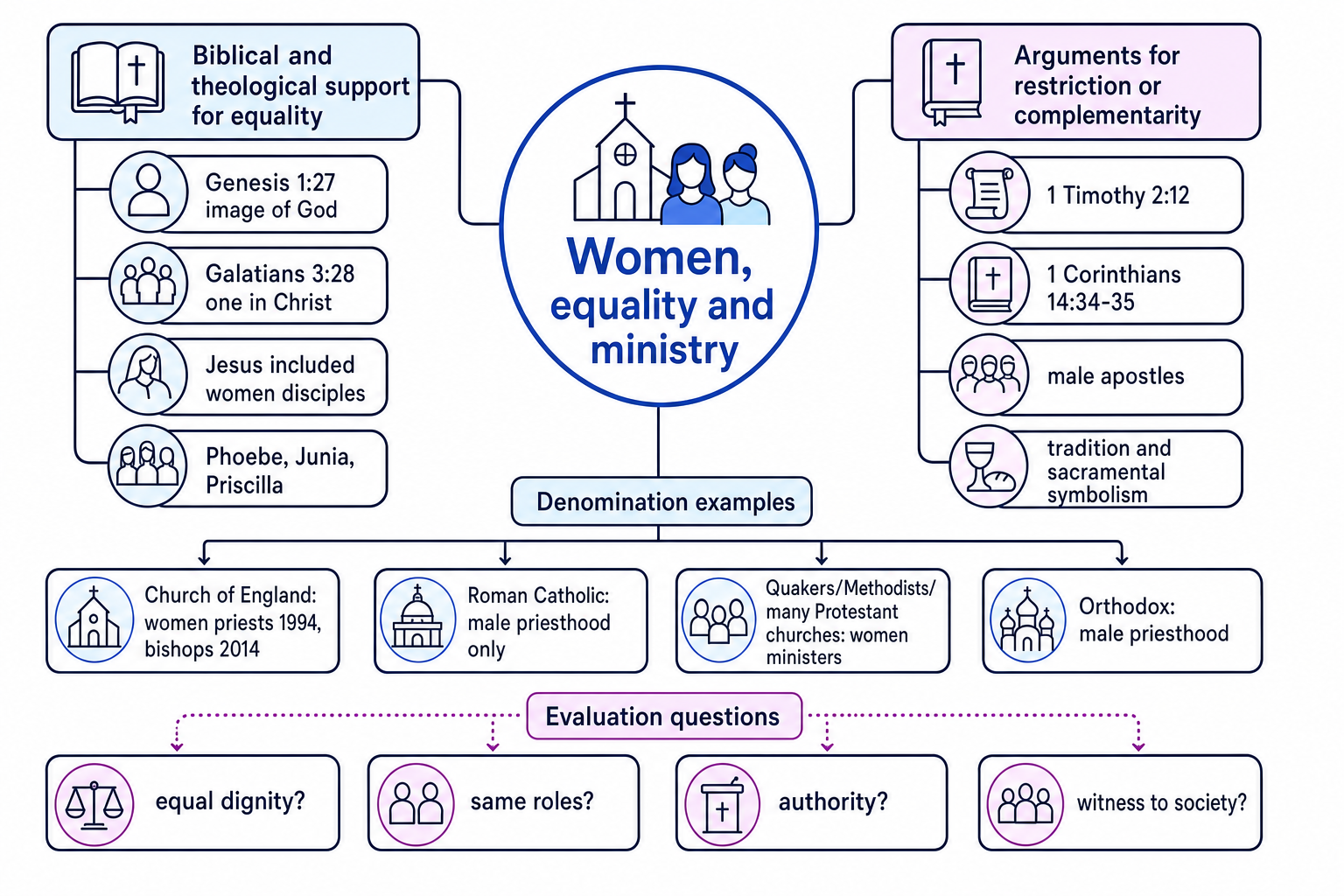
Genesis 1:27 says that male and female are created in the image of God, meaning human beings share a God-given dignity. Galatians 3:28 says, “There is no longer male and female; for all of you are one in Christ Jesus.” Many Christians see this as a powerful basis for equality.
However, Christians disagree about whether equal dignity means identical roles in Church leadership.
Definition
Egalitarianism and complementarianism
- Egalitarianism is the view that men and women are equal in dignity and should have equal access to roles of leadership and ministry.
- Complementarianism is the view that men and women are equal in dignity but have different God-given roles, often including male leadership in the Church or family.
Biblical bases for women’s equality
Supporters of women’s ministry point to Jesus’ treatment of women. He taught Mary of Bethany as a disciple, spoke seriously with the Samaritan woman in John 4, and Mary Magdalene is presented as a first witness to the resurrection.
The early Church also included women in significant roles. Romans 16 mentions Phoebe, described as a deacon or servant of the church, Priscilla, a teacher, and Junia, who is described by many translations as “prominent among the apostles”.
Arguments used to restrict women’s ministry
Those who oppose women’s ordination often appeal to passages such as 1 Timothy 2:12, where Paul is presented as saying, “I permit no woman to teach or to have authority over a man,” and 1 Corinthians 14:34–35, where women are told to be silent in churches.
They may also argue from tradition: Jesus chose male apostles, and the historic priesthood has been male. In Roman Catholic theology, the priest acts in persona Christi, meaning “in the person of Christ”, and the Church teaches that it does not have authority to ordain women as priests.
Egalitarian Christians reply that some restrictive passages may address specific local problems, not universal rules. They also note that 1 Corinthians 11 assumes women pray and prophesy publicly, so “silence” cannot be absolute.
Denominational differences
Different denominations have developed differently.
- The Church of England ordained women as priests from 1994; legislation allowing women bishops was passed in 2014, with the first woman bishop consecrated in 2015.
- The Roman Catholic Church teaches that only men can be ordained priests, while still affirming the equal dignity of women.
- Many Methodist, Baptist, United Reformed, Quaker and other Protestant communities accept women in ministry.
- The Eastern Orthodox Churches maintain a male priesthood, though there is some discussion about ancient female deacons.
These differences affect ecumenism. For example, women bishops may be seen by some Anglicans as progress, but they also make unity with Roman Catholic and Orthodox Churches more difficult.
Common Mistake
Assuming equality always means identical roles
Many Christians who reject women’s ordination still claim to affirm equal dignity. The evaluation issue is whether “equal but different” is a coherent Christian position or whether it becomes discrimination in practice.
Progress, society and significance
There has clearly been progress in many churches: women now preach, lead, teach theology, serve as priests or ministers, and hold senior roles in several denominations. This reflects wider social changes, including feminism, education, employment equality and changing expectations about leadership.
However, progress is uneven. Some churches see women’s ordination as faithfulness to the gospel; others see refusal to ordain women as faithfulness to Scripture and tradition.
The significance is personal and communal. For individuals, the debate affects vocation, conscience, belonging and representation. For communities, it affects unity, credibility, pastoral care and public witness. A Church that excludes women from leadership may be seen as counter-cultural faithfulness by supporters, but discriminatory and damaging by critics.
Example
Evaluating women in ministry
-
Compare the biblical evidence. Galatians 3:28, Genesis 1:27 and examples such as Phoebe and Junia support equality and female leadership; 1 Timothy 2:12 and traditional male apostleship are used to restrict leadership.
-
Decide how Scripture should be interpreted. If restrictive texts are universal commands, complementarianism becomes stronger. If they address local issues in the early Church, egalitarianism becomes stronger.
-
Assess the wider significance. Women’s ordination may strengthen justice, vocation and the Church’s witness to society, but it can also create division with Christians who believe tradition has been broken.
-
Reach a judgement. A strong conclusion might argue that equal dignity is not enough unless women can exercise their gifts fully; or it might argue that equality can coexist with different sacramental roles, depending on one’s view of Church authority.
Exam technique
In the exam
-
Keep the distinctions clear: multiculturalism is a social reality; pluralism is a philosophical claim about religious truth.
-
Compare Rahner and Hick directly. Rahner is inclusivist and Christ-centred; Hick is pluralist and Reality-centred.
-
For gender essays, define equality first, then use biblical evidence, denominational examples and the wider social context.
-
Always reach a justified judgement: which view is strongest, for which kind of Christian, and why?
Self review
Check yourself
- How is Rahner’s inclusivism different from Hick’s pluralism?
- Why is the Ecumenical movement not the same as interfaith dialogue?
- Can a church affirm equal dignity while restricting women’s ordination? What arguments support and challenge that claim?