Revision notes for Edexcel AS Level Religious Studies Works of scholars. Open the guide for explanations and worked examples. Written against the Edexcel AS Level Religious Studies specification, so the content matches what's examinable rather than general Religious Studies background.
Works of scholars
What you'll learn
- What atonement and soteriology mean, and why they matter in Christianity.
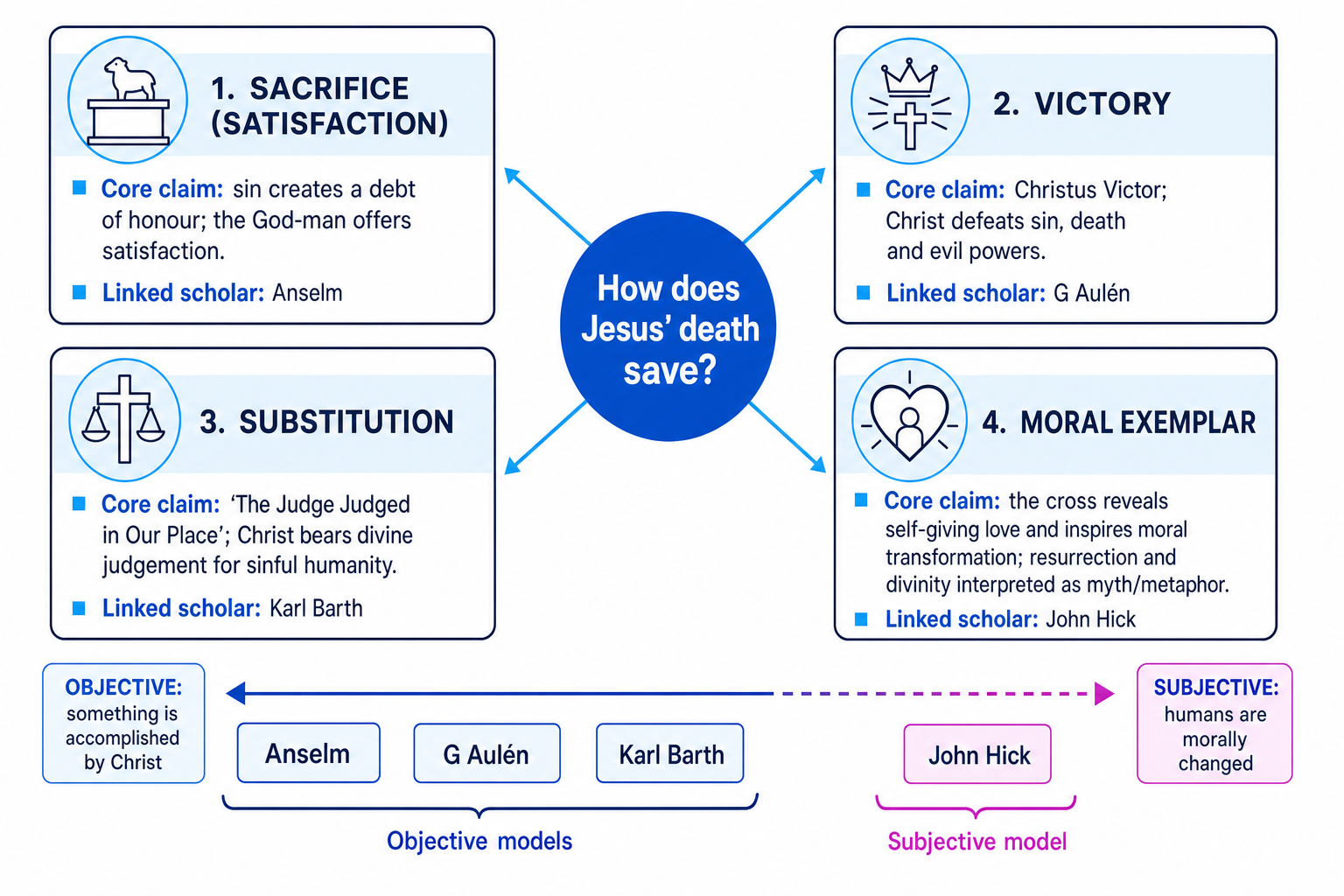
- Four major models of atonement: sacrifice, victory, substitution and moral exemplar.
- How Anselm, Gustaf Aulén, Karl Barth and John Hick explain the saving meaning of Jesus’ death.
- How to compare Barth and Hick for Edexcel Paper 4 Christianity essays and Anthology extracts.
Why atonement matters
Christianity claims that Jesus’ life, death and resurrection are not only inspiring events but saving events. The key question is: how does Jesus’ death restore the relationship between God and sinful humanity?
Definition
Atonement and soteriology
Atonement means reconciliation between God and humanity, often understood as humanity being brought back into right relationship with God through Jesus Christ. Soteriology is the study or doctrine of salvation: how humans are saved, from what, and by whom.
Atonement theories usually begin with sin, meaning human rebellion against God, moral failure, and separation from God. Different models explain the problem differently: some focus on guilt, some on evil powers, and some on human moral transformation.
Key Idea
Objective and subjective models
An objective model says something is actually accomplished by Christ before God or in the cosmos. A subjective model says the cross changes human beings by inspiring repentance, love and discipleship.
The map below gives you the big picture before we zoom in.
The sacrifice model
The sacrifice model uses the language of offering. In the Hebrew Bible, sacrifice could express repentance, thanksgiving, covenant relationship or cleansing from sin. In the New Testament, Jesus is often presented using sacrificial imagery: for example, as the “Lamb of God” and as the one who offers himself “once for all”.
This model sees Jesus’ death as a self-offering to God that deals with sin and restores communion between God and humanity.
Anselm: satisfaction for sin
Anselm of Canterbury developed a famous version in Cur Deus Homo? — “Why did God become human?” His theory is usually called satisfaction theory.
For Anselm, sin dishonours God. God’s honour and justice cannot simply be ignored, because the moral order of the universe matters. Humans owe satisfaction to God, but because sin is against God, finite humans cannot offer adequate satisfaction. Therefore, the one who makes satisfaction must be both fully human and fully divine: Jesus Christ.
Definition
Satisfaction theory
Satisfaction theory is Anselm’s view that Jesus’ obedient death restores the honour owed to God by sinful humanity. It is not exactly the same as penal substitution, because Anselm focuses on honour and satisfaction rather than God directly punishing Jesus instead of sinners.
Example
Using Anselm to explain the incarnation
- Start with Anselm’s problem: sin creates a debt of honour owed by humanity to God.
- Human beings ought to repay the debt, because humans caused the offence.
- But ordinary humans cannot repay it adequately, because the offence is against God.
- Therefore the saviour must be human, to represent humanity, and divine, to offer satisfaction of infinite worth.
- This leads Anselm to argue that the incarnation is necessary: only the God-man, Jesus Christ, can restore the relationship between God and humanity.
Common Mistake
Calling Anselm simple penal substitution
Do not write that Anselm simply says “God punished Jesus instead of us.” Anselm’s key ideas are honour, debt and satisfaction. Penal substitution is closer to later Reformed theology and to Barth’s language of judgement.
The victory model
The victory model, often called Christus Victor, presents the cross and resurrection as God’s victory over the powers that enslave humanity: sin, death, evil and sometimes the devil.
G Aulén: the classic view
Gustaf Aulén, in Christus Victor, argued that this was the “classic” early Christian view of atonement. He contrasted it with Anselm’s more legal and satisfaction-based “Latin” view.
For Aulén, atonement is not mainly a payment or legal transaction. It is a divine drama: God in Christ enters the human condition, confronts the powers of evil, and defeats them through death and resurrection. This gives the resurrection a central role, because victory is not complete if Jesus simply dies.
Strengths of Aulén’s view include its strong biblical themes of liberation and triumph. It can speak powerfully to Christians who see evil as more than individual wrongdoing. A weakness is that modern readers may find the language of “powers” or the devil difficult unless it is interpreted symbolically or socially.
The substitution model
Substitution means Christ takes the place of sinful humanity. In some versions, Jesus bears the penalty humans deserve; this is called penal substitution.
Substitutionary language has biblical roots, including Isaiah’s suffering servant, Paul’s claim that Christ was “made sin”, and New Testament imagery of judgement, curse, forgiveness and reconciliation.
Karl Barth: “The Judge Judged in Our Place”
Karl Barth was a major twentieth-century Reformed theologian. The Reformed tradition is the Protestant theological tradition associated with figures such as Calvin, often stressing God’s sovereignty, human sinfulness and salvation by grace.
Barth’s key phrase is “the Judge judged in our place.” He means that in Jesus Christ, God does not merely judge humanity from a distance. God takes human judgement upon himself. Jesus is both the divine Judge and the human one judged.
This matters because Barth avoids the crude idea that an angry Father punishes an innocent third party. For Barth, the triune God acts in Christ to bear judgement and offer forgiveness. The cross shows the seriousness of sin and the depth of divine grace.
Key Idea
Barth’s atonement
For Barth, Jesus’ death is substitutionary: Christ stands in the place of sinful humanity, takes God’s judgement on himself, and opens the way to forgiveness and reconciliation.
Barth’s view has strong meaning for many Christians because it preserves traditional doctrines: the seriousness of sin, the necessity of grace, the divinity of Christ, and the saving power of the cross. It also fits well with biblical language of guilt, judgement and forgiveness.
However, critics argue that substitutionary atonement can sound morally troubling. It may appear to glorify suffering or imply that justice requires violence. Barth’s reply is that God does not punish someone else; God in Christ bears judgement himself.
The moral exemplar model
The moral exemplar model says Jesus saves by revealing perfect love and inspiring human moral transformation. The cross shows what self-giving love looks like. Humans respond by repentance, discipleship and ethical change.
This is more subjective than Anselm, Aulén or Barth, because the main change happens in human hearts and lives.
John Hick: myth, metaphor and modern Christianity
John Hick was a twentieth-century philosopher of religion and pluralist theologian. He argued that some traditional Christian doctrines should be understood as myth and metaphor.
Definition
Myth and metaphor in Hick
For Hick, calling a doctrine “myth” does not simply mean it is a lie. A myth is a story or image that shapes religious understanding and behaviour. A metaphor communicates truth indirectly rather than as a literal factual description.
Hick applies this to the incarnation, the doctrine that Jesus is God made flesh. He argues that Jesus’ divinity should not be understood as a literal metaphysical claim that Jesus is uniquely God in a way no other religious figure could be. Instead, Jesus can be seen as a human life fully open to God and transparent to divine love.
This affects the Trinity, the Christian doctrine that God is Father, Son and Holy Spirit. If Jesus’ divine sonship is metaphorical rather than literal, then traditional Trinitarian belief is also reinterpreted.
Hick also treats resurrection language in a non-literal or symbolic way. The resurrection can express the continuing significance of Jesus and God’s vindication of him, rather than functioning as a straightforward supernatural proof.
For Hick, the cross matters in the modern age because it reveals self-giving love in a world marked by violence and atrocity. Twentieth-century events such as genocide and war show the depth of human evil, but they also make sacrificial love and moral transformation urgent.
Hick’s view also supports interfaith dialogue, because it reduces the claim that Christianity alone possesses final and absolute truth through a uniquely divine incarnation. This makes space for other religions as genuine responses to the Real.
Common Mistake
Using myth to mean false
When writing about Hick, do not say “Hick thinks Christianity is just made up.” His point is subtler: religious myths can be meaningful and transformative without being literal descriptions of metaphysical facts.
Barth and Hick compared
| Issue | Karl Barth | John Hick |
|---|---|---|
| Jesus | Fully divine and fully human; God acts uniquely in Christ | Jesus is a supreme God-conscious human life; divinity is myth/metaphor |
| Sin | Serious guilt before God requiring judgement and forgiveness | Real human moral failure, seen sharply after modern atrocities |
| Cross | Substitution: the Judge is judged in our place | Moral exemplar: the cross reveals self-giving love |
| Resurrection | Central to Christian revelation and salvation | Interpreted symbolically or non-literally |
| Modern impact | Preserves orthodox Christian identity | Encourages pluralism and interfaith dialogue |
Example
Comparing Barth and Hick in an essay
- Choose a clear criterion for judgement: for example, whether an atonement theory must preserve traditional Christian doctrine or speak convincingly to the modern pluralist world.
- Apply Barth to the criterion: he strongly preserves biblical and Reformed themes of sin, judgement, grace and forgiveness, but may be criticised for morally difficult legal imagery.
- Apply Hick to the same criterion: he speaks powerfully to modern ethics and interfaith dialogue, but may weaken traditional doctrines of incarnation, Trinity and objective salvation.
- Reach a balanced judgement: Barth is stronger if Christianity requires a real saving act by God in Christ; Hick is stronger if atonement is primarily about moral transformation and religious openness.
Strengths and weaknesses overall
Barth’s view is powerful because it gives the cross objective saving significance. It takes sin seriously and offers a rich account of divine grace. For many Christians, it protects the heart of the gospel: God saves humanity through Christ.
Its weakness is that the language of guilt, judgement and punishment can be hard for modern believers. Some may see it as ethically troubling or too dependent on courtroom imagery.
Hick’s view is attractive because it makes Christianity more accessible in a pluralist world. It highlights the ethical challenge of the cross and encourages humility in relation to other faiths.
Its weakness is that many Christians would argue it changes Christianity too radically. If incarnation, resurrection and Trinity are only myth or metaphor, then the cross may become inspirational rather than truly salvific.
Tip
Best comparison angle
A strong essay will not simply say “Barth is traditional and Hick is modern.” Compare what each thinks the cross actually does: Barth says Christ bears judgement and reconciles humanity to God; Hick says Jesus inspires moral transformation and opens Christianity to pluralist reinterpretation.
Exam technique
In the exam
- Use the named scholars precisely: Anselm for satisfaction, Aulén for Christus Victor, Barth for “the Judge Judged in Our Place”, and Hick for moral exemplar plus myth/metaphor.
- Compare Barth and Hick point by point: sin, Jesus’ identity, the cross, resurrection, Trinity, and modern significance.
- Make a justified judgement: explain which view is stronger and why, using both AO1 knowledge and AO2 evaluation throughout.
Self review
Check yourself
- Why does Anselm think only the God-man can make satisfaction for sin?
- How does Barth’s “Judge Judged in Our Place” avoid the idea of God punishing an unrelated third party?
- What does Hick gain and lose by interpreting incarnation and resurrection as myth and metaphor?