Revision notes for Edexcel AS Level Religious Studies Social and historical developments. Open the guide for explanations and worked examples. Written against the Edexcel AS Level Religious Studies specification, so the content matches what's examinable rather than general Religious Studies background.
Social and historical developments
What you'll learn
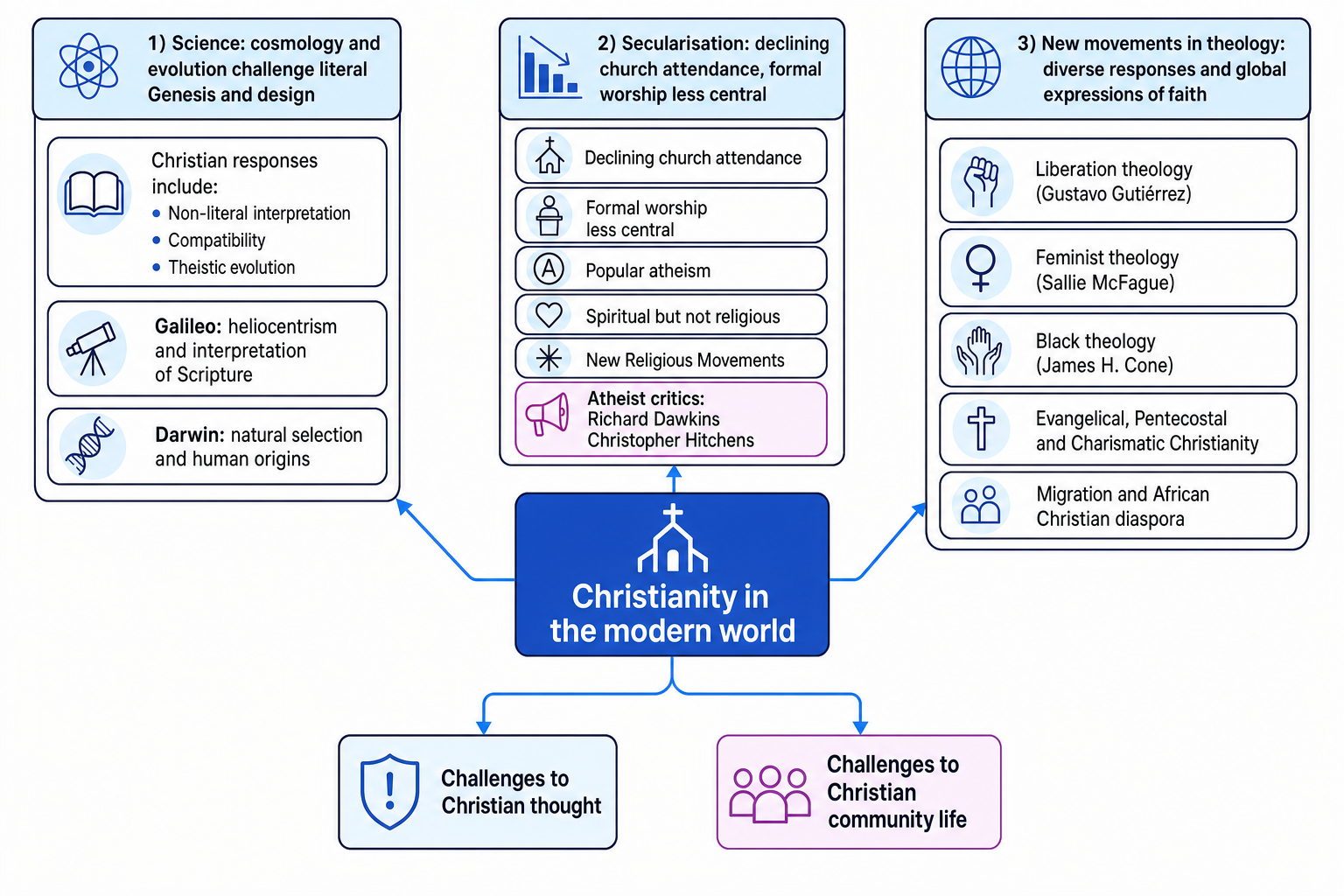
- How modern science, especially cosmology and evolution, has challenged some Christian beliefs.
- How secularisation and popular atheism have affected Christianity in modern society.
- How Liberation, Feminist, Black, Evangelical, Pentecostal and Charismatic Christianity have reshaped Christian life.
- How to use Galileo, Darwin, Dawkins, Hitchens, Gutiérrez, McFague and Cone in essay evaluation.
The big picture
This topic is about how Christianity has responded to modern historical change. The key issue is not simply “Christianity versus modernity”. It is better to ask: which form of Christianity is being challenged, and how have Christians adapted, resisted or developed?
Key Idea
The main pattern
Modern developments often challenge traditional Christian authority, but they do not always destroy Christian belief. They can also lead to reinterpretation, reform and new forms of worship.
1. Science and Christian belief
Cosmology and evolution
Definition
Cosmology
Cosmology is the study of the origin, structure and development of the universe. In this topic, it matters because modern accounts of the universe can seem to replace religious accounts of creation.
Modern cosmology challenges a literal reading of Genesis if Genesis is treated as a scientific account of how the universe was made in six days. However, many Christians read Genesis as theological truth: it teaches that God is creator, creation is good, and humans have responsibility before God.
Definition
Evolution
Evolution is the process by which living organisms change over generations. Darwin’s theory of natural selection explains adaptation through inherited variation, survival and reproduction.
Darwin’s On the Origin of Species challenged special creation, the belief that God created each species separately in its present form. It also raised questions about Adam and Eve, original sin, human uniqueness and divine design.
Galileo: science and Scripture
Galileo supported heliocentrism, the view that the Earth moves around the Sun. This conflicted with some Church authorities who read biblical passages as supporting an Earth-centred universe. In his Letter to the Grand Duchess Christina, Galileo argued that Scripture cannot truly err, but human interpreters can misunderstand it. He used the idea that the Bible teaches “how one goes to heaven, not how heaven goes”.
This gives Christians a response to science: if a scientific claim is well established, believers may need to reinterpret Scripture rather than reject evidence.
Darwin: evolution and purpose
Darwin’s theory seemed to remove the need for direct divine intervention in the development of life. For some atheists, this weakens the design argument: complex life can arise through natural selection rather than an obvious designer.
Christian responses vary. Some reject evolution, but many accept theistic evolution, the belief that God creates through evolutionary processes. This preserves belief in God as creator while accepting scientific explanations.
Common Mistake
Science equals atheism
Do not write as if science automatically disproves Christianity. Science challenges some interpretations of Christianity, especially literalist ones, but many Christians argue that science explains mechanisms while religion explores meaning, purpose and value.
Example
Evaluating Darwin’s challenge to Christianity
-
Identify the belief being challenged: Darwin most directly challenges special creation and a literal reading of Genesis, not every possible belief in God.
-
Compare Christian responses: a fundamentalist Christian may see evolution as a direct threat, while a theistic evolutionist can say natural selection is the method by which God creates.
-
Make a judgement: Darwin is a serious challenge to literalism and some design arguments, but it is weaker against non-literal Christianity because it does not settle questions of ultimate purpose or why there is an ordered universe at all.
2. Secularisation and popular atheism
Definition
Secularisation
Secularisation is the process by which religion loses social influence, public authority or personal importance within a society.
In the UK and much of Western Europe, church attendance and formal worship have declined. The Church no longer shapes everyday life as strongly as it once did. Baptisms, confirmations, Sunday services and obedience to church teaching are less central for many people.
However, secularisation does not mean religion has disappeared. Churches still contribute through schools, food banks, chaplaincy, national ceremonies, moral debate and community life. Globally, Christianity is growing in many places, especially in parts of Africa, Asia and Latin America.
Dawkins and Hitchens
Richard Dawkins, especially in The God Delusion, argues that belief in God lacks evidence and that religion can encourage irrationality. He also attacks religious upbringing when it becomes indoctrination.
Christopher Hitchens, in God Is Not Great, argues that “religion poisons everything”. He is best described as an anti-theist, meaning not just someone who disbelieves in God, but someone who thinks religion is harmful.
Their strengths are clear: they challenge religious privilege, expose abuses of religious power, and push believers to justify claims carefully. Their weaknesses are also important: they can treat religion as if it were always fundamentalist, ignore sophisticated theology, and underplay religious contributions to justice and community.
Spiritual, religious and New Religious Movements
Definition
Spiritual and religious
To be religious usually means belonging to an organised tradition with shared beliefs, practices and authority structures. To be spiritual usually means seeking meaning, experience or connection without necessarily belonging to an institution.
Some people are disillusioned with traditional religion because of scandals, hypocrisy, patriarchy, abuse, exclusion or perceived irrelevance. But they may not become hard-line atheists. Instead, they may describe themselves as “spiritual but not religious”.
Definition
New Religious Movements
New Religious Movements are relatively recent or alternative religious groups, often developing outside older mainstream institutions. Examples can include New Age movements, Scientology, Wicca, or newer Christian and quasi-Christian groups.
The rise of such movements suggests that secularisation may involve religious change, not simply religious decline.
Example
Assessing whether secularisation means religion is dying
-
Weigh the evidence for decline: in many Western contexts, formal worship and church membership have fallen, so secularisation is a real social trend.
-
Add counter-evidence: religion remains active in public service, global Christianity is growing, and many people pursue spirituality outside institutions.
-
Reach a balanced conclusion: secularisation weakens traditional Church authority, but it does not prove that religion itself is disappearing.
3. New movements in theology
Liberation theology: Gustavo Gutiérrez
Definition
Liberation theology
Liberation theology is a Christian movement that interprets the gospel from the perspective of the poor and oppressed, emphasising action against injustice.
Gustavo Gutiérrez, writing from Latin America, described theology as “critical reflection on praxis in the light of the Word”. Praxis means reflective action: faith must be lived through justice. He argues for the preferential option for the poor, meaning Christians should prioritise the needs of the poor because God is revealed as liberator in Exodus, the prophets and Jesus.
Its strength is that it makes Christianity practical and socially engaged. A criticism is that it can appear to reduce salvation to politics or rely too heavily on Marxist social analysis.
Feminist theology: Sallie McFague
Definition
Feminist theology
Feminist theology critiques male-dominated Christian language, structures and interpretations, and seeks more inclusive ways of speaking about God and human dignity.
Sallie McFague argues that language about God is metaphorical. She challenges exclusively male images of God as king or father and proposes models such as God as mother, lover and friend. She also speaks of the world as God’s body, encouraging ecological responsibility.
Her work helps Christianity address patriarchy and environmental crisis. Critics argue that her models may weaken traditional beliefs about God’s transcendence.
Black theology: James H. Cone
Definition
Black theology
Black theology interprets Christianity through the experience of Black oppression and resistance, especially in the context of racism and white supremacy.
James H. Cone argued that God sides with the oppressed. When Cone says “God is black”, he does not mean God has a literal skin colour. He means God identifies with Black people in their struggle against racist oppression.
Cone’s strength is his prophetic challenge to white Christianity. A criticism is that it risks making theology too dependent on one social context, though Cone would respond that supposedly “neutral” theology has often served white power.
Example
Comparing Gutiérrez and Cone on liberation
-
Establish the similarity: both argue that Christian faith must be judged by whether it liberates oppressed people, not merely by correct doctrine.
-
Identify the difference: Gutiérrez focuses especially on poverty and class in Latin America, while Cone focuses on race, white supremacy and the Black experience in America.
-
Evaluate the comparison: both make Christianity socially urgent, but Cone more directly challenges churches whose theology has ignored racism, while Gutiérrez gives a broader economic analysis of oppression.
4. Evangelical, Pentecostal and Charismatic Christianity
Definition
Evangelicalism
Evangelicalism is a global Protestant movement emphasising the authority of the Bible, personal conversion, the saving death of Jesus and active mission.
Evangelical Christianity has spread through missions, revival movements, media, global networks and migration. It has influenced politics, education, charity and worship, especially in the US and the Global South.
Definition
Pentecostal and Charismatic Christianity
Pentecostal Christianity emphasises the gifts of the Holy Spirit, such as tongues, healing and prophecy. Charismatic Christianity shares this emphasis but often operates within older denominations rather than separate Pentecostal churches.
Pentecostal and Charismatic worship is often expressive, emotional and music-centred. It has grown strongly in the US and beyond, especially through African, Latin American and Asian churches.
Migration is crucial. African Christian diaspora communities have brought new worship styles to Britain, Europe and America, including lively music, healing services, all-night prayer, deliverance ministries and strong community networks.
Common Mistake
Confusing the movements
Evangelical, Pentecostal and Charismatic Christianity overlap, but they are not identical. Evangelicalism focuses on Bible, conversion and mission; Pentecostal and Charismatic Christianity focus especially on the Holy Spirit and spiritual gifts.
Impact on Christianity today
These developments have changed Christian thought and practice in major ways. Science has encouraged non-literal biblical interpretation. Secularisation has forced churches to rethink mission and public relevance. Liberation, Feminist and Black theology have challenged churches to confront poverty, patriarchy and racism. Pentecostal and Charismatic Christianity have reshaped worship and helped Christianity grow globally.
Tip
Essay judgement shortcut
Ask: does this development weaken Christianity, purify it, or transform it? Strong answers usually show that the same development can do more than one of these.
Exam technique
In the exam
-
Anchor each paragraph in a named thinker: for example, Galileo on Scripture and science, Darwin on evolution, Dawkins or Hitchens on atheism, and Gutiérrez, McFague or Cone on theology.
-
Avoid one-sided answers: show both the challenge to Christianity and the Christian response.
-
Keep asking “which Christianity?” A literalist, liberal, Evangelical, Catholic or Pentecostal Christian may respond very differently.
-
Make your final judgement precise: do not say “science disproves religion” or “secularisation proves religion is irrelevant” without qualification.
Self review
Check yourself
- How does Galileo’s approach to Scripture help Christians respond to modern science?
- Why might secularisation show religious change rather than simple religious decline?
- How do Gutiérrez, McFague and Cone each connect theology with liberation?