Revision notes for Edexcel AS Level Religious Studies Sources of wisdom and authority. Open the guide for explanations and worked examples. Written against the Edexcel AS Level Religious Studies specification, so the content matches what's examinable rather than general Religious Studies background.
Sources of wisdom and authority
What you'll learn
- How the Bible functions as a source of authority in Christianity, alongside tradition.
- The difference between revealed theology and natural theology, including the role of the Holy Spirit.
- Strengths and weaknesses of different ways of interpreting the Bible.
- How Christian understanding of Jesus developed through the Early Church, Reformation and modern debates about divine suffering.
The big picture: where Christian authority comes from
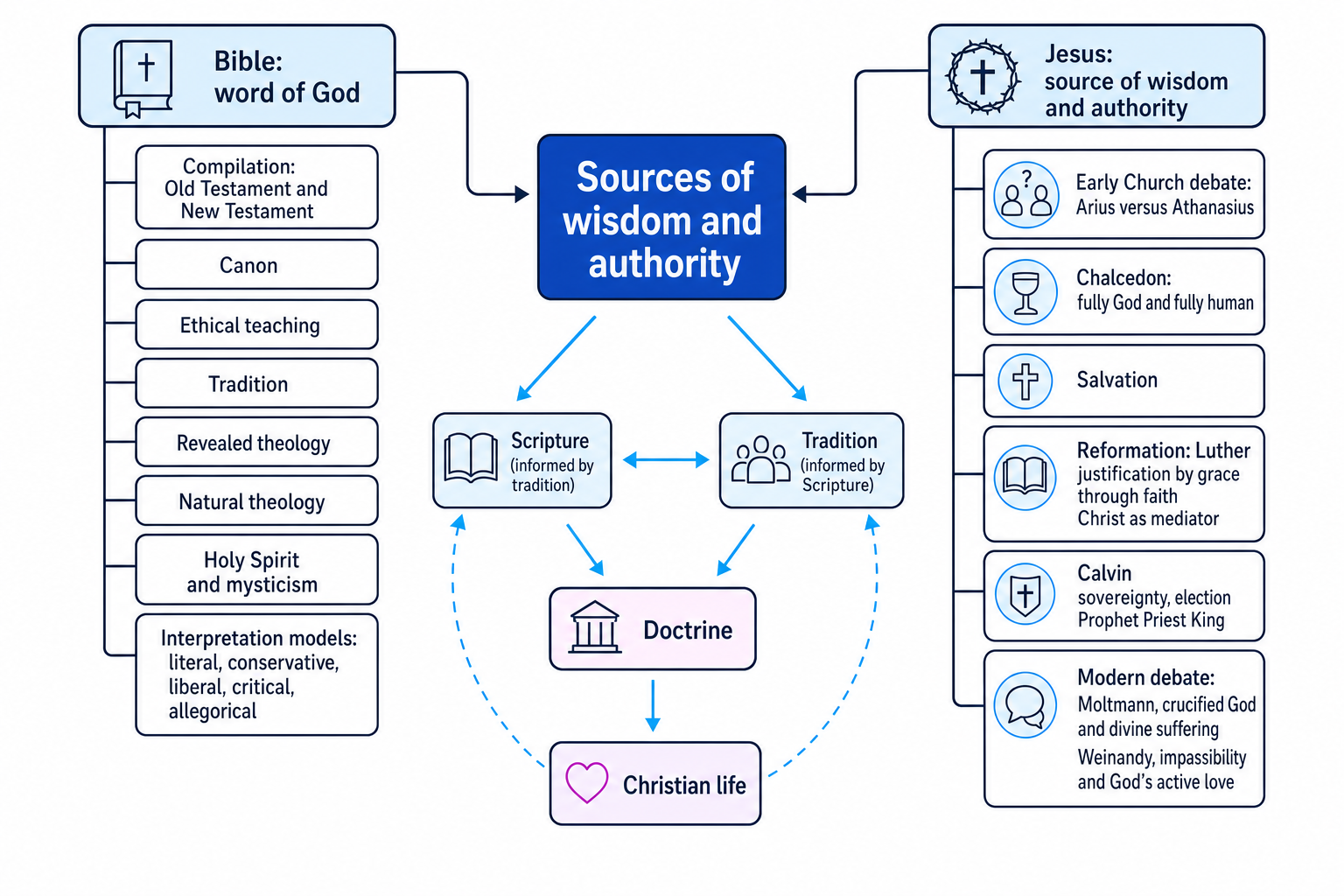
In Christianity, “sources of wisdom and authority” means the places Christians look to for truth about God, human life, salvation and ethics. The most important sources in this topic are the Bible, tradition and Jesus Christ.
Definition
Authority
Authority means the right or power to guide belief and behaviour. In Christianity, authority may be linked to Scripture, Church tradition, reason, religious experience, conscience and the person of Jesus.
The Bible is not just one book. It is a collection of texts, including the Old Testament and New Testament, gathered into an authorised list called the canon. Christians often describe it as the word of God, though they disagree about exactly what that means.
For some, the Bible is directly inspired and without error in matters of faith. For others, it is a human collection of writings through which God’s revelation is encountered. Either way, it has shaped Christian doctrine, worship, ethics and identity.
Key Idea
Scripture and tradition belong together
Even Christians who strongly emphasise the Bible usually read it through some form of tradition: creeds, sermons, liturgy, Church teaching, denominational history or inherited interpretation.
The Bible as a source of authority
The Bible as the word of God
Calling the Bible the word of God can mean several things:
- God inspired the biblical writers.
- God speaks through the text to believers today.
- The Bible witnesses to God’s saving action in history.
- The Bible points to Jesus, who is called the Word or Logos in John 1.
This matters because Christian teaching on sin, salvation, the Church, worship and ethics is often grounded in biblical texts. For example, the Ten Commandments, the Sermon on the Mount and Pauline teaching about love and community have shaped Church moral teaching.
Compilation and canon
Definition
Canon
The canon is the recognised collection of books accepted as authoritative Scripture by a religious community.
The Bible was compiled over time. The Old Testament contains law, history, prophecy, poetry and wisdom literature. The New Testament contains the Gospels, Acts, letters and Revelation. The Church did not receive the Bible as a single finished book dropped from heaven; it recognised, preserved and interpreted texts within worshipping communities.
This creates an important issue: if the Church helped recognise the canon, then tradition seems to have some authority alongside Scripture.
Common Mistake
Treating the Bible as isolated from the Church
Do not write as if Christianity first had a complete Bible and only later developed tradition. Historically, Christian communities, worship and teaching existed while the New Testament canon was still forming.
The Bible and ethical teaching
The Bible is used as a basis for Christian ethics. It gives direct commands, moral examples, principles and narratives. However, applying it is rarely simple. Christians debate whether a text is timeless, culturally specific, symbolic, fulfilled in Christ or superseded by later revelation.
For example, “love your neighbour” is widely treated as a lasting principle. Some Old Testament purity laws, however, are not applied by most Christians in the same way today.
Revealed theology and natural theology
Definition
Revealed theology
Revealed theology is knowledge of God believed to come from God’s self-disclosure, especially through Scripture, Jesus Christ and the Holy Spirit.
Definition
Natural theology
Natural theology is knowledge of God gained through reason and observation of the world, without relying directly on special revelation.
The Bible is central to revealed theology because it tells Christians what they could not fully discover by reason alone: the Trinity, incarnation, resurrection, forgiveness of sins and salvation through Christ.
Natural theology may support belief in God through arguments from design, causation or morality. But many Christians argue that natural theology cannot reveal the full Christian gospel. It may point towards God; Scripture and Christ disclose who God is.
The role of the Spirit and mysticism
The Holy Spirit is understood as God active in inspiration, guidance and transformation. Christians may say the Spirit inspired Scripture, guides the Church in interpreting it, and opens believers to God’s presence.
Definition
Mysticism
Mysticism is direct or deeply personal experience of God, often described as beyond ordinary language and transformative for the believer.
Mystical experience can support revealed theology because it is seen as the Spirit making God known personally. But it also raises questions: how can private experience be tested? What happens when mystical claims conflict with Scripture or Church teaching?
Interpreting the Bible
Definition
Hermeneutics
Hermeneutics means the theory and practice of interpretation, especially of texts such as the Bible.
Different models of interpretation include:
| Model | Basic idea | Strength | Weakness |
|---|---|---|---|
| Literal/plain sense | Read the text according to its direct meaning | Takes Scripture seriously | Can ignore genre, metaphor and context |
| Conservative/inerrantist | Bible is fully trustworthy, often without error | Gives clear authority | May struggle with apparent contradictions |
| Liberal | Bible contains human responses to God, shaped by culture | Allows historical development | May weaken biblical authority |
| Historical-critical | Studies authorship, context, sources and redaction | Avoids naïve readings | Can become too academic or sceptical |
| Allegorical/typological | Finds symbolic or Christ-centred meanings | Shows unity of Scripture | Can impose meanings not in the text |
Example
Interpreting a difficult saying of Jesus
Take Jesus’ words: “If your right eye causes you to sin, tear it out” from Matthew 5.
- A literal reading asks what the sentence directly says. It appears to command physical removal of an eye if it leads to sin.
- A genre-sensitive reading compares it with Jesus’ wider teaching style. Since Jesus often uses exaggeration and vivid imagery, the saying can be read as hyperbole rather than a command to self-harm.
- A moral interpretation identifies the principle behind the image: disciples should treat sin seriously and remove causes of temptation.
- An evaluative answer can then argue that a purely literal reading is weak here because it conflicts with the wider Christian belief that the body is created by God and should not be deliberately mutilated.
Tip
Interpretation needs balance
Good essays avoid saying “literal bad, liberal good” or the reverse. Instead, judge which model best fits the genre, context and theological purpose of the passage.
Jesus as a source of wisdom and authority
Christian authority is not only textual. Christianity is centred on the person of Jesus Christ.
Definition
Christology
Christology is the study of the person, nature and role of Jesus Christ.
The key question is: who is Jesus? A prophet? The Son of God? Fully divine? Fully human? The answer affects salvation, worship, prayer, ethics and Christian identity.
The Early Church: Arius, Athanasius and Chalcedon
Arius
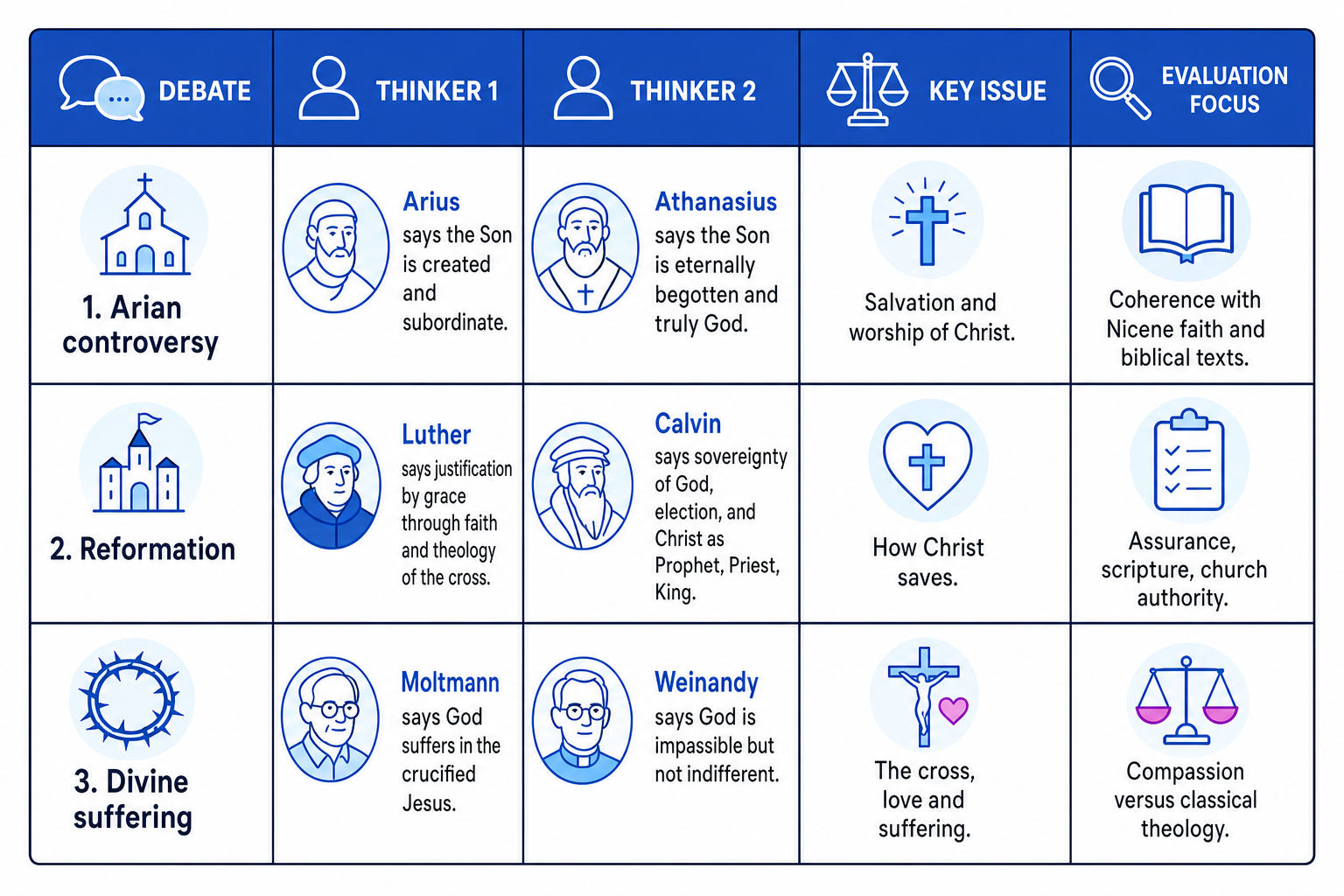
Arius argued that the Son was not eternal in the same way as the Father. The Son was created by God before the world and was therefore subordinate to the Father. His famous idea is often summarised as: “there was when he was not.”
Arius wanted to protect monotheism and God’s transcendence. He could point to biblical texts such as “the Father is greater than I” in John 14:28.
Athanasius
Athanasius strongly opposed Arius. He argued that the Son is eternally begotten, not made, and is of the same divine substance as the Father. This is expressed by the term homoousios, meaning “of the same substance.”
For Athanasius, salvation depends on Christ being truly God. If Jesus is merely a creature, he cannot unite humanity with God or defeat sin and death.
Key Idea
Athanasius links Christology to salvation
Athanasius’ argument is not just abstract metaphysics. His point is soteriological: only God can save, so Christ must be truly divine.
Chalcedon
The Chalcedonian Definition of 451 taught that Jesus Christ is one person in two natures: fully divine and fully human, “without confusion, change, division or separation.”
This protects two claims at once:
- Jesus must be fully human to represent and heal humanity.
- Jesus must be fully divine to reveal God and accomplish salvation.
Its strength is balance. Its weakness is that it uses technical philosophical language that can seem distant from the simple Gospel narratives.
The Reformation: Luther and Calvin on salvation
Definition
Justification
Justification means being put right with God. In Reformation theology, it is not earned by human merit but received through God’s grace.
Martin Luther
Martin Luther taught justification by grace through faith. Human beings are sinful and cannot earn salvation by good works, rituals or Church-controlled merit. Christ’s sacrifice is sufficient, and faith trusts in God’s promise.
Luther’s view challenged medieval Catholic practices such as indulgences and shifted authority towards Scripture. He also emphasised the theology of the cross: God is revealed most clearly in the suffering and crucified Christ, not in human power or glory.
John Calvin
John Calvin also emphasised grace, but placed stronger stress on God’s sovereignty. He taught that salvation depends entirely on God’s gracious election, not human achievement.
Calvin is especially associated with Christ’s threefold office:
- Prophet: Christ reveals God’s truth.
- Priest: Christ offers sacrifice and intercedes for believers.
- King: Christ rules, protects and governs his people.
This gives a full account of Christ’s authority: he teaches, saves and rules.
Example
Comparing Luther and Calvin on salvation
- Start with their shared foundation: both reject the idea that human beings earn salvation by their own works and both emphasise grace.
- Identify Luther’s distinctive emphasis: faith receives justification because Christ’s sacrifice is sufficient, giving believers assurance before God.
- Identify Calvin’s distinctive emphasis: God’s sovereign election explains why salvation is entirely God’s work, and Christ exercises authority as Prophet, Priest and King.
- Evaluate the contrast: Luther may be pastorally stronger on assurance, while Calvin may give a more systematic account of divine sovereignty, though predestination raises difficult questions about justice and human freedom.
Common Mistake
Saying Protestants reject good works
Luther and Calvin do not say good works are worthless. They deny that works earn justification. Good works are the fruit of grace, not the cause of salvation.
Modern views: does God suffer in Jesus?
Definition
Impassibility
Impassibility is the classical Christian belief that God cannot be overwhelmed, damaged or passively changed by suffering as creatures are.
This does not necessarily mean God is cold or uncaring. Classical theologians argue that God’s love is perfect and active, not emotionally unstable or dependent on creation.
Jürgen Moltmann
Jürgen Moltmann wrote after the horrors of the Second World War and in the shadow of Auschwitz. In The Crucified God, he argues that Christian theology must begin with the cross. God is not a distant observer of suffering; God is involved in it.
For Moltmann, the Son suffers abandonment on the cross, and the Father suffers the grief of the Son. The cross is therefore a Trinitarian event. This gives powerful support to suffering believers: God is with victims, not merely above them.
Thomas Weinandy
Thomas Weinandy defends divine impassibility. He argues that if God suffered in the same way creatures suffer, God would be diminished and in need of rescue. God saves precisely because he is not overcome by suffering.
However, Weinandy does not deny that Jesus suffers. He argues that the Son truly suffers in his human nature through the incarnation, while the divine nature remains impassible. This fits closely with Chalcedon: Christ is fully human and fully divine, without confusing the two natures.
Example
Evaluating divine suffering
- Begin with the biblical tension: Jesus weeps, suffers and cries out on the cross, yet Christian tradition also says God is perfect, unchanging and not overcome by suffering.
- Apply Moltmann: he gives a powerful reading of the cross as God’s solidarity with victims, especially meaningful after modern experiences of mass suffering.
- Apply Weinandy: he protects God’s transcendence and saving power by arguing that God’s impassible love is not indifference.
- Reach a judgement: Moltmann may be more pastorally compelling, but Weinandy may be more consistent with classical theism and Chalcedonian distinctions between Christ’s human and divine natures.
Common Mistake
Do not caricature impassibility
Impassibility does not mean “God does not love.” It means God’s love is not a passive emotion forced on him by events outside himself.
Pulling it together for essays
This topic is really about how Christianity decides what is true and authoritative. The Bible provides foundational testimony. Tradition shapes doctrine and interpretation. Jesus is both the content of revelation and the supreme authority for Christian life.
The named thinkers help you show development:
- Arius and Athanasius: who Jesus is.
- Luther and Calvin: how Jesus saves.
- Moltmann and Weinandy: whether God suffers in or through Jesus.
A strong answer will not just describe these debates. It will ask which view best explains Scripture, tradition, salvation and Christian experience.
Exam technique
In the exam
- Anchor each paragraph in the wording of the question: Bible, tradition, interpretation, Jesus’ nature, salvation or divine suffering.
- Use the named scholars comparatively, not separately; show the exact point of disagreement between Arius and Athanasius, Luther and Calvin, or Moltmann and Weinandy.
- Build evaluation throughout: judge strengths and weaknesses as you go, then finish with a clear justified conclusion.
Self review
Check yourself
- Why does Athanasius think salvation depends on Jesus being truly divine?
- How do revealed theology and natural theology differ?
- Which is more convincing on divine suffering: Moltmann or Weinandy, and why?