Revision notes for Edexcel AS Level Religious Studies Religious beliefs, values and teachings. Open the guide for explanations and worked examples. Written against the Edexcel AS Level Religious Studies specification, so the content matches what's examinable rather than general Religious Studies background.
Religious beliefs, values and teachings
What you'll learn
- How Christians understand God as personal, omnipotent, immutable and Creator.
- How the Trinity is grounded in scripture and developed through relation, analogy and modern theology.
- How the Church is understood as one, holy, catholic and apostolic.
- Why love is the central Christian moral principle behind all other values.
The big picture is that Christian belief is not just abstract doctrine. It shapes how Christians understand the self, purpose, worship, community, ethics, death and hope.
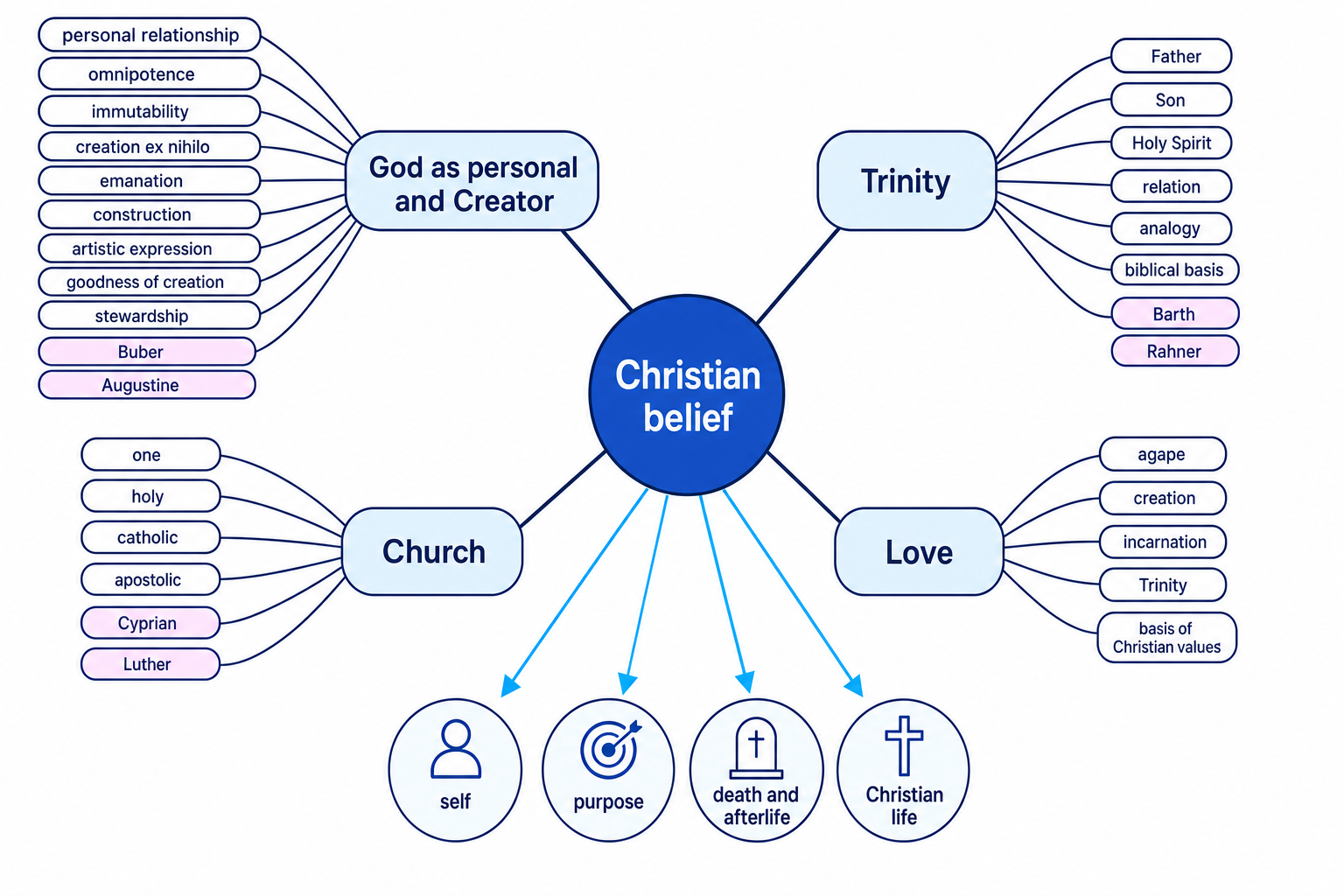
1. God as personal and Creator
God as personal, omnipotent and immutable
Definition
Personal God
A personal God is a God who can know, love, will, communicate and be addressed in prayer. Omnipotence means God has supreme power, usually understood as power to do all that is logically possible and consistent with God’s nature. Immutability means God’s essential nature and purposes do not change.
Christianity usually holds these ideas together: God is not an impersonal force, but God is also not just a bigger version of a human being. Christians pray to God, trust God, worship God and believe God can enter into relationship with them.
This raises a tension. If God is immutable, can God genuinely respond to prayer? Classical Christian thinkers often answer that God’s eternal will does not change, but human beings can still enter into a real relationship with God.
Creation: different models
Christianity classically teaches creation ex nihilo, meaning creation “out of nothing”. God does not shape the universe from eternal matter; rather, everything depends on God for its existence.
| Model | Meaning | Strength or challenge |
|---|---|---|
| Ex nihilo | God creates out of nothing. | Protects divine aseity, meaning God’s self-existence and dependence on nothing else. |
| Emanation | Creation flows out from God’s being. | Stresses closeness between God and creation, but risks making the world part of God. |
| Construction | God shapes pre-existing matter or chaos. | Easy to picture, but weakens the idea that God is ultimate Creator. |
| Artistic expression | Creation expresses God’s beauty, wisdom and love. | Helps Christians value creation, if understood as metaphor rather than literal production. |
Genesis 1 repeatedly says creation is “good”, and finally “very good”. This matters because Christianity is not supposed to despise the material world. The body, nature, food, relationships and work can all be seen as part of God’s good creation.
Stewardship means responsible care for creation on God’s behalf. In Genesis, human “dominion” should not mean exploitation; it should mean wise service under God.
Key Idea
Creation shapes Christian identity
If God creates and sustains everything, then the self is not self-made or accidental. Human life is received as a gift, and purpose is found in relationship with God, neighbour and creation.
Buber and Augustine
Martin Buber, a Jewish philosopher, helps explain what a personal relationship with God might mean. He distinguishes between I-It relationships, where we treat something as an object, and I-Thou relationships, where we encounter another personally. For Buber, God is the Eternal Thou: God is not an object to be analysed, but the ultimate personal presence encountered in genuine relationship.
Augustine, a Christian theologian, strongly defends God as Creator. In Confessions, he argues that the human heart is “restless” until it rests in God. He also teaches that God created time itself, so God is not simply one being inside the universe. Creation is good because it comes from God; evil is not a created substance but a privation, meaning a lack or corruption of good.
Implications for self, purpose, death and afterlife
If humans are made in the imago Dei, the image of God, they have dignity and moral responsibility. They are relational beings, made for love of God and neighbour.
Purpose is therefore not just personal success. It includes worship, moral growth, service and stewardship.
Death is also interpreted differently. If God is Creator of the whole person, Christian hope is not merely escape from the body. Traditional Christianity looks towards resurrection, judgement, heaven and the final renewal of creation.
Example
Weighing personal relationship and immutability
- Buber supports the idea that faith is relational: if God is the Eternal Thou, then prayer and worship are genuine encounters, not just thinking about an idea.
- Augustine protects God’s transcendence: if God is immutable, God’s love and goodness are not unstable or emotionally changeable like human feelings.
- A balanced judgement could argue that immutability need not destroy personal relationship, but it does challenge simple claims that prayer “changes God’s mind”.
Common Mistake
Making God too human
Do not write as if “personal” means God has a physical body or human limitations. In Christian theology, personal language usually means God can know, love and relate.
2. The Trinity
What Christians mean by Trinity
Definition
Trinity
The Trinity is the Christian doctrine that there is one God in three persons: Father, Son and Holy Spirit. The persons are distinct, but not three separate gods.
The Trinity is central because it shapes Christian beliefs about creation, incarnation, salvation, prayer and worship. Christians are baptised “in the name of the Father and of the Son and of the Holy Spirit” in Matthew 28:19.
Biblical basis
The New Testament does not present the Nicene Creed as a ready-made formula, but Christians see a Trinitarian pattern in scripture:
- At Jesus’ baptism, the Son is baptised, the Spirit descends, and the Father’s voice is heard.
- John 1 describes the Word who was “with God” and “was God”, later identified with Christ.
- John 14–16 speaks of the Spirit as the Advocate sent by the Father and the Son.
- 2 Corinthians 13:13 blesses believers with the grace of Christ, the love of God and the fellowship of the Holy Spirit.
- Matthew 28:19 gives a threefold baptismal formula.
Relation and analogy
Relation means that the divine persons are understood through how they eternally relate: the Father begets the Son, the Son is begotten, and the Spirit proceeds. This is not about time, because the Son and Spirit are not created later.
Analogy means using a comparison to speak about God while recognising that the comparison is limited. Augustine’s psychological analogy compares the Trinity to memory, understanding and will in one mind. Social analogies compare the Trinity to a communion of persons in perfect love.
Common Mistake
Overusing weak analogies
Water as ice, liquid and steam often sounds like modalism, the mistaken view that Father, Son and Spirit are just three temporary masks worn by one person. Use analogies carefully and explain their limits.
Barth and Rahner
Karl Barth grounds the Trinity in revelation, meaning God’s self-disclosure. For Barth, God is the one who reveals, the revelation itself, and the revealedness received by humans. He uses the language of three “modes of being” to avoid imagining three separate centres of consciousness. A strength is that Barth keeps the Trinity tied to Christ and salvation. A weakness is that “modes of being” can sound dangerously close to modalism if misunderstood.
Karl Rahner distinguishes the economic Trinity, God as revealed in salvation history, from the immanent Trinity, God in God’s eternal life. His famous rule is that the economic Trinity is the immanent Trinity, and the immanent Trinity is the economic Trinity. In simpler terms: the God Christians meet in creation, incarnation and grace is who God truly is. A strength is that Rahner makes the Trinity relevant to Christian life. A weakness is that some argue it risks reducing God’s mystery to what humans experience.
Example
Testing a Trinity analogy
- Suppose someone says the Trinity is like one person who is a parent, worker and friend. This explains one being in three roles.
- Compare it with Christian doctrine: Father, Son and Spirit are not merely roles, because they relate to one another eternally.
- The judgement should be that the analogy may introduce the idea of unity, but it fails to protect real distinction within God.
3. The nature of the Church
The four marks of the Church
The Church means the community of believers called together in Christ, not just a building.
The Nicene Creed describes the Church as:
| Mark | Meaning |
|---|---|
| One | United in Christ, despite diversity. |
| Holy | Set apart by God, even though its members are sinful. |
| Catholic | Universal or whole; not simply “Roman Catholic” in this context. |
| Apostolic | Rooted in the apostles’ teaching and mission. |
Cyprian and Luther
Cyprian of Carthage emphasised visible unity under the bishops. He argued that a Christian cannot have God as Father without the Church as Mother, and he is linked with the idea that there is no salvation outside the Church. His view strongly protects unity and sacramental authority, but it can seem exclusivist.
Martin Luther challenged corrupt church authority during the Reformation. For Luther, the true Church is found where the Gospel is rightly preached and the sacraments are rightly administered. He also emphasised the priesthood of all believers. This protects the authority of scripture and faith, but critics argue it can encourage fragmentation into many denominations.
Challenges and impact
The Church’s claim to be “one” is challenged by schism and denominational division. Its claim to be “holy” is challenged by sin, abuse and hypocrisy within Christian communities. Its claim to be “catholic” is tested by cultural diversity and global Christianity. Its claim to be “apostolic” raises debate: is apostolicity mainly historical succession, or faithfulness to apostolic teaching?
For Christians, these beliefs affect worship, sacraments, authority, mission, belonging and moral formation.
Example
Comparing visible and gospel-centred unity
- Cyprian would judge division as spiritually dangerous because unity is visibly guarded through bishops and sacramental communion.
- Luther would ask whether the Gospel is being faithfully preached; visible institution matters less than faithfulness to Christ.
- A strong evaluation can argue that Cyprian explains why unity matters, while Luther explains why unity must not come at the cost of truth and reform.
4. Love as the principal Christian value
Definition
Agape
Agape is self-giving love rooted in God’s own love. It is not merely emotion or liking someone; it is active commitment to the good of the other.
Jesus summarises the law as love of God and love of neighbour in Matthew 22. John 13 presents love as the mark of discipleship: “love one another.” 1 Corinthians 13 describes love as greater than faith and hope, and 1 John 4:8 states that “God is love.”
Love revealed in creation, incarnation and Trinity
In creation, God’s love is shown by giving existence and sustaining life.
In the incarnation, meaning God taking human flesh in Jesus Christ, divine love becomes visible in a human life. For many Christians, the cross is the clearest sign of self-giving love.
In the Trinity, love is not something God starts doing after creating the world. God is eternally relational: Father, Son and Spirit exist in communion.
How love relates to all Christian values
Christian values such as justice, forgiveness, humility, compassion, truthfulness, sanctity of life and stewardship should all be interpreted through love.
Justice without love can become revenge. Forgiveness without love can become empty words. Stewardship without love can become mere management. Love gives Christian ethics its centre.
Example
Connecting love to stewardship
- If creation is God’s good gift, then love of God includes valuing what God has made.
- If neighbour-love seeks the good of others, then care for the environment matters because creation supports human and non-human life.
- Stewardship is therefore not an optional extra; it is one practical expression of agape.
Common Mistake
Reducing love to niceness
Christian love is not just being pleasant. Agape can require sacrifice, truth-telling, justice and costly service.
Exam technique
In the exam
- Build essays as a chain: doctrine, evidence, named scholar, challenge, significance for Christian life, then judgement.
- Compare the required scholars directly: Buber with Augustine, Barth with Rahner, and Cyprian with Luther.
- Use biblical evidence briefly but explain it; do not just drop in references.
- In Edexcel extract questions, connect the Anthology material to the wider debate and balance accurate AO1 with evaluative AO2.
Self review
Check yourself
- How can Christians claim that God is both personal and immutable?
- Why does Rahner’s rule make the Trinity relevant to salvation and worship?
- How would Cyprian and Luther disagree about what makes the Church truly one?