Revision notes for Edexcel AS Level Religious Studies Practices that shape and express religious identity. Open the guide for explanations and worked examples. Written against the Edexcel AS Level Religious Studies specification, so the content matches what's examinable rather than general Religious Studies background.
Practices that shape and express religious identity
What you'll learn
- How different Christian denominations understand and practise the Eucharist.
- Key Eucharistic terms: sacrament, grace, Real Presence, transubstantiation, transignification and memorial.
- How Christian art, music and prayer express belief and shape identity.
- How to analyse these practices as both religious experience and community formation.
Why practices matter
Religious identity means the beliefs, practices, stories and symbols that make someone recognisably part of a religious tradition. In Christianity, identity is not only expressed by saying “I believe”; it is also formed through repeated actions such as receiving Communion, singing hymns, praying with others, or meditating on an image of Christ.
Christian practices are therefore both expressive and formative. They express what Christians already believe, but they also shape what believers come to feel, value and understand.
Key Idea
Practice forms belief
For this topic, do not treat practices as “extras” after doctrine. In Christianity, worship often teaches doctrine through the body, memory, emotion and community.
The Eucharist: the starting point
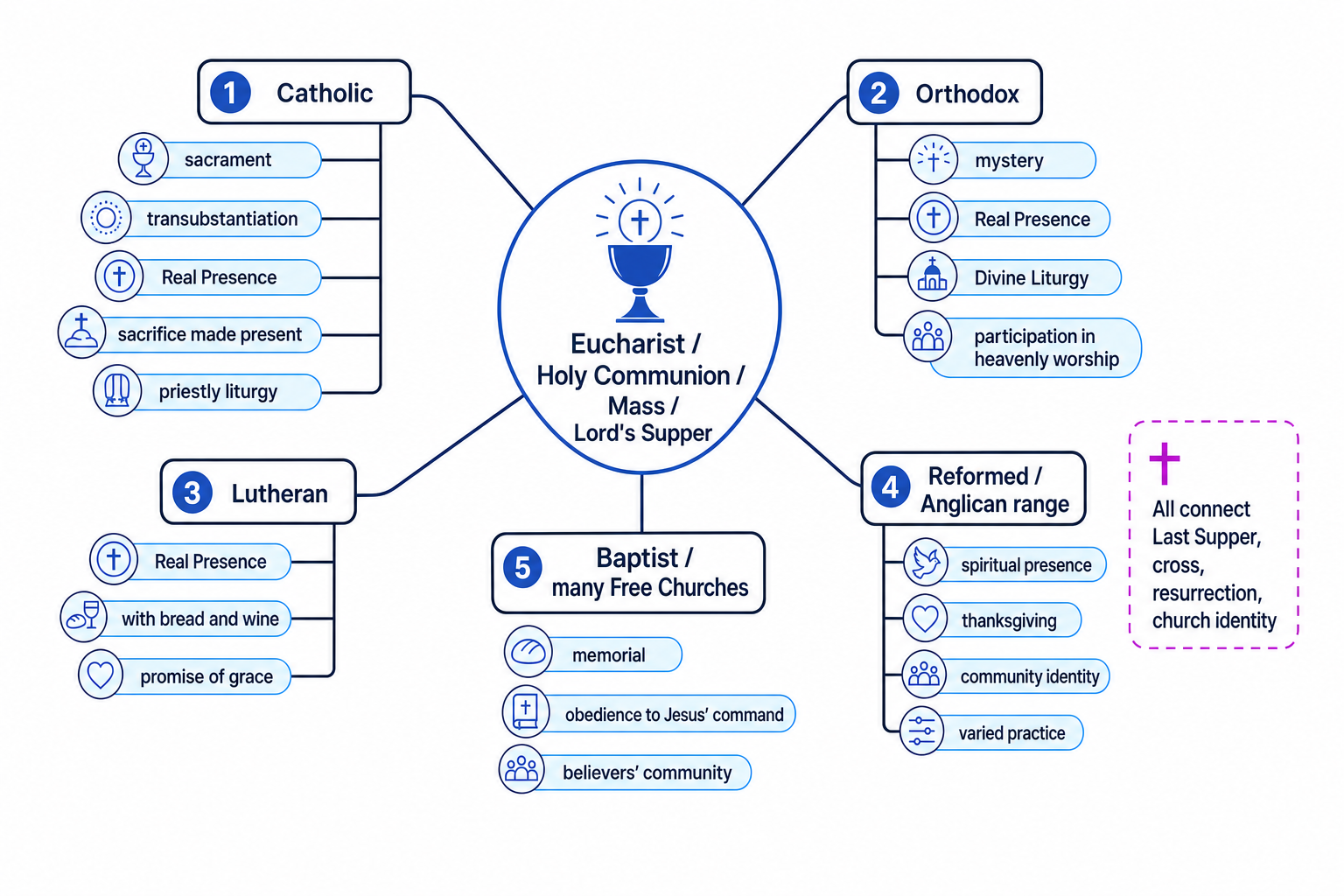
The Eucharist is the Christian ritual meal using bread and wine, rooted in Jesus’ Last Supper with his disciples. It is also called Holy Communion, the Mass, or the Lord’s Supper, depending on denomination.
The key biblical words are Jesus’ command: “Do this in remembrance of me” in Luke 22 and 1 Corinthians 11. Christians agree that the Eucharist connects them to Jesus’ death and resurrection, but they disagree sharply about how that connection works.
The map below gives you the main denominational range.
Sacraments and grace
In Catholic, Orthodox and many Anglican traditions, the Eucharist is a sacrament. Sacraments matter because they are understood as visible, physical actions through which God gives spiritual help.
Definition
Sacrament and grace
- A sacrament is an outward and visible sign of inward spiritual grace.
- Grace is God’s freely given love, forgiveness and transforming help.
- Catholic Christianity teaches seven sacraments; many Protestant churches recognise only Baptism and the Eucharist as sacraments instituted by Christ.
For Roman Catholics, the Eucharist is the “source and summit” of Christian life: it is central, not optional. Orthodox Christians similarly see the Eucharist as a holy mystery, meaning a sacred reality that cannot be fully explained in ordinary concepts.
By contrast, some Free Church traditions prefer the word ordinance, meaning a practice commanded by Jesus but not necessarily a channel of grace in the same sacramental sense. Quakers and the Salvation Army traditionally do not practise outward sacraments, emphasising inward spiritual reality instead.
What happens in the Eucharist?
The main disagreements concern the bread and wine. Are they changed? Is Christ really present? Is the action mainly symbolic? These questions became especially important during the Reformation.
Definition
Key Eucharistic ideas
- Real Presence means Christ is truly present in the Eucharist, not merely remembered.
- Transubstantiation is the Catholic teaching that the substance of bread and wine becomes Christ’s body and blood, while the accidents — their appearance, taste and texture — remain bread and wine.
- Transignification is the view that the meaning or significance of the bread and wine changes so that they become signs of Christ’s presence for the worshipping community.
- A memorial view sees the Eucharist primarily as an act of remembrance and obedience to Jesus’ command.
Catholic and Orthodox views
Roman Catholic theology, especially developed by Thomas Aquinas, uses Aristotelian language of substance and accidents to explain transubstantiation. The bread and wine still look the same, but their deepest reality is changed.
Orthodox Christianity also strongly affirms the Real Presence, but usually avoids defining the change through scholastic categories. The Eucharist is a divine mystery experienced in the liturgy.
Lutheran, Reformed and memorial views
Martin Luther affirmed the Real Presence: Christ is truly present “in, with and under” the bread and wine. However, Lutherans usually avoid the word consubstantiation, because it can misrepresent their view as a neat technical theory.
John Calvin rejected a local physical presence of Christ in the elements, but he did not reduce Communion to bare memory. He argued that believers truly feed on Christ spiritually through the Holy Spirit.
Huldrych Zwingli defended a more memorial interpretation. The bread and wine symbolise Christ’s body and blood and strengthen the community’s faith and obedience.
Common Mistake
Memorial does not mean meaningless
A memorial view is not “just a snack” or “not important”. For many Baptists and Free Churches, the Lord’s Supper is deeply serious because it publicly remembers Christ’s sacrifice and unites believers in obedience.
Example
Interpreting Eucharistic practice
A church has a priest, an altar, consecrated bread and wine, and teaches that only baptised members in good standing should receive Communion.
-
The language of priest, altar and consecration suggests a sacramental understanding, not a purely memorial meal.
-
Restricting who may receive Communion suggests the Eucharist is tied to visible Church unity, discipline and shared doctrine.
-
The best interpretation is therefore closer to Catholic, Orthodox or Anglo-Catholic practice than to a Baptist memorial service, where the emphasis is usually on obedient remembrance by the gathered believers.
The believer’s experience of the Eucharist
For believers, the Eucharist can create reflection and self-awareness. Paul tells Christians to “examine” themselves before eating the bread and drinking the cup in 1 Corinthians 11. This has encouraged practices of confession, repentance and preparation.
The Eucharist can also create a strong sense of belonging. Sharing one bread and one cup expresses the Church as the body of Christ. However, it can also reveal division: closed Communion may protect doctrine and reverence, but it can feel excluding to other Christians.
The practical implications are significant. A church that celebrates weekly Communion may place sacrament and liturgy at the centre of Christian life. A church that celebrates monthly or occasionally may place more emphasis on preaching, conversion or personal faith.
Creative expressions of Christian identity
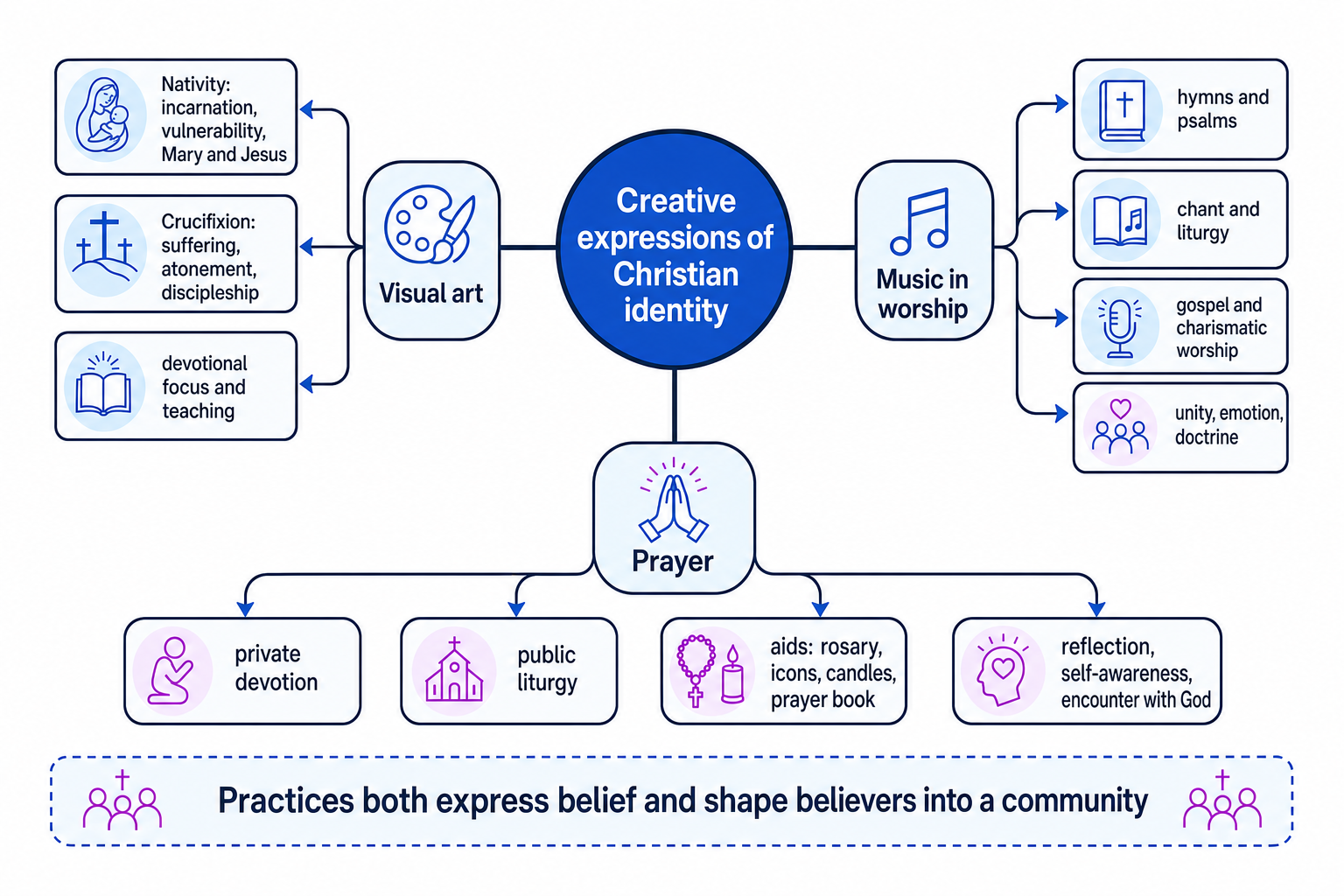
Christian identity is also expressed through art, music and prayer. These are not merely decorative. They can teach doctrine, shape emotion, support memory and become a vehicle for religious experience, meaning an encounter with, or awareness of, God or the sacred.
Christian art: Nativity and crucifixion
The Nativity is the depiction of Jesus’ birth. It expresses the doctrine of the Incarnation, the belief that God became human in Jesus Christ. A Nativity image may emphasise humility, poverty, Mary’s obedience, the vulnerability of the child Jesus, or the universal significance of Christ through the shepherds and Magi.
The crucifixion depicts Jesus’ death on the cross. It can express atonement, suffering, forgiveness, sacrifice and discipleship. Some crucifixion art stresses Jesus’ agony; other images stress victory over sin and death.
In Orthodox Christianity, icons are not treated as ordinary pictures. John of Damascus defended icons by arguing that because God became visible in Christ, sacred images can help believers honour the divine prototype. Some Protestant traditions have been more cautious, fearing that images can become idolatrous or distract from Scripture.
Music in worship
Music shapes Christian worship in very different ways. Catholic and Orthodox traditions often use chant to support reverence and continuity with ancient liturgy. Anglican worship may use choral music and hymns. Methodist and evangelical traditions often use congregational singing to teach doctrine and encourage personal faith. Pentecostal and charismatic churches may use contemporary worship, repetition, raised hands and improvisation to express openness to the Holy Spirit.
Music can create unity because many voices become one act of praise. It can also carry theology: a hymn about the cross teaches worshippers what salvation means. But music can be controversial when Christians disagree about emotional intensity, instruments, performance, or whether worship has become entertainment.
Tip
Link music to identity
When writing about music, go beyond “it makes people feel happy”. Explain how music forms memory, teaches doctrine, unites the congregation and can create an experience of God’s presence.
Prayer: private, public and aided
Prayer is communication with God. It may include praise, confession, thanksgiving, intercession, silence, contemplation or petition.
Private prayer can be spontaneous and personal, such as praying alone at home. Public prayer can be liturgical, using set words from a prayer book, or informal, such as extempore prayer in evangelical worship.
Many Christians use aids to prayer: rosary beads, icons, candles, prayer books, the Bible, kneelers, music, or the Stations of the Cross. These aids can focus attention and involve the body as well as the mind. However, some Christians worry that aids may become mechanical or distract from a direct relationship with God.
Example
Evaluating a creative practice
A student argues that crucifixion art is valuable because it helps Christians understand suffering.
-
A strong AO1 point is that crucifixion art expresses central Christian beliefs: Jesus’ sacrifice, forgiveness, atonement and solidarity with human pain.
-
A strong AO2 development is that the value depends on interpretation. For some believers, the image deepens devotion; for others, especially iconoclastic Protestants, visual images may risk idolatry or emotional manipulation.
-
A justified judgement could be that crucifixion art is powerful when it directs devotion towards Christ, but problematic if the image itself becomes the object of devotion.
Overall significance
These practices shape Christianity because they connect belief to lived experience. The Eucharist forms a sacramental or memorial identity. Art teaches Christians how to see Jesus. Music trains the emotions and memory. Prayer forms habits of dependence on God.
A balanced essay should recognise both sides. For believers, these practices may genuinely mediate grace or religious experience. From a more sociological or non-religious perspective, they may be explained as community-forming rituals that create shared emotion and belonging. A good answer does not dismiss either view too quickly.
Exam technique
In the exam
-
Use precise denominational language: say Catholic, Orthodox, Lutheran, Reformed, Baptist or Free Church, rather than vague phrases like “some Christians”.
-
For Eucharist essays, compare at least two interpretations, such as Aquinas on transubstantiation, Luther on Real Presence, Calvin on spiritual presence, or Zwingli on memorial.
-
For creative expression essays, evaluate impact: explain how art, music or prayer expresses belief, shapes identity, and may act as a vehicle for religious experience.
Self review
Check yourself
- What is the difference between transubstantiation, transignification and memorial?
- How might the Eucharist create both unity and division within Christianity?
- In what ways can art, music or prayer shape Christian identity rather than simply express it?