Revision notes for Edexcel AS Level Religious Studies Religion and society. Open the guide for explanations and worked examples. Written against the Edexcel AS Level Religious Studies specification, so the content matches what's examinable rather than general Religious Studies background.
Religion and society
What you'll learn
- How ahimsa shapes Buddhist choices about food, work and violence.
- Why different Buddhist traditions apply the First Precept differently in modern society.
- How Buddhists may respond to pluralism, interfaith dialogue, liberationist movements and science.
- How to use the named scholars: the 14th Dalai Lama, Tessa Bartholomeusz and K. Sri Dhammananda.
This topic is really about one big question: how should Buddhist beliefs be lived in a complicated modern world? Keep this map in mind as the “shape” of the topic.
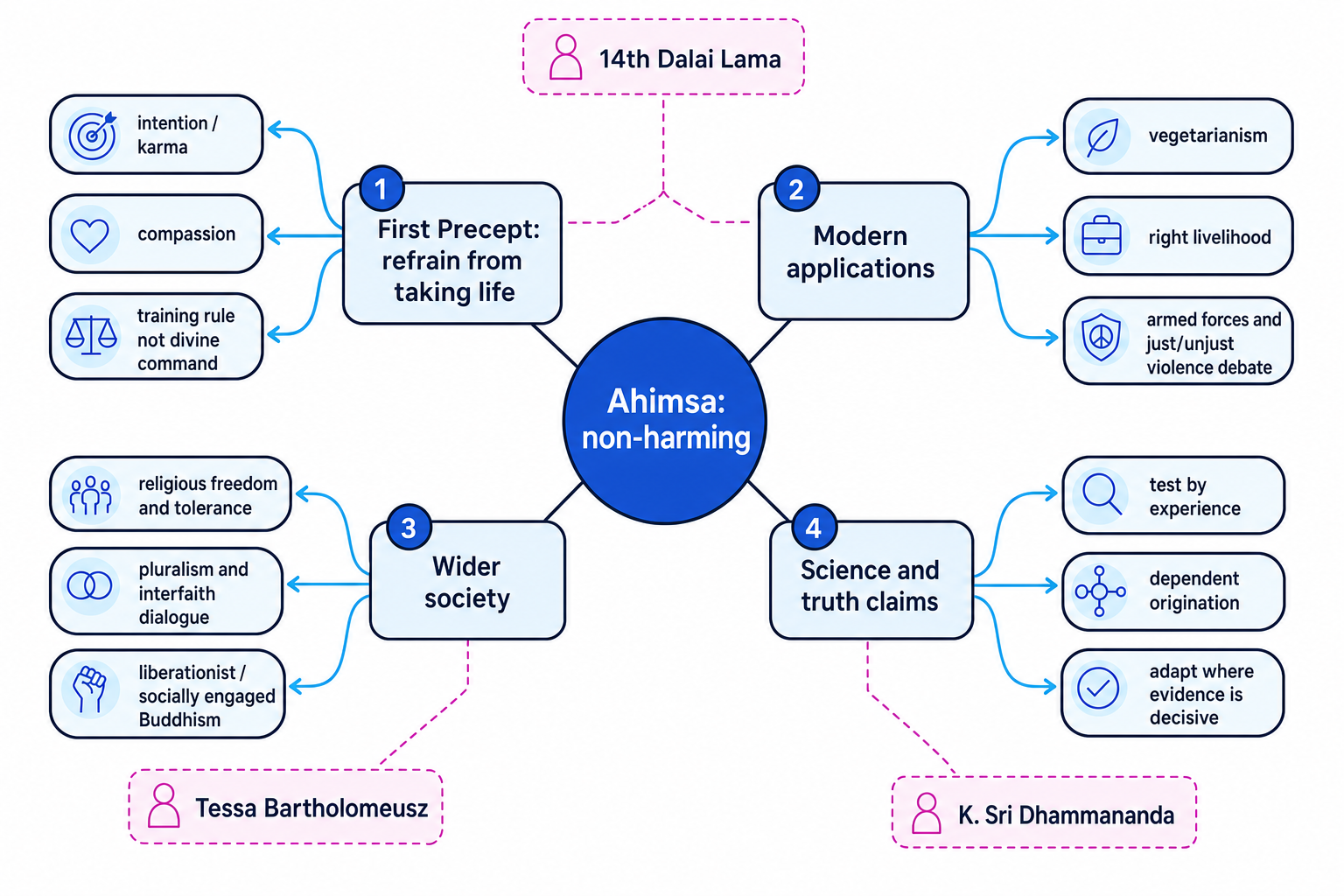
1. Ahimsa and the First Precept
Definition
Ahimsa
Ahimsa means non-harming or non-violence towards living beings. In Buddhism, it is closely linked to compassion, karma and the First Precept.
The First Precept is usually expressed as: “I undertake the training rule to refrain from taking life.” In Pali, this is panatipata veramani sikkhapadam samadiyami. A precept is a training commitment, not a command from God. Buddhists follow precepts to reduce craving, hatred and delusion.
The First Precept is not only about murder. It encourages Buddhists to avoid attitudes and systems that harm sentient beings — beings capable of experience, especially suffering.
Key Idea
Precepts are training rules
For Buddhists, morality is about training the mind. The key question is not just “What rule was broken?” but “What intention, attachment or hatred produced this action?”
Pali Canon foundations
Definition
Pali Canon
The Pali Canon is the early Buddhist scripture collection preserved in Pali, especially important in Theravada Buddhism. It includes teachings, monastic rules and philosophical analysis.
The Pali Canon strongly supports non-harming. The Dhammapada says that all beings tremble before violence and fear death; therefore, comparing oneself with others, one should not kill or cause killing. The Karaniya Metta Sutta encourages loving-kindness to all beings.
However, the Pali Canon also shows complexity. Monks were allowed to receive meat in alms if they had not seen, heard or suspected that the animal was killed specifically for them. This is sometimes called the “threefold purity” rule.
Lotus Sutra foundations
Definition
Lotus Sutra
The Lotus Sutra is a major Mahayana Buddhist scripture which teaches the universal possibility of Buddhahood and the importance of skilful means.
Skilful means means adapting teaching and action compassionately to the needs of particular people. In the Lotus Sutra, the Bodhisattva Never Disparaging refuses to despise anyone because all can become Buddhas. This supports respect, tolerance and non-harming.
For many Mahayana Buddhists, the bodhisattva ideal deepens ahimsa: a bodhisattva seeks enlightenment for the benefit of all beings, not just for personal liberation.
2. Living ahimsa today
Vegetarianism
Vegetarianism is one clear way some Buddhists practise ahimsa. If eating meat supports killing animals, then avoiding meat can express compassion.
But practice differs. Many Mahayana Buddhists, especially in East Asian traditions, strongly favour vegetarianism. Some Theravada Buddhists are not vegetarian because monks traditionally rely on whatever food is offered. Tibetan Buddhists have also often eaten meat due to geography and climate, though many modern Tibetan teachers encourage reducing harm where possible.
Common Mistake
Assuming all Buddhists must be vegetarian
Ahimsa gives a strong reason for vegetarianism, but Buddhist traditions apply this differently. In essays, say “many Buddhists” or “some Mahayana Buddhists”, not “all Buddhists”.
Right livelihood
Definition
Right livelihood
Right livelihood is the part of the Noble Eightfold Path concerned with earning a living in a way that does not cause harm.
The Pali Canon warns against trades in weapons, human beings, meat, intoxicants and poisons. Modern applications might include avoiding jobs in arms manufacturing, exploitative industries, animal slaughter, trafficking, or businesses that deliberately fuel addiction.
This links ahimsa to society: harm is not only personal violence, but also economic and institutional harm.
Armed forces
Military service is especially difficult. A combat role may involve the intention to kill, which conflicts with the First Precept and creates negative karma. Yet some Buddhists argue that force may be used to protect innocent people, defend a community, or prevent greater suffering.
The 14th Dalai Lama strongly favours non-violence and has promoted peaceful resistance in Tibet. However, he is not always presented as an absolute pacifist: he recognises that difficult situations may involve self-defence or protecting others, though violence remains morally dangerous.
Tessa Bartholomeusz, in In Defense of Dharma, argues that Buddhist societies have sometimes developed justifications for war, especially in Sri Lankan contexts where violence was framed as defending Buddhism or the nation. Her work is important because it challenges the simplistic claim that Buddhism is always purely pacifist in practice.
Example
Applying ahimsa to armed service
- Identify the moral tension: a combat role involves likely intentional harm, so it directly conflicts with the First Precept and right livelihood.
- Weigh intention and consequence: protecting civilians may be compassionate, but Buddhist karma still treats the intention to kill as morally serious.
- Compare scholarship: the Dalai Lama supports non-violent solutions as the ideal, while Bartholomeusz shows that some Buddhist cultures have justified defensive or religiously framed war.
- Reach a balanced judgement: a Buddhist might prefer medical, peacekeeping or humanitarian service; combat could be seen as a tragic exception rather than a positive ideal.
3. Other beliefs that shape ahimsa
Ahimsa does not stand alone. It is shaped by several other Buddhist beliefs:
- Karma: intentional actions have moral consequences.
- Compassion (karuna): Buddhists should respond to suffering with care.
- Loving-kindness (metta): goodwill should extend to all beings.
- Wisdom (panna/prajna): ethical action requires understanding causes and consequences.
- Dependent origination: things arise through conditions, so harm spreads through networks of relationship.
The Buddha’s own example is generally non-violent. He teaches restraint, compassion and inner transformation. Yet he also lived in societies with rulers, armies and social conflict, so Buddhist ethics often works through persuasion and training rather than political control.
Tip
Evaluation shortcut
A strong essay can argue that Buddhist ahimsa is a clear ideal but not a single fixed rulebook. Application depends on intention, context, tradition and consequences.
4. Buddhism in a multicultural society
Definition
Pluralism
Pluralism is the view that different religions or worldviews may coexist respectfully, and may contain genuine insight or value.
Buddhists in multicultural societies often support religious freedom, tolerance, pluralism and interfaith dialogue. These fit well with non-harming because coercion, hatred and religious arrogance are forms of mental and social harm.
A liberationist approach uses religion to challenge oppression and social suffering. In Buddhism this appears in Socially Engaged Buddhism, which applies the Dharma to poverty, racism, war, environmental destruction and caste oppression. The Buddhist aim is not only private calm but the reduction of suffering in the world.
The Dalai Lama teaches universal responsibility: because human beings are interdependent, compassion should shape politics, education and global ethics. He often argues that different religions can serve different human needs, like different medicines for different illnesses.
K. Sri Dhammananda, a Theravada teacher in Malaysia, also strongly emphasised tolerance and rational faith. He presented Buddhism as a religion that does not require coercion or blind belief, and he encouraged peaceful coexistence in multi-religious societies.
5. Diversity within Buddhism and truth claims
Buddhism is not one single culture. Theravada, Mahayana and Vajrayana traditions can respond differently to other religions and non-religious worldviews.
Theravada Buddhism may emphasise the historical Buddha, the Pali Canon and the path to nibbana. It may view other paths as ethically valuable but incomplete if they lack insight into impermanence, non-self and craving.
Mahayana Buddhism often has more obviously pluralist resources, especially through skilful means and the bodhisattva ideal. The Lotus Sutra’s “one vehicle” can be read inclusively: different teachings may guide beings according to their needs.
Vajrayana Buddhism, especially Tibetan Buddhism, preserves distinctive tantric practices, but the Dalai Lama has repeatedly encouraged respect for other religions and has sometimes advised people not to convert unless there is a serious reason.
Non-religious worldviews also matter. Buddhists may agree with humanists about compassion and reducing suffering, while disagreeing if materialism denies karma, rebirth or liberation.
Common Mistake
Pluralism does not mean all beliefs are identical
Buddhist tolerance does not require saying every religion teaches the same thing. It means disagreement should be handled with compassion, humility and non-coercion.
6. Interfaith dialogue: benefits and barriers
Interfaith dialogue can reduce prejudice, build peace, protect minority communities and allow shared action on poverty, climate change and violence. It is especially important where Buddhists live as minorities, for example in many Western countries, or where Buddhist-majority societies contain Muslim, Christian, Hindu or secular minorities.
But there are barriers. Some communities fear losing identity. Historical conflict can make trust difficult. Language, caste, ethnicity, nationalism and politics may distort religious teaching. In some countries, Buddhist institutions have been linked to nationalism, making dialogue harder.
The extent of involvement varies. Western Buddhist groups may be highly active in interfaith and social justice work. Some traditional monastic communities may prioritise meditation, ritual and education. In countries where Buddhism is culturally dominant, interfaith dialogue may be less urgent — or more politically sensitive.
7. Buddhism and science
Buddhism has often been presented as unusually open to science because it values experience, causation and testing teachings in practice. The Kalama Sutta is often used here: the Buddha advises people not to accept claims merely because of tradition, scripture or authority, but to examine whether they lead to welfare or harm.
The Dalai Lama has made science dialogue central to modern Tibetan Buddhism, especially through discussions of neuroscience, meditation and consciousness. He famously argues that if strong scientific evidence disproved a Buddhist claim, Buddhism should revise that claim. However, he also argues that science alone cannot provide ethics or the full meaning of human experience.
K. Sri Dhammananda similarly presents Buddhism as rational and compatible with scientific inquiry. He stresses that Buddhism does not depend on blind faith. Yet he also sees science as limited: it can explain physical processes, but it cannot by itself solve suffering, greed or moral confusion.
Example
Evaluating a Buddhist response to science and rebirth
- Separate the issue: ancient Buddhist cosmology may be easier to reinterpret than core teachings such as karma, rebirth and liberation.
- Apply the Dalai Lama: if evidence clearly disproves a traditional cosmological claim, Buddhism should adapt; but questions of consciousness and ethics may not be reducible to laboratory measurement.
- Apply Dhammananda: Buddhism can welcome scientific inquiry while arguing that science needs moral guidance to help human beings live wisely.
- Make a judgement: Buddhism can be science-friendly, but it is not simply “science”; it remains a religious path concerned with liberation from suffering.
Common Mistake
Do not overstate the science link
Avoid saying “Buddhism predicted modern science” or “Buddhism is not a religion.” Better: Buddhism has resources that make dialogue with science easier than in some traditions, but tensions remain over rebirth, karma, miracles and cosmology.
8. Scholar comparison for essays
| Issue | 14th Dalai Lama | Tessa Bartholomeusz | K. Sri Dhammananda |
|---|---|---|---|
| Ahimsa and violence | Non-violence is the ideal; compassion and universal responsibility should shape politics. | Buddhist societies have sometimes justified war, especially to defend Dharma or nation. | Emphasises tolerance, non-coercion and rational moral living. |
| Society | Supports interfaith harmony and secular ethics based on compassion. | Shows real Buddhist history can include nationalism and militarism. | Presents Buddhism as peaceful, reasonable and suited to multicultural life. |
| Science | Buddhism should adapt where evidence is decisive, while ethics goes beyond science. | Less central for science; useful for challenging idealised views of Buddhism. | Buddhism is compatible with inquiry, but science cannot replace moral and spiritual wisdom. |
Exam technique
In the exam
- Start with the Buddhist principle, then show variation: “Ahimsa is central, but Theravada, Mahayana and Vajrayana Buddhists may apply it differently.”
- Use named scholars to create debate: the Dalai Lama gives a strong non-violent ideal; Bartholomeusz complicates this with real examples of Buddhist justifications of war; Dhammananda supports tolerance and rational engagement with science.
- Evaluate with judgement, not description: decide whether Buddhist teaching gives clear guidance for modern society, or whether context makes application genuinely contested.
Self review
Check yourself
- How might a Buddhist use the First Precept to argue both for and against vegetarianism?
- Why does Bartholomeusz challenge an overly simple view of Buddhist pacifism?
- What are the strengths and limits of saying Buddhism is compatible with science?