Revision notes for Edexcel AS Level Religious Studies Works of scholars. Open the guide for explanations and worked examples. Written against the Edexcel AS Level Religious Studies specification, so the content matches what's examinable rather than general Religious Studies background.
Works of scholars
What you'll learn
- What the bodhisattva ideal means and why it matters in Buddhism.
- How Arthur Basham and Walpola Rahula compare on the bodhisattva doctrine.
- How the Lotus Sutra presents wisdom, liberation, loving-kindness and skilful means.
- How to evaluate debates about Theravada, the bodhisattva path, and transfer of karmic merit.
Why this topic matters
This is the “works of scholars” section for Edexcel Buddhism, so you are not just learning Buddhist teaching in general. You need to compare two named scholars — Arthur Basham and Walpola Rahula — and use their ideas to build an essay with accurate knowledge and clear evaluation.
The key debate is: is the bodhisattva ideal mainly a Mahayana development, or is it already present in Theravada Buddhism too?
The basic Buddhist background
Buddhism teaches that beings are trapped in samsara, the cycle of birth, death and rebirth, shaped by karma, intentional action with moral consequences. The goal is nirvana, liberation from greed, hatred and delusion.
Different Buddhist traditions describe the ideal liberated person in different ways.
Definition
Bodhisattva / bodhisatta
A bodhisattva is an “awakening-being”: someone committed to attaining Buddhahood for the welfare of all beings. Bodhisattva is the Sanskrit form, used especially in Mahayana Buddhism; bodhisatta is the Pali form, used in Theravada sources.
An arhat or arahant is one who has attained nirvana by following the Buddha’s teaching. In Theravada Buddhism, the arahant is a central ideal. In Mahayana Buddhism, the bodhisattva is often presented as the higher ideal because of the explicit commitment to universal compassion.
Common Mistake
Theravada is not ‘selfish’
Do not write that Theravada Buddhists only care about themselves. That is a Mahayana polemical contrast, not a fair description. Rahula especially argues that Theravada contains compassion, loving-kindness and bodhisattva elements.
Key Idea
The question behind the topic
The issue is not simply “what is a bodhisattva?” but whether the bodhisattva ideal is best understood as a distinctive Mahayana doctrine or as a wider Buddhist ideal also present in Theravada.
Arthur Basham on the bodhisattva ideal
Arthur Basham was a historian of Indian religion and culture. His approach is mainly historical: he explains how Buddhist ideas developed over time, especially with the rise of Mahayana Buddhism.
For Basham, the bodhisattva doctrine is strongly connected with Mahayana’s growth. Earlier Buddhism focused more on the arahant ideal, while Mahayana presented the bodhisattva as a more universal and compassionate model. The bodhisattva does not seek liberation only for themselves, but works for the liberation of all beings.
Basham also draws attention to celestial bodhisattvas, such as Avalokiteshvara, who became objects of devotion. This shows Mahayana becoming more devotional and accessible to ordinary Buddhists, not just monastic specialists.
Strengths and limits of Basham
Basham is useful because he shows how Mahayana Buddhism developed a rich doctrine of compassion, worship, vows and cosmic bodhisattvas. However, his approach can make the difference between Theravada and Mahayana sound too sharp, as if the bodhisattva ideal suddenly appeared in Mahayana with no earlier roots.
Walpola Rahula on the bodhisattva ideal
Walpola Rahula was a Sri Lankan Buddhist monk and scholar. His approach is more internal to Buddhism: he is concerned to correct misunderstandings about Theravada and Mahayana.
Rahula argues that the bodhisattva ideal is not absent from Theravada. In Pali texts, the Buddha before his enlightenment is called the bodhisatta. The Jataka stories, which tell of the Buddha’s previous lives, show him developing virtues such as generosity, patience and compassion over many lifetimes. Theravada also recognises the future Buddha Metteyya.
Rahula therefore challenges the idea that Theravada is merely individualistic while Mahayana alone is compassionate. He accepts that Mahayana develops the bodhisattva ideal more fully, but he denies that Mahayana owns compassion exclusively.
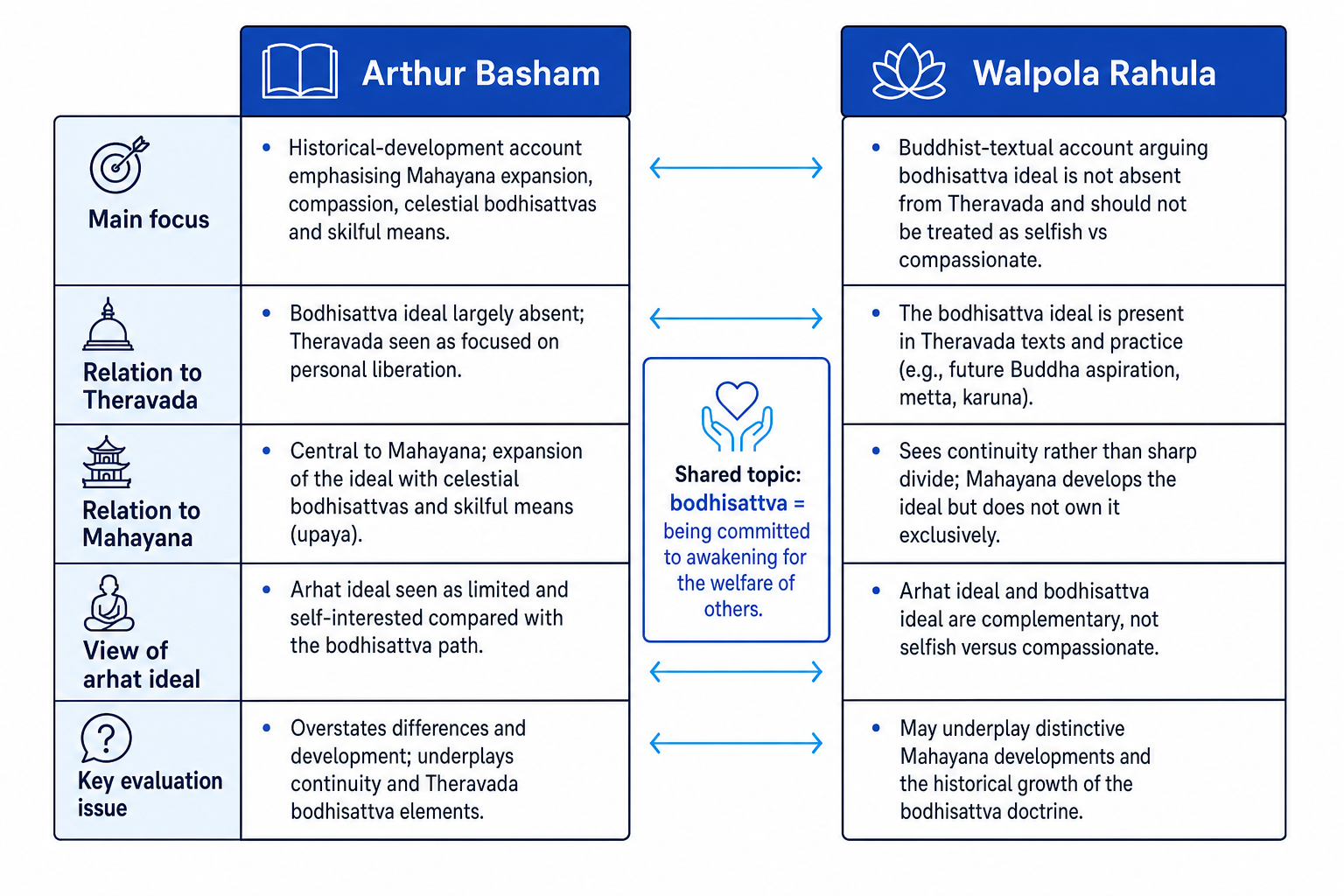
Here is the comparison you need to master:
Example
Comparing Basham and Rahula
-
Start with the shared ground: both scholars recognise the bodhisattva as an ideal connected with awakening, compassion and the welfare of others.
-
Identify the main difference: Basham emphasises Mahayana development and the rise of celestial bodhisattvas, while Rahula stresses continuity with Theravada sources such as the Jataka stories and the bodhisatta career of Gotama Buddha.
-
Apply textual evidence: the Lotus Sutra supports Basham’s focus on Mahayana universal Buddhahood and skilful means, while Theravada ideas about the Buddha’s previous lives and Metteyya support Rahula’s claim that the ideal has earlier roots.
-
Reach a balanced judgement: Basham is strong on historical development, but Rahula is strong on correcting the oversimplified contrast between “selfish Theravada” and “compassionate Mahayana”.
The Lotus Sutra and Mahayana Buddhism
The Lotus Sutra is one of the most important Mahayana scriptures. It presents the Buddha’s teaching as universal and compassionate, and it strongly supports the bodhisattva ideal.
A central teaching is the One Vehicle: although Buddhism may seem to contain different paths, all are ultimately directed towards Buddhahood. Even those who thought they had reached final liberation as arhats are shown to have the potential to become Buddhas.
Definition
Skilful means
Skilful means, or upāya, means the Buddha’s compassionate use of different teachings and methods according to the needs and capacities of different beings.
Wisdom
In the Lotus Sutra, wisdom means recognising that the Buddha’s teachings may be adapted for different audiences. Some teachings are provisional, not false, because they guide beings step by step towards liberation.
Liberation
Liberation is not presented as a private escape from suffering. The highest goal is Buddhahood, which includes the liberation of others. This fits the bodhisattva ideal: awakening is inseparable from compassion.
Loving-kindness and compassion
The Lotus Sutra presents bodhisattvas as motivated by universal care. The figure of Never Disparaging Bodhisattva, who honours others because they will become Buddhas, expresses the idea that every being has spiritual potential.
Skilful means in the burning house parable
In the parable of the burning house, a father persuades his children to leave a dangerous burning house by promising them different carts. Once they are safe, he gives them something even greater. The father represents the Buddha, the burning house represents samsara, and the carts represent different teachings or vehicles.
Example
Using the burning house parable
-
Interpret the symbols: the burning house represents samsara, the children represent deluded beings, and the father represents the Buddha acting compassionately.
-
Explain the doctrine: the different promised carts represent different paths, but the father’s final gift points to the One Vehicle leading to Buddhahood.
-
Link it to bodhisattva teaching: the parable shows that wisdom and compassion work together, because the Buddha adapts the teaching skilfully to save beings.
Key Idea
Lotus Sutra
The Lotus Sutra supports a strongly Mahayana view of the bodhisattva path: all beings can attain Buddhahood, and compassionate skilful means are central to liberation.
Stages and perfections of the bodhisattva path
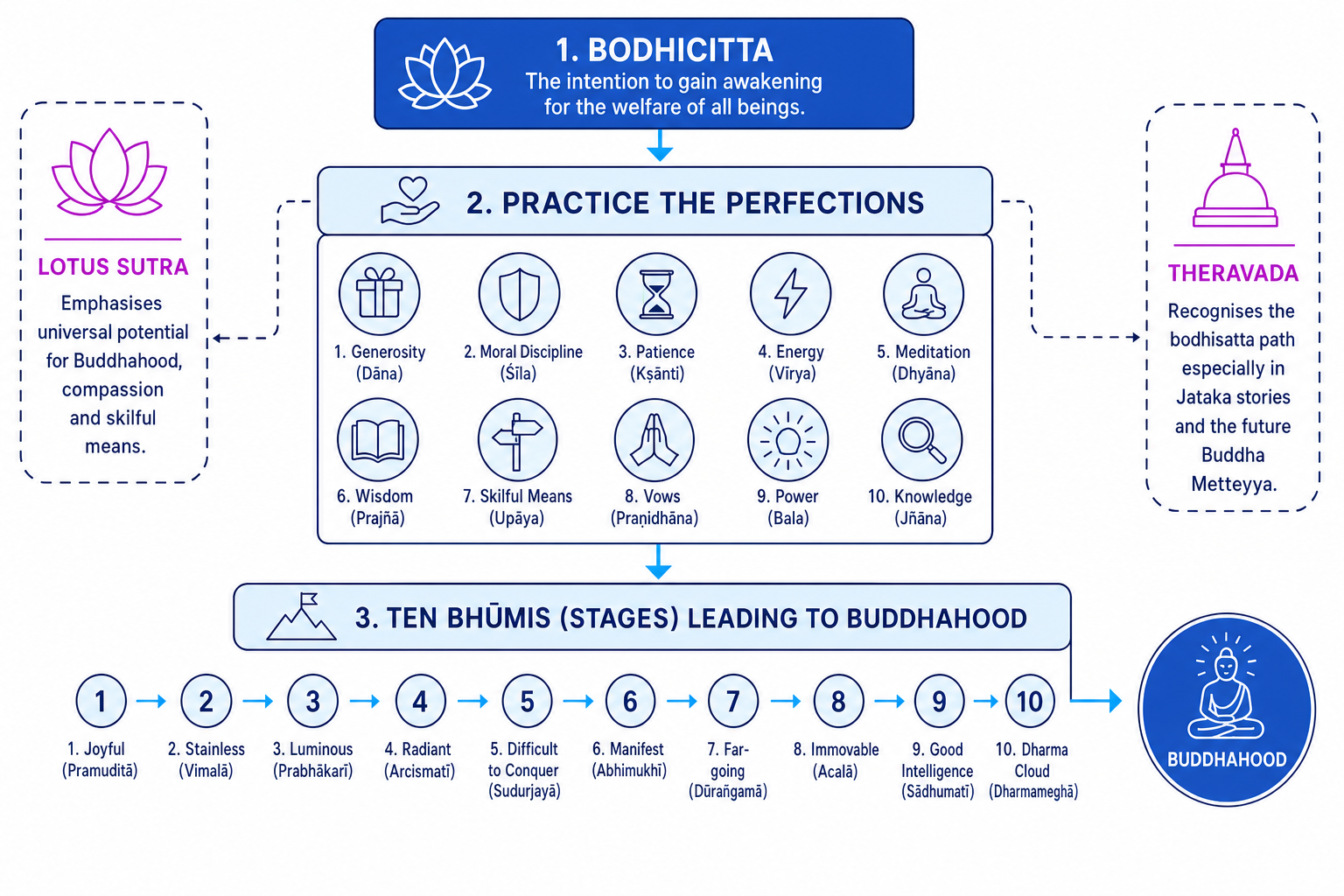
The bodhisattva path begins with bodhicitta, the awakened intention to attain Buddhahood for the benefit of all beings.
The path is then developed through the perfections, known as pāramitās. In many Mahayana traditions, the six key perfections are:
- Generosity: giving without attachment.
- Moral discipline: ethical conduct.
- Patience: endurance and forgiveness.
- Energy: determined effort.
- Meditation: mental cultivation.
- Wisdom: insight into reality.
Some Mahayana lists expand these to ten, adding skilful means, vows, power and knowledge. The bodhisattva may also be described as progressing through ten bhūmis, or stages, leading towards Buddhahood.
The following map shows how the path fits together:
Tip
Perfections lists
Do not assume every Buddhist tradition uses the same list. Theravada also has ten pāramīs, including renunciation, truthfulness, determination, loving-kindness and equanimity. Mahayana lists often begin with the six pāramitās and then expand them.
Their place in particular traditions
In Mahayana Buddhism, the bodhisattva path is central. Traditions such as Tibetan Buddhism place great importance on bodhisattva vows, compassion practices and the aspiration to work for all beings. Devotion to bodhisattvas such as Avalokiteshvara also becomes important.
In Theravada Buddhism, the bodhisatta path is respected but usually seen as the exceptional career of a future Buddha, not the required path for every Buddhist. The arahant ideal remains central, but the bodhisatta ideal is still present in stories of the Buddha’s past lives and in the expectation of Metteyya.
Debate: is the bodhisattva ideal really Mahayana?
This is where Basham and Rahula are most useful.
Basham helps you explain why the bodhisattva doctrine feels distinctively Mahayana: it becomes a universal ideal, linked with cosmic bodhisattvas, devotional practice, skilful means and the salvation of all beings.
Rahula helps you avoid exaggeration. He argues that Theravada has always known the bodhisatta path through the Buddha’s previous lives, the perfections and the ideal of future Buddhahood. The difference is therefore one of emphasis and development, not total opposition.
Common Mistake
The ‘postponed nirvana’ shortcut
It is common to say that a bodhisattva “postpones nirvana”. This can be useful, but it is too simple. In Mahayana thought, the bodhisattva’s wisdom sees liberation and compassionate activity together, rather than treating nirvana as a private prize put off until later.
Debate: transfer of karmic merit
Another key issue is whether a bodhisattva can help others by transferring or dedicating merit.
Definition
Transfer or dedication of merit
Merit is positive karmic benefit created by wholesome action. Transfer of merit usually means dedicating the benefit of good actions to others, especially for their welfare or better rebirth.
The difficulty is that karma is usually understood as linked to one’s own intentional actions. If karma is morally personal, can merit really be transferred to someone else?
In Theravada practice, merit may be shared or dedicated, but this is often explained carefully: another being benefits by rejoicing in the good deed, which becomes a wholesome mental act for them. So merit is not simply moved like money from one account to another.
In Mahayana Buddhism, bodhisattvas dedicate their merit to all beings. This supports the compassionate ideal, but it raises philosophical questions about whether another person’s liberation can be assisted by someone else’s merit. Defenders argue that Buddhism already teaches interdependence, so spiritual progress is not isolated.
Example
Evaluating transfer of merit
-
Start from the problem: karma depends on intentional action, so a simple “transfer” of moral results from one person to another seems to weaken personal responsibility.
-
Apply the Theravada solution: merit-sharing can be understood as creating an opportunity for the recipient to rejoice, generating their own wholesome karma.
-
Apply the Mahayana solution: bodhisattvas dedicate merit compassionately, not to remove the need for practice, but to create favourable conditions for others’ liberation.
-
Form a judgement: transfer of merit is strongest when understood as dedication and interdependence, but weaker if described as a mechanical cancellation of another person’s karma.
Pulling it together
A strong essay should not simply choose Basham or Rahula. The best judgement is likely to be balanced: Basham explains the distinctive Mahayana development of the bodhisattva ideal, while Rahula shows that this development has roots in earlier Buddhist tradition and should not be used to caricature Theravada.
So your overall line could be: the bodhisattva doctrine is both continuous and transformed. It is continuous because Theravada contains the bodhisatta ideal, the Jataka stories and the perfections. It is transformed because Mahayana texts such as the Lotus Sutra make the bodhisattva path central, universal and cosmic.
Exam technique
In the exam
-
Compare Basham and Rahula directly rather than writing two separate mini-essays.
-
Use the Lotus Sutra to support Mahayana ideas such as the One Vehicle, universal Buddhahood and skilful means.
-
Avoid unfair contrasts: do not present Theravada as selfish or Mahayana as simply “better”.
-
Finish with a justified judgement, such as “Basham explains development, but Rahula gives a necessary correction about continuity.”
Self review
Check yourself
-
Why does Rahula reject the idea that the bodhisattva ideal is absent from Theravada?
-
How does the burning house parable illustrate skilful means?
-
Why is transfer of merit philosophically difficult in a religion that teaches karma?