Revision notes for Edexcel AS Level Religious Studies Social and historical developments. Open the guide for explanations and worked examples. Written against the Edexcel AS Level Religious Studies specification, so the content matches what's examinable rather than general Religious Studies background.
Social and historical developments
What you'll learn
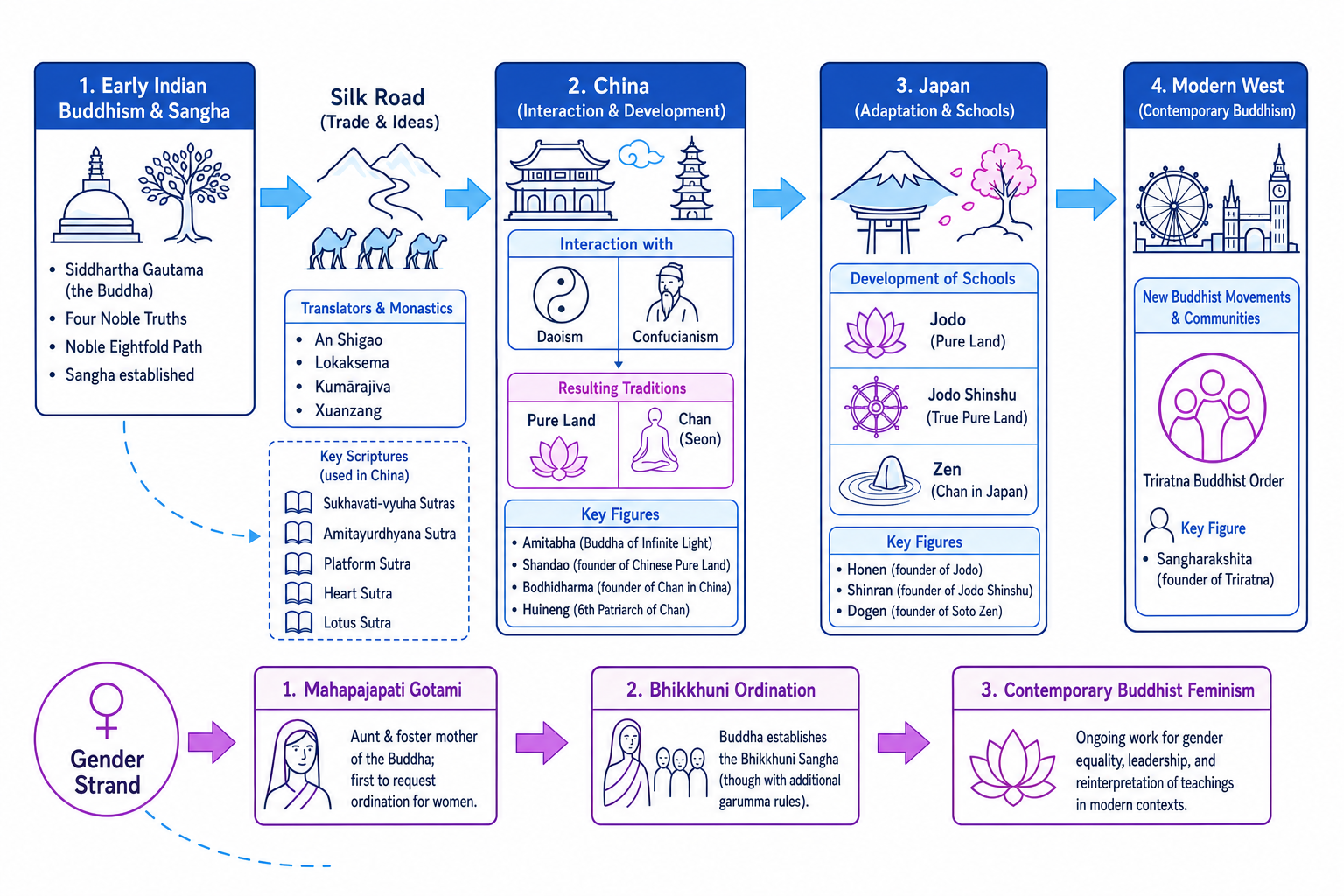
- How Buddhism spread into China and Japan, especially through Pure Land and Zen.
- How Triratna Buddhism developed as a modern Western Buddhist movement.
- How women’s and men’s roles in Buddhist history have changed and been debated.
- How to use Mochizuki, de Bary, Vajragupta, Coleman, Salgado and Bartholomeusz in evaluation.
1. The big idea: Buddhism develops by adapting
Buddhism did not spread as a fixed package. As it moved across Asia and into the modern West, it met new languages, customs, political systems and expectations. This produced both continuity and change.
Definition
Social and historical developments
A social and historical development is a change in Buddhist belief, practice or organisation caused by real historical circumstances: migration, translation, politics, local culture, gender roles, modernity or secularisation.
Definition
Key background terms
- Sangha means the Buddhist community. In early usage it often meant the ordained community of monks and nuns, but it can also mean the wider Buddhist community.
- Dhamma or Dharma means the Buddha’s teaching, the truth it reveals, and the path of practice.
- Migration means the movement of people and ideas across regions.
- Modernity refers to features of the modern world such as science, individualism, nationalism, democracy, secular education and globalisation.
- Secularisation means the declining public authority of religion in society.
A helpful way to revise this topic is to ask: what stayed Buddhist, and what changed because Buddhism entered a new setting?
Key Idea
Continuity and change
For Edexcel, the strongest essays do not simply say “Buddhism changed”. They explain how much it changed, why it changed, and whether the change still fits core Buddhist aims such as liberation, compassion, wisdom and refuge in the Three Jewels.
2. Buddhism in China and Japan: Pure Land and Zen
Buddhism’s movement into China
Buddhism entered China mainly through trade routes such as the Silk Road, carried by monks, merchants and translators. This mattered because Buddhism had to be expressed in Chinese language and concepts.
China already had powerful indigenous traditions:
- Confucianism, which emphasised family, hierarchy, social duty and filial piety.
- Daoism, which emphasised naturalness, non-attachment, spontaneity and harmony with the Dao.
This created tension. Buddhist monasticism could look unfilial because monks and nuns left family life. Buddhist ideas such as emptiness and meditation, however, could also be interpreted through Daoist vocabulary.
Buddhism’s movement into Japan
Buddhism came to Japan largely through Korea and China. In Japan it encountered:
- Kami worship, later associated with Shinto.
- Court politics and temple institutions.
- Later, samurai culture and medieval social instability.
Japanese Buddhism developed distinctive schools, including Jōdo and Jōdo Shinshū forms of Pure Land, and Rinzai and Sōtō forms of Zen.
3. Pure Land Buddhism
Definition
Pure Land Buddhism
Pure Land Buddhism is a Mahāyāna Buddhist tradition focused on devotion to Amitābha or Amida Buddha and aspiration for rebirth in his Pure Land, Sukhāvatī, where enlightenment is easier to attain.
The key scriptures are the Larger Sukhāvatīvyūha Sūtra, the Smaller Sukhāvatīvyūha Sūtra and the Amitāyurdhyāna Sūtra. These describe Amitābha’s vows, especially the promise to help beings who sincerely call upon him.
Its central practice is nianfo in Chinese or nembutsu in Japanese: reciting the name of Amitābha, for example “Namo Amituofo” or “Namu Amida Butsu”.
Key people and emphases
| Figure | Importance |
|---|---|
| Huiyuan | Associated with early Chinese devotion to Amitābha and Pure Land practice. |
| Tanluan | Emphasised reliance on Amitābha’s compassionate power. |
| Daochuo | Connected Pure Land practice with the difficult age of decline. |
| Shandao | Systematised Chinese Pure Land practice and stressed sincere recitation. |
| Hōnen | Founded Japanese Jōdo-shū and taught exclusive nembutsu. |
| Shinran | Founded Jōdo Shinshū and emphasised Other Power and true entrusting. |
Definition
Other Power
Other Power, or tariki, means relying on the compassionate power of Amitābha rather than depending mainly on one’s own spiritual achievement.
Pure Land was especially important because it made Buddhist hope accessible to laypeople, the poor, the uneducated and those who felt unable to complete demanding monastic practices.
Common Mistake
Calling Pure Land 'not really Buddhist'
Pure Land is devotional, but it is still Buddhist. It keeps Mahāyāna concerns with compassion, liberation and Buddhahood. The debate is not whether it is Buddhist, but how far its reliance on Amitābha changes earlier emphases on self-discipline and meditation.
Mochizuki on Pure Land
S. Mochizuki is useful for showing that Pure Land Buddhism has a serious doctrinal history, not merely popular superstition. He presents Pure Land as rooted in Mahāyāna scriptures and developed through Chinese and Japanese teachers.
This helps evaluation: Pure Land is a development, but not a random invention. It grows out of Buddhist ideas about compassion, vows, rebirth and skilful means.
4. Zen Buddhism
Definition
Zen Buddhism
Zen is the Japanese form of Chinese Chan Buddhism. It emphasises direct insight into reality through disciplined practice, especially meditation, rather than relying only on words, concepts or ritual.
Zen is often described as a “special transmission outside the scriptures”. This does not mean Zen rejects all texts. It means awakening cannot be reduced to book knowledge.
Important scriptures and texts include:
- The Platform Sūtra, associated with Huineng.
- The Heart Sūtra and Diamond Sūtra, expressing emptiness.
- Dōgen’s Shōbōgenzō, central to Sōtō Zen.
Key people and practices
| Figure | Importance |
|---|---|
| Bodhidharma | Traditionally seen as bringing Chan to China. |
| Huineng | Sixth Patriarch; associated with sudden awakening and the Platform Sūtra. |
| Eisai | Helped bring Rinzai Zen to Japan. |
| Dōgen | Founded Sōtō Zen in Japan and taught shikantaza, “just sitting”. |
| Hakuin | Revitalised Rinzai Zen and kōan practice. |
Zen practices include zazen or seated meditation, kōans in Rinzai Zen, and disciplined everyday awareness.
Definition
Kōan
A kōan is a short saying, question or story used in Zen practice to disrupt ordinary conceptual thinking and open the practitioner to insight.
de Bary on East Asian Buddhist development
W. T. de Bary is useful for showing that Chinese and Japanese Buddhism should not be treated as a simple copy of Indian Buddhism. He emphasises that East Asian Buddhism developed through translation, social context and distinctive schools such as Zen and Pure Land.
This supports a balanced judgement: East Asian Buddhism changed significantly, but often by applying Buddhist aims to new cultural worlds.
Example
Judging whether Pure Land is a radical change
- Compare Pure Land with early monastic Buddhism: early traditions often stress discipline, meditation and personal effort, while Pure Land stresses faith, recitation and Amitābha’s vow.
- Identify continuity: Pure Land still aims at liberation from saṃsāra and relies on Buddhist ideas of karma, rebirth, compassion and Buddhahood.
- Weigh the change: it is radical in practice because ordinary laypeople can access salvation through nembutsu, but it is less radical doctrinally because it develops Mahāyāna ideas already present in scripture.
- Add scholarship: Mochizuki supports its doctrinal seriousness, while de Bary helps show that East Asian adaptation is a normal feature of Buddhist history.
5. Debates about Pure Land and Zen
Pure Land debates include:
- Whether the Pure Land is a literal place or a symbolic way of describing awakened reality.
- Whether nembutsu alone is enough, or whether moral effort and meditation are also needed.
- Whether Other Power weakens personal responsibility.
Zen debates include:
- Sudden enlightenment versus gradual cultivation.
- Meditation practice versus scriptural study.
- Whether modern Zen presentations overstate Zen as pure, individual experience.
- Whether Zen institutions have sometimes compromised Buddhist ethics through nationalism or hierarchy.
Tip
A useful comparison phrase
Pure Land democratises Buddhism through faith and recitation; Zen radicalises Buddhism through direct insight and disciplined practice.
6. Triratna Buddhism and the modern West
Definition
Triratna Buddhism
Triratna Buddhism, formerly the Friends of the Western Buddhist Order, is a modern Buddhist movement founded by Sangharakshita in Britain in 1967. Its name means “Three Jewels”: Buddha, Dharma and Sangha.
Triratna developed in response to Western secularisation, individualism and lack of traditional Buddhist culture. It tries to express Buddhist commitment in a form suitable for modern Western life.
Its central idea is Going for Refuge to the Three Jewels. Sangharakshita argued that this commitment matters more than whether someone is technically a monk, nun or layperson.
Triratna beliefs and practices
Important features include:
- Commitment to the Buddha, Dharma and Sangha.
- A united sangha that does not sharply divide monks from laypeople.
- Meditation, especially mindfulness of breathing and loving-kindness meditation.
- Spiritual friendship.
- Ethical practice through precepts rather than detailed Vinaya rules.
- Mission and outreach, including centres, retreats, publishing and social action.
Common Mistake
Thinking Triratna means 'no rules'
Triratna rejects making traditional monastic Vinaya rules the basis of the whole sangha, but it does not reject ethics. It emphasises commitment, precepts and spiritual friendship.
Vajragupta and Coleman
Vajragupta, writing from within Triratna, presents the movement as a serious attempt to translate Buddhism into Western culture. He highlights friendship, practice, community and the need to learn honestly from mistakes.
James Coleman analyses Western Buddhism more sociologically. He sees movements like Triratna as part of a wider “new Buddhism” shaped by lay practice, meditation, equality, psychology and modern individualism.
A balanced evaluation should say Triratna has succeeded in making Buddhism accessible to many Westerners, but it has also faced criticism. Some traditional Buddhists question its lack of formal lineage or Vinaya structure. Triratna has also had to confront serious controversies around power, sexuality and the conduct of its founder.
Example
Evaluating Triratna as adaptation
- Start with the problem: Western society often lacks the cultural support that Asian monastic Buddhism assumes, so a direct transplant of traditional structures may not work.
- Assess the adaptation: Triratna’s focus on Going for Refuge gives Western converts a clear Buddhist identity without requiring monastic life.
- Test the criticism: if rules and lineages are loosened too far, critics may argue that the movement becomes too dependent on personal authority or Western individualism.
- Reach a judgement: Vajragupta helps defend Triratna as committed adaptation, while Coleman helps evaluate it as part of a broader Western transformation of Buddhism.
7. Women, men and the sangha
Mahāpajāpatī Gotamī
Definition
Mahāpajāpatī Gotamī
Mahāpajāpatī Gotamī was the Buddha’s aunt and foster mother. She is traditionally remembered as the first woman to request and receive ordination as a Buddhist nun.
According to tradition, the Buddha initially refused her request. Ānanda then asked whether women were capable of attaining enlightenment. The Buddha accepted that they were, and women entered the ordained sangha.
However, the stories also include the garudhammas, or “heavy rules”, which subordinate nuns to monks. Scholars debate whether these rules go back to the Buddha or were added later to reflect patriarchal concerns.
Key Idea
Equality and hierarchy
Buddhist tradition contains both a radical claim that women can attain awakening and historical structures that often placed women below men institutionally.
Men in the sangha
Men historically held most authority as monks, teachers, abbots and lineage-holders. But male ordination was also demanding: monks renounced family life, property and sexual activity, and depended on lay support.
In contemporary Buddhism, men’s roles are changing too. Male authority is less likely to be treated as automatic, and men may be expected to support equality, family responsibility, lay practice and women’s ordination.
8. Family life and gender roles
Buddhism is not only monastic. The Sigālovāda Sutta presents family life as an ethical network of reciprocal duties between parents, children, husbands, wives, friends, workers and religious practitioners.
Historically, however, men and women often had different roles:
| Context | Men | Women |
|---|---|---|
| Ordained life | More access to authority and education | Often restricted by ordination lineages and hierarchy |
| Lay life | Household leadership and patronage | Merit-making, family care, support for monks and temples |
| Contemporary Buddhism | Lay teachers, fathers, activists | Nuns, scholars, meditation teachers, feminist leaders |
Buddhist teaching can support equality because there is no permanent self and enlightenment is not essentially male. Yet Buddhist societies have often reflected wider patriarchal cultures.
9. Feminist approaches in contemporary Buddhism
Definition
Buddhist feminism
Buddhist feminism is the attempt to challenge gender inequality in Buddhist texts, institutions and cultures while drawing on Buddhist teachings such as compassion, non-self, wisdom and liberation.
Feminist Buddhists often:
- Recover women’s voices, such as the poems of the Therīgāthā.
- Campaign for full bhikkhunī ordination.
- Critique patriarchal interpretations of karma, rebirth and monastic hierarchy.
- Reinterpret non-self and emptiness as challenges to fixed gender roles.
- Build international networks such as women’s Buddhist conferences and education projects.
Salgado and Bartholomeusz
Tessa Bartholomeusz is helpful for showing the tension between spiritual equality and institutional inequality. She pays attention to Buddhist nuns, especially in Sri Lankan contexts, and shows how women have negotiated limited structures.
N. S. Salgado warns against assuming that Western feminist goals automatically describe all Buddhist women’s experiences. She stresses listening to women practitioners in their own contexts, rather than treating them only as victims needing rescue.
Example
Balancing feminist interpretations
- Establish the tension: early Buddhist sources allow women’s awakening, but monastic institutions often placed women under male authority.
- Use Bartholomeusz to analyse inequality: her work helps show how women’s ordination and practice have been shaped by patriarchal structures.
- Use Salgado to refine the judgement: not all women interpret their practice through Western feminist categories, so evaluation should include local agency and lived religion.
- Conclude carefully: Buddhist feminism is strongest when it combines doctrinal critique with attention to real Buddhist women’s voices.
Exam technique
In the exam
- Organise essays around continuity and change: what stayed Buddhist, what changed, and why the change happened.
- Use the named scholars comparatively: Mochizuki with de Bary, Vajragupta with Coleman, and Salgado with Bartholomeusz.
- Avoid one-sided judgements: Pure Land, Zen, Triratna and feminist Buddhism can be both authentic developments and controversial departures.
- Support AO2 evaluation with specific examples: nembutsu, zazen, Going for Refuge, Mahāpajāpatī Gotamī, the garudhammas and bhikkhunī ordination.
Self review
Check yourself
- How did Pure Land and Zen adapt Buddhism differently in China and Japan?
- Why is Triratna both a successful Western adaptation and a source of controversy?
- How can Buddhism teach spiritual equality while also having patriarchal institutions?