Revision notes for Edexcel AS Level Religious Studies Sources of wisdom and authority. Open the guide for explanations and worked examples. Written against the Edexcel AS Level Religious Studies specification, so the content matches what's examinable rather than general Religious Studies background.
Sources of wisdom and authority
What you'll learn
- How the Buddha’s life functions as a source of wisdom for Buddhists, not just as biography.
- How the Buddha’s teaching emerged in a world of sacrifice, caste, renunciation, kingship and social change.
- Why the Tipitaka is so important as the main Theravāda collection of the Buddha’s teachings.
- How to use Karen Armstrong, Ñāṇamoli Bhikkhu, Damien Keown and M. Meghprasara in evaluation.
Starting point: what is a source of wisdom and authority?
In Buddhism, authority is not mainly about a God giving commands. It is more often about what reliably leads to liberation from dukkha, meaning suffering, dissatisfaction or unsatisfactoriness.
Wisdom means insight into reality: especially impermanence, suffering, non-self and the path to nibbana — the extinction of greed, hatred and delusion.
Definition
Source of wisdom and authority
A source of wisdom and authority is something Buddhists trust for guidance about truth, practice and liberation. In this topic, the two central sources are the life of the Buddha and the Tipitaka, the “Three Baskets” of Buddhist scripture.
The Buddha’s life as wisdom in narrative form
The Buddha was born Siddhattha Gotama in the Sakya clan, traditionally at Lumbini. The title Buddha means “Awakened One”: someone who has realised the truth and is free from ignorance.
The life story matters because it shows Buddhist teaching being lived: renunciation, the Middle Way, Enlightenment, compassion, teaching and final liberation.
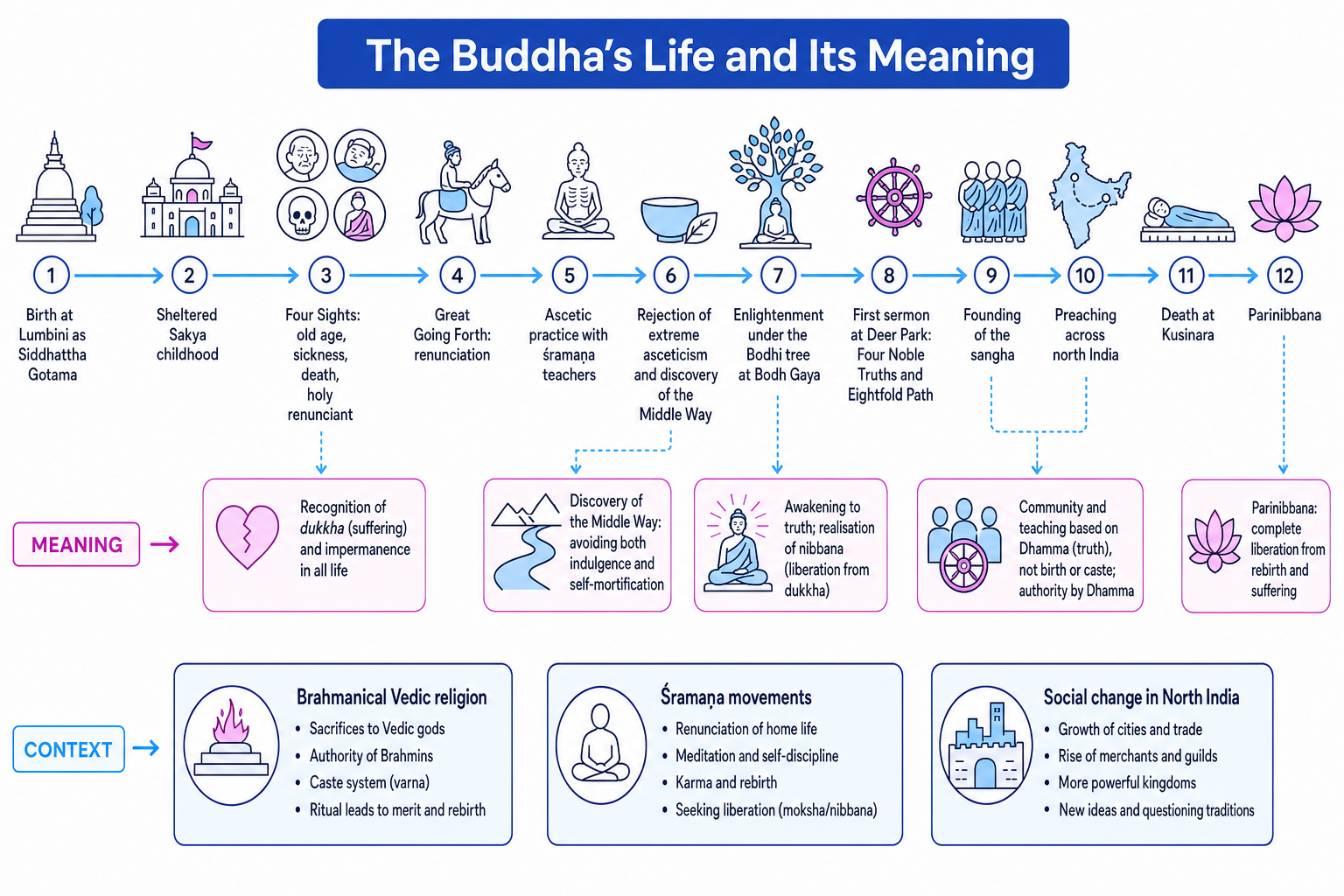
Key events and what they teach
The Buddha’s birth and childhood are traditionally linked with prophecy: he would become either a great ruler or a great spiritual teacher. His sheltered upbringing shows the attractions and limits of worldly comfort.
The Four Sights were old age, sickness, death and a holy renunciant. They reveal that suffering is universal and that a spiritual solution may be possible.
Definition
Asceticism
Asceticism means severe self-discipline or self-denial, often involving fasting, poverty or physical hardship, used as a spiritual practice.
Siddhattha left palace life in the Great Going Forth and practised asceticism with wandering teachers. However, he rejected extreme self-mortification and discovered the Middle Way, avoiding both indulgence and harsh self-punishment.
His Enlightenment under the Bodhi tree at Bodh Gaya means awakening to the truth of reality and the end of ignorance. His first sermon at Deer Park taught the Four Noble Truths and the Noble Eightfold Path.
He then founded the sangha, the Buddhist community, especially the monastic community of monks and nuns. His preaching across north India shows that the path was offered across social groups, not only to religious elites.
His death at Kusinara is followed by parinibbana, the final passing away of an enlightened being, beyond rebirth and suffering.
Key Idea
Why the life matters
The Buddha’s life is authoritative because it is a model of the path: seeing suffering clearly, rejecting extremes, awakening through disciplined practice, and teaching compassionately for the liberation of others.
Armstrong and Ñāṇamoli Bhikkhu
Karen Armstrong reads the Buddha historically and contextually. She stresses that we cannot write a modern biography of the Buddha with certainty, but we can understand his life within the social and religious world of north India. For Armstrong, the Buddha’s originality lies in offering a practical path of transformation rather than relying on ritual, speculation or inherited status.
Ñāṇamoli Bhikkhu presents the life of the Buddha through the Pali Canon, the early Theravāda scriptures. His approach is more traditional: the canonical life story is not just historical data but a religious source showing the Buddha’s authority, teaching and example.
A strong essay can compare them: Armstrong helps you explain historical context and social change; Ñāṇamoli helps you explain how Buddhists receive the Buddha’s life as sacred and authoritative.
Example
Interpreting the Four Sights in context
-
Start with the event: Siddhattha sees old age, sickness and death, so he recognises that no worldly privilege can protect humans from dukkha.
-
Connect this to social context: in a world of ritual sacrifice and social hierarchy, the Four Sights shift the focus from outward status to the universal human condition.
-
Add the fourth sight: the renunciant suggests that liberation may require a disciplined spiritual path rather than luxury, power or ritual alone.
-
Evaluate with scholarship: Armstrong supports a contextual reading of the event as part of a wider renouncer culture; Ñāṇamoli supports its religious meaning as a turning point in the Buddha’s path to awakening.
Religious and social context
The Buddha lived in a world shaped by several overlapping religious groupings.
Brahmanical Vedic religion centred on the authority of the Vedas, priestly ritual and sacrifice. Brahmins were the priestly class, and correct ritual performance was believed to maintain cosmic and social order.
Śramaṇa movements were renouncer traditions that questioned ordinary household life. These included Jains, ascetics, meditators and other groups concerned with karma, rebirth and liberation.
Definition
Karma and rebirth
Karma means intentional action with moral consequences. Rebirth means the continuation of existence through future lives, shaped by karma.
The Buddha accepted ideas such as karma and rebirth, but reworked them ethically. What matters is not birth status or ritual correctness, but intention, conduct and insight.
Common Mistake
Buddhism did not appear in a vacuum
Avoid writing as if the Buddha simply “rejected Hinduism” as one fixed religion. It is better to say he emerged from a complex world of Brahmanical ritual, Upanishadic speculation and śramaṇa renunciation.
Sacrifice, caste, economics and kingship
A sacrifice is a ritual offering, often performed by priests. In the Buddha’s context, sacrifice could involve offerings to gods and sometimes animals. The Buddha’s teaching shifts value away from costly ritual and towards ethical conduct, non-harming and generosity.
The caste system, or more accurately varna hierarchy, divided society into ranked groups such as Brahmins, Kshatriyas, merchants and workers. The Buddha did not instantly abolish social hierarchy, but he challenged its spiritual authority. In the sangha, spiritual status depended on discipline and progress, not birth.
Socially, north India was changing. Cities, trade and merchant groups were growing. Kings in larger states such as Magadha and Kosala became important patrons. This matters because Buddhism appealed not only to renouncers but also to merchants, rulers and lay supporters.
Kingship gave political authority, Brahmins claimed ritual authority, and ascetics claimed spiritual authority. The Buddha’s authority was different: it came from awakening and from the Dhamma, meaning the truth or teaching he discovered.
Tip
Authority comparison
For evaluation, compare birth-based authority with practice-based authority. Buddhism weakens the idea that someone is spiritually superior just because they are born into a high caste.
The Tipitaka: the Three Baskets
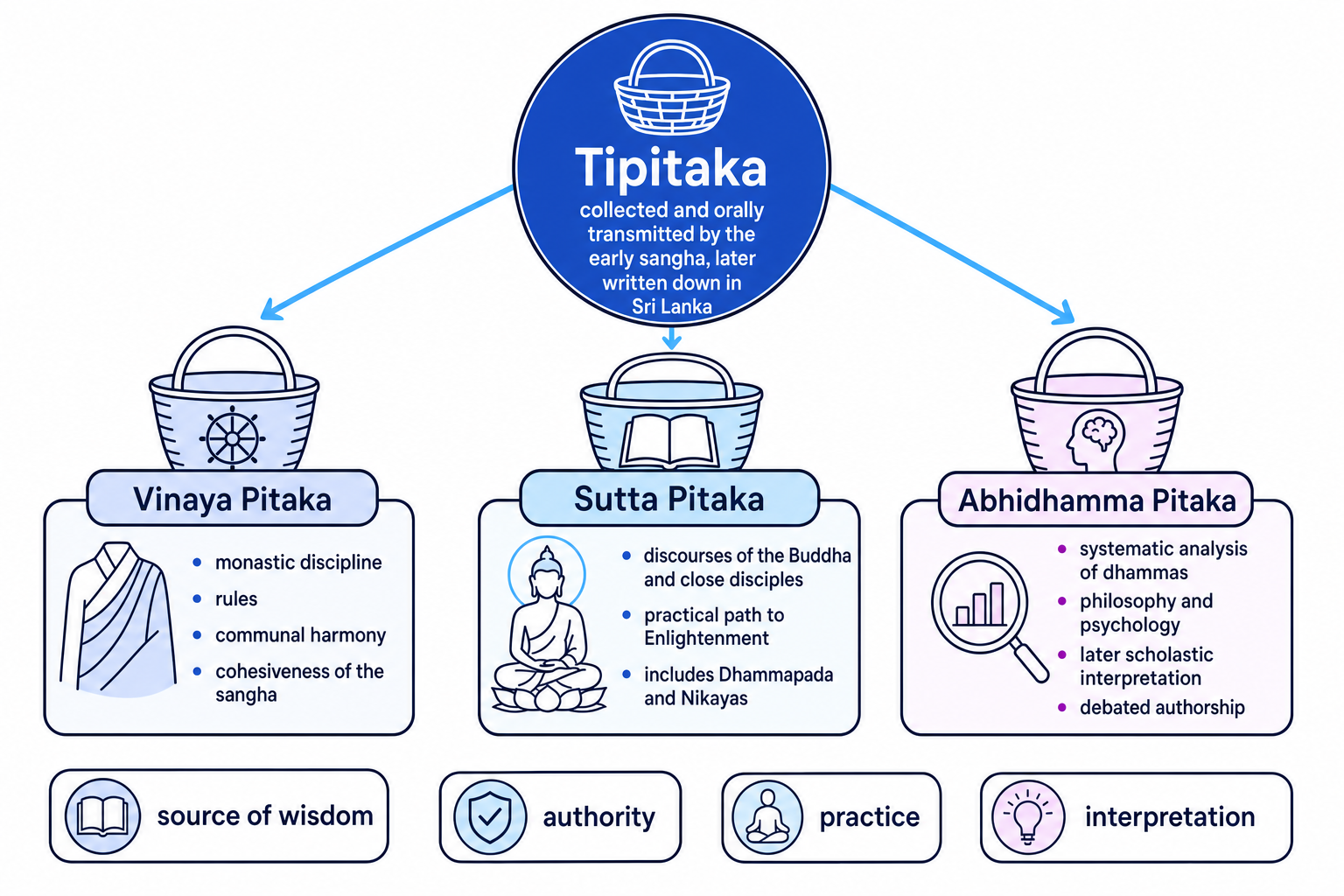
The Tipitaka is the Pali Canon of Theravāda Buddhism. Pali is the language in which this canon is preserved. Tipitaka means “Three Baskets”: Vinaya, Sutta and Abhidhamma.
Definition
Buddhavacana
Buddhavacana means “word of the Buddha”. Buddhists use this idea for teachings regarded as preserving the Buddha’s liberating message, even though the canon was transmitted orally and formed over time.
Collection and formation
After the Buddha’s death, the teachings were preserved through oral recitation. Tradition links the First Council at Rajagaha with Ānanda reciting the discourses and Upāli reciting the monastic discipline.
The canon developed over centuries and was eventually written down in Sri Lanka, traditionally in the first century BCE. This does not make it “unimportant”; it means its authority depends on communal memory, recitation, practice and consistency with the path.
Common Mistake
Calling the Tipitaka the Buddhist Bible
The Tipitaka is not a single book and not all Buddhists use only this canon. It is best described as the central Theravāda scriptural collection.
The three sections
| Section | Main content | Why it matters |
|---|---|---|
| Vinaya Pitaka | Monastic rules and procedures | Creates a cohesive sangha through discipline, confession, ordination and dispute-settlement |
| Sutta Pitaka | Discourses of the Buddha and close disciples | Gives practical teaching on Enlightenment, including ethics, meditation and wisdom |
| Abhidhamma Pitaka | Systematic analysis of experience, mind and reality | Interprets the teachings in a detailed philosophical and psychological form |
Vinaya Pitaka: forming a community
The Vinaya Pitaka regulates monastic life. It aims to produce harmony, trust and discipline. Rules are not just restrictions; they protect the sangha from conflict and help monks and nuns live in a way that supports liberation.
Sutta Pitaka: the search for Enlightenment
The Sutta Pitaka contains sermons and dialogues. It is the most direct source for teachings such as the Four Noble Truths, the Eightfold Path, dependent arising, meditation and compassion. It shows the Buddha teaching different audiences: monks, kings, Brahmins, householders and wanderers.
Abhidhamma Pitaka: interpretation and debate
The Abhidhamma Pitaka is more analytical. It breaks experience into basic phenomena called dhammas and systematises Buddhist psychology and philosophy.
Its authorship is debated. Traditional Theravāda accounts often connect it with the Buddha’s own deeper teaching. Many modern scholars argue that it is a later scholastic development. This debate matters because it raises the question: does authority require the Buddha to have spoken every word personally?
Keown and Meghprasara
Damien Keown gives a careful academic account of the Tipitaka. He emphasises its importance as the earliest complete Buddhist canon, while also noting its oral formation and the likelihood that the Abhidhamma developed later.
M. Meghprasara is useful for explaining the Tipitaka from a more traditional Buddhist perspective: it functions as an integrated source of guidance for conduct, meditation, doctrine and interpretation.
Together, they help you balance history and religious significance. Keown strengthens critical analysis of formation; Meghprasara strengthens understanding of how the Tipitaka is treated as living wisdom.
Example
Evaluating the Abhidhamma's authority
-
Separate two issues: whether the Buddha personally spoke the Abhidhamma in its final form, and whether it can still be authoritative for Buddhists.
-
Weigh the evidence: its systematic style supports Keown’s view that it reflects later scholastic development, not simple sermon material.
-
Consider tradition: if Meghprasara is used to show its role within the whole Tipitaka, the Abhidhamma may still be authoritative as a faithful interpretation of the Dhamma.
-
Reach a balanced judgement: its authority is weaker if “authority” means exact historical speech by the Buddha, but strong if “authority” means a trusted tool for understanding and practising the path.
Why the Tipitaka matters as wisdom and authority
The Tipitaka shapes Buddhist life in several ways. Monastics use the Vinaya for discipline and communal identity. Teachers use the Suttas for sermons, chanting and meditation instruction. Scholars and some meditation traditions use the Abhidhamma for detailed analysis of mind and reality.
Its impact is practical, not merely textual. It preserves the Buddha’s teaching, guides the sangha, supports lay devotion, and gives Buddhists a shared language for liberation.
Key Idea
The heart of the topic
The Buddha’s life shows wisdom embodied in a person; the Tipitaka preserves and interprets that wisdom for the Buddhist community.
Exam technique
In the exam
-
Always link life events to meaning: do not just narrate the Buddha’s biography; explain what each event teaches about authority, suffering, renunciation or liberation.
-
Use named scholars in pairs: Armstrong with Ñāṇamoli for the Buddha’s life, and Keown with Meghprasara for the Tipitaka.
-
Evaluate carefully: distinguish historical certainty from religious authority, especially when discussing oral transmission and the Abhidhamma.
Self review
Check yourself
- How do the Four Sights challenge worldly power, wealth and caste-based authority?
- Why might the Vinaya Pitaka be essential for a cohesive sangha?
- Does the Abhidhamma need to be the Buddha’s exact words to be authoritative?