Revision notes for Edexcel AS Level Religious Studies Religious beliefs, values and teachings. Open the guide for explanations and worked examples. Written against the Edexcel AS Level Religious Studies specification, so the content matches what's examinable rather than general Religious Studies background.
Religious beliefs, values and teachings
What you'll learn
- How the Four Noble Truths and the Three Poisons explain the problem Buddhism aims to solve.
- How the Eightfold Path, Five Precepts and Three Refuges shape Buddhist daily life.
- How the Three Marks and Five khandas support anatta, rebirth and a non-theistic worldview.
- How Theravada and Mahayana approaches can be compared using named scholars.
The starting point: Buddhism as a path of liberation
Buddhism is not centred on worship of a creator God. It is mainly a path for ending dukkha: suffering, unsatisfactoriness, frustration, and the instability of ordinary existence.
Definition
Theravada and Mahayana
Theravada means “Teaching of the Elders” and is historically dominant in Sri Lanka and much of South East Asia. It often emphasises the Pali Canon, monastic discipline, insight, and the arahant ideal: one who attains liberation.
Mahayana means “Great Vehicle” and is historically dominant in East Asia and Tibet. It accepts core Buddhist teachings but often emphasises the bodhisattva ideal: seeking awakening for the benefit of all beings.
The Four Noble Truths
The Four Noble Truths are the basic structure of the Buddha’s teaching. Damien Keown presents them as a kind of medical diagnosis: identify the illness, find its cause, show that a cure is possible, and prescribe the treatment. Bhikkhu Bodhi likewise treats them as the framework for the whole path to liberation.
Definition
The Four Noble Truths
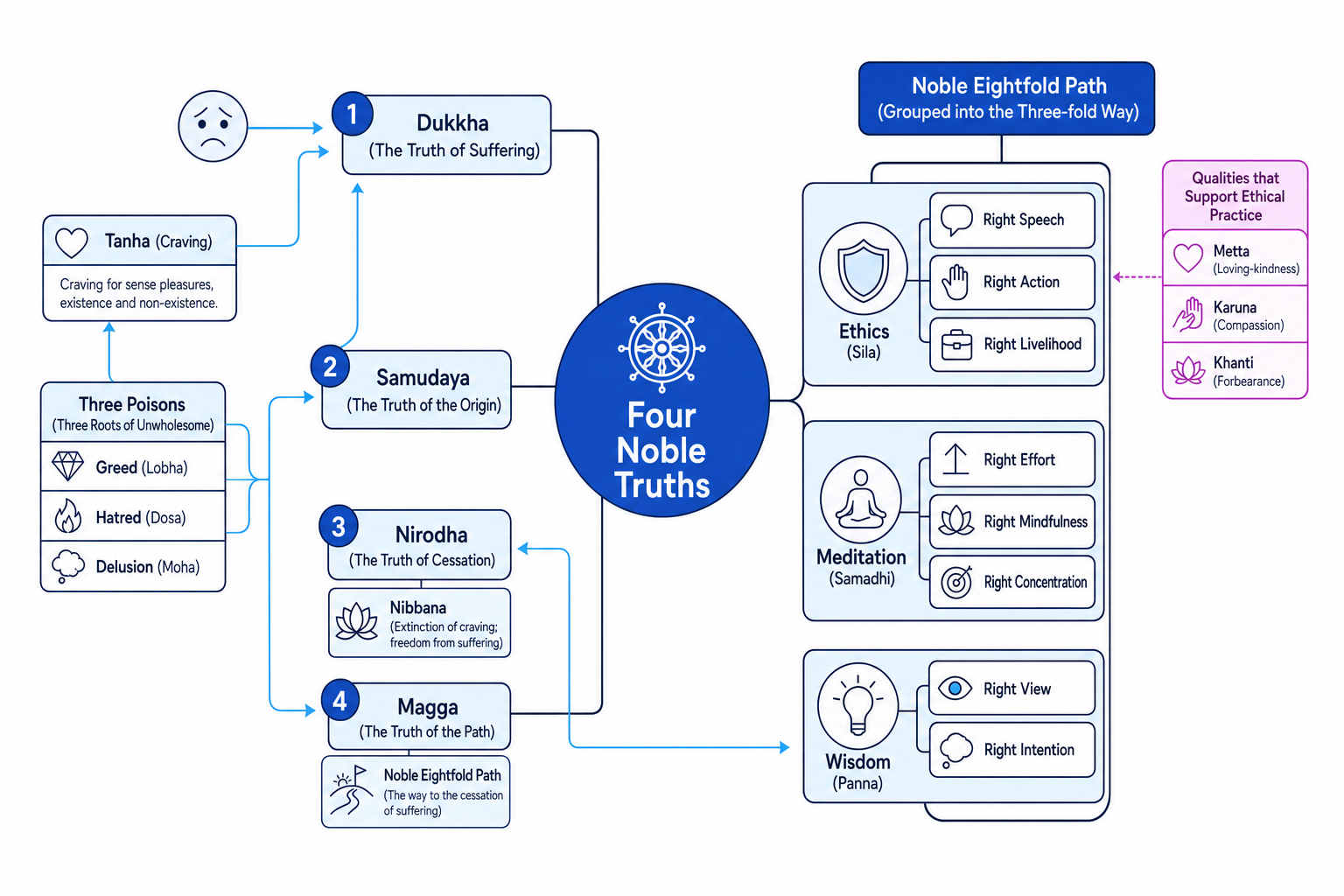
The Four Noble Truths teach that:
- Dukkha: life within samsara, the cycle of birth, death and rebirth, is marked by suffering and unsatisfactoriness.
- Samudaya: dukkha has an origin in tanha, craving or “thirst”.
- Nirodha: dukkha can cease through the ending of craving.
- Magga: the way to cessation is the Noble Eightfold Path.
The map below shows how the Truths, the Three Poisons and the Eightfold Path fit together.
The Three Poisons
The Three Poisons are the roots of unwholesome action and suffering:
- Greed or craving: grasping after pleasure, possessions, status or existence.
- Hatred or aversion: hostility, anger and rejection.
- Delusion or ignorance: misunderstanding reality, especially impermanence and no-self.
Key Idea
Why the Three Poisons matter
The Four Noble Truths are not just abstract beliefs. They explain how greed, hatred and delusion create dukkha, and how Buddhist practice trains the mind away from those poisons.
Nibbana and Enlightenment
Enlightenment, or bodhi, means awakening to reality as it truly is. Nibbana means the “blowing out” or extinguishing of greed, hatred and delusion. It is not the destruction of a permanent soul, because Buddhism denies such a soul exists. Rather, it is liberation from craving and the end of dukkha.
In Theravada, nibbana is often described as the unconditioned reality realised by the Buddha and arahants. In Mahayana, liberation is often linked with wisdom into shunyata, “emptiness”: the lack of independent, permanent essence in all things.
Example
Applying the Four Noble Truths to craving
-
Suppose someone is distressed because they constantly need praise. This shows dukkha, because their happiness depends on something unstable: other people’s approval.
-
The origin, samudaya, is tanha: craving for status, reassurance and a fixed identity as “successful” or “liked”.
-
Nirodha becomes possible if that craving weakens. The person may still enjoy praise, but they are less controlled by it.
-
Magga gives the practical route: right mindfulness notices the craving, right intention reduces self-centred grasping, and right speech avoids manipulating others for approval.
The Noble Eightfold Path and the Three-fold Way
The Noble Eightfold Path is the fourth Noble Truth, magga. It is traditionally summarised as the Three-fold Way:
- Ethics: right speech, right action, right livelihood.
- Meditation: right effort, right mindfulness, right concentration.
- Wisdom: right view, right intention.
The ethical principles are especially important for this topic:
- Right speech means avoiding lies, harsh speech, divisive speech and pointless gossip.
- Right action means avoiding killing, stealing and sexual misconduct.
- Right livelihood means earning a living in ways that do not cause harm.
The path also cultivates key virtues: metta is loving-kindness, karuna is compassion, and khanti is patience or forbearance. These are not optional extras; they weaken hatred, selfishness and impulsiveness.
Common Mistake
Treating the path as a staircase
Do not write as if Buddhists complete one path factor and then move to the next. Bhikkhu Bodhi stresses that the path factors support each other: ethics steadies the mind, meditation deepens awareness, and wisdom removes ignorance.
Theravada and Mahayana understandings
For Theravada Buddhists, the Four Noble Truths are strongly linked to the Buddha’s first sermon and to the arahant’s search for nibbana. Monastic discipline, meditation and insight are often central.
For Mahayana Buddhists, the Four Noble Truths remain foundational, but they are interpreted through the bodhisattva path. Compassion becomes especially prominent: the practitioner seeks awakening not only for themselves but for all beings.
In the contemporary world, some Buddhists encounter the path through mindfulness, social action or lay practice rather than through traditional monastic life. However, the underlying aim is still the transformation of craving, suffering and ignorance.
The Three Marks of Existence
Definition
The Three Marks
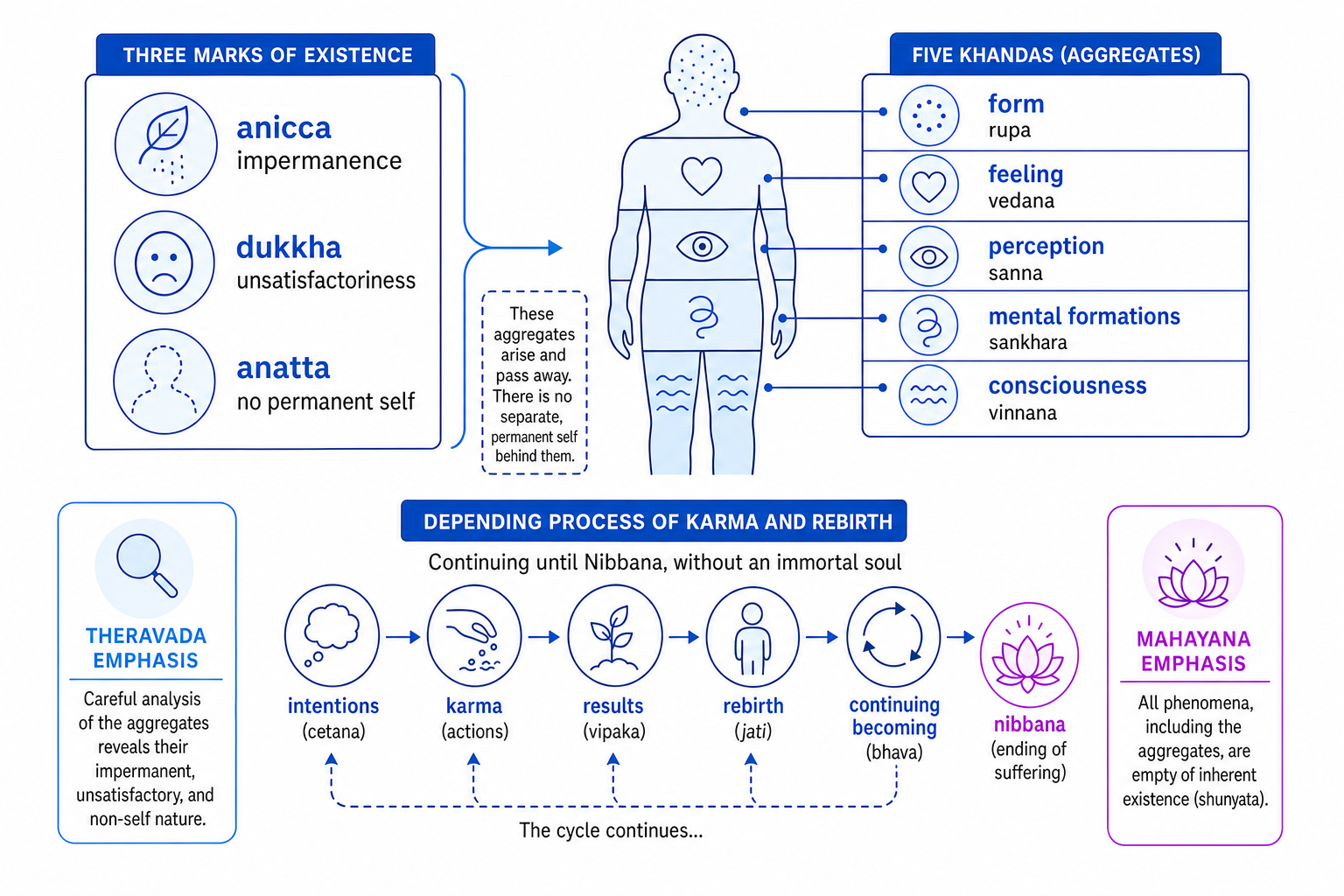
The Three Marks of Existence are:
- Anicca: impermanence; all conditioned things change.
- Dukkha: unsatisfactoriness; clinging to changing things brings frustration.
- Anatta: no permanent self; there is no eternal, independent soul or essence.
These marks shape Buddhist views of reality. If everything conditioned is changing, then clinging to possessions, relationships, body or identity as permanent will produce suffering. The purpose of life is therefore not obedience to a creator God, but awakening to reality and ending delusion.
The diagram below links the Three Marks to the Five khandas, karma and rebirth.
The Five khandas and no-self
Khandas means “aggregates” or “heaps”. They are the five changing processes that make up what we conventionally call a person:
- Rupa: physical form or body.
- Vedana: feeling tone, such as pleasant, unpleasant or neutral.
- Sanna: perception or recognition.
- Sankhara: mental formations, including intentions and habits.
- Vinnana: consciousness or awareness of objects.
Theravada analysis uses the khandas to show that there is no permanent owner behind experience. In the Visuddhimagga, Buddhaghosa systematises this insight through meditation and analysis. His famous idea is that “mere suffering exists, but no sufferer is found”: there are processes and consequences, but no fixed self standing behind them.
Tenzin Wangyal Rinpoche, used here as a Tibetan contemplative voice, gives a more experiential emphasis. The “self” we defend is a construction produced by grasping at thoughts, emotions and memories. Meditation loosens that identification and opens insight into emptiness.
Common Mistake
No-self does not mean nothing exists
Anatta does not mean you are imaginary or that moral responsibility disappears. It means there is no permanent, independent essence behind the changing physical and mental processes.
Rebirth, karma and no creator God
Karma means intentional action and its consequences. It is not fate. Rebirth is not the movement of an immortal soul from one body to another; it is causal continuity shaped by craving, ignorance and karma.
This also links to Buddhism’s rejection of a creator God. Buddhism can include gods or heavenly beings in some cosmologies, but they are not eternal creators or ultimate saviours. Dependent arising, karma and ignorance explain the cycle of suffering without needing a divine first cause.
Example
Analysing anger through the khandas
-
Break the experience into khandas: the body heats up (rupa), the feeling is unpleasant (vedana), the other person is labelled as “insulting me” (sanna), angry intentions arise (sankhara), and the mind is aware of the conflict (vinnana).
-
Apply anicca: each part of the experience changes moment by moment, so the anger is not a permanent identity.
-
Apply anatta: there is anger, but no fixed “angry self” behind it. This supports Buddhaghosa’s view that processes occur without a permanent owner.
-
Draw the ethical implication: if anger is conditioned, it can be trained. Metta, karuna and khanti become practical antidotes to hatred.
The Three Refuges
Definition
The Three Refuges
To “go for refuge” is to commit one’s trust and direction to the Buddha, the dhamma and the sangha. These are also called the Three Jewels.
- The Buddha is the awakened teacher and example.
- The dhamma is the Buddha’s teaching, the truth it points to, and the path of practice.
- The sangha is the Buddhist community. In a narrow sense it means the monastic community or the “noble sangha” of awakened practitioners; in a wider sense it includes lay Buddhists too.
The three refuges are interrelated: the Buddha realises and teaches the dhamma; the dhamma creates and guides the sangha; the sangha preserves and embodies the dhamma.
Theravada often stresses the historical Buddha as an extraordinary human teacher and the monastic sangha as a field of merit. Mahayana may also speak of cosmic Buddhas, bodhisattvas and the Trikaya, the “three bodies” of the Buddha, giving the Buddha a more expansive role.
Bhikkhu Bodhi sees going for refuge as the entry point into Buddhist life: not blind faith, but a serious commitment to the path. Thanissaro Bhikkhu similarly emphasises refuge as active practice: confidence in the Buddha is tested and deepened through living the dhamma.
In daily life, the refuges appear in chanting, bowing before Buddha images, listening to teachings, supporting monks and nuns, meditation, festivals, and taking the precepts.
Key moral principles: the Five Precepts
Definition
The Five Precepts
The Five Precepts are voluntary training commitments to refrain from killing, stealing, sexual misconduct, false speech, and intoxicants that cause heedlessness.
The precepts are not commandments from God. They are practical disciplines for reducing harm, purifying intention and supporting progress on the path.
Peter Harvey explains Buddhist ethics through intention, karma, compassion and wisdom. The precepts train character and reduce suffering. Bhikkhu Bodhi links them directly to the Eightfold Path: ethical conduct is the foundation for meditation and wisdom.
Theravada Buddhists commonly undertake the Five Precepts as lay ethics, while monastics follow the more detailed Vinaya, the monastic discipline. Mahayana Buddhists also accept the precepts, but often frame them within bodhisattva compassion. In some Mahayana contexts, vegetarianism, environmental concern and social action become especially important expressions of non-harm.
Common Mistake
Calling the precepts commandments
Avoid saying Buddhists “obey commandments”. It is more accurate to say they undertake training rules that aim to reduce dukkha and cultivate wholesome states of mind.
Named scholars: quick comparison grid
| Spec area | Scholars to compare |
|---|---|
| Four Noble Truths | Keown presents the Truths as a diagnosis and cure, showing Buddhism is not pessimistic but practical. Bodhi stresses the Eightfold Path as the concrete way to end suffering. |
| Three Marks and khandas | Buddhaghosa gives a rigorous Theravada analysis of the aggregates in the Visuddhimagga. Tenzin Wangyal Rinpoche emphasises direct contemplative recognition that the defended “self” is constructed. |
| Three Refuges | Bodhi stresses refuge as entry into the Buddhist path. Thanissaro Bhikkhu stresses active, tested confidence through practice. |
| Five Precepts | Harvey analyses Buddhist ethics through intention, karma and virtue. Bodhi links moral discipline to the wider path of purification and liberation. |
Tip
A strong essay judgement
A balanced judgement might argue that the Four Noble Truths, Three Marks and refuge in the Three Jewels are foundational for all Buddhists, but their expression differs: Theravada often stresses analytical insight and monastic discipline, while Mahayana often stresses compassion, emptiness and the bodhisattva path.
Exam technique
In the exam
-
Define key terms precisely: dukkha is broader than “pain”, tanha is craving, and anatta denies a permanent self rather than denying ordinary personal existence.
-
Compare traditions carefully: do not say Mahayana rejects early teachings; say it reinterprets them through emptiness, compassion and the bodhisattva ideal.
-
Use scholars for evaluation, not just name-dropping: explain how Keown, Bodhi, Buddhaghosa, Tenzin Wangyal Rinpoche, Thanissaro Bhikkhu or Harvey support a judgement.
Self review
Check yourself
- How do the Three Poisons connect samudaya to the need for the Eightfold Path?
- Why does anatta create a challenge for rebirth, and how might a Buddhist answer it?
- In what ways might the sangha be understood differently in Theravada and Mahayana?