Revision notes for Edexcel AS Level Religious Studies Practices that shape and express religious identity. Open the guide for explanations and worked examples. Written against the Edexcel AS Level Religious Studies specification, so the content matches what's examinable rather than general Religious Studies background.
Practices that shape and express religious identity
What you'll learn
- How Theravada and Mahayana Buddhism shape distinctive religious identities.
- Why images, stupas, renunciation, nibbana, Buddha nature and the trikaya matter.
- How meditation fits into the Noble Eightfold Path and moral development.
- How to use scholars such as Gombrich, Gunaratana, Basham, the Dalai Lama, Thanissaro Bhikkhu and Joseph Goldstein in essays.
Religious identity: the basic idea
Definition
Religious identity
Religious identity means the way a person or community understands and expresses who they are through beliefs, practices, symbols, stories, ethical commitments and communal belonging.
In Buddhism, identity is not mainly about “believing in God”. It is shaped by taking refuge in the Three Jewels: the Buddha as awakened teacher, the Dhamma/Dharma as teaching, and the Sangha as the Buddhist community.
Practices such as meditation, chanting, giving, pilgrimage, image-veneration and monastic discipline express what Buddhists value: wisdom, compassion, detachment, mindfulness and liberation.
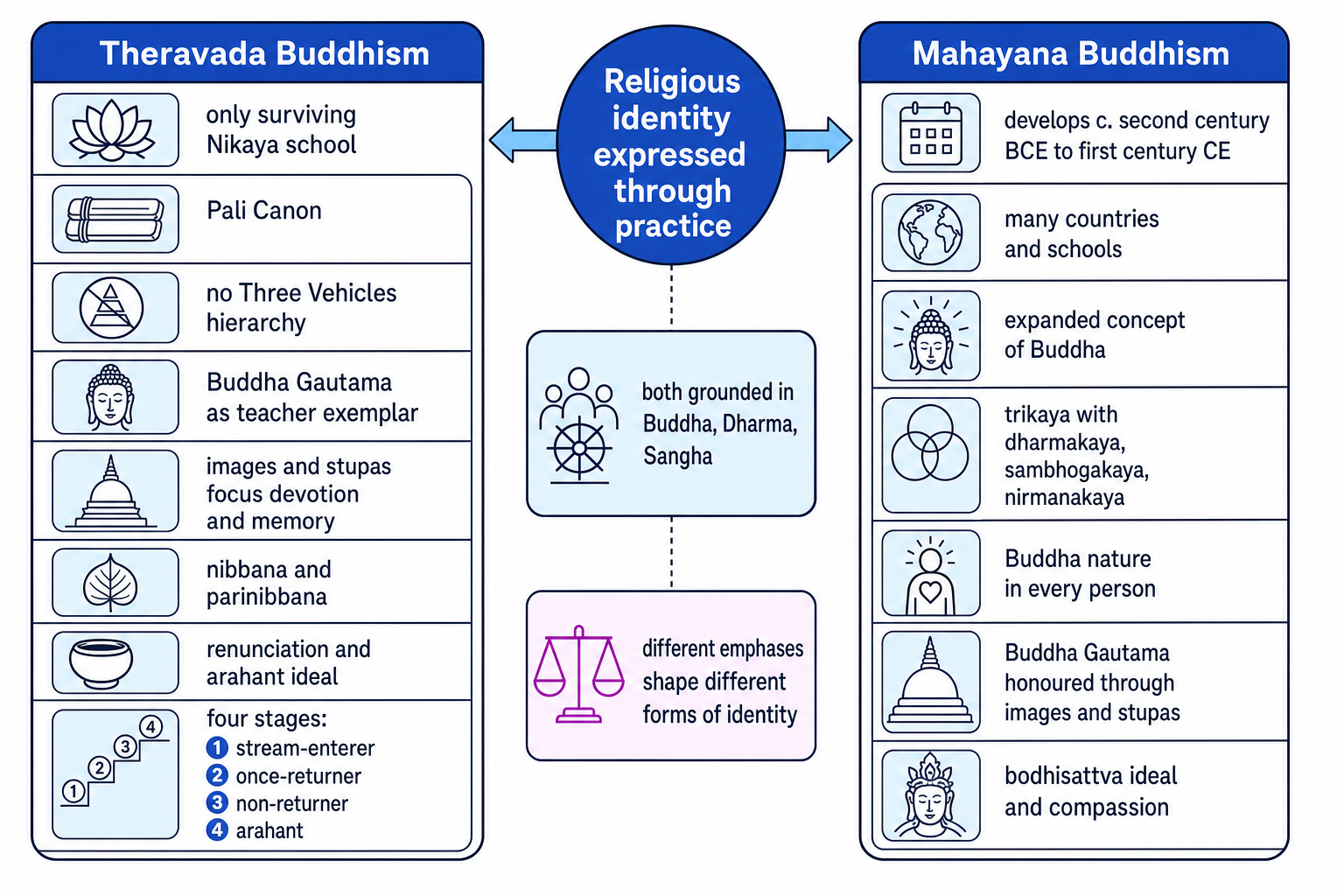
Theravada Buddhism
Definition
Theravada
Theravada means “Teaching of the Elders”. It is the only surviving form of Nikaya Buddhism, the early Buddhist schools that developed after the Buddha’s death.
Theravada is especially associated with Sri Lanka, Myanmar, Thailand, Laos and Cambodia. It gives central authority to the Pali Canon, also called the Tipitaka, the collection of teachings, monastic rules and philosophical analysis preserved in Pali.
The only surviving form of Nikaya Buddhism
Theravada’s identity is strongly shaped by its claim to preserve the early teaching and monastic discipline of the historical Buddha, Siddhartha Gautama. This does not mean Theravada has never changed, but it does mean that continuity with early Buddhism is especially important.
Richard Gombrich argues that Theravada is historically rooted in the early Buddhist tradition, but he also warns against treating it as a fossil. Buddhist practice has always been lived in real cultures, with rituals, merit-making and devotional forms developing alongside textual preservation.
Key Idea
Theravada identity
Theravada identity is shaped by continuity with the early Sangha, the Pali Canon, monastic discipline and the goal of liberation through wisdom and renunciation.
Rejection of the Three Vehicles
Definition
Three Vehicles
In many Mahayana contexts, the Three Vehicles are the path of the disciple or sravaka, the path of the solitary Buddha or pratyekabuddha, and the path of the bodhisattva, who seeks Buddhahood for the sake of all beings.
Theravada rejects the Mahayana idea that it is a “lesser” or incomplete vehicle. It does not accept the label Hinayana, meaning “lesser vehicle”, because that is a polemical Mahayana term rather than a neutral description.
Theravada focuses on the path to becoming an arahant, a perfected person who has destroyed greed, hatred and delusion.
Common Mistake
Calling Theravada Hinayana
Do not describe Theravada as “Hinayana” in an essay unless you are explaining that this is a Mahayana polemical term. Use Theravada for the living tradition.
Buddha Gautama, images and stupas
Definition
Stupa
A stupa is a dome-shaped Buddhist monument, often containing relics or symbolising the Buddha’s awakened presence and teaching.
In Theravada, Gautama Buddha is not worshipped as a creator God. He is honoured as the supremely awakened teacher. Images and stupas help Buddhists recollect the Buddha’s virtues, gain inspiration, practise devotion and make merit.
This matters for identity because Theravada is not only philosophical. Bowing before a Buddha image, offering flowers or walking around a stupa can express gratitude, humility and commitment to the path.
Nibbana, parinibbana and renunciation
Definition
Nibbana and parinibbana
Nibbana is the extinguishing of greed, hatred and delusion: liberation from suffering and rebirth. Parinibbana is the final passing away of a Buddha or arahant at death, after which there is no further rebirth.
Theravada places strong emphasis on renunciation, meaning the letting go of craving, attachment and worldly distraction. This is visible in monastic life: shaving the head, wearing robes, keeping the Vinaya rules and depending on alms.
The four stages to becoming an arahant are:
| Stage | Meaning |
|---|---|
| Stream-enterer | Has entered the irreversible stream towards awakening |
| Once-returner | Will return to the human realm at most once |
| Non-returner | Will not return to the human realm, but will attain liberation in a higher realm |
| Arahant | Fully liberated; no further rebirth |
Henepola Gunaratana, a Theravada monk, presents the path as practical training. In works such as Mindfulness in Plain English, he stresses mindfulness, ethical discipline and insight into impermanence, suffering and not-self.
Example
Explaining Theravada practice as identity
- Start with the Theravada goal: liberation is understood as nibbana, reached by overcoming greed, hatred and delusion.
- Connect that goal to practice: renunciation, meditation, monastic discipline and recollection of the Buddha train the person away from craving.
- Show identity: a Theravada Buddhist’s life is shaped by the arahant ideal, respect for the Pali Canon and practical discipline rather than by devotion to cosmic Buddhas.
- Add evaluation: Gombrich helps you avoid oversimplifying Theravada as only “early Buddhism”, while Gunaratana shows how its teachings remain lived through meditation and mindfulness.
Mahayana Buddhism
Definition
Mahayana
Mahayana means “Great Vehicle”. It is a broad family of Buddhist traditions that emphasise the bodhisattva path, universal compassion and the possibility of Buddhahood for all beings.
Mahayana developed in India roughly between the second century BCE and first century CE. It was not a single organisation, but a range of movements, texts and practices that spread into China, Korea, Japan, Tibet, Mongolia and Vietnam.
A. L. Basham saw Mahayana as a major development in Buddhism because it broadened Buddhist religious life through devotion, cosmic Buddhas and the bodhisattva ideal. This helped Buddhism speak powerfully to laypeople as well as monastics.
The extension of the Buddha: trikaya
Definition
Trikaya
The trikaya is the Mahayana doctrine of the “three bodies” of the Buddha: dharmakaya, sambhogakaya and nirmanakaya.
The three bodies are:
- Dharmakaya: the truth body; the ultimate reality or truth of Buddhahood.
- Sambhogakaya: the enjoyment or heavenly body; the glorious form experienced by advanced bodhisattvas.
- Nirmanakaya: the emanation body; the Buddha appearing in history, such as Gautama Buddha.
This extends the concept of Buddha beyond one historical teacher. Gautama remains central, but he can be understood as a historical manifestation of a deeper Buddhahood.
Buddha nature
Definition
Buddha nature
Buddha nature, or tathagatagarbha, is the Mahayana teaching that all sentient beings have the potential for Buddhahood.
This shapes identity by giving Mahayana practice a strongly hopeful and inclusive tone. Every person, however confused, has the capacity for awakening.
The 14th Dalai Lama teaches that Buddhist practice must unite wisdom and compassion. In Mahayana terms, wisdom sees emptiness and interdependence, while compassion works for the liberation of all beings. Buddha nature should not be treated as a permanent soul; it is better understood as the potential for awakening.
Common Mistake
Turning Buddha nature into a soul
Buddha nature does not simply cancel the Buddhist teaching of anatta, or no-self. In most Mahayana interpretation, it points to awakened potential, not an eternal personal essence.
Mahayana schools in context
Mahayana looks different in different countries:
| School or tradition | Context and emphasis |
|---|---|
| Pure Land | China, Japan, Vietnam; devotion to Amitabha Buddha and rebirth in the Pure Land |
| Zen / Chan / Seon / Thien | Japan, China, Korea, Vietnam; meditation, direct insight and sometimes koan practice |
| Nichiren Buddhism | Japan; devotion to the Lotus Sutra and chanting “Nam-myoho-renge-kyo” |
| Tibetan Buddhism | Tibet and Himalayan regions; bodhisattva path, tantra, visualisation, mantras and teacher-disciple lineage |
Key Idea
Mahayana identity
Mahayana identity is shaped by the bodhisattva ideal: the practitioner seeks awakening not only for themselves, but for the liberation of all beings.
Example
Comparing Theravada and Mahayana
- Identify the shared foundation: both traditions honour the Buddha, Dharma and Sangha, and both aim at liberation from suffering.
- Contrast the ideal figure: Theravada often centres the arahant, while Mahayana centres the bodhisattva.
- Contrast the Buddha concept: Theravada stresses Gautama as historical awakened teacher, while Mahayana extends Buddhahood through teachings such as trikaya and Buddha nature.
- Make a judgement: the traditions are not simply “selfish versus compassionate”; Theravada includes compassion and Mahayana includes wisdom, but they express Buddhist identity through different emphases.
Meditation in Buddhism
Definition
Meditation
Meditation is disciplined mental cultivation. In Buddhism it trains attention, calm, insight, compassion and freedom from craving.
Meditation belongs within the Noble Eightfold Path, especially Right Effort, Right Mindfulness and Right Concentration. It is not isolated from ethics. Morality supports meditation because a dishonest or harmful life agitates the mind; meditation supports morality because awareness makes craving and anger easier to notice.
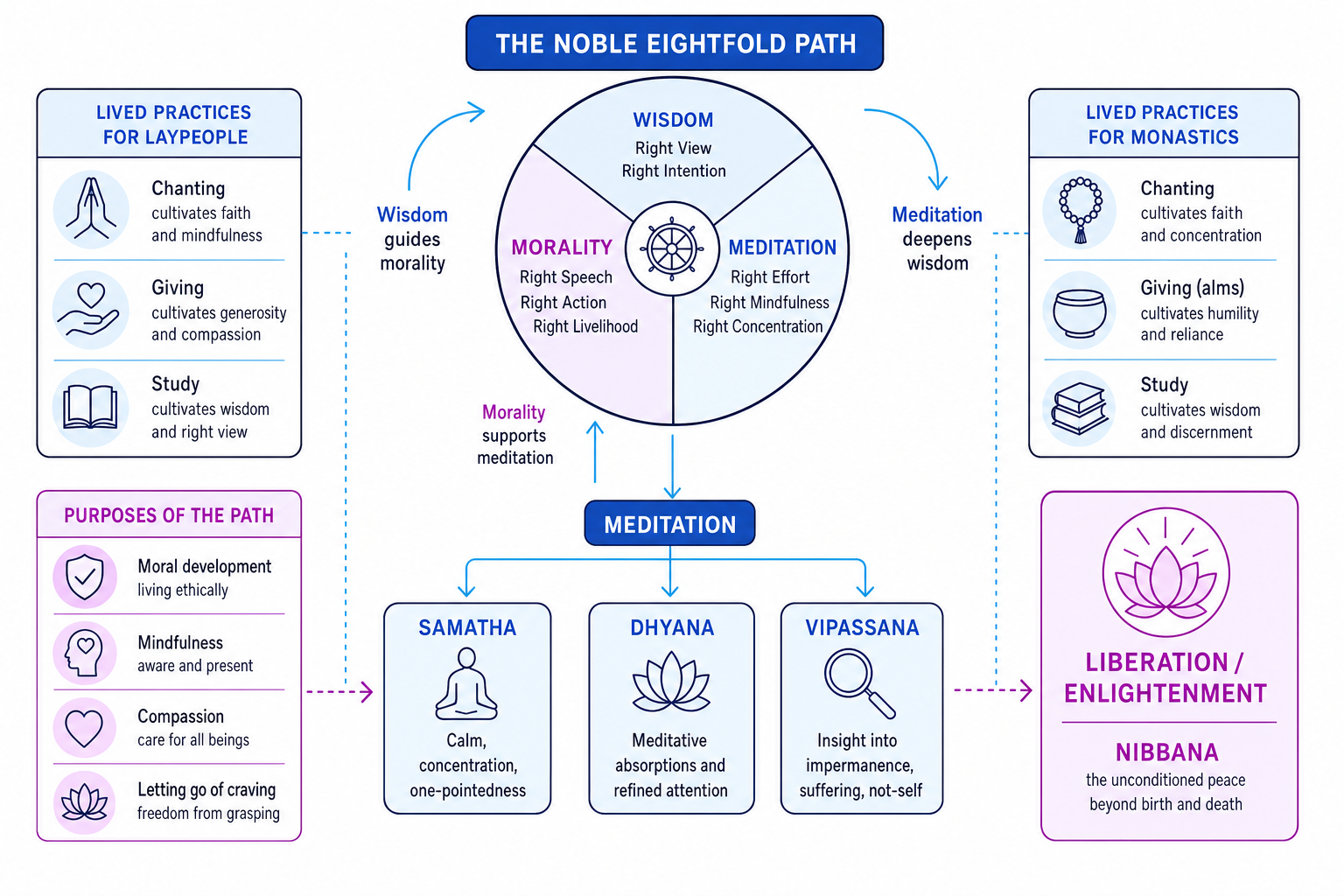
Samatha
Definition
Samatha
Samatha means calm or tranquillity meditation. It develops concentration, steadiness and one-pointedness of mind.
A common samatha technique is mindfulness of breathing: the practitioner attends to the breath, notices distraction and gently returns attention. Its purpose is to calm the mind so it becomes less scattered and more capable of insight.
Dhyana
Definition
Dhyana
Dhyana, or jhana in Pali, refers to deep meditative absorptions connected with Right Concentration.
Thanissaro Bhikkhu argues that jhana is not an optional extra. In his reading of the early texts, right concentration is a central part of the path. He also stresses that mindfulness is not merely “bare awareness”; it involves remembering and applying skilful teachings.
Vipassana
Definition
Vipassana
Vipassana means insight meditation. It aims to see reality clearly, especially the three marks of existence: impermanence, suffering and not-self.
Joseph Goldstein, associated with the modern Insight Meditation movement, presents vipassana as direct observation of experience. By observing sensations, thoughts and emotions as changing processes, the practitioner weakens attachment and develops compassion.
Example
Linking meditation to moral development
- Begin with a moral problem: anger arises when someone criticises you.
- Apply mindfulness: you notice the anger as a changing mental state rather than immediately acting on it.
- Apply insight: vipassana helps you see that the feeling is impermanent and not a fixed “self”.
- Connect to ethics: because you are less controlled by anger, you are more likely to practise Right Speech and avoid harm.
Chanting, giving and study
Meditation is important, but Buddhism as lived by laypeople and monastics is broader than silent sitting.
- Chanting can express devotion, memorise teachings and focus the mind.
- Giving, or dana, develops generosity and reduces attachment.
- Study develops right view and helps Buddhists understand how to practise wisely.
Tip
Do not make Buddhism only about meditation
In essays, include lay practices such as giving, chanting, festivals, pilgrimage and supporting the Sangha. This shows you understand Buddhism as a lived religion, not just a private technique.
How to evaluate this topic
A strong essay should avoid ranking traditions too crudely. Theravada may look more conservative because of its Pali Canon and arahant ideal, but Gombrich shows it is historically lived and culturally rich. Mahayana may look more devotional and expansive, but the Dalai Lama shows its compassion is inseparable from disciplined wisdom.
For meditation, Thanissaro Bhikkhu and Joseph Goldstein are useful for comparison. Thanissaro emphasises early canonical structure, discipline and jhana; Goldstein emphasises accessible insight practice and moment-by-moment awareness. Both show that meditation is about transformation, not relaxation alone.
Exam technique
In the exam
- Define the key tradition or practice first, then explain how it shapes identity through goals, symbols, community and discipline.
- Use named scholars precisely: Gombrich and Gunaratana for Theravada, Basham and the Dalai Lama for Mahayana, Thanissaro Bhikkhu and Goldstein for meditation.
- Evaluate with balance: compare emphases without caricaturing either Theravada or Mahayana as “better”, “selfish” or “more authentic”.
Self review
Check yourself
- How does the arahant ideal shape Theravada religious identity?
- Why does the trikaya doctrine change the way Mahayana Buddhists understand the Buddha?
- How can meditation influence moral behaviour as well as insight?