Revision notes for Edexcel AS Level Religious Studies Situation Ethics. Open the guide for explanations and worked examples. Written against the Edexcel AS Level Religious Studies specification, so the content matches what's examinable rather than general Religious Studies background.
Situation Ethics
What you'll learn
- Why the mid-20th century produced a “new morality”.
- How Joseph Fletcher’s Situation Ethics uses agape as its central principle.
- How J. A. T. Robinson connects Situation Ethics with Jesus’ ministry and Christian freedom.
- How to apply and evaluate the theory in Edexcel essay answers.
Starting point: why this was called the “new morality”
Situation Ethics developed in the 1960s, a period of rapid social, political and cultural change. In Britain and the USA, traditional authority was being questioned: churches had less automatic influence, sexual attitudes were changing, and new medical technologies created moral dilemmas that older rule-based systems did not always handle easily.
Important background changes included the contraceptive pill, debates about abortion and divorce, the civil rights movement, feminism, and greater concern for personal autonomy. In the UK, the 1960s also saw major legal changes, including the Sexual Offences Act 1967, the Abortion Act 1967 and the Divorce Reform Act 1969.
Definition
The new morality
The “new morality” means a mid-20th-century approach to ethics that rejected rigid moral rule-keeping and argued that responsible love, freedom and personal circumstances should guide moral decisions.
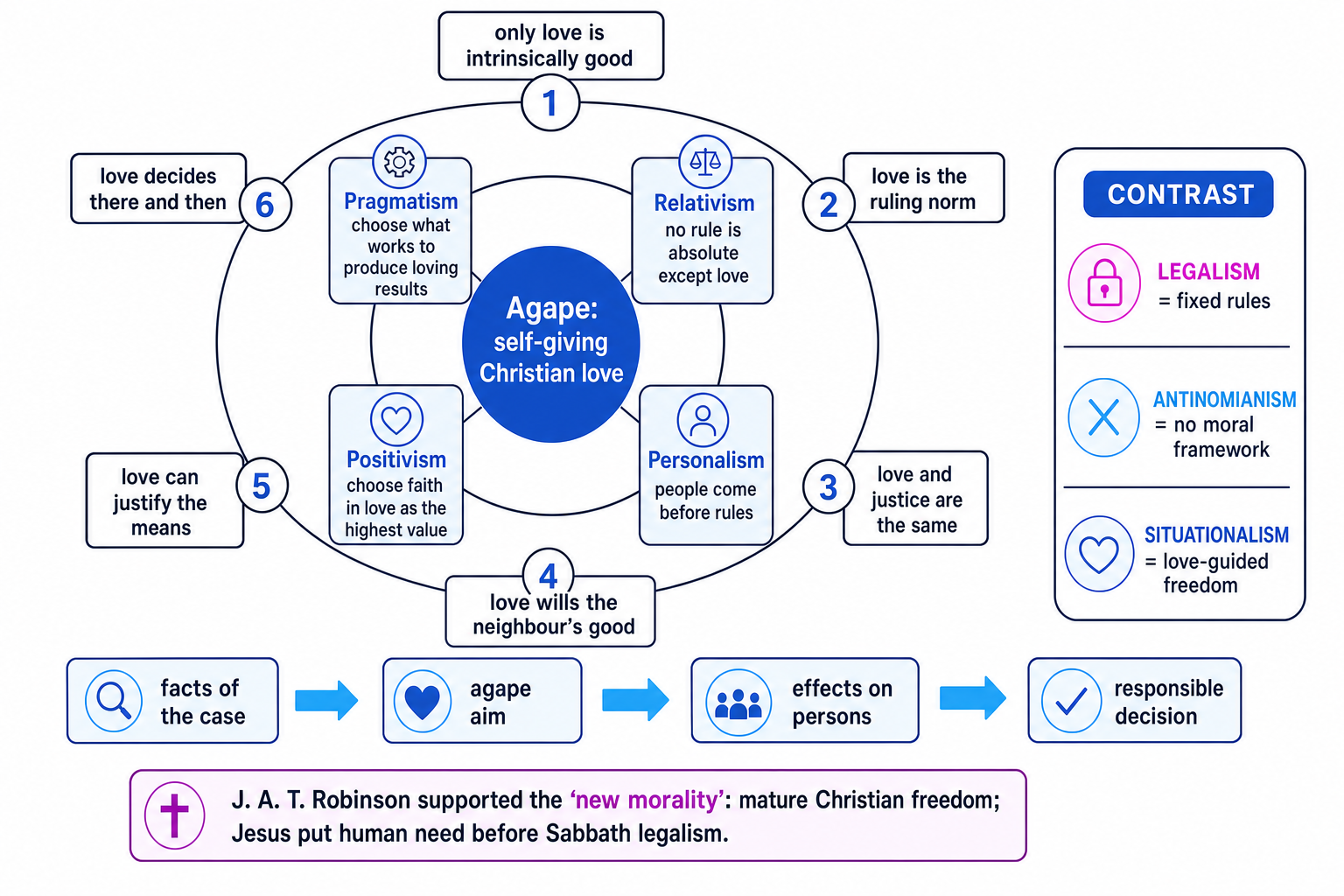
J. A. T. Robinson, Bishop of Woolwich, helped popularise this mood in Honest to God (1963). He argued that mature Christians should not simply obey inherited rules, but should act responsibly in love. Joseph Fletcher then gave the approach its most famous systematic form in Situation Ethics: The New Morality (1966).
What is Situation Ethics?
Definition
Situation Ethics
Situation Ethics is a Christian ethical theory which says that the morally right action is the one that produces the most loving outcome in the particular situation. It is teleological, meaning it judges actions mainly by their goal, end or consequence.
Fletcher presents Situation Ethics as a middle way between two extremes:
- Legalism: following fixed rules whatever the circumstances.
- Antinomianism: rejecting moral rules altogether, leaving decisions without a clear framework.
- Situationalism: taking rules seriously, but being prepared to set them aside when love requires it.
Key Idea
The core idea
For Fletcher, rules are useful guidelines, but they are never absolute. The only absolute is agape.
Agape: the love at the centre
Definition
Agape
Agape is self-giving, unconditional love that seeks the good of the neighbour, whether or not we personally like them.
Fletcher’s famous claim is that “only one thing is intrinsically good; namely love: nothing else at all.” An intrinsic good is something good in itself, not just good because it leads to something else.
This means actions such as lying, stealing or even killing are not automatically wrong in every possible situation. They are wrong if they fail to serve agape; they could be justified if they genuinely produce the most loving outcome.
Common Mistake
Agape is not just emotion
Do not describe agape as “doing what feels loving”. Fletcher means a disciplined moral concern for persons, not sentimentality or personal preference.
Fletcher’s four working principles
Fletcher uses four “working principles” to explain how Situation Ethics operates.
Pragmatism
Pragmatism means judging an action by whether it works in practice. For Fletcher, a moral decision must actually help people; it is not enough for it to sound noble in theory.
Relativism
Relativism means that moral rules are not absolute. Fletcher does not mean “anything goes”. He means every rule is relative to agape.
Positivism
Positivism means choosing, as an act of faith, to place love first. Fletcher thinks Situation Ethics begins with a positive commitment to agape, not with a proof that everyone must accept.
Personalism
Personalism means people come before rules, institutions or abstract principles. Fletcher says ethics is about persons, not laws for their own sake.
Tip
Remember the four principles
Use P-R-P-P: Pragmatism, Relativism, Positivism, Personalism. Then link each one back to agape.
Fletcher’s six fundamental principles
Fletcher also gives six propositions:
- Only love is intrinsically good.
- Love is the ruling norm of Christian decision-making.
- Love and justice are the same, because justice is love distributed fairly.
- Love wills the neighbour’s good, whether we like the neighbour or not.
- Only the end justifies the means.
- Love’s decisions are made situationally, not prescriptively.
“Prescriptively” means according to fixed commands given in advance. Fletcher thinks moral judgement must happen in the real situation, with real people and real consequences.
Common Mistake
The end must be love
When Fletcher says “the end justifies the means”, he does not mean any desired outcome can justify any action. Only an agape-centred end can justify the means.
Applying Situation Ethics
A situationist does not begin by asking, “Which rule has been broken?” Instead, they ask, “What action best serves self-giving love for everyone affected?”
Example
Lying to protect a persecuted neighbour
-
Identify the moral conflict: telling the truth usually matters, but telling the truth here would expose an innocent neighbour to serious harm.
-
Apply agape: the loving aim is to protect the vulnerable person’s life and dignity, not to preserve truth-telling as an abstract rule.
-
Compare likely outcomes: truth-telling would assist persecution; lying would break a normal moral rule but protect a person from grave injustice.
-
Reach a situationist judgement: Fletcher would likely say lying is morally right in this case, because the rule against lying is relative to the higher demand of love.
Fletcher’s own examples are deliberately provocative. One famous case concerns a woman in a prisoner-of-war camp who becomes pregnant so that she can be released and return to her family. Fletcher uses this to argue that even acts traditionally condemned, such as adultery, cannot be judged apart from the loving purpose and circumstances.
That example is useful for essays because it shows both the appeal and the danger of Situation Ethics. It seems compassionate and realistic, but critics may argue it can excuse actions that religious traditions have usually seen as intrinsically wrong.
Biblical examples of situationist thinking
Fletcher and Robinson both argue that Situation Ethics fits the ministry of Jesus. Jesus often challenged religious legalism when rules harmed people.
Key examples include:
- Jesus saying, “The Sabbath was made for man, not man for the Sabbath” in Mark 2.
- Jesus healing on the Sabbath, prioritising human need over strict rule-keeping.
- The parable of the Good Samaritan, where love of neighbour matters more than religious status.
- Jesus’ summary of the law as love of God and love of neighbour in Matthew 22.
- Paul’s teaching in Romans 13 that love is the fulfilment of the law.
Example
Reading the Sabbath healing as situationist
-
Start with the rule: Jewish Sabbath law restricted work, and healing could be interpreted as breaking that rule.
-
Notice Jesus’ priority: the suffering person’s need is treated as more important than preserving a rule in a rigid way.
-
Draw the ethical principle: the rule is not abolished, but it is judged by whether it serves human good.
-
Link to Fletcher and Robinson: this supports their claim that Christian ethics should put persons and love before legalism.
However, this biblical support is debated. More conservative Christians may reply that Jesus did not reject God’s law; he interpreted it properly. They may argue that Fletcher goes further than Jesus by allowing almost any rule to be broken.
J. A. T. Robinson and Joseph Fletcher compared
Fletcher and Robinson are closely connected, but they are not identical.
| Scholar | Main contribution | Key emphasis |
|---|---|---|
| J. A. T. Robinson | Popularised the “new morality” in liberal Christian thought | Mature Christian freedom and love beyond outdated legalism |
| Joseph Fletcher | Systematised Situation Ethics as a method | Agape as the one absolute norm, with four working principles and six propositions |
Robinson’s approach is broader and more theological. He wanted Christianity to speak meaningfully to a modern, secularising world. Secularisation means the declining influence of religion in public and personal life.
Fletcher is more precise as an ethical theorist. He gives students a clearer framework for applying the theory to moral problems.
Strengths of Situation Ethics
Situation Ethics is strong because it is flexible. It recognises that real moral life is complex, and that fixed rules can sometimes produce cruel results.
It is also strongly personalist. It protects the idea that people matter more than systems. This fits many examples from Jesus’ ministry and appeals to Christians who see love as the heart of the gospel.
It can also seem appropriate in a changing society. Modern law often considers circumstances: abortion law, medical consent, divorce and safeguarding all involve attention to context rather than one simple rule for every case.
Weaknesses of Situation Ethics
The biggest weakness is subjectivity. Subjectivity means depending too much on personal judgement or perspective. A person may sincerely claim to be acting lovingly while actually rationalising selfishness.
Another problem is predicting consequences. Since Situation Ethics is teleological, it needs some estimate of outcomes. But in complex cases, we may not know what will produce the most loving result.
Critics also argue that some acts should be treated as intrinsically wrong. Roman Catholic Natural Law ethics, for example, generally rejects the idea that adultery, murder or intentionally killing the innocent could become right because of circumstances.
William Barclay criticised Situation Ethics for giving ordinary people too much responsibility without enough moral guidance. Rules, on this view, are not just restrictive; they protect the vulnerable and educate conscience.
Common Mistake
Forgetting religious disagreement
Do not write as if all Christians accept Situation Ethics. It is most compatible with liberal Protestant Christianity, but it conflicts with more rule-based approaches such as Catholic Natural Law and some conservative biblical ethics.
Continuing relevance today
Situation Ethics still matters because many modern moral debates are case-based: end-of-life care, abortion, war, sexuality, poverty, medical confidentiality and family ethics all involve difficult circumstances.
Social attitudes have also moved closer to some situationist instincts. Divorce, contraception and same-sex relationships are more widely accepted in the UK than they were in the early 20th century. This makes Fletcher and Robinson seem less shocking than they once did.
But continuing application also has limits. Public ethics needs stable laws, rights and safeguards. A society cannot rely only on individuals deciding what love requires in each situation. For example, medical ethics needs compassion, but it also needs consent, professional standards and legal protection.
A balanced judgement might be: Situation Ethics is powerful as a corrective to cold legalism, but dangerous if it becomes the whole of ethics. It works best when agape shapes moral judgement, while rules and rights still provide boundaries.
Exam technique
In the exam
-
Define Situation Ethics accurately: it is not “no rules”, but agape-centred situational judgement.
-
Use both named scholars: Robinson for the “new morality” and Christian freedom; Fletcher for the four working principles and six propositions.
-
Evaluate with balance: explain why the theory fits Jesus’ ministry and modern case-based ethics, then challenge it using subjectivity, consequences and conflict with rule-based religious approaches.
Self review
Check yourself
- What is the difference between legalism, antinomianism and situationalism?
- How do Fletcher’s four working principles help apply agape?
- Why might some Christians argue that Situation Ethics is not fully compatible with biblical ethics?

Keep learning
Make a free account to read the full revision notes and worked examples.