The dialogue between Judaism and philosophy
What you'll learn
- How key Jewish beliefs can be discussed through philosophical questions about reason, meaning and coherence.
- How to connect Judaism with topics from philosophy of religion, such as religious language, religious experience and miracles.
- Why “faith” can mean both accepting claims as true and living in trusting covenant with God.
- How to build evaluative essay paragraphs for AQA dialogue questions.
1. What this “dialogue” means
In AQA Section B, dialogue means a two-way conversation between Judaism and philosophy. You are not just listing Jewish beliefs, and you are not just listing philosophical criticisms. You are asking how philosophical enquiry challenges, clarifies or supports Jewish belief.
Dialogue
A dialogue is a synoptic discussion where beliefs from Judaism are tested through philosophical questions, such as whether they are reasonable, meaningful, coherent and relevant to faith.
Use the map below as a revision checklist: every Jewish belief area can be tested through the same philosophical questions.
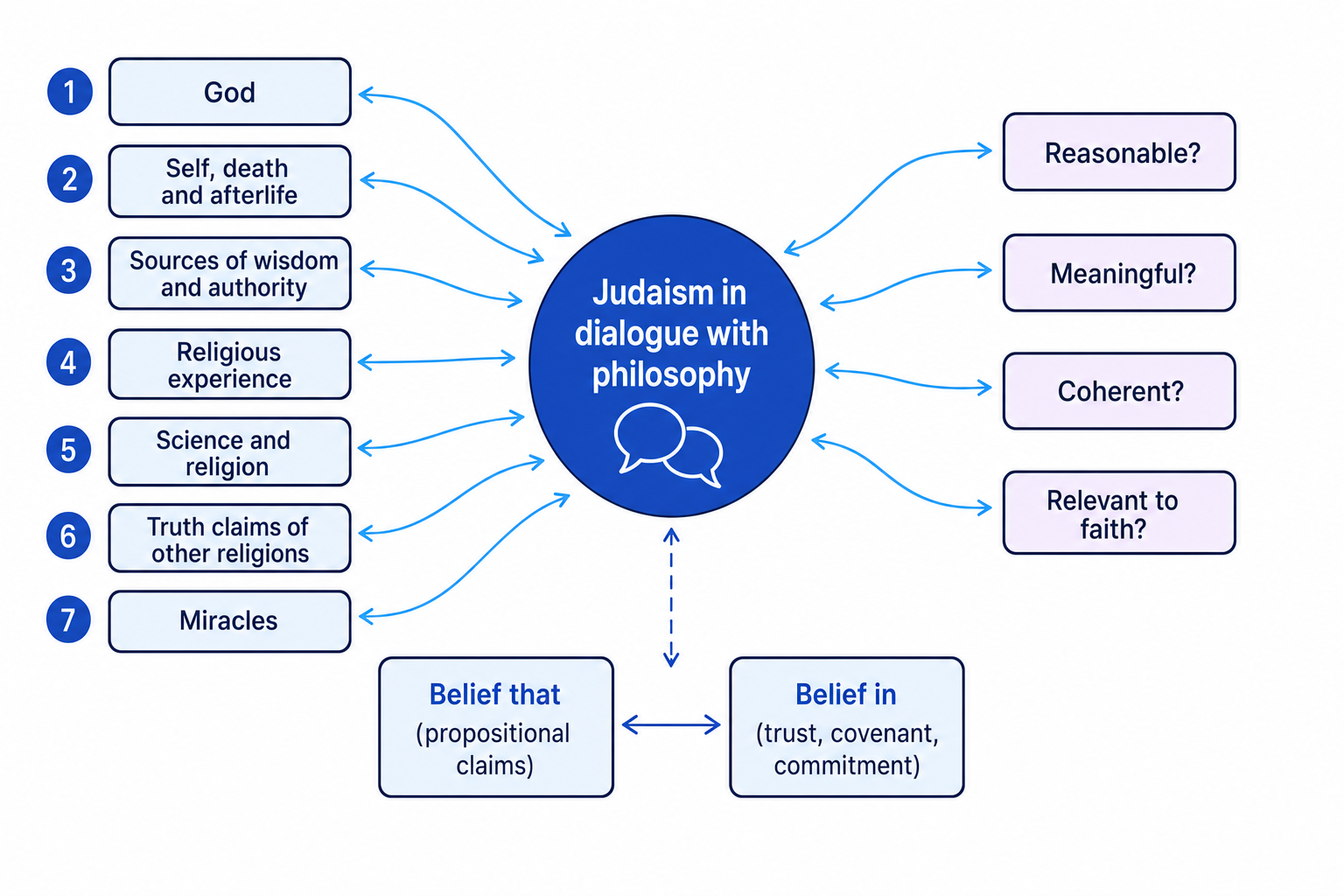
The four philosophical tests
- Reasonable: is the belief based on reason, evidence or experience, or at least consistent with reason?
- Meaningful: does the statement actually communicate something, and for whom?
- Coherent: does the belief fit with other Jewish beliefs, or does it create contradiction?
- Relevant to faith: does philosophy help religious faith, or does faith belong more to trust, practice and covenant?
2. Faith: “belief that” and “belief in”
A vital distinction for this topic is between belief that and belief in.
Belief that and belief in
- Belief that means accepting a proposition as true, such as “God exists” or “God gave the Torah”.
- Belief in means trust, loyalty and commitment, such as trusting God through the covenant and living by the mitzvot, the commandments.
In Judaism, faith is often linked with emunah, meaning faithfulness, trust or reliability. This matters because Judaism is not only about abstract propositions. It is also about covenant, worship, law, community and action.
A covenant is a binding relationship or agreement between God and human beings. In Judaism, the covenant with Abraham and the covenant at Sinai shape Jewish identity and duty.
Applying belief that and belief in
-
Take the Shema from Deuteronomy 6:4: “Hear, O Israel: the LORD our God, the LORD is one.” As belief that, this asserts monotheism: there is one God, not many gods.
-
Philosophically, you can test that claim for coherence: if God is one, eternal and incorporeal, Jewish belief must avoid picturing God as a physical being among other beings.
-
As belief in, the Shema is not just a theory. It is recited in prayer and shapes covenant loyalty, worship and obedience to God.
-
A balanced judgement is that philosophy can test the truth-claim, but it cannot fully capture the lived meaning of Jewish faith as trust and practice.
3. God: unity, creation and divine attributes
Judaism is strongly monotheistic, meaning it teaches belief in one God. The Shema is the classic expression of this. God is also understood as creator, judge, lawgiver, merciful and just.
God is transcendent, meaning beyond the created world, but also immanent, meaning active within history and human life. Maimonides, a major medieval Jewish philosopher, argued that God is incorporeal, so God has no body. In The Guide for the Perplexed, he used via negativa, or negative theology: it is safer to say what God is not than to describe God positively in human terms.
This helps with meaningfulness. If “God is powerful” is taken too literally, it risks making God sound like a very strong human. Maimonides’ approach protects divine mystery while still allowing meaningful religious speech.
The main coherence problem is the problem of evil: if God is good, powerful and just, why is there suffering? For Jewish thought, this becomes especially serious after the Holocaust. Some, such as Emil Fackenheim, argued that Jewish faith must continue as resistance to evil; others, such as Richard Rubenstein, questioned traditional belief in a covenantal God after Auschwitz.
Forgetting diversity within Judaism
Do not write as if all Jews respond in the same way. Orthodox, Reform, Liberal, mystical, rationalist and post-Holocaust Jewish thinkers may handle God, scripture, afterlife and miracles differently.
4. Self, death and afterlife
Genesis 1:27 teaches that humans are created b’tzelem Elohim, in the image of God. This supports the dignity and value of human life. Judaism also teaches moral responsibility: humans have free will and must choose between the yetzer ha-tov, the good inclination, and the yetzer ha-ra, the evil inclination.
Jewish beliefs about death and afterlife are varied. Olam ha-ba means the World to Come. Some Jewish sources teach resurrection of the dead, especially in rabbinic Judaism and in Maimonides’ Thirteen Principles. Other Jewish approaches focus more on this-worldly obedience, legacy, memory and community.
Philosophically, afterlife raises questions of personal identity. If the body dies, what continues? A purely materialist view of the self challenges survival after death. However, bodily resurrection may fit Judaism better than a Greek-style immortal soul, because Judaism often sees the human person holistically rather than as a soul trapped in a body.
The belief can be seen as reasonable if it supports divine justice: if good and evil are not fully rewarded or corrected in this life, the World to Come may complete moral order. But it is less easy to prove by public evidence.
5. Sources of wisdom and authority
The central source of authority in Judaism is the Torah, meaning teaching or instruction. The Written Torah is the first five books of the Hebrew Bible. The Oral Torah is the tradition of interpretation preserved in texts such as the Mishnah and Talmud. Halakhah means Jewish law, literally “the way”.
Philosophically, this raises the issue of revelation and reason. If the Torah is from God, it has unique authority. But how should it be interpreted? Jewish tradition does not usually treat authority as anti-intellectual. The Talmud records arguments, minority opinions and careful reasoning.
This makes Jewish authority partly coherent with philosophical enquiry: reason is used inside the tradition. However, outsiders may ask whether revealed authority can be justified without already accepting Jewish premises.
6. Religious experience
A religious experience is an experience interpreted as an encounter with God or the sacred. In Judaism, the most important example is communal revelation at Sinai in Exodus 19–20, where God gives the Torah. Prophetic experiences, prayer, Shabbat, worship and mystical traditions such as Kabbalah also matter.
Philosophers ask whether religious experience is reliable. William James argued that experiences may be judged by their “fruits”, meaning their practical effects. Rudolf Otto described the numinous as the awe-filled experience of the holy. Richard Swinburne’s principle of credulity suggests we should usually trust how things seem unless we have a reason not to.
Judaism adds an important test: experience must fit Torah and monotheism. Deuteronomy 13 warns that even impressive signs should be rejected if they lead Israel to other gods. So religious experience is not automatically authoritative; it must be coherent with the belief system.
7. Science and religious discourse
A discourse is a way of speaking and explaining. Scientific discourse uses observation, evidence and testable theories. Religious discourse often asks questions of meaning, value, purpose and covenant.
Genesis 1 teaches that God is creator, creation is ordered and good, and Shabbat is built into the rhythm of life. Many Jews do not read Genesis as a science textbook. Maimonides argued that where reason gives strong demonstration, scripture should not be interpreted in a crude literal way.
Science and Genesis
A strong essay avoids the lazy claim that “science disproves Judaism”. Instead, ask what kind of claim Genesis is making: scientific, historical, theological, symbolic, liturgical, or several at once.
The dialogue is still real. If a believer claims the universe was created in a particular historical sequence, science may challenge that. But if the claim is that creation depends on God for its existence and meaning, science and religion may be addressing different levels of explanation.
8. Truth claims of other religions
A truth claim is a statement that says something is actually true. Judaism makes truth claims: God is one, Torah is authoritative, and Israel has a covenantal role.
Judaism is often particularist without being simply exclusivist. Particularism means God has a special covenant with Israel. But the Noahide covenant with all humanity and the idea of righteous non-Jews show a universal moral dimension. Judaism does not generally teach that everyone must become Jewish to be righteous before God.
Philosophically, this connects with pluralism. John Hick argued that world religions are culturally shaped responses to “the Real”. This may help explain why different religions contain wisdom and moral transformation. However, it can weaken specific Jewish claims about Torah, covenant and the oneness of God. For example, Judaism cannot simply accept Christian claims about incarnation or Trinity if they conflict with the Shema.
9. Miracles
A miracle is an extraordinary event understood as an act or sign of God. Jewish examples include the Exodus, the parting of the Sea, manna in the wilderness and the story behind Hanukkah.
David Hume defined a miracle as a violation of the laws of nature and argued that testimony is usually too weak to establish one. Maurice Wiles argued that interventionist miracles make God seem morally arbitrary: why would God intervene sometimes but not to prevent terrible suffering?
Evaluating a miracle claim
-
Start with the Jewish claim: the Exodus miracles are not just strange events; they reveal God as liberator and covenant partner.
-
Apply Hume: because the events are ancient and depend heavily on testimony and tradition, a sceptic may argue that natural explanation or error is more likely.
-
Apply Wiles: if God intervened to save Israel at the Sea, the believer must address why God does not always intervene, especially in events such as the Holocaust.
-
Weigh the Jewish response: miracles may function less as public proof and more as covenant memory, shaping Pesach, identity and trust in God.
This shows the dialogue clearly. Philosophy challenges whether miracles are reasonable and coherent. Judaism may reply that miracles are meaningful within worship, history and covenant, even if they do not compel belief from outsiders.
10. Overall impact on Jewish belief
Philosophical enquiry has had a major impact on Jewish belief past and present. Medieval thinkers such as Maimonides used philosophy to refine belief in God, creation and religious language. Modern Jewish thinkers use philosophy to address science, pluralism, Holocaust theology and religious experience.
The best evaluative judgement is not simply “philosophy destroys faith” or “faith ignores philosophy”. Philosophy can test belief that claims for reasonableness and coherence. But Judaism also involves belief in God through covenant, mitzvot, prayer, memory and community. That means philosophical enquiry is relevant, but not exhaustive.
In the exam
-
Begin with a clear Jewish belief and anchor it in a source, such as the Shema, Genesis 1:27, Sinai, Torah, Talmud or Exodus.
-
Bring in the philosophical issue explicitly: reasonableness, meaningfulness, coherence, religious experience, science, truth claims or miracles.
-
Evaluate the impact on faith: does philosophy weaken the belief, clarify it, or show that Jewish faith is more about covenantal trust than abstract proof?
Check yourself
- How does the distinction between “belief that” and “belief in” change the way you evaluate Jewish faith?
- Why might Maimonides’ via negativa help Jewish statements about God remain meaningful?
- How do Hume and Wiles challenge Jewish belief in miracles differently?

Keep learning
Make a free account to read the full revision notes and worked examples.