The dialogue between Judaism and ethics
What you'll learn
- How Jewish ethics relates to Kantian duty, Benthamite consequences, and virtue ethics.
- Why Judaism cannot be reduced to just one ethical approach.
- How Jewish principles apply to life and death, sexuality, wealth, truth, animals, genetics, and religious freedom.
- How free will, moral responsibility, and conscience shape Jewish moral decision-making.
1. What is this “dialogue” topic asking you to do?
In AQA dialogues, you are not just describing Judaism. You are showing how Judaism interacts with ethical theories and ethical issues from Component 1.
So your essay task is usually synoptic: you explain Jewish beliefs and practices, then compare them with ethical approaches such as deontology, utilitarianism, and virtue ethics.
Dialogue
A dialogue is a two-way conversation between areas of the course. Here, it means exploring how Jewish ethics supports, challenges, modifies, or is challenged by ethical theories and applied ethical debates.
A strong answer avoids saying “Judaism teaches X” as if all Jews agree. Judaism contains different traditions, especially Orthodox, Conservative/Masorti, Reform, and Liberal Judaism.
Judaism is not one voice
Jewish ethics is rooted in Torah and halakhah, but Jewish communities differ over how fixed, flexible, or historically developing those sources should be.
2. The foundations of Jewish moral decision-making
Before comparing Judaism with ethical theories, you need the basic Jewish moral framework.
Torah, mitzvot and halakhah
Torah
The Torah means “teaching” or “instruction”. Narrowly, it refers to the first five books of the Hebrew Bible; more broadly, it can include the whole Jewish tradition of divine teaching.
Mitzvot
Mitzvot are commandments. Traditional Judaism often refers to 613 mitzvot, shaping worship, community life, justice, food laws, sexuality, business ethics, and personal conduct.
Halakhah
Halakhah means Jewish law, literally “the way of walking”. It is the practical legal and moral tradition developed from Torah, Talmud, rabbinic debate, and later responsa.
Jewish ethics is covenantal. A covenant is a binding relationship between God and the Jewish people. This means morality is not merely private preference: it is part of living faithfully before God.
Important moral principles include:
- Sanctity of life: human beings are made in the image of God — imago Dei — in Genesis 1:27.
- Pikuach nefesh: saving human life, which can override most commandments.
- Tzedakah: often translated as charity, but closer to justice-based giving.
- Chesed: loving-kindness or covenant loyalty.
- Tikkun olam: “repairing the world”, often used in modern Jewish social justice.
- Shalom: peace, wholeness, and flourishing.
- Kavod habriyot: human dignity, literally the dignity of created beings.
Pikuach nefesh
Pikuach nefesh is the principle that saving human life overrides almost all other religious duties. It is strongly associated with rabbinic teaching, including discussion in Yoma 85b.
3. Jewish ethics and ethical theories
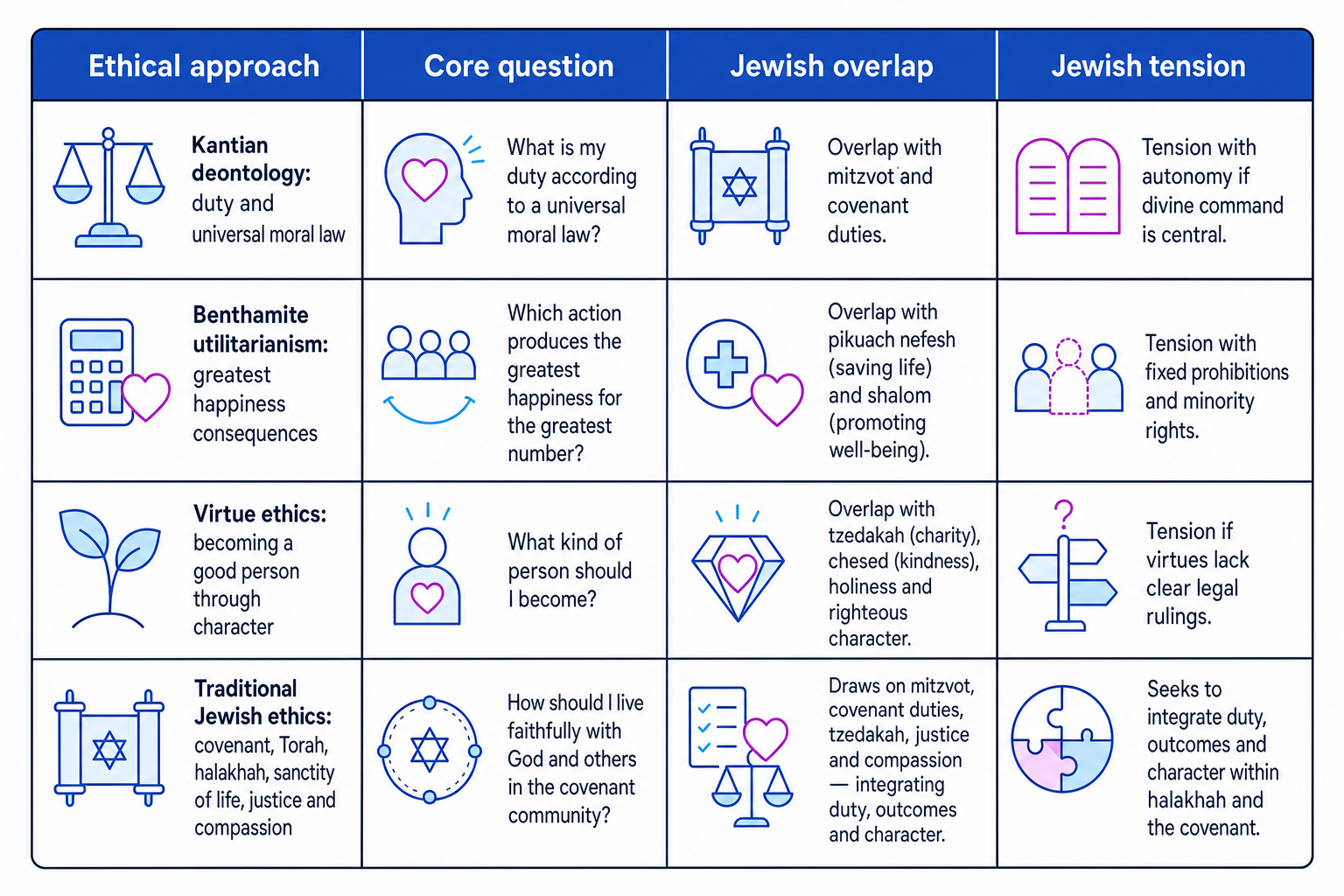
AQA names three major approaches: Kantian deontology, Benthamite teleological/consequential ethics, and virtue ethics.
Deontological ethics and Kant
Deontological ethics
Deontological ethics judges actions by whether they fulfil duties or rules, rather than mainly by their consequences.
Immanuel Kant argued that morality is based on reason, duty, and the categorical imperative. The categorical imperative is a moral command that applies universally, regardless of personal desire.
Kant’s famous formulations include:
- Act only according to a maxim you could will to become a universal law.
- Treat humanity, whether in yourself or others, always as an end and never merely as a means.
Judaism has clear deontological features. The mitzvot are duties. “You shall not murder”, “You shall not steal”, and “You shall not bear false witness” in Exodus 20 are not presented as optional calculations.
However, Judaism is not simply Kantian. Kant grounds morality in autonomous rational will, whereas traditional Judaism grounds duty in God, Torah, covenant, and rabbinic authority. Also, Jewish law allows duties to be weighed — for example, pikuach nefesh may override Sabbath restrictions.
Do not call Judaism simply Kantian
Judaism has many duties, but Kantian ethics is based on autonomous reason, while Jewish ethics is normally based on covenant, Torah, and God’s commandments.
Teleological and consequential ethics with Bentham
Teleological ethics
Teleological ethics judges actions by their end or goal. The word comes from telos, meaning purpose or end.
Consequential ethics
Consequential ethics judges actions by their outcomes or consequences.
Jeremy Bentham’s utilitarianism says the right action is the one producing “the greatest happiness of the greatest number”. Bentham used the hedonic calculus to consider factors such as intensity, duration, certainty, and extent of pleasure.
Judaism can sometimes look consequentialist. Pikuach nefesh asks what preserves life. Jewish concern for shalom, welfare, community stability, and reducing suffering can involve consequences.
But Judaism resists pure utilitarianism. It does not usually allow the majority’s happiness to override the dignity of the individual. A Jewish argument against utilitarianism would say that each human being has worth because they are created in God’s image, not because they maximise social utility.
Character-based ethics and virtue ethics
Virtue ethics
Virtue ethics focuses on the kind of person you become, rather than only on rules or consequences. In Aristotle, the goal is eudaimonia, meaning human flourishing, achieved through virtues and practical wisdom.
Virtue ethics connects strongly with Judaism. Judaism is not only about isolated actions; it forms a holy people and righteous character. Qualities such as humility, justice, compassion, honesty, courage, and generosity are central.
There is also a Jewish tradition of mussar, ethical and spiritual character formation. This resonates with Aristotle’s idea that moral habits shape the person.
However, virtue ethics may be criticised from a Jewish perspective if it lacks clear divine command or legal guidance. Jewish ethics often asks not only “What kind of person should I be?” but also “What does Torah require in this situation?”
Lying to save a life
-
Start with the apparent duty: Exodus 23:7 says to keep far from falsehood, and the Ten Commandments prohibit false witness, so Judaism has a strong duty-based opposition to lying.
-
Weigh the higher principle: if lying is necessary to save an innocent life, pikuach nefesh becomes morally decisive because preserving life overrides many other commandments.
-
Compare the theories: Kant would likely reject lying because it cannot be universalised, while Bentham might permit it because it produces better consequences.
-
Reach a Jewish judgement: Judaism is not simply consequentialist, because it still treats truth as a serious duty; but it is not rigidly Kantian either, because duties exist within a hierarchy shaped by Torah and the sanctity of life.
4. How far is Jewish ethics deontological, teleological, consequential, or character-based?
The best answer is: Jewish ethics contains all four elements, but within a covenantal and halakhic framework.
It is deontological because mitzvot create binding duties. It is teleological because Jewish life has a purpose: holiness, covenant faithfulness, justice, peace, and closeness to God. It is consequential because outcomes matter, especially where life, suffering, and communal wellbeing are involved. It is character-based because Torah forms people into a righteous and compassionate community.
The balanced judgement
Jewish ethics is best understood as covenantal: it integrates duty, consequences, purpose, and character under the authority of Torah, halakhah, and Jewish moral tradition.
5. Jewish responses to applied ethical issues
Human life and death
Jewish ethics strongly affirms the sanctity of life. Genesis 1:27 teaches that humans are made in God’s image, and Deuteronomy 30:19 says, “Choose life.”
This affects issues such as abortion, euthanasia, suicide, capital punishment, war, organ donation, fertility treatment, and end-of-life care.
In general:
- Abortion is not usually treated exactly like murder in Jewish law, because the fetus does not have the same legal status as a born person. However, it is still morally serious. Many authorities permit abortion to save the mother’s life; more liberal movements may allow broader concern for wellbeing.
- Euthanasia is usually rejected if it actively causes death, because life belongs to God. However, some authorities allow withdrawing burdensome treatment where death is imminent and suffering is severe.
- Organ donation may be supported through pikuach nefesh, though questions about defining death can be debated.
- Capital punishment exists in biblical law, but rabbinic Judaism made its application extremely difficult, showing concern for justice and preventing wrongful death.
Animal life and death
Judaism values animals, though it usually gives humans a special status. The principle of tza’ar ba’alei chayim means preventing unnecessary animal suffering.
Jewish animal ethics affects:
- Shechita, Jewish ritual slaughter, which supporters argue is a religiously required and humane method when properly performed.
- Vegetarianism, supported by some Jews as an ideal of compassion, though not required by mainstream halakhah.
- Animal experimentation, which may be permitted for serious human medical benefit but challenged if suffering is unnecessary.
- Bal tashchit, the prohibition on needless destruction, based on Deuteronomy 20:19.
A utilitarian may focus mainly on balancing suffering and benefit. Jewish ethics shares concern for suffering but also frames animal treatment through divine creation, human responsibility, and commandment.
Theft and lying
Theft is condemned in the Ten Commandments and developed in laws about honest weights, fair trade, and restitution. Leviticus 19:11 says not to steal, deal falsely, or lie.
Lying is also condemned, but Judaism recognises complex cases. Rabbinic tradition sometimes allows modifying the truth for peace, kindness, or saving life. This differs from Kant’s strict approach.
Marriage
Marriage is highly valued in Judaism as a covenantal relationship involving commitment, family life, sexuality, and community. Genesis 2:24 speaks of a man leaving his parents and being united with his wife, and Genesis 1:28 commands humans to “be fruitful and multiply”.
Traditional Judaism sees marriage as between a man and a woman, with procreation as significant but not the only purpose. Reform and Liberal Judaism often place greater emphasis on mutual love, equality, companionship, and personal fulfilment.
Same-sex relationships and transgender matters
Traditional Orthodox Judaism usually prohibits male same-sex intercourse on the basis of Leviticus 18:22 and 20:13, while often distinguishing between orientation and prohibited acts. Female same-sex relationships are treated differently in many halakhic discussions but may still be disapproved in traditional circles.
Reform, Liberal, and many progressive Jewish communities affirm same-sex relationships and conduct same-sex marriages, appealing to dignity, justice, love, and the need to reinterpret ancient texts in light of modern knowledge.
Transgender matters are complex. Some traditional responses appeal to fixed categories of male and female, and sometimes to Deuteronomy 22:5 on clothing associated with another sex. More progressive Jewish responses emphasise kavod habriyot, mental wellbeing, human dignity, and the recognition that Jewish legal sources already discuss people who do not fit simple binary categories.
Use diversity carefully
For sexuality and gender, do not write “Jews believe…” Instead, contrast Orthodox halakhic caution with progressive emphasis on dignity, inclusion, and developing interpretation.
Genetic engineering
Jewish responses to genetic engineering are often more positive than some Christian natural law approaches, because Judaism does not always see “nature” as morally perfect or untouchable. Humans may be partners with God in healing creation.
Genetic screening, gene therapy, and technologies preventing serious disease can be supported through pikuach nefesh and healing. However, concerns arise over designer babies, inequality, eugenics, embryo status, and whether humans are acting arrogantly.
A Benthamite might ask whether genetic engineering maximises happiness. A Jewish response would also ask whether it respects human dignity, family, justice, and the limits of responsible partnership with God.
6. Wealth, tolerance, and freedom of religious expression
Wealth
Judaism does not usually teach that wealth is evil in itself. The issue is how wealth is gained and used.
Tzedakah is a duty, not merely optional generosity. The Torah commands care for the poor, the widow, the orphan, and the stranger. Leviticus 19 teaches leaving the corners of fields for the poor, and Deuteronomy 15 urges open-handedness.
This challenges both selfish capitalism and simplistic utilitarian redistribution. Judaism supports justice, responsibility, and community obligation.
Tolerance
Jewish ethics has strong resources for tolerance: all humans are made in God’s image, and Torah repeatedly commands love for the stranger. Leviticus 19:34 says the stranger should be loved as oneself.
However, Judaism also has a strong covenant identity, and traditional sources reject idolatry. So Jewish tolerance is not the same as saying all beliefs are equally true. It is better understood as respect for persons, justice for minorities, and peaceful coexistence.
Freedom of religious expression
Because Jews have often lived as minorities, religious freedom is deeply important in modern Jewish thought. The ability to keep Shabbat, wear religious clothing, eat kosher food, practise circumcision, and gather for worship may be defended through human dignity and minority rights.
At the same time, conflicts can arise with secular law or public values, such as debates about shechita, circumcision, equality law, or religious dress. Jewish ethics must therefore balance covenant loyalty with life in a plural society.
7. Free will, moral responsibility, and conscience
Free will
Free will is the ability to make genuine moral choices rather than being completely controlled by fate, biology, society, or divine predestination.
Jewish ethics strongly affirms moral responsibility. Deuteronomy 30:19 says, “I have set before you life and death, blessings and curses. Now choose life.”
Maimonides argues in Laws of Repentance that human freedom is essential: if people were not free, reward, punishment, repentance, and commandment would make no sense.
Rabbi Akiva’s saying in Pirkei Avot 3:15 — “Everything is foreseen, yet freedom is given” — captures a Jewish tension: God’s knowledge does not remove human responsibility.
Conscience
Conscience is a person’s inner awareness or judgement about right and wrong.
In Judaism, conscience matters, but it is not usually treated as a completely independent authority. Conscience should be educated by Torah, community, prayer, rabbinic wisdom, and moral reflection.
This creates a useful comparison with Kant. Kant gives high authority to rational moral autonomy. Judaism values moral agency, but sees the self as accountable before God and shaped by covenant.
8. The impact of other ethical perspectives on Jewish views
Other ethical perspectives have both challenged and supported Jewish ethics.
Kantian ethics supports Jewish concern for human dignity, especially the idea that people must never be treated merely as tools. But Kant’s autonomy challenges traditional divine command and rabbinic authority.
Utilitarianism supports concern for welfare, reducing suffering, medical progress, and social policy. But it may conflict with Jewish protections for minorities, sacred duties, and the non-negotiable dignity of each person.
Virtue ethics strongly supports Jewish character formation, especially humility, generosity, justice, and compassion. But Jewish ethics may criticise virtue ethics if it becomes too vague without commandments and law.
Modern applied ethics has influenced Jewish responsa on IVF, organ donation, genetic testing, environmental ethics, sexuality, gender identity, and human rights. Progressive Jewish movements have often been more willing to revise practice in light of equality and autonomy, while Orthodox authorities are more likely to work within halakhic precedent.
In the exam
-
Start with Jewish sources and principles, then bring in Kant, Bentham, or virtue ethics as comparison, not as an unrelated paragraph.
-
Show diversity within Judaism: Orthodox, Conservative/Masorti, Reform, and Liberal responses may differ, especially on sexuality, gender, and medical ethics.
-
Make a judgement using “how far”: Judaism is partly deontological, partly consequential, partly teleological, and partly character-based, but most fully covenantal and halakhic.
Check yourself
- Why is pikuach nefesh a challenge to calling Judaism purely deontological?
- How might Orthodox and Reform Jewish responses differ on same-sex marriage or transgender identity?
- In what ways does Jewish ethics agree with and resist Benthamite utilitarianism?

Keep learning
Make a free account to read the full revision notes and worked examples.