Judaism, migration and religious pluralism
What you'll learn
- How migration shaped Jewish life in Britain and produced a diverse Jewish community.
- What religious pluralism means, both within Judaism and between Judaism and other faiths.
- How Jewish ideas of being the chosen people can be understood in a multicultural society.
- How Ignaz Maybaum and Richard Rubenstein responded differently to the Holocaust.
The starting point: migration, diaspora and multicultural Britain
To understand this topic, begin with context. Judaism in Britain did not develop in isolation. It has been shaped by migration, legal change, antisemitism, emancipation, Holocaust memory, and life in a modern secular state.
Migration, diaspora and multicultural society
Migration means the movement of people from one place to another, often because of persecution, poverty, war, work or family. Diaspora means Jewish communities living outside the land of Israel. A multicultural society is one in which different ethnic, religious and cultural communities live alongside one another.
Jewish life in Britain has a long but interrupted history. Jews lived in medieval England but were expelled in 1290 under Edward I. A Jewish presence was re-established from 1656, often linked to Oliver Cromwell’s readmission of Jews and the influence of the Sephardi Jewish leader Menasseh ben Israel. Later, Britain saw Sephardi communities, Ashkenazi migration, and then large numbers of Eastern European Jews arriving in the late nineteenth and early twentieth centuries, many fleeing pogroms and poverty.
In the twentieth century, Britain also received Jewish refugees from Nazi Europe, including children on the Kindertransport, as well as Holocaust survivors. Later Jewish migration included communities from the Middle East, North Africa, South Africa, Russia and Israel.
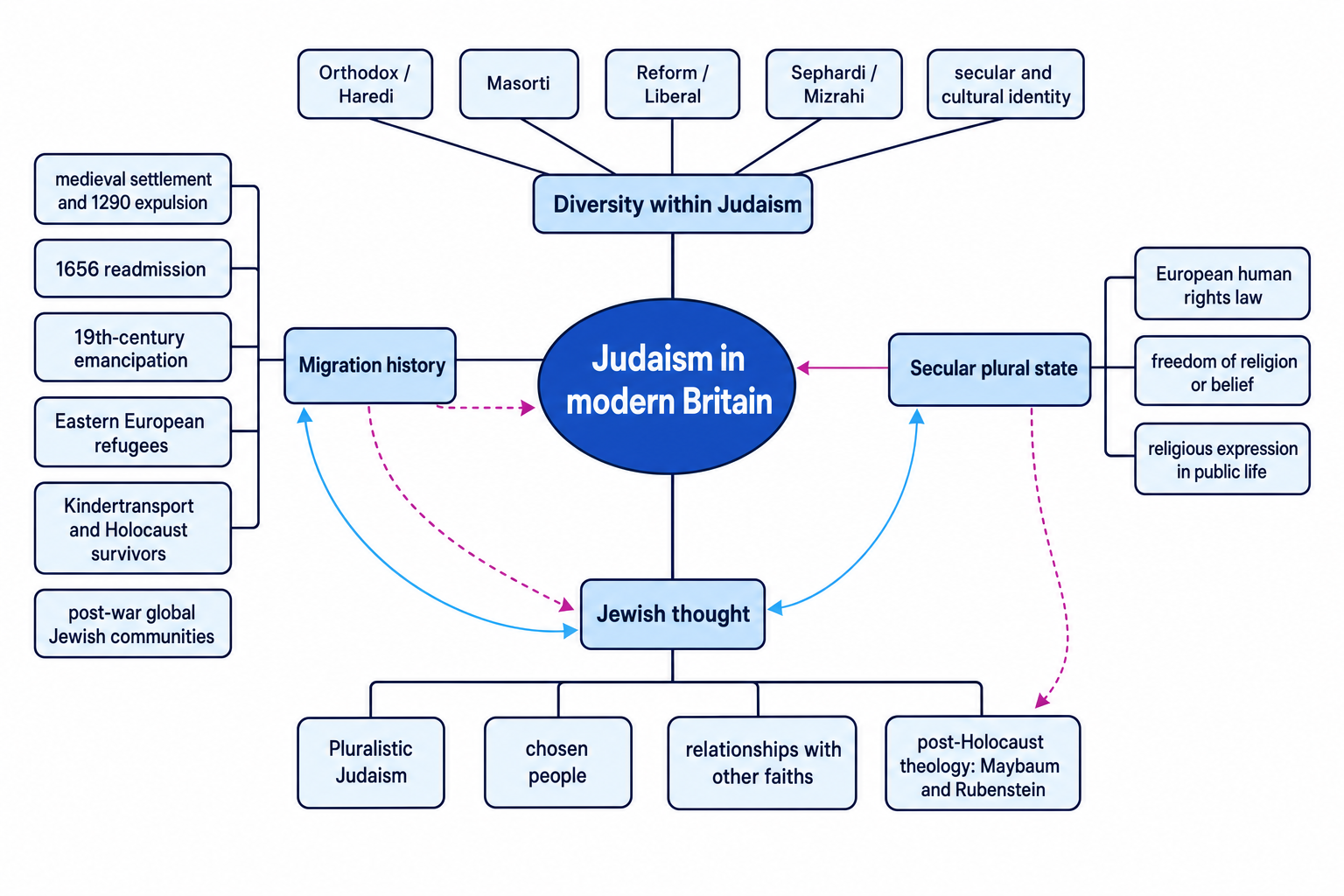
Context shapes Jewish thought
Migration created a British Jewish community that is not uniform. Jewish thought in Britain has therefore had to respond to diversity, integration, antisemitism, religious freedom, and the challenge of maintaining identity in a secular plural society.
Diversity within British Judaism
British Judaism includes many different forms of Jewish identity and practice. There are Haredi or strictly Orthodox Jews, mainstream Orthodox communities, Masorti Judaism, Reform Judaism, Liberal Judaism, Sephardi and Mizrahi traditions, and Jews who identify culturally or ethnically rather than religiously.
Denomination
A denomination is a recognised branch or movement within a religion. In Judaism, denominations often differ over the authority of Torah, the interpretation of halakhah, gender roles, conversion, synagogue worship and engagement with modern society.
Orthodox Judaism generally sees halakhah — Jewish religious law — as binding and rooted in divine revelation. Progressive movements such as Reform and Liberal Judaism tend to place more emphasis on ethical development, historical context and individual conscience.
This diversity matters for exam essays because “Judaism teaches…” is often too vague. A stronger answer asks: which Jewish tradition, and why?
Avoid treating Judaism as one voice
Do not write as if all Jews respond identically to migration, pluralism or religious freedom. AQA rewards precise awareness of diversity within Judaism, especially in modern Britain.
Freedom of religion in European law
Modern British Jewish life is also shaped by the legal protection of religious freedom. The key European reference point is Article 9 of the European Convention on Human Rights, incorporated into UK law through the Human Rights Act 1998.
Freedom of religion or belief
Freedom of religion or belief is the right to hold religious or non-religious beliefs, and to manifest them through worship, teaching, practice and observance. Under Article 9, the inner freedom to believe is strongly protected, but outward religious expression can sometimes be limited to protect public safety, health, morals, order, or the rights of others.
For Jewish communities, this can affect issues such as wearing a kippah, keeping Shabbat, kosher food, Jewish schooling, circumcision, synagogue security, eruv boundaries, and religious slaughter for kosher meat.
A secular state is not necessarily anti-religious. In this topic, it usually means a state where law and citizenship are not controlled by one religious authority, and where different religious and non-religious groups are expected to coexist.
Balancing freedom of religious expression
-
Identify the religious practice: for example, kosher slaughter, known as shechita, is important for many observant Jews because it relates to keeping kosher dietary laws.
-
Apply Article 9: shechita is an outward manifestation of religion, so it falls under freedom of religion or belief. However, it is not an unlimited right because animal welfare is also a public ethical concern.
-
Weigh the competing claims: Jewish communities may argue that banning shechita would restrict religious life and minority identity. Critics may argue that animal welfare law should apply uniformly.
-
Reach an evaluative judgement: a strong answer recognises the tension. A plural society should protect minority religious practice where possible, but it may still regulate practices if restrictions are lawful, proportionate and necessary.
Religious pluralism and Pluralistic Judaism
Religious pluralism
Religious pluralism is more than the fact that many religions exist. It is the view that different religious communities should be able to coexist with respect, and sometimes the stronger theological claim that more than one tradition may contain religious truth or value.
Pluralistic Judaism refers to forms of Jewish thought and practice that recognise the legitimacy or value of diversity within Judaism. It can support cooperation between Orthodox, Reform, Liberal, Masorti, Sephardi, Mizrahi and secular Jewish communities.
This has practical implications. It can encourage shared Jewish schools, inter-denominational dialogue, common responses to antisemitism, and cooperation through organisations such as representative Jewish bodies. However, it also creates tensions. Some Orthodox authorities do not recognise Progressive conversions, women rabbis, or certain approaches to marriage and divorce. For them, pluralism may look like relativising halakhah.
Pluralism is not just diversity
Plurality means many groups exist. Pluralism means there is an attitude, policy or theology of respectful coexistence and engagement. Do not use the terms as if they are identical.
Pluralistic Judaism also affects relationships with other faiths. Many Jewish thinkers support interfaith dialogue, especially after the Holocaust and after centuries of Christian antisemitism. Jewish-Christian relations, Jewish-Muslim dialogue, and shared social action can all be seen as responses to life in a multicultural society.
AO2 evaluation should be balanced. Pluralism can promote peace and reduce prejudice, but it may also raise concerns about assimilation, loss of distinctiveness, or weakening Jewish law and identity.
Chosen people: privilege or responsibility?
A central Jewish belief is that the Jewish people are in a special covenant relationship with God. This is often called being the chosen people.
Chosen people
In Judaism, being the chosen people means that Jews have a covenantal responsibility to God, especially through Torah and the commandments. It should not be understood simply as racial superiority or as God loving non-Jews less.
Key biblical roots include God’s covenant with Abraham in Genesis and the Sinai covenant in Exodus. Exodus 19 describes Israel as a “kingdom of priests” and a “holy nation”. This suggests vocation: Jews are called to live in a way that witnesses to God’s holiness.
In a plural society, this belief can be interpreted in different ways. A traditional view may emphasise the unique covenant and the binding nature of mitzvot. A more pluralistic view may stress that Jewish chosenness is about service, ethical responsibility and being a “light to the nations”, not domination over others.
Chosen means called, not superior
For strong AO2, explain that chosenness can be exclusivist if misunderstood, but within Judaism it is often interpreted as a demanding responsibility rather than a claim of ethnic superiority.
The belief can support good relations with other faiths when linked to ethical monotheism, justice and the idea that righteous non-Jews can have a relationship with God. However, it can create tension if other groups see chosenness as incompatible with equality in a secular democratic society.
Jewish responses to freedom of religious expression
Jewish responses vary. Orthodox Jews may stress the need for legal protection so that halakhic life remains possible in Britain. Progressive Jews may also defend religious freedom, but often link it closely to equality, conscience and human rights.
Common areas of response include:
- defending the right to wear Jewish symbols in public;
- campaigning against antisemitism and hate speech;
- protecting Jewish schools and synagogue security;
- supporting Shabbat observance where possible in work and education;
- defending kosher food production and religious circumcision;
- joining interfaith campaigns for freedom of religion or belief.
This context influences Jewish thought by making questions of identity more public. Jews in Britain must often negotiate between integration and distinctiveness: how to participate fully in national life while preserving Jewish practice and memory.
Useful essay distinction
Use the phrase integration without assimilation. It captures the idea that many Jews seek full participation in British society without losing Jewish identity, law, history or communal belonging.
Post-Holocaust theology: Maybaum and Rubenstein
The Holocaust forced Jewish thinkers to ask whether traditional beliefs about God, covenant and chosenness could still be affirmed. Two important but very different responses are those of Ignaz Maybaum and Richard Rubenstein.
Post-Holocaust theology
Post-Holocaust theology is Jewish theological reflection on God, covenant, evil, suffering and Jewish identity after the murder of six million Jews in the Holocaust.
Ignaz Maybaum: churban, remnant and suffering servant
Ignaz Maybaum was a Reform rabbi and theologian. He interpreted the Holocaust using the idea of churban, a Hebrew term meaning destruction or catastrophe, especially associated with the destruction of the Jerusalem Temples. Maybaum saw the Holocaust as a kind of “third churban”.
He also used the idea of the remnant: the surviving Jewish people who continue Jewish life after catastrophe. For Maybaum, survival was not merely biological. It carried religious significance because the remnant had a duty to continue Jewish witness.
Most controversially, Maybaum described Jewish suffering through the image of the suffering servant, drawing on Isaiah’s servant imagery. He suggested that Jewish suffering had a role in the moral and spiritual transformation of humanity. He even compared Auschwitz to a kind of modern Golgotha, which many Jews find deeply problematic because it sounds too close to Christian ideas of redemptive suffering.
Maybaum preserves meaning, covenant and divine purpose. But his view is vulnerable to criticism because it can appear to make Jewish victims serve a divine plan, which risks justifying or spiritualising atrocity.
Richard Rubenstein: the “death” of God and the Covenant
Richard Rubenstein took a much more radical position. In After Auschwitz, he argued that the Holocaust makes it impossible to believe in the traditional covenantal God who acts in history to protect or punish Israel.
For Rubenstein, if God directly governs history, then the Holocaust would have to be part of God’s will. That conclusion is morally intolerable. Therefore, he speaks of the “death” of God, meaning the death of the traditional Jewish idea of an omnipotent, covenant-making God who directs history. He also rejects the traditional Covenant as a guarantee of Jewish meaning or divine election.
This does not necessarily mean simple atheism in every sense. Rubenstein still saw value in Jewish ritual, community and identity. But he denied that history has a secure divine purpose.
Comparing Maybaum and Rubenstein
| Issue | Maybaum | Rubenstein |
|---|---|---|
| God and history | God’s purposes may still be found in catastrophe | Traditional belief in God’s rule over history is no longer credible |
| Covenant | Preserved through the surviving remnant | The Covenant, as traditionally understood, has “died” |
| Holocaust | A third churban with religious meaning | A challenge that destroys traditional theodicy |
| Strength | Maintains Jewish continuity and hope | Avoids making God responsible for genocide |
| Weakness | Risks making suffering seem divinely meaningful | May abandon too much of Jewish theology |
Evaluating Maybaum and Rubenstein
-
Start with the shared problem: both thinkers are responding to the Holocaust as a crisis for belief in a good, powerful, covenantal God.
-
Compare their solutions: Maybaum keeps theological meaning by interpreting the Holocaust as churban and the survivors as a remnant; Rubenstein refuses that move because it risks making God morally responsible.
-
Test the implications: Maybaum offers continuity and purpose, but may seem to sanctify innocent suffering. Rubenstein protects moral protest, but may leave Judaism without its traditional covenantal foundation.
-
Form a judgement: you might argue that Rubenstein is ethically stronger because he refuses to justify atrocity, while Maybaum is religiously stronger for explaining how Jewish identity can continue after catastrophe.
Bringing the topic together
This whole topic is about the relationship between context and theology. Migration produced a diverse Jewish community in Britain. Secular human rights law protects Jewish practice but also places it within a wider framework of competing freedoms. Religious pluralism encourages dialogue, but it can challenge traditional claims about truth, law and chosenness.
Post-Holocaust theology then deepens the issue: if Jews are chosen, what does Jewish suffering mean? Maybaum answers by preserving covenantal meaning through churban, remnant and suffering servant. Rubenstein answers by rejecting the traditional God of history and the Covenant as no longer believable after Auschwitz.
In the exam
-
Show range: refer to migration history, British Jewish diversity, Article 9, pluralism, chosenness, and post-Holocaust theology rather than writing only about one area.
-
Evaluate throughout: ask whether pluralism strengthens Jewish life by protecting diversity, or weakens it by relativising distinctive beliefs and practices.
-
Compare Maybaum and Rubenstein directly: Maybaum preserves meaning after the Holocaust; Rubenstein argues that such meaning is morally impossible.
Check yourself
- What is the difference between plurality and religious pluralism?
- Why might “chosen people” be better understood as responsibility rather than superiority?
- Which thinker gives the more convincing response to the Holocaust: Maybaum or Rubenstein?

Keep learning
Make a free account to read the full revision notes and worked examples.