The dialogue between Islam and philosophy
What you'll learn
- How Islamic beliefs can be assessed through reason, meaning and coherence.
- How philosophy interacts with Islamic teachings about God, authority, afterlife, experience, science, other religions and miracles.
- How to use scholars such as Hume, Wiles, Swinburne, Wittgenstein, Hick, Descartes, Aquinas, Paley and Kant in dialogue essays.
- How to evaluate faith as both “belief that” and “belief in”.
1. What “dialogue” means in AQA Islam
Dialogue
A dialogue is a two-way conversation between Islamic belief and another area of study. In this topic, you do not just describe Islam or just describe philosophy: you ask how philosophical ideas support, challenge, clarify or reshape Islamic beliefs.
So, for example, when you write about miracles, you should connect Islamic teachings about Allah’s power and prophetic signs with philosophical debates from Hume, Wiles and Swinburne. When you write about God, you connect tawhid with arguments for God, religious language and the problem of evil.
The diagram below gives you the “big map” of the topic.
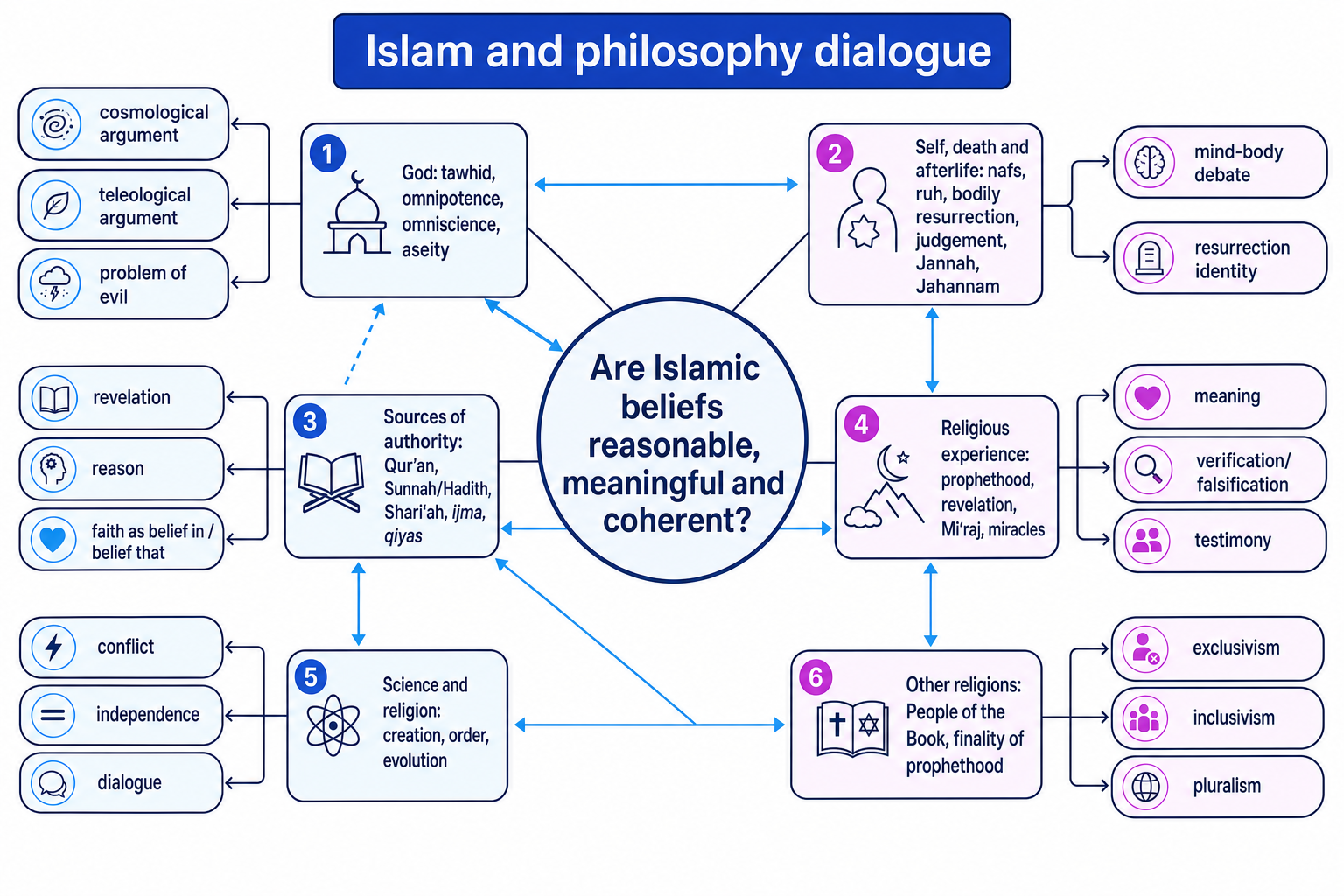
The core exam move
A strong dialogue essay keeps asking: Is this Islamic belief reasonable? Is it meaningful? Is it coherent with other Islamic beliefs?
2. The three philosophical tests
Reasonable
A belief is reasonable if it is based on reason, evidence, experience or argument, or at least does not contradict reason. In Islam, reason is not usually treated as an enemy of faith. Classical Muslim thinkers used kalam — rational Islamic theology — and falsafa — philosophy influenced partly by Greek thought — to discuss God, creation and revelation.
Meaningful
A statement is meaningful if it successfully communicates something. Philosophers of religious language ask whether claims like “Allah is merciful” or “Allah is beyond comparison” actually convey meaning.
For a logical positivist such as A.J. Ayer, a statement is meaningful only if it is analytic or empirically verifiable. By contrast, Wittgenstein suggests language has meaning within a “language game”, so Islamic language may be meaningful within Muslim worship, law and community life.
Coherent
A belief is coherent if it fits logically with other beliefs in the same system. For Islam, this includes asking whether belief in Allah’s omniscience fits with human freedom, whether miracles fit with natural law, and whether final revelation fits with respect for earlier religions.
Testing a faith claim
Consider the claim: “Allah answers prayer.”
-
Assess reasonableness by asking what evidence could support the claim. A Muslim might appeal to personal experience, testimony, Qur’anic teaching and the wider belief that Allah is personal and compassionate.
-
Assess meaningfulness by asking what “answers” means. It need not mean that every request is granted; it may mean Allah responds according to wisdom. This makes the claim more nuanced and less easily falsified.
-
Assess coherence by comparing it with other Islamic beliefs. If Allah is omniscient and perfectly wise, then unanswered prayer can be interpreted as consistent with divine wisdom, though critics may argue this makes the claim too flexible to test.
3. God: tawhid, attributes and arguments
Tawhid
Tawhid is the absolute oneness and uniqueness of Allah. It means Allah has no partners, rivals or equals. Qur’an 112 teaches that Allah is One, eternal, neither begetting nor begotten, and incomparable.
Islamic belief about God includes Allah as creator, omniscient — all-knowing — omnipotent — all-powerful — and merciful. Allah also has aseity, meaning self-existence: Allah depends on nothing else for existence. Qur’an 42:11 states, “There is nothing like Him,” which protects divine transcendence.
Philosophy can support this through arguments for God. Aquinas’ cosmological arguments reason from motion, causation and contingency to a first cause or necessary being. This connects well with Islamic belief in Allah as creator. Paley’s teleological argument reasons from design and order to an intelligent designer; many Muslims see the order of creation as signs — ayat — of Allah.
But there are challenges. Hume criticises design arguments by questioning whether the world really resembles a machine and whether one designer follows from the evidence. Russell rejects the need for a first cause by asking, “Who made God?” Kant argues that existence is not a predicate, challenging Anselm’s ontological argument.
The problem of evil is also central. If Allah is powerful and merciful, why is there suffering? Islamic responses often stress life as a test, human free will, soul-making, and final justice in the afterlife. Qur’an 2:155 speaks of being tested through fear, hunger, loss and hardship. Philosophically, this can be compared with Hick’s soul-making theodicy and Swinburne’s free will defence.
Turning tawhid into a simple design argument
Do not reduce Islamic belief in Allah to “the universe looks designed”. Tawhid is much richer: it includes worship, dependence, uniqueness, revelation, moral accountability and rejection of shirk — associating partners with Allah.
4. Religious language: speaking about Allah
Islamic theology holds together two ideas: Allah is utterly beyond creation, but Allah also reveals names and attributes. The 99 Names of Allah, such as al-Rahman — the Most Compassionate — and al-Alim — the All-Knowing — allow meaningful speech about God.
Philosophically, this raises a tension. If Allah is completely unlike creation, can human words apply to Allah? Via negativa means speaking about God by saying what God is not, for example “Allah is not limited” or “Allah is not created.” This protects transcendence but may feel too vague. Analogy suggests words apply to God in a related but not identical way. Tillich’s symbolic language can also help: religious language points beyond itself to ultimate reality.
For Muslim belief, religious language is most meaningful for those who participate in the practices of Islam: prayer, recitation, fasting, worship and moral obedience. However, a critic may argue that if religious claims cannot be verified or falsified, their cognitive meaning remains uncertain.
5. Self, death and afterlife
Islam teaches that human beings are morally responsible creatures created by Allah. The nafs can mean the self, soul or ego, especially in its moral struggle. The ruh is often understood as spirit; Qur’an 32:9 refers to Allah breathing spirit into the human being.
Akhirah
Akhirah means the afterlife. It includes death, the intermediate state often called barzakh, resurrection, judgement, and final destiny in Jannah — paradise — or Jahannam — hell.
Islamic afterlife belief is usually strongly bodily: people are resurrected and judged. This connects to philosophical questions about personal identity. If the body decays, what makes the resurrected person the same person? Descartes’ substance dualism supports the idea that the soul can survive bodily death, while materialist views challenge survival after death.
Hick’s eschatological verification is useful here. Hick argues that some religious claims could be verified after death, even if they cannot be verified now. This helps Islamic afterlife claims remain meaningful, though only from within a future-looking framework.
The afterlife also helps Islam answer the problem of evil. If earthly life is not the whole story, then justice may be completed beyond death. Critics may reply that this postpones rather than solves the problem.
6. Sources of wisdom and authority
The main Islamic source of authority is the Qur’an, understood by Muslims as the revealed word of Allah. The Sunnah is the example of Muhammad, preserved through Hadith reports. Shari‘ah is the divine path or law, developed through sources such as ijma — scholarly consensus — and qiyas — analogical reasoning.
This matters philosophically because Islam is not based on reason alone. It is grounded in revelation. However, reason is still needed to interpret, apply and defend revelation. Ijtihad means independent reasoning, especially when applying Islamic principles to new situations.
In classical Islam, al-Ghazali criticised philosophers when he thought they contradicted revelation, especially on issues such as bodily resurrection. Ibn Rushd defended philosophy, arguing that true reason and true revelation cannot ultimately conflict, though scripture may need careful interpretation.
Belief that and belief in
Belief that means accepting propositions as true, such as “Allah exists” or “Muhammad is the Messenger of Allah.” Belief in means personal trust, commitment and reliance, such as trusting Allah and submitting to Allah’s will.
Islam includes both. The shahadah is propositional — “There is no god but Allah, and Muhammad is the Messenger of Allah” — but it is also a lived commitment. Philosophy often tests “belief that”, while religious faith also involves “belief in”.
Using faith in essays
A strong judgement might say: philosophy can assess whether Islamic truth claims are rationally defensible, but it cannot fully capture Islam as lived submission, worship and trust.
7. Religious experience
Islam gives central importance to revelation. Muhammad’s reception of the Qur’an through Jibril is not just a private experience; it becomes the foundation of a whole religious community. The Isra and Mi‘raj — Night Journey and Ascension — is linked to Qur’an 17:1 and is often discussed as a profound religious experience.
Philosophically, William James describes mystical experiences as ineffable, noetic, transient and passive. These features can apply to some Sufi experiences, such as deep awareness of Allah through dhikr — remembrance. Otto’s idea of the numinous, the experience of the holy as both awe-inspiring and attractive, can also illuminate Islamic worship and reverence.
Swinburne’s principle of credulity says we should generally trust how things seem unless there is a reason not to. His principle of testimony says we should generally trust others’ reports unless there are defeaters. This supports taking religious experience seriously. Critics reply that religious experiences vary across traditions, so they cannot all straightforwardly prove the same truth claims.
8. Miracles
Miracle
A miracle is an extraordinary event understood as an act or sign of God. In Islam, miracles are usually signs of Allah’s power, not independent powers possessed by prophets.
The Qur’an presents miracles of earlier prophets, such as Musa and Isa, always by Allah’s permission. For Muslims, the greatest miracle is often the Qur’an itself, especially its i‘jaz — inimitability. Qur’an 2:23 challenges doubters to produce a surah like it.
Hume defines a miracle as a violation of the laws of nature and argues that testimony for miracles is never strong enough to outweigh our evidence for regular natural law. Wiles objects morally to interventionist miracles: if God intervenes sometimes, why not prevent horrors such as mass suffering? Swinburne replies that if there is independent reason to believe in God, miracles are not automatically unreasonable.
Evaluating a miracle claim
Take the claim: “The Qur’an is a miracle.”
-
Compare it with Hume’s approach. Hume’s critique is strongest against reports of physical violations of natural law, so it may apply less directly if the miracle is understood as linguistic, spiritual and revelatory.
-
Apply Wiles’ concern. If the Qur’an is a miracle of guidance rather than selective physical intervention, it may avoid the charge that Allah arbitrarily helps some people but not others.
-
Weigh Swinburne’s point. If belief in Allah is already reasonable through revelation, experience or arguments for God, then interpreting the Qur’an as miraculous becomes more plausible within the Islamic worldview.
9. Science and religious discourse
A scientific discourse explains the natural world through observation, testing and revisable theories. A religious discourse deals with meaning, purpose, value, worship and ultimate reality, though it can still make claims about the world.
Some Muslims see harmony between science and Islam because the Qur’an encourages reflection on nature as signs of Allah. Others are cautious about claiming that modern science is directly “predicted” by the Qur’an, because scientific theories change and scripture may be misused.
On creation and evolution, Muslim views vary. Many accept scientific explanations of natural processes while maintaining that Allah is the ultimate creator. Human evolution can be more controversial because of beliefs about Adam, human dignity and the ruh. Philosophically, this is not simply “science versus Islam”; it is about how different kinds of explanation relate.
Saying science has disproved Islam
Avoid sweeping claims. Science may challenge some literal interpretations, but it does not automatically disprove beliefs about ultimate cause, purpose, value or divine creation.
10. Truth claims of other religions
Islam recognises earlier prophets and scriptures, especially in relation to the People of the Book. Qur’an 2:256 says there is “no compulsion in religion,” and Qur’an 5:48 suggests that different communities have received a law and way, while being called to compete in goodness.
At the same time, Islam teaches that Muhammad is the Seal of the Prophets — Qur’an 33:40 — and that the Qur’an is the final revelation. This creates a range of possible positions:
- Exclusivism: Islam alone gives the final and fully correct path.
- Inclusivism: other religions contain truth, but Islam completes and corrects them.
- Pluralism: different religions are valid responses to the same ultimate reality.
John Hick’s pluralism argues that religions are culturally shaped responses to “the Real”. This may support interfaith respect, but it can conflict with Islamic claims about final revelation and the uniqueness of the Qur’an. A balanced judgement might say Islam has resources for respect and dialogue, but full philosophical pluralism is difficult to reconcile with traditional Islamic authority.
In the exam
-
Start with the Islamic belief, then bring in philosophy. Do not write a generic philosophy essay with Islam added at the end.
-
Evaluate using the three tests: reasonable, meaningful, coherent. These help you move from AO1 explanation to AO2 judgement.
-
Keep the dialogue two-way: show how philosophy challenges Islam, but also how Islamic ideas challenge philosophical assumptions about reason, revelation and lived faith.
Check yourself
- How could tawhid be supported by cosmological or teleological reasoning, and how might Hume or Russell challenge that support?
- Why is the distinction between belief that and belief in important for understanding Islamic faith?
- Is Islamic belief in miracles more vulnerable to Hume’s critique or Wiles’ critique?

Keep learning
Make a free account to read the full revision notes and worked examples.