The dialogue between Islam and ethics
The relationship between Islamic ethics and Western normative ethical systems is one of the most intellectually vibrant areas of modern religious studies. This topic explores how traditional Islamic moral sources interface with Kantian deontology, Bentham's utilitarianism, and Aristotelian virtue ethics, before applying these concepts to contemporary moral debates.
The synoptic link
In Component 2 of the AQA course, you must demonstrate "synoptic" skills. This means you need to connect your study of Islam (theology, history, and sources of authority) directly with the normative ethical theories you studied in Component 1 (Kant, Utilitarianism, and Virtue Ethics).
1. What you'll learn
- How the foundational sources of Islamic authority shape moral decision-making.
- How to compare and contrast Islamic ethics with Kantian Deontology, Utilitarianism, and Virtue Ethics.
- How Muslim jurists use jurisprudential tools to respond to contemporary moral issues (such as genetic engineering, transgender matters, and wealth).
- The theological tension between human free will, predestination, and the role of the conscience (Fitrah).
2. The Foundations of Islamic Moral Decision-Making
To understand the dialogue between Islam and ethics, you must first master the sources of authority that shape Islamic law (Shari'ah) and ethics (Akhlaq). Islamic ethics is not a single, monolithic system; it is a dynamic process of jurisprudence (Fiqh).
Shari'ah
Literally meaning 'the path to the waterhole', Shari'ah refers to the divine law of Islam derived from the Qur'an and the Sunnah, representing Allah's perfect will for human conduct.
Akhlaq
The term for Islamic virtue, morality, and character. It refers to the disposition of the soul to act in accordance with divine command.
When facing an ethical issue, a Muslim scholar or jurist (Mujtahid) will consult four primary sources in hierarchical order:
- The Qur'an: The literal, uncreated Word of God and the ultimate source of moral authority.
- The Hadith and Sunnah: The recorded sayings, actions, and approvals of the Prophet Muhammad, who serves as the perfect moral exemplar (Al-Insan al-Kamil).
- Ijma: The consensus of Islamic scholars on a particular issue when the Qur'an and Sunnah are not explicitly clear.
- Qiyas: Analogical reasoning. This is the process of comparing a modern, unresolved ethical issue to an established ruling in the Qur'an or Sunnah based on a shared underlying cause ('Illah).
The tool of Ijtihad
When a jurist engages in independent intellectual effort to find a legal or moral ruling on a novel issue, they are practicing Ijtihad. In modern ethics, this is the primary mechanism for updating Islamic responses to scientific developments like genetic engineering.
3. Islamic Ethics vs. Western Normative Theories
A major part of the AQA specification is analyzing "how far" Muslim ethics can be classified under Western ethical models.
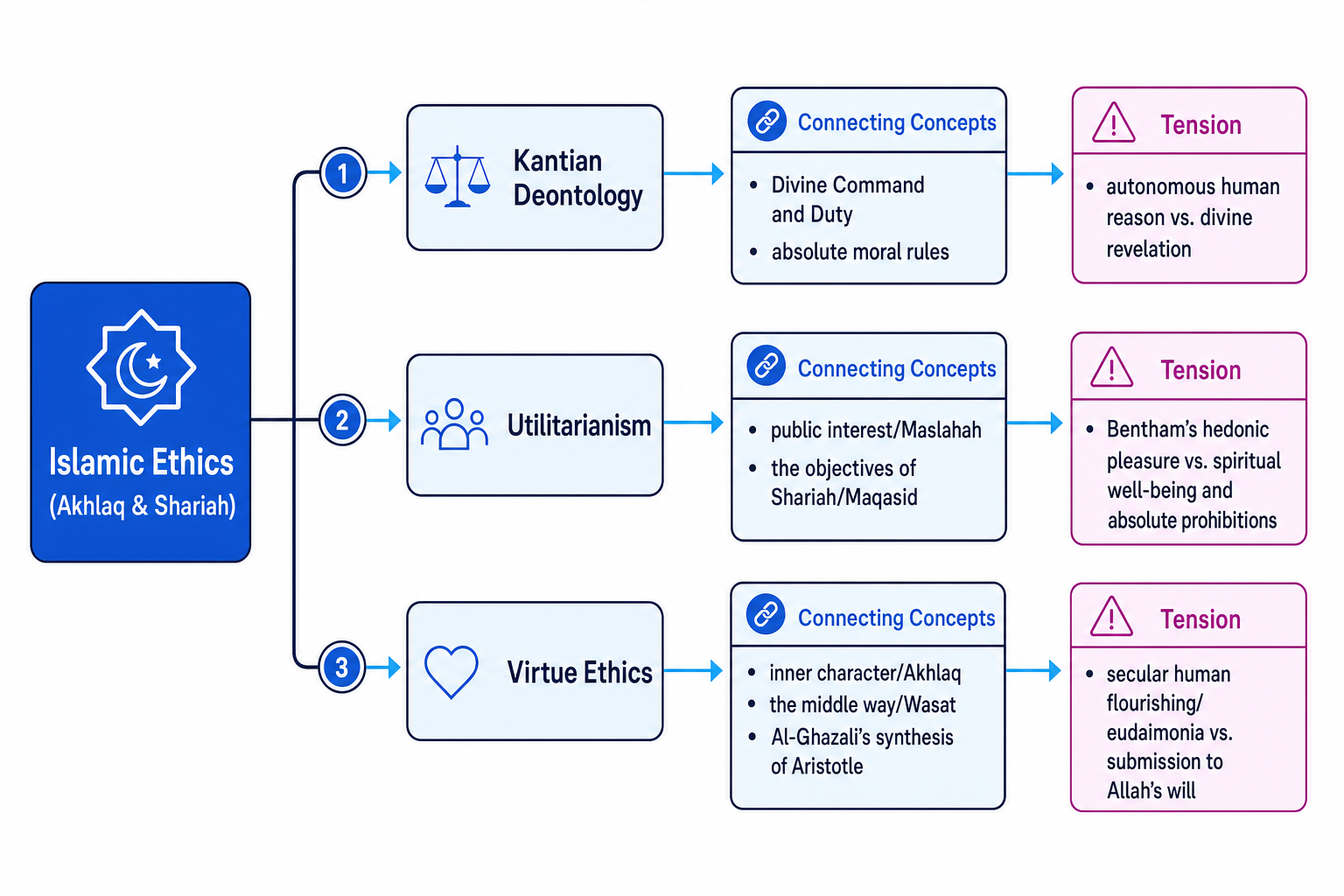
Deontological Ethics (The Dialogue with Immanuel Kant)
Deontology is a duty-based ethical framework. At first glance, Islamic ethics appears deeply deontological because it relies on Divine Command Theory—actions are intrinsically right or wrong because Allah has commanded or forbidden them.
- Points of Compatibility: Both systems emphasize absolute moral duties (e.g., the prohibition of lying and theft) that do not change based on consequences. Both argue that moral laws are universal.
- Tensions and Contrasts:
- Source of Authority: Kant argues that moral duty must be derived from autonomous human reason alone. For Kant, if you do something simply because a religious authority tells you to, you are acting heteronomously (non-rationally). Islam, however, is fundamentally heteronomous; moral duties are grounded in divine revelation, and human reason is secondary to Allah's sovereign will.
- Motivation: Kant rejects the idea of acting for a reward (such as heaven) or out of fear (such as hell), arguing that we must do our duty purely for duty’s sake. In contrast, Islam actively encourages moral behavior by appealing to the accountability of the Day of Judgment (Akhirah) and the cultivation of God-consciousness (Taqwa).
Teleological and Consequentialist Ethics (The Dialogue with Jeremy Bentham)
Bentham's Utilitarianism states that the moral worth of an action is determined solely by its outcomes—specifically, whether it maximizes pleasure and minimizes pain (the Utility Principle).
- Points of Compatibility: Islam contains a robust teleological dimension through the concept of Maslahah (public interest/common welfare) and the Maqasid al-Shariah (the five objectives of Islamic law). Jurists often make rulings aimed at preventing harm (Darar) and promoting the common good.
- Tensions and Contrasts:
- Defining the "Good": Bentham's utilitarianism is secular and hedonistic, defining the good as physical/emotional pleasure. Islam defines the ultimate "good" (Falah) as spiritual and physical well-being in this life and the next, which is determined by aligning one's actions with Allah's pleasure, not human pleasure.
- The End Does Not Justify the Means: In act utilitarianism, any rule can be broken if the consequences yield a net positive. In Islam, a clear textual prohibition from the Qur'an (Nass) can never be bypassed for secular utility. For example, one cannot steal (which violates a divine commandment) to give charity, even if it produces a "greater good."
Maqasid al-Shariah (The Five Objectives)
The classical scholar Al-Ghazali formulated the five essential human values that Islamic law protects:
- Faith (Din)
- Life (Nafs)
- Intellect (Aql)
- Lineage/Family (Nasl)
- Property/Wealth (Mal) Any ethical ruling that protects these five objectives is considered to have positive teleological value.
Character-Based Ethics (The Dialogue with Virtue Ethics)
Virtue ethics, tracing back to Aristotle, focuses not on rules or consequences, but on the cultivation of moral virtues to achieve human flourishing (eudaimonia).
- Points of Compatibility: Islamic ethics has a rich tradition of virtue ethics, known as Ilm al-Akhlaq (the science of character). Medieval Muslim philosophers, most notably Al-Ghazali, synthesized Aristotle’s virtue ethics with Islamic theology.
- Al-Ghazali argued that the soul must be trained to balance its faculties (reason, anger, desire) to achieve the virtues of Wisdom, Courage, Temperance, and Justice.
- Aristotle's "Golden Mean" (virtue as the middle path between excess and deficiency) matches the core Islamic concept of Wasat (moderation/the middle path). The Qur'an describes the ideal Muslim community as a "midmost nation" (Ummah Wasat - Surah 2:143).
- Tensions and Contrasts: For Aristotle, the ultimate goal of virtue is secular, civic flourishing (eudaimonia) within the Greek city-state. For Muslims, the ultimate goal of developing a virtuous character is spiritual purification (Tazkiyah) and submission (Islam) to Allah, aiming for eternal reward in the afterlife.
4. Worked Example: Jurisprudential Reasoning in Action
To see how these abstract ethical frameworks function in Islamic jurisprudence, let's look at how a scholar would apply Qiyas (analogy) to evaluate a modern substance that is not mentioned in scripture.
Applying Qiyas to recreational drugs
Identify how a Muslim jurist determines the moral ruling on synthetic recreational drugs using the four elements of analogical reasoning.
- Identify the Original Case (Asl): The jurist identifies an established ruling in the sacred text. In this case, the consumption of wine (Khamr), which is explicitly mentioned in the Qur'an (Surah 5:90).
- Identify the Ruling (Hukm) of the Original Case: The Qur'an states that wine is Haraam (strictly forbidden).
- Identify the Effective Cause ('Illah): The jurist analyzes why wine is forbidden. The common denominator and logical reason ('Illah) is that it causes intoxication, which clouds the human intellect (Aql) and prevents mindful prayer.
- **Identify the New Case (Far'): The jurist introduces the modern issue requiring a ruling: synthetic recreational drugs (e.g., ecstasy or methamphetamine).
- Formulate the Conclusion/Ruling:** Because the new case (Far') shares the exact same effective cause ('Illah - intoxication and clouding of the intellect) as the original case, the jurist declares that synthetic recreational drugs are also Haraam.
5. Applied Ethical Issues: Islamic Responses
The AQA specification requires you to know how Islam responds to specific issues, and how these views clash with or support modern ethical perspectives.
Human Life and Death (Abortion and Euthanasia)
- Abortion: Human life is sacred, a gift from Allah (Nafs). However, abortion is permitted in specific, limited circumstances (e.g., if the mother's life is in danger) before ensoulment (Ruh). Scholars differ on when ensoulment occurs: some Sunni schools argue it is at 120 days of gestation (based on Hadith), while others argue it is at 40 days.
- Dialogue: This differs from a strict Kantian view (which might prohibit abortion completely as it cannot be universalized) and secular utilitarianism (which may permit abortion freely based on quality of life and parental choice).
- Euthanasia: Strictly prohibited (Haraam). Only Allah has the right to give and take life (Surah 3:145). Suffering is viewed as a spiritual trial (Bala) that can expiate sins.
- Dialogue: This directly clashes with modern liberal humanism and preference utilitarianism, which prioritize individual autonomy and the "right to die."
Animal Life and Death
- Stewardship (Khalifah): Humans are appointed as guardians of the earth, not absolute owners. Animals are communities created by Allah (Surah 6:38) and must be treated with compassion. Cruelty is strictly forbidden.
- Halal Slaughter (Zabiha): Meat must be slaughtered in a swift, humane manner, mentioning the name of Allah to acknowledge the taking of a life for sustenance.
- Animal Testing: Allowed only for genuine medical advancements (protecting human life—a key Maqasid objective) and if no alternatives exist. Testing cosmetics on animals is forbidden.
- Dialogue: This is more anthropocentric than deep ecology or Peter Singer's preference utilitarianism (which rejects speciesism), but far more protective of animal welfare than classical Cartesian or Kantian views (which deny animals moral standing because they lack reason).
Theft and Lying
- Both are strictly Haraam. Theft violates the preservation of wealth (Mal), and lying violates the trust (Amanah) that binds society together.
- Exceptions (The Rule of Necessity - Darurah): Under extreme conditions of starvation, stealing food to survive is not punished, as the protection of life (Nafs) supersedes the protection of property (Mal). Lying is also permitted in three specific situations: to save an innocent life, to reconcile an estranged married couple, or during warfare (Taqiyya or strategic deception).
- Dialogue: This is a clear point of divergence from Kant, who argued that lying is always wrong, even to a murderer looking for your friend. Islamic ethics is far more teleological/pragmatic in its exceptions.
Marriage, Same-Sex Relationships, and Transgender Matters
- Marriage (Nikah): Highly encouraged as the foundation of a moral society and the only legal avenue for sexual expression.
- Same-Sex Relationships: Traditional Islamic law strictly prohibits same-sex sexual activity (Liwat), drawing on the Qur’anic narrative of the People of Lot.
- Transgender Matters: There is a notable theological divergence here:
- In Shia-majority Iran, gender reassignment surgery has been legal since a fatwa by Ayatollah Khomeini in the 1980s. Khomeini argued that gender dysphoria is a medical condition, and surgery is a permissible cure.
- In contrast, most Sunni scholars view gender reassignment surgery as Haraam, classifying it as "altering Allah's creation" (Taghyir khalq Allah), unless it is to correct an intersex condition.
- Dialogue: This highlights how internal Islamic ethical tools (Shia juristic flexibility vs. Sunni textual caution) can produce radically different responses to modern gender identity debates, clashing with or partially matching modern secular rights.
Generalizing 'Islamic views'
Never write "Islam says..." without acknowledging diversity of thought. Always distinguish between Sunni and Shia approaches, or conservative and progressive viewpoints, especially on modern issues like transgender matters and genetic engineering.
Genetic Engineering
- Therapeutic Genetic Engineering: (e.g., gene therapy to cure genetic diseases like cystic fibrosis) is widely supported. It is seen as a form of medicine (Tibb), which aligns with the Maqasid goal of preserving life.
- Enhancement/Cloning: (e.g., designing babies for intelligence, eye color, or reproductive cloning) is strictly forbidden. It is viewed as "playing God" (Shirk) and changing Allah's natural design.
- Dialogue: Highly compatible with Fletcher's Situation Ethics when acting out of love (Agape) to heal, but rejects the radical transhumanist agenda of secular modern ethics.
Wealth, Tolerance, and Freedom of Religious Expression
- Wealth: All wealth belongs to Allah; humans are merely trustees. The system of Zakat (2.5% annual compulsory charity) and the prohibition of Riba (usury/interest) ensure that wealth does not accumulate only among the rich (Surah 59:7).
- Tolerance and Freedom of Expression: The Qur'an states, "There is no compulsion in religion" (Surah 2:256), establishing a foundation for religious tolerance. However, classical Islamic law sets limits on freedom of expression when it comes to open blasphemy (Sabb) or inciting social discord (Fitnah), as these threaten the preservation of faith (Din) and social order.
- Dialogue: This contrasts sharply with modern Western libertarian views of absolute free speech (such as J.S. Mill's Harm Principle), where speech is only restricted if it causes direct physical harm.
6. Free Will, Moral Responsibility, and the Conscience
For moral responsibility to exist, humans must possess some degree of free will. If we are entirely predestined, divine judgment on the Last Day would be unjust—a concept that directly challenges Allah’s absolute justice (Adl).
The Theological Debates
- The Mu'tazilites (Rationalists): Argued that humans must have absolute free will (Ikhtiyar). Since Allah is perfectly just (Adl), He must reward or punish humans based on choices they freely made. Human reason alone can distinguish right from wrong.
- The Ash'arites (Traditionalists): Argued that absolute free will limits Allah’s absolute power (Qadar). Instead, they developed the theory of Kasb (Acquisition). Allah creates all potential actions, but humans "acquire" the choice to perform them, thus retaining moral responsibility.
- The Shi'a Perspective: Holds a middle position—neither absolute determinism (Jabr) nor absolute free will (Tafwid), but a "pathway between the two."
Conscience (Fitrah)
In Islam, the conscience is deeply linked to Fitrah—the primordial, natural state of purity and belief in God that every human is born with.
Fitrah
The innate, natural moral and spiritual disposition of human beings, which intuitively recognizes the existence of Allah and the basics of right and wrong.
While humans possess Fitrah, our moral compass can be clouded by worldly desires (Nafs) and the temptations of Iblis (Satan). Therefore, the conscience is not completely self-sufficient; it must be constantly guided, calibrated, and corrected by the objective standard of Divine Revelation (the Qur'an and Sunnah).
Conscience vs. Reason
Do not confuse the Western secular definition of conscience (which is often seen as entirely subjective or rationalist) with the Islamic Fitrah. In Islam, a well-functioning conscience is one that naturally submits to and recognizes divine authority, rather than one that declares its own moral autonomy.
7. Evaluating the Dialogues (AO2 Focus)
When writing essays, your AO2 (analysis and evaluation) carries the highest marks. You must evaluate how the dialogue between Islam and Western ethics impacts the religion's authority and relevance.
Strengths of the Islamic Ethical System
- Coherence and Stability: By anchoring moral rules in the immutable word of Allah, Islamic ethics avoids the moral relativism and shifting social sands that plague secular systems.
- Holistic Nature: It seamlessly integrates personal character (Virtue Ethics), absolute duties (Deontology), and societal welfare (Teleology through Maslahah).
- Adaptability: Through Ijtihad and Qiyas, Islamic jurisprudence can address highly complex modern issues (like genetic engineering) while remaining anchored to its core theological roots.
Criticisms and Vulnerabilities
- The Challenge of Modernity: Critics argue that because Islamic ethics is tied to 7th-century texts, it struggle to accommodate modern, progressive views on individual autonomy, gender equality, and LGBTQ+ rights.
- The Euthyphro Dilemma: If actions are good simply because Allah commands them (Ash'arite Deontology), morality becomes arbitrary. If Allah commands them because they are inherently good, then "the Good" exists independently of Allah, challenging His absolute sovereignty (Tawhid).
- Juristic Disagreement (Ikhtilaf): Because many moral decisions rely on the interpretation of scholars, there can be deep contradictions between different legal schools (Madhabs), causing confusion for individual Muslims trying to navigate contemporary moral mazes.
In the exam
- Never treat Islam as a monolith. Show off your AO1 by using terms like Sunni, Shia, Ash'arite, Mu'tazilite, and Al-Ghazali to demonstrate internal debate.
- Structure synoptic essays around the ethical frameworks. If asked about the dialogue between Islam and ethics, structure your body paragraphs around Deontology (Kant), Consequentialism (Bentham), and Virtue Ethics (Aristotle), evaluating the fit of each.
- Use scriptural references accurately. Instead of just writing "the Qur'an says," quote or closely paraphrase key texts (e.g., Surah 5:32 for the Sanctity of Life, or Surah 2:256 for religious tolerance).
- Balance AO1 and AO2. Ensure your paragraphs do not just explain what Muslims believe (AO1) but analyze how far these beliefs are compatible with Western perspectives and what the implications are for Islamic authority (AO2).
Check yourself
- How does Al-Ghazali's synthesis of Aristotelian philosophy adapt secular virtue ethics into a spiritual, Islamic framework?
- What are the four steps of Qiyas, and how would you apply them to a modern moral issue not found in the Qur'an?
- Why does Kant's emphasis on moral autonomy create a fundamental theological tension with Islamic Divine Command Theory?

Keep learning
Make a free account to read the full revision notes and worked examples.